
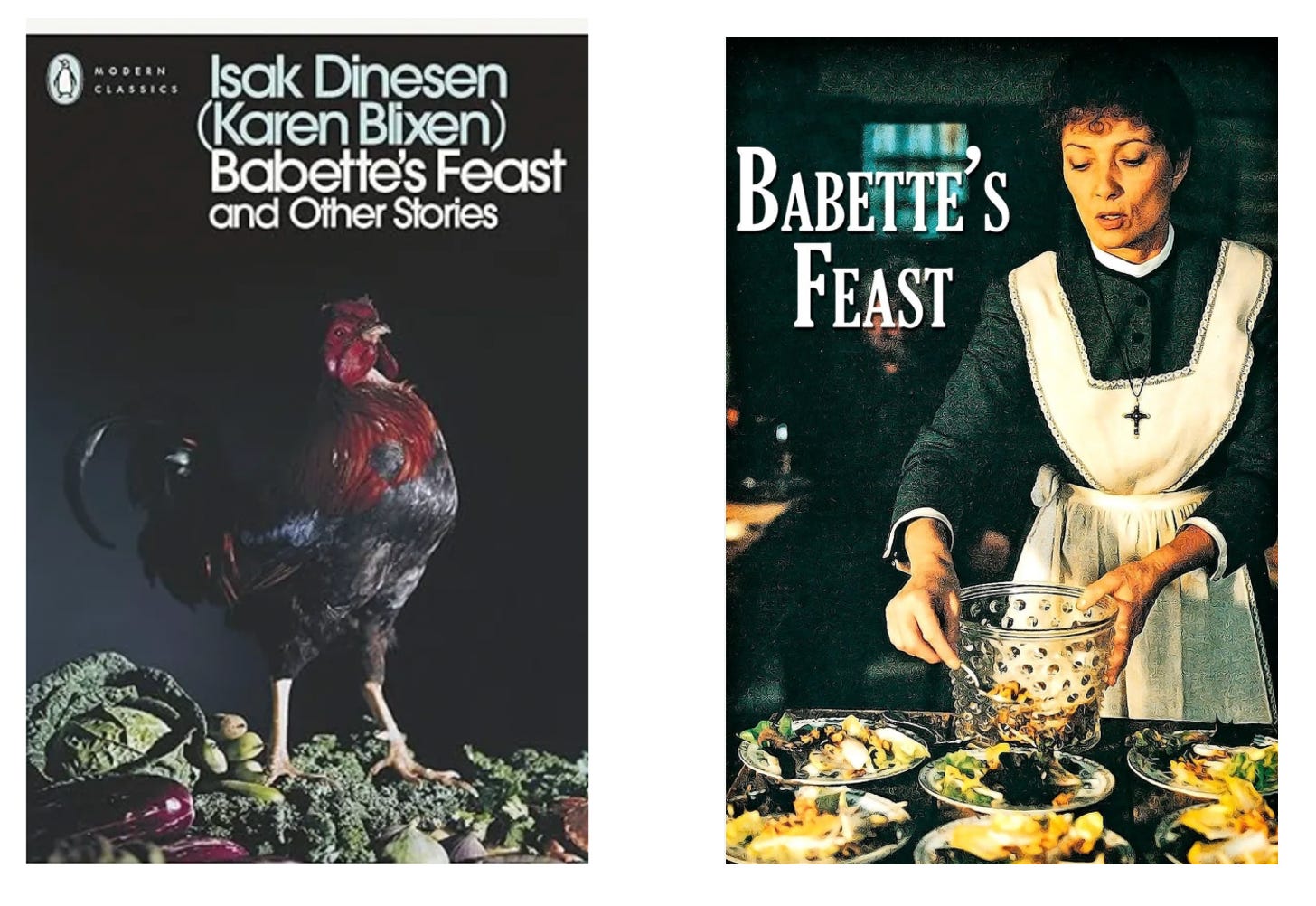
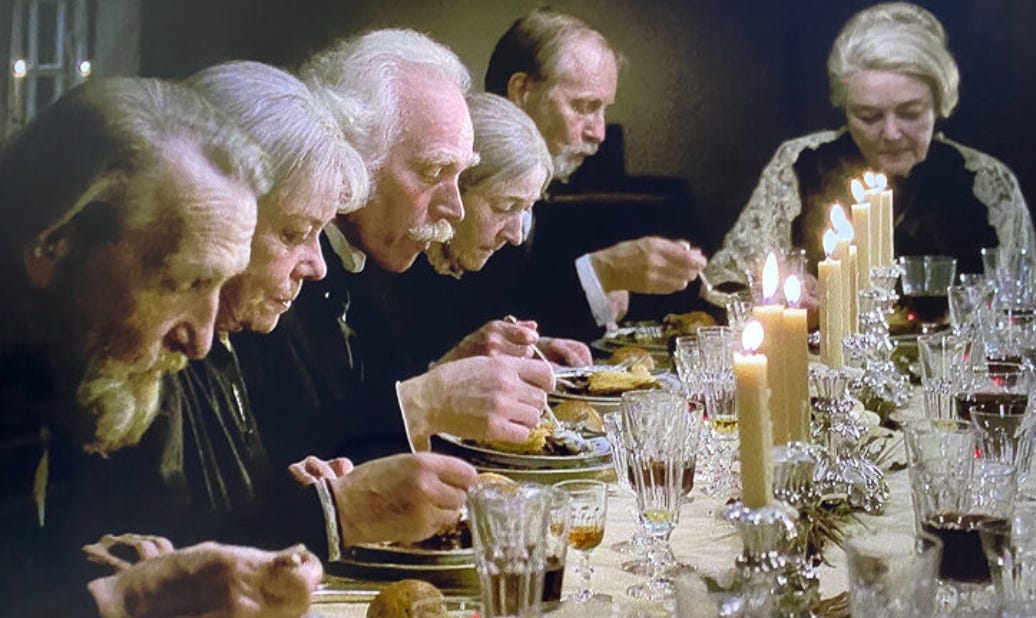
There is a moment in Babette’s Feast (1987) when food ceases to function merely as nourishment, if indeed it ever does, and becomes something stranger: an instrument of memory, mourning, seduction, and resurrection. The dinner table glows with candlelight, turtle soup steams in porcelain bowls, champagne flows, quails arrive entombed in pastry coffins and the guests, rigid, fearful, devoutly Protestant, slowly begin to soften under the force of the meal.
On the surface, it is one of literature and cinema’s most beautiful depictions of food. Beneath that beauty, however, lies violence.
I recently mentioned Babette’s Feast during my conversation with food stylist dorothy barrick on A Curious Appetite, as one of the films that inspired her work and understanding of food styling on screen. Returning to the story again, I found myself thinking less about “comfort food” or culinary pleasure and more about what I have increasingly come to think of as dark food.
Not exactly Gothic food, but something adjacent to it.
Dark food is a concept I have developed to describe the ways food can carry, recreate, and communicate traumatic memory through acts of consumption. It emerges particularly within contexts of exile, grief, displacement, and political violence, where meals become bound up with histories that continue to haunt the present. In this sense, food becomes a medium through which violence, loss, migration, and political upheaval continue to speak long after the original events have passed.
And nowhere is this more hauntingly realised than in Isak Dinesen’s Babette’s Feast.
Babette Hersant arrives in Norway on “a rainy June night of 1871,” collapsing unconscious at the doorstep of two ageing Lutheran sisters after fleeing the destruction of Paris following the Commune.
The description is unmistakably Gothic:
“a massive, dark, deadly pale woman… fell down on the doorstep in a dead swoon.”
She enters the narrative like a revenant.
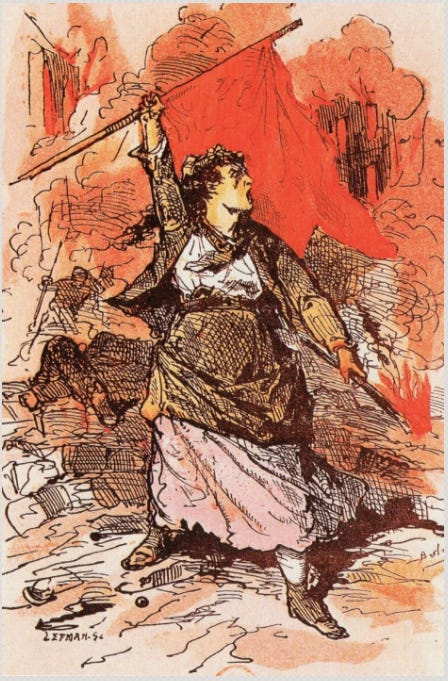
The sisters know almost nothing about her except what is contained in a letter carried from France by the opera singer Achille Papin. Paris has burned. The Communards have been “crushed and annihilated.” Babette’s husband and son have been killed. She herself has narrowly escaped execution after being accused of being a Pétroleuse, one of the infamous women supposedly responsible for setting Paris ablaze.
From the beginning, Dinesen frames Babette as uncanny. The text repeatedly associates her with mystery, magic, and danger. She sits silently studying a “heavy black book” the sisters imagine might be a Catholic prayer book. Her eyes are “enigmatical and fatal as a Pythia upon her tripod.” Her movements possess strange authority.
“She had appeared to be a beggar,” Dinesen writes, “she turned out to be a conqueror.”
Food becomes the language through which this conquered woman gradually reclaims power.
One of the most striking aspects of Babette’s Feast is the extent to which Babette herself is silenced. She cannot properly speak Norwegian, her political past remains largely unspoken, and for years nobody around her fully understands who she really is. Even her identity as one of the greatest chefs in Paris is concealed beneath the routine of domestic labour. Yet despite this silence, Babette communicates constantly through food.
From the moment she enters the sisters’ household, meals begin to acquire new emotional and symbolic weight. Even the simple ale-and-bread soup prepared for the poor is described as gaining “a new mysterious power to stimulate and strengthen.” Food becomes a language through which Babette expresses care, memory, artistry, and authority long before the famous feast takes place.
This connects closely to the work of theorists such as Roland Barthes and Mary Douglas, both of whom argued that food operates as a cultural system of meaning rather than merely nourishment. Meals communicate ideas about hierarchy, ritual, belonging, and power. They reveal who hosts, who serves, who is permitted pleasure, and who is expected to remain restrained or silent. In Babette’s Feast, Babette’s inability to speak openly makes the communicative power of food even more significant. Her cooking becomes the primary way through which grief, memory, generosity, and identity are expressed.
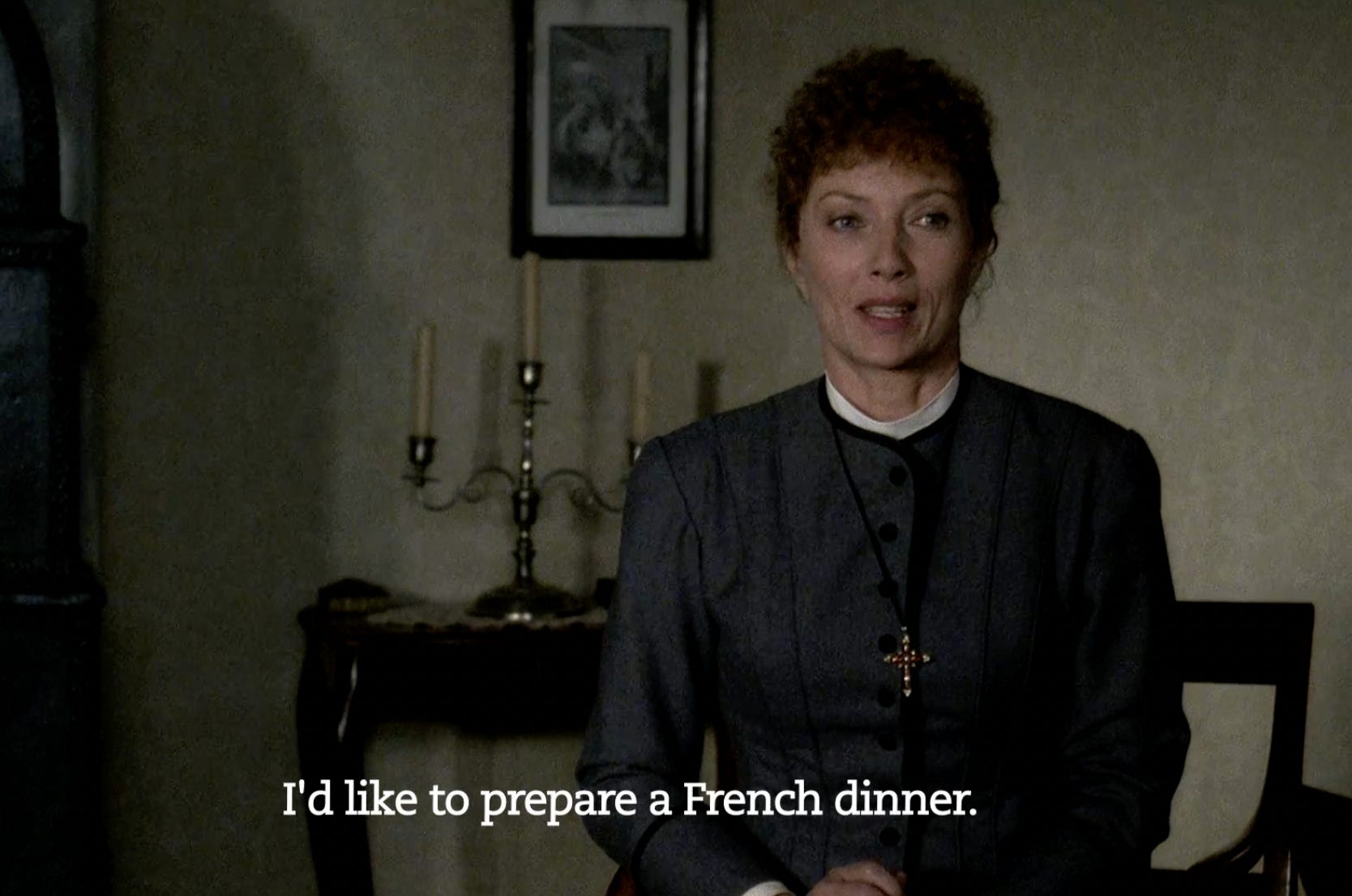
The sisters initially fear Babette’s proposal to prepare a “real French dinner.”
Their terror is not irrational.
Food here threatens disorder.
Luxury itself appears sinful. French cuisine represents excess, sensuality, Catholicism, worldliness, and appetite, everything their austere religious community has spent decades suppressing.
And the text repeatedly frames the feast in almost supernatural terms.
When the sisters finally agree, Babette physically transforms:
“They saw suddenly that she had once been beautiful.”
Elsewhere, Dinesen writes that Babette swells “like a bottled demon of the fairy tale.”
The kitchen itself becomes uncanny territory. Fires burn from dawn. Cauldrons bubble. Babette acquires a red-haired helper described almost like a witch’s familiar. The sisters no longer dare enter the kitchen.
Even the dining room becomes a kind of protective ritual space, decorated with juniper branches and berries traditionally associated with warding off evil. The meal begins to feel less like ordinary cooking and more like an act of invocation, as though Babette is summoning memory, transformation, and buried emotion through the rituals of the table itself.
The most important dish in the feast is almost certainly Cailles en Sarcophage, quails in sarcophagi.
Here, food and death become inseparable.
The dish functions as memorial, performance, and burial rite all at once. Babette delicately entombs the birds in pastry coffins while recreating the culinary world she lost during the Commune.
The meal itself becomes a form of mourning.
Throughout the feast, the guests experience something deeply uncanny. Though they had sworn not to comment on the food, conversation slowly loosens. Resentments dissolve. Old wounds soften. Memory resurfaces.
General Loewenhielm alone fully recognises what is happening. He identifies the turtle soup, recognises the wines, and understands the significance of Cailles en Sarcophage. Most importantly, he realises that only one chef in Paris could have created such a meal: the former culinary genius of the Café Anglais, a woman whose artistry belonged to another Paris entirely, the Paris that existed before siege, starvation, and massacre, the Paris Babette lost.
It is impossible to separate Babette’s Feast from the historical trauma of the Franco-Prussian War and the Paris Commune. During the Siege of Paris between 1870 and 1871, the city was cut off from supplies for months and food shortages became severe. Horses, domestic animals, zoo animals, and even rats were consumed as hunger intensified. Bread was rationed, milk disappeared, and starvation became part of everyday life. Many Parisians later believed that the city had not truly been defeated militarily, but by hunger itself.
This history is crucial to understanding Babette and the emotional force of her feast. The dinner recreates abundance after deprivation and pleasure after prolonged suffering, transforming food into a medium through which memory, artistry, grief, and political trauma can all be expressed at once. Through cooking, Babette reconstructs a sense of ritual and connection in the aftermath of violence and social collapse. The meal offers a temporary form of communion, bringing people together through shared consumption after a period defined by division, fear, and loss.
The scholar Alison Landsberg uses the term prosthetic memory to describe the way films, museums, and cultural experiences can create emotional connections to events that individuals did not personally experience. Food can operate in a similar way. Ritual meals often preserve and communicate memory across generations. The Passover meal, for example, uses symbolic foods to recall histories of suffering, displacement, and survival, allowing memory to be experienced through acts of eating and repetition.
In Babette’s Feast, the guests do not fully understand the meanings embedded within Babette’s dinner, yet they still respond emotionally to it. The meal carries references to loss, exile, and a vanished Parisian world that the guests themselves cannot entirely decode. This is where the concept of dark food becomes useful.
Dark food refers to the way traumatic memories can be recreated and communicated through consumption. Through Babette’s feast, the guests unknowingly participate in memories connected to war, revolution, and displacement, even if they cannot fully articulate what they are experiencing.
At the end of the story, Babette finally reveals the truth.
She was the chef of the Café Anglais. She spent the entire lottery fortune, ten thousand francs, on this single dinner.
And then she makes the extraordinary declaration:
“I was a Communard!”
This revelation changes everything.
Babette fought against the very aristocratic world she once fed, standing upon barricades and loading rifles during the Commune while simultaneously remaining deeply attached to the artistic world of Parisian haute cuisine. Part of the tragedy of her character lies in this tension. The people who most fully understood and appreciated her artistry were also implicated in the structures of inequality she opposed. Food therefore becomes the space through which these contradictions are temporarily reconciled. Through cooking, Babette brings together worlds otherwise held apart: luxury and poverty, Catholicism and Lutheranism, sensuality and restraint, revolution and aristocracy, bodily appetite and spiritual grace. The feast cannot erase trauma or historical violence, but it allows those experiences to be transformed into something communal, restorative, and briefly transcendent.
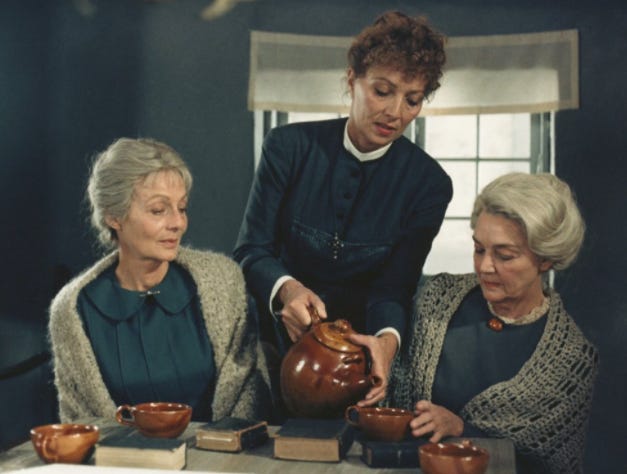
Gabriel Axel’s 1987 adaptation captures the emotional and symbolic importance of food with remarkable subtlety. The film pays close attention to the textures and rituals surrounding the meal, from the preparation of the dishes to the reactions of the guests at the table. However, the feast is never presented as food for spectacle alone. Throughout the film, the meal remains connected to Babette’s experiences of exile, loss, and memory. This is what makes Babette’s Feast such an important food film. It shows how meals can communicate emotion, history, reconciliation, and identity all at once. Food in the film becomes a way of expressing things that the characters themselves struggle to articulate directly, particularly grief, longing, and forgiveness.
No posts
Comments
Nothing yet. Say the first thing.
Sign in to join the conversation.