
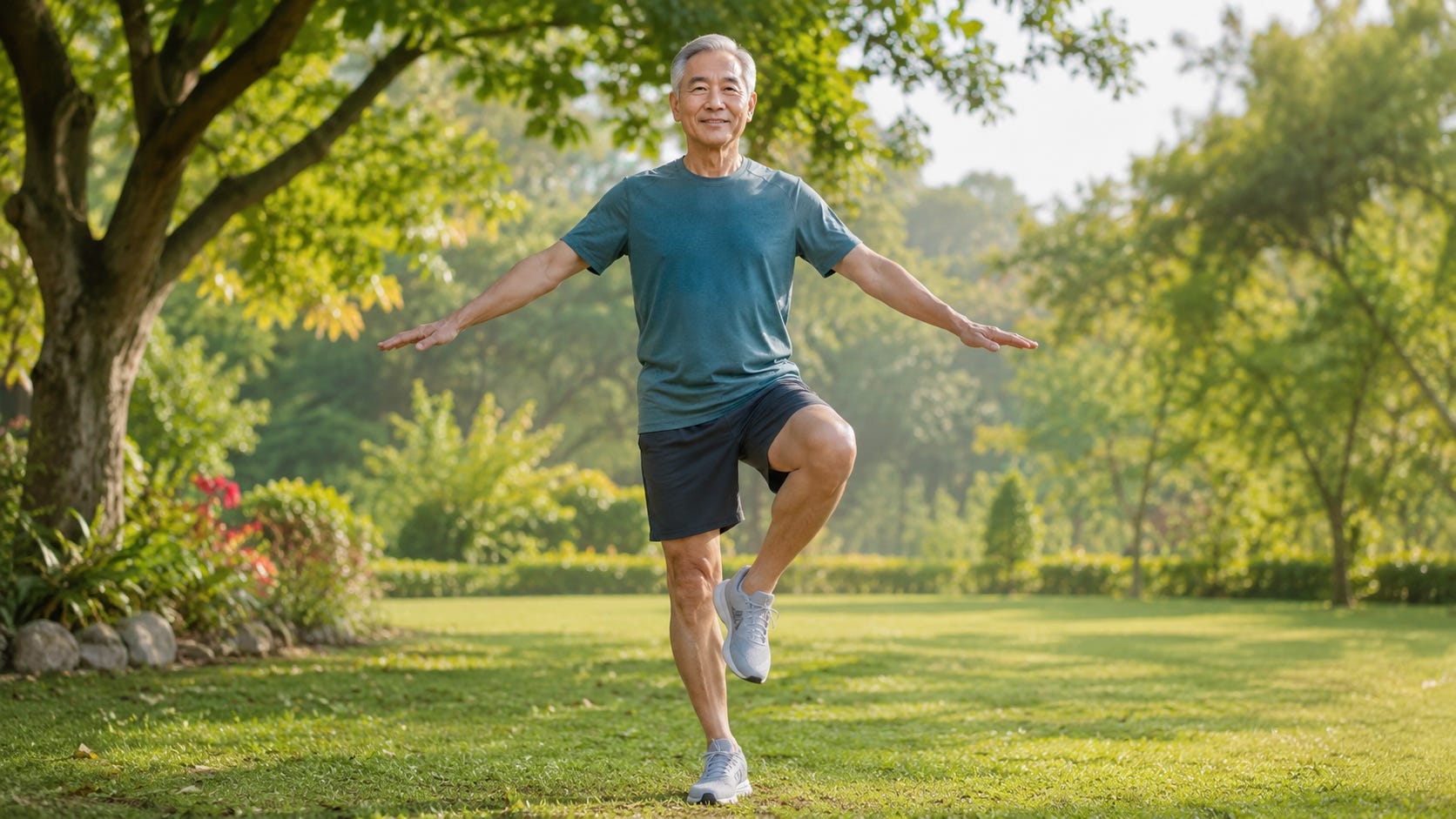
In one study, people who couldn’t stand on one leg for 10 seconds were nearly four times as likely to die over the next 7 years as people who could. [1]
The raw figures were 17.5% against 4.6%. [1]
Even after the researchers adjusted for age, sex, weight, and existing illness, failing the test still came with an 84% higher risk of death. [1]
The test costs nothing and takes 10 seconds.
Most people have never tried it.
After 20 years as a doctor, the checks I like best are the ones you can do at home for free.
This is one of them.
In this article, you’ll see why balance predicts so much, how to do the 10-second test properly, and how to train it in about a minute a day.
The aim is to give you a quick read on your body that usually goes unmeasured until something goes wrong.
Balance draws on several systems at once. Your inner ear, your eyes, the sensors in your joints, your leg strength, and how fast your brain ties them together. [1]
When any of those fade, your balance is often where you notice it first. That makes standing on one leg a quick read on several systems at the same time.
Balance also drops faster than people expect after the mid-50s. [1] In the study, one in five adults aged 51 to 75 could not hold the 10-second stand. [1] The share who failed climbed with age, which is part of why the test carries so much information in this group. [1]
A second, larger study followed nearly 19,000 adults in China. For every extra second a person could hold their balance, the risk of dying during the study dropped by about 10%. [2]
These are observational studies, so they show a link, not proof. Still, balance carries information that blood tests and blood pressure readings miss.
Here is the version used in the research. Stand with support nearby, such as a wall or a kitchen counter, in case you wobble.
Rest the front of one foot on the back of the opposite lower leg. Keep your arms by your sides and your eyes open and looking ahead. Then hold. [1]
The goal is 10 seconds without holding on. It is worth trying both legs, since one side is often steadier than the other.
If you can’t hold it yet, treat it as a starting point. Balance responds quickly to practice.
The encouraging part is that balance improves fast, and the payoff is real.
A large review of 88 trials with more than 19,000 older adults found that exercise cut the rate of falls by 21%. The programmes that challenged balance directly worked best, reducing falls by up to 39%. [3]
You don’t need a class or any equipment. Stand on one leg while you brush your teeth. Hold for 20 to 30 seconds on each side, twice a day, near a counter for safety.
As it gets easier, make it harder. Close your eyes, stand on a cushion, or turn your head side to side while you hold the position. Each small step keeps challenging the systems that keep you upright, which is what drives the improvement.
If you do one thing this week, run the 10-second test once, then add one-leg stands to something you already do every day. Brushing your teeth works well, because it happens twice a day without fail. Keep support within reach, and build up slowly. The basics work, and balance is one of the quiet ones. It holds you up, it keeps you off the floor as you age, and it takes about a minute a day to protect.
Wishing you the best of health,
Adrian
Thanks for reading Longevity Decoded! This post is public so feel free to share it.
This article is general health information for adults, not personalised medical advice. It is not a substitute for consultation with your own doctor. The research described here is observational, which means it shows associations but cannot prove cause and effect. Individual results vary. If you have a medical condition, are pregnant, take medication, or are considering changes to your treatment or lifestyle, talk to your own doctor first.
Araujo CG, de Souza E Silva CG, Laukkanen JA, Fiatarone Singh M, Kunutsor SK, Myers J, et al. Successful 10-second one-legged stance performance predicts survival in middle-aged and older individuals. British Journal of Sports Medicine. 2022;56(17):975-980. DOI: 10.1136/bjsports-2021-105360. PMID: 35728834. https://doi.org/10.1136/bjsports-2021-105360
Xie K, Han X, Hu X. Balance ability and all-cause death in middle-aged and older adults: a prospective cohort study. Frontiers in Public Health. 2023;10:1039522. DOI: 10.3389/fpubh.2022.1039522. PMID: 36699907. https://doi.org/10.3389/fpubh.2022.1039522
Sherrington C, Michaleff ZA, Fairhall N, Paul SS, Tiedemann A, Whitney J, et al. Exercise to prevent falls in older adults: an updated systematic review and meta-analysis. British Journal of Sports Medicine. 2017;51(24):1750-1758. DOI: 10.1136/bjsports-2016-096547. PMID: 27707740. https://doi.org/10.1136/bjsports-2016-096547
No posts
Comments
Nothing yet. Say the first thing.
Sign in to join the conversation.