
Walking might be the most underrated of the basics.
It’s free, it needs no kit, and people have leaned on it for thousands of years to think, write, and stay well.
Long before anyone measured it in a lab, the people who built their lives around walking left us their reasons.
Here are 15 of the best lines, the stories behind a few famous walkers, and a simple way to start your own habit.
What’s striking is how many of these were working writers, scientists, and composers, not health gurus.
They didn’t walk to hit a step count.
They walked because it was where the work got done.
“A journey of a thousand miles begins with a single step.” Lao Tzu, Tao Te Ching. Often rendered this way in English; older translations read “begins beneath one’s feet”.
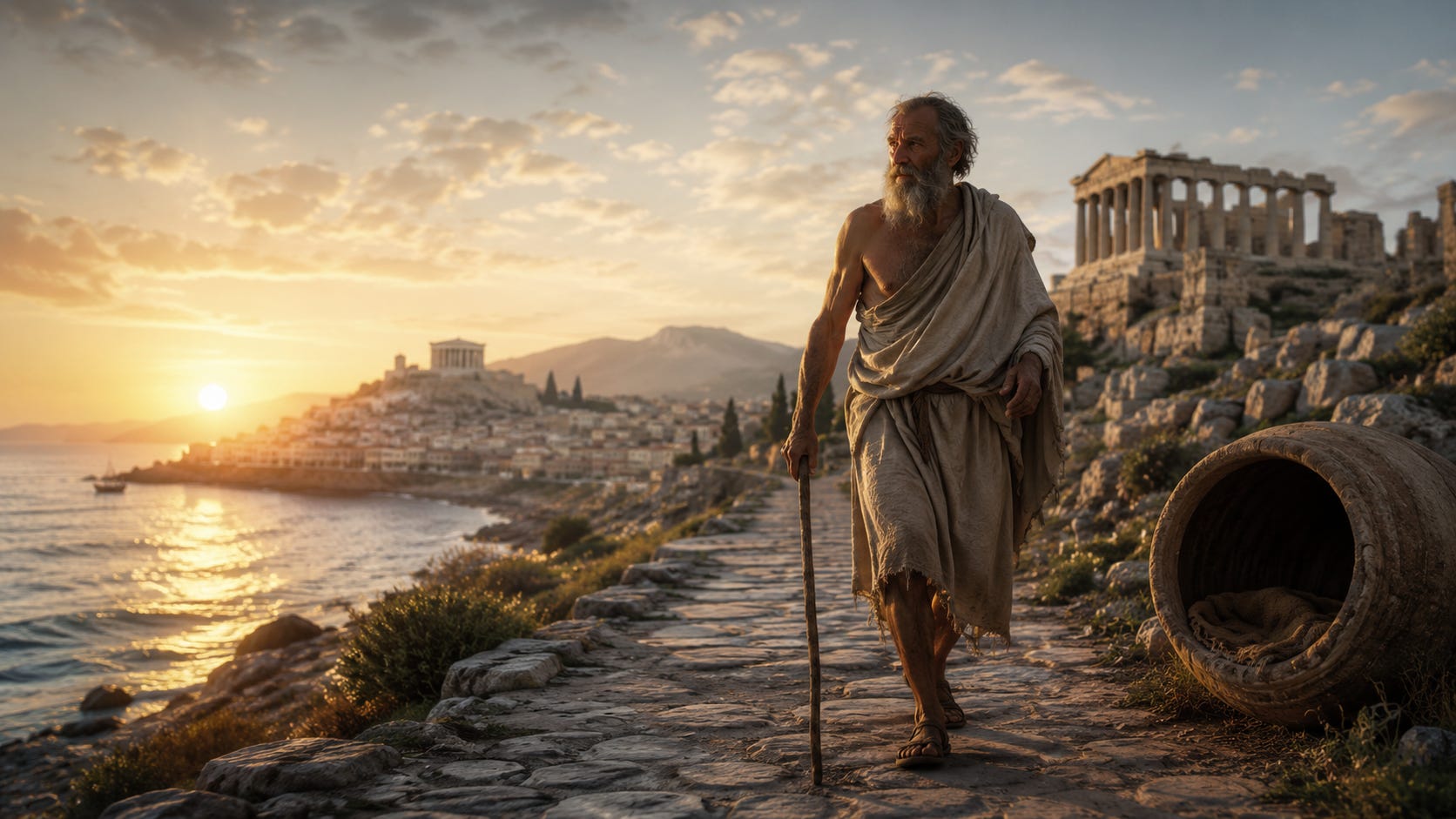
“Solvitur ambulando.” It is solved by walking. A Latin phrase linked to the ancient Cynic Diogenes, used ever since for problems that loosen up once you get moving.
“Walking is man’s best medicine.” Attributed to Hippocrates almost everywhere, but it doesn’t appear in any of his surviving writings. Treat it as folk wisdom, not a real quote.
“I can only meditate when I am walking. When I stop, I cease to think; my mind only works with my legs.” Jean-Jacques Rousseau, Confessions.
“Walking is the best possible exercise. Habituate yourself to walk very far.” Thomas Jefferson, in a 1785 letter to his nephew Peter Carr.
“Nine-tenths of my verses have been poured out in the open air.” William Wordsworth, recalled by Thomas De Quincey, who reckoned the poet had walked something like 180,000 miles in his life.
“Few people know how to take a walk. The qualifications are endurance, plain clothes, old shoes, an eye for nature, good humour, vast curiosity, good speech, good silence, and nothing too much.” Ralph Waldo Emerson.
“I think that I cannot preserve my health and spirits, unless I spend four hours a day at least, sauntering through the woods and over the hills.” Henry David Thoreau, from his essay Walking (1862).
“Above all, do not lose your desire to walk. I have walked myself into my best thoughts, and I know of no thought so burdensome that one cannot walk away from it.” Søren Kierkegaard, in an 1847 letter to his niece Jette.
“All truly great thoughts are conceived by walking.” Friedrich Nietzsche, Twilight of the Idols (1889).
“If I couldn’t walk fast and far, I should just explode and perish.” Charles Dickens, in an 1854 letter to his friend John Forster.
“I only went out for a walk and finally concluded to stay out till sundown, for going out, I found, was really going in.” John Muir, from his journals.
“I have two doctors, my left leg and my right.” G. M. Trevelyan, from his 1913 essay Walking.
“I would walk along the quais when I had finished work or when I was trying to think something out. It was easier to think if I was walking.” Ernest Hemingway, A Moveable Feast.
“I like walking because it is slow, and I suspect that the mind, like the feet, works at about three miles an hour.” Rebecca Solnit, Wanderlust: A History of Walking.
The quotes weren’t just nice lines. Several of these people organised their working lives around a daily walk.
Aristotle taught while walking. His school in Athens earned the name the Peripatetics, from the Greek for walking about, because lessons happened on the move through the Lyceum.
Immanuel Kant walked the same route through Königsberg every afternoon at 3pm, so reliably that neighbours were said to set their clocks by him. The story goes that the only time he broke the habit was when he got lost in Rousseau’s book Émile for a few days.
Charles Darwin built a quarter-mile gravel loop at the back of his garden at Down House and called it his thinking path, the Sandwalk. For about 40 years he walked it several times a day in all weather, sometimes stacking stones at the entrance and knocking one aside with his stick after each circuit so he could count laps without thinking. He kept the same routine while working through the ideas that became On the Origin of Species.
William Wordsworth treated walking as part of the writing itself. His friend Thomas De Quincey reckoned the poet covered something like 180,000 miles in his life around the Lake District, and Wordsworth himself said nine-tenths of his verses were composed in the open air rather than at a desk.
Henry David Thoreau reckoned he needed at least four hours a day on his feet to keep his health and his spirits. He wandered the woods and fields around Concord, Massachusetts, and turned the practice into his essay Walking, which made the case that sauntering was a serious pursuit, not idleness.
Ludwig van Beethoven walked through Vienna and its woods after lunch most days, carrying a pencil and sheets of paper to catch musical ideas on the spot.
Charles Dickens was a famous night walker who routinely covered ten to twelve miles around London, often after dark, and credited the habit with keeping him sane and productive.
Pyotr Ilyich Tchaikovsky took a walk of exactly two hours every day. He believed his health depended on it and reportedly wouldn’t come home early, even by a few minutes, jotting down ideas as he went.
Steve Jobs, much more recently, was known for holding walking meetings, talking business on foot rather than across a desk. It’s a modern echo of a very old idea.
The through-line in all of this is that walking does two jobs at once. It moves the body and it loosens the mind.
On the body side, regular walking is one of the most reliable, low-risk things you can do for long-term health. In a meta-analysis of 15 studies and 47,471 adults, people who took more daily steps had a steadily lower risk of dying early, with the benefit levelling off at around 6,000 to 8,000 steps for adults over 60 [1]. A separate pooled study of 50,225 British walkers found that an average or brisk pace was linked to a 20 to 24% lower risk of death than a slow one [2]. Both are observational, so they show a link rather than proof, but the signal is large and consistent. It’s gentle on the joints, it suits almost every fitness level, and it costs nothing. It also fits a busy life in a way few other forms of exercise do, since you can take a call, walk a child to school, or clear your head on the same trip.
On the mind side, these writers were onto something real. A steady walk tends to lift mood, ease stress, and shake loose ideas that wouldn’t come at a desk. You don’t have to be a poet to feel it. Most people notice their head is clearer at the end of a walk than it was at the start.
There’s a reason so many of them paired walking with their hardest work. A gentle, rhythmic pace seems to free the mind to wander while the body stays busy, which is often when the useful thought arrives. Darwin’s stones and Tchaikovsky’s notebook weren’t quirks. They were both trying to catch what the walk gave them before it slipped away.
None of this needs a target of 10,000 steps or a fancy tracker. The 10,000 figure started as a marketing slogan for a 1960s Japanese pedometer, and the research finds clear benefits well below it [1]. The benefit is in the doing, not the measuring.
The mistake most people make is starting too big and quitting in a week. A habit that sticks usually starts small and boring.
Start with 10 minutes. One short walk a day, every day, beats a long march once a fortnight. You can build the length later once the habit is in place.
Attach it to something you already do. A walk right after lunch or dinner, or first thing with your coffee, gives the habit a fixed home in your day. Anchoring it to an existing routine is what makes it automatic.
Make it easy to say yes. Keep your shoes by the door. Pick a route you don’t have to think about. Lower the bar on the days you’re tired, even five minutes counts and keeps the streak alive.
Use it the way these walkers did. Leave the phone in your pocket sometimes and let your mind wander, or take a call or a problem with you and see what shakes loose by the end. Company helps too. A walk with a friend or partner doubles as time together.
Build slowly. Adding a few minutes each week is plenty. The aim is a habit you’ll still have in 10 years, not a burst you abandon by next month.
Notice what it does for you. Pay attention to how you feel and think on the days you walk versus the days you don’t. That personal evidence tends to hold the habit in place far better than any rule about steps or distance, because you start walking for how it makes you feel rather than out of duty.
The basics work, and walking is about as basic as it gets.
Pick one line from this list that lands for you, put your shoes on, and go.
See you out there :)
Dr Adrian
Paluch AE, Bajpai S, Bassett DR, et al. Daily steps and all-cause mortality: a meta-analysis of 15 international cohorts. Lancet Public Health. 2022;7(3):e219-e228. DOI: 10.1016/S2468-2667(21)00302-9. PMID: 35247352. https://doi.org/10.1016/S2468-2667(21)00302-9
Stamatakis E, Kelly P, Strain T, et al. Self-rated walking pace and all-cause, cardiovascular disease and cancer mortality: individual participant pooled analysis of 50,225 walkers from 11 population British cohorts. Br J Sports Med. 2018;52(12):761-768. DOI: 10.1136/bjsports-2017-098677. PMID: 29858463. https://doi.org/10.1136/bjsports-2017-098677
This is general information, not medical advice. If you have a heart condition, joint problems, or any concern about starting exercise, have a word with your own doctor first.
No posts
Comments
Nothing yet. Say the first thing.
Sign in to join the conversation.