
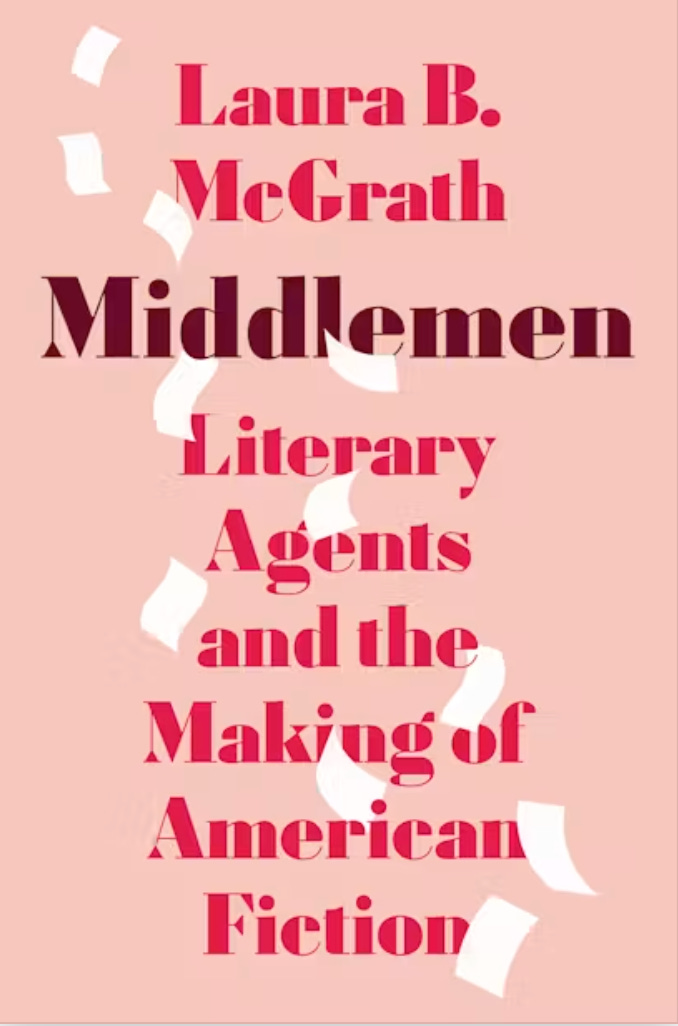
Middlemen: Literary Agents and the Making of American Fiction, Laura B. McGrath, Princeton University Press, 2026, 296 pages
Anyone who has spent time trying to get a novel published — as it turns out, there is a surprisingly large number of us — will find in Laura McGrath’s new book, Middlemen, both an illuminating backstory and a strange comfort.
Here’s my reason to be interested: I’ve spent the last eight months querying literary agents — sending dozens of 250-word pitches containing a brief bio and an equally brief pitch for my debut-novel manuscript. And so, McGrath’s book helped me to see what this process looks like from the other side.
McGrath, a professor of English literature at Temple University and a self-described “outsider” to the industry, brings sociological rigor and considerable narrative verve to her subject. Chronicling the story of literary agents in the United States from the 1950s to today, she describes their critical role in the making of American literature — from the three-martini lunch to the Frankfurt Book Fair. Her method is impressively hybrid: original archival research, data analysis, and interviews with more than seventy-five literary agents and other publishing professionals. The result is a book that reads less like a polemic and more like a guided tour of a world most readers never see.
Early on, McGrath pauses to sketch the demographics of the profession, and the portrait is startling: There are more than 1,500 literary agents in the United States — and most of them are white, most of them are women, most of them are clustered in or near New York City. There is no licensing requirement, no certification, no formal credential. Agenting is an apprentice trade, passed from supervisors to assistants who eventually become supervisors themselves, perpetuating the industry’s assumptions and aesthetics from one generation to the next. The informality sounds almost quaint until you register what it means: the people who function as the primary gatekeepers of American literary fiction have acquired their authority largely by proximity and inheritance.
I read that demographic portrait as a small mirror. As a white man — and, for what it’s worth, someone well over six feet tall — I’m accustomed to navigating spaces with relative ease and (many would say) privilege. Yet entering the querying trenches was an immediate lesson in rejection, with some agents passing in under twenty-four hours. (Only two have ever asked to see the full manuscript.)
The book’s central argument is simple but consequential: no figure has been more significant, and yet more invisible, in American literature than the literary agent. Agents are far more than contract negotiators. As intermediaries between author and publisher, they act as advocates, matchmakers, negotiators, and tastemakers, balancing artistic values with the commercial imperatives of publishing conglomerates. They shape not only individual books but entire literary categories — the debut novel, the story collection, postmodernism, multiethnic fiction, and world literature all bear the imprint of agenting decisions made across decades.
Some of the book’s most interesting moments come in its profiles of legendary figures: Sterling Lord, who shepherded Jack Kerouac; Candida Donadio, whose regular table at the Italian Pavilion was, as McGrath puts it, the undisputed central node in the network of the U.S. literary world; Andrew Wylie, who transformed Philip Roth’s reputation by selling translation rights to prestigious European publishers. These are stories of taste wielded as power, and McGrath tells them well.
The book is most bracing when it confronts how agents function as market gatekeepers. Agents decide who gets access to the literary marketplace and who doesn’t, by virtue of their decisions about who to represent. They also, as McGrath makes clear, operate in a system with structural biases. The book devotes serious attention to how agents of color navigate a profession that has historically valued whiteness.
One important bit of intentional irony is the book’s title: eighty percent of literary agents are in fact women, which turns the “middlemen” label into a bit of sad humor. McGrath leans into this productively, I think, using it to ask whose interests the industry’s structures actually serve.
Not every aspect of the agenting world receives full treatment. The book can sometimes drift away from the fact that agents do more than represent authors — the slow, unglamorous work of career development, the authors who never earn out, the manuscripts shepherded for years without a sale. Also, by focusing primarily on the agents whose clients command the highest advances and win the major prizes, McGrath illuminates the top of the pyramid while the base (where I live) remains in shadow. Middlemen deserves a wide readership — including, perhaps especially, those of us still waiting to hear back from the agents we’ve queried.
I’ve been surprised by how humbling that waiting has been. It reminds me, oddly, of not making my high school baseball team after years of playing Little League, where I’d been, by my own reckoning, a genuinely fine ballplayer. The sting wasn’t just the rejection; it was the gap between how I’d sized myself up and how someone else, holding all the cards, sized me up instead.

Laura is an Assistant Professor of English at Temple University and a National Endowment for the Humanities Fellow. Prior to joining the faculty at Temple, she was the Associate Director of the Literary Lab at Stanford University. Her academic writing has been published in New Literary History, American Literary History, Post45, CA: The Journal of Cultural Analytics, and the Encyclopedia of Contemporary American Fiction, 1980-2020. She is Special Features editor of CA: The Journal of Cultural Analytics, founding co-editor of the Post45 Data Collective, and the “Culture Industries” section editor at Public Books. A former Kennedy Fellow with the Smithsonian Institute of American History, her work has been supported by the NEH, the Mellon Foundation, ACLS, and the Big Ten.
An encouraging note: I learned yesterday that Virginia Evans, author of the breakout epistolary novel, The Correspondent (now #1 on the New York Times best-seller list), spent roughly 20 years writing seven complete, unpublished novels before her eighth completed novel finally became her first published work. Let’s see, if I follow that path, I’ll only be 92 when my debut novel appears.
Comments
Nothing yet. Say the first thing.
Sign in to join the conversation.