
When I returned to the United States after five years in Switzerland, I expected reverse culture shock — the massive size of grocery stores, the sudden absence of bicycles, and the expectation to tip for every conceivable service. What I did not expect was that church would be the strangest part.
My wife and I settled in Holland, Michigan, a small town with more than seventy churches, and one Sunday I sat in a pew, looked around, and realized how much everyone looked like me. Same skin tone, same age bracket, even the same haircut, more or less. But what was unsettling was not the pattern of sameness. It was the realization that I was noticing this for the first time in my life. I had served American congregations for thirty-five years — Wheaton, Ann Arbor, Fort Lauderdale — and they had all looked like this one. But I had never noticed that. Homogeneity is invisible from the inside.
It took five years away for me to see what is obvious.
The church I served in Zürich drew its members from more than two dozen nationalities. I would love to tell you this was because the church was made up of unusually friendly and outgoing people. It was not. The church was multicultural because it had no choice: the internationals kept coming through the door, and the congregation could either do the work or cease to exist.
And it was work. Meetings often ran long. A baptism could set off days, even weeks, of theological conversation. The consensus I had taken for granted my whole career turned out to be a luxury of sameness.
But communion Sundays were different. When my congregation came forward on those Sundays — every accent, every skin tone — I would think of the congregation in Revelation 7, “a great multitude that no one could count, from every nation, tribe, people and language,” and I would understand that I was being shown something: a picture of what the church actually is.
I was so taken with what I found in Zürich that I wrote a book about it, with a how-to title which embarrasses me now: How to Become a Multicultural Church. The title assumed readers would want what I had. The years since have taught me how naïve that was. What was missing in the American church was the longing.
Here is what I had to admit after coming home: Nothing in American church life will ever make that picture something we long for. Church-growth experts figured this out decades ago and turned it into a principle: People come to churches where they already recognize themselves. Sameness is the key. It is efficient and comfortable. Which is why the question why would anyone bother? has no market answer. There isn’t one. I say this without any moral high ground, because for thirty-five years nothing made me bother either. I needed necessity to teach me what conviction should have taught me long before.
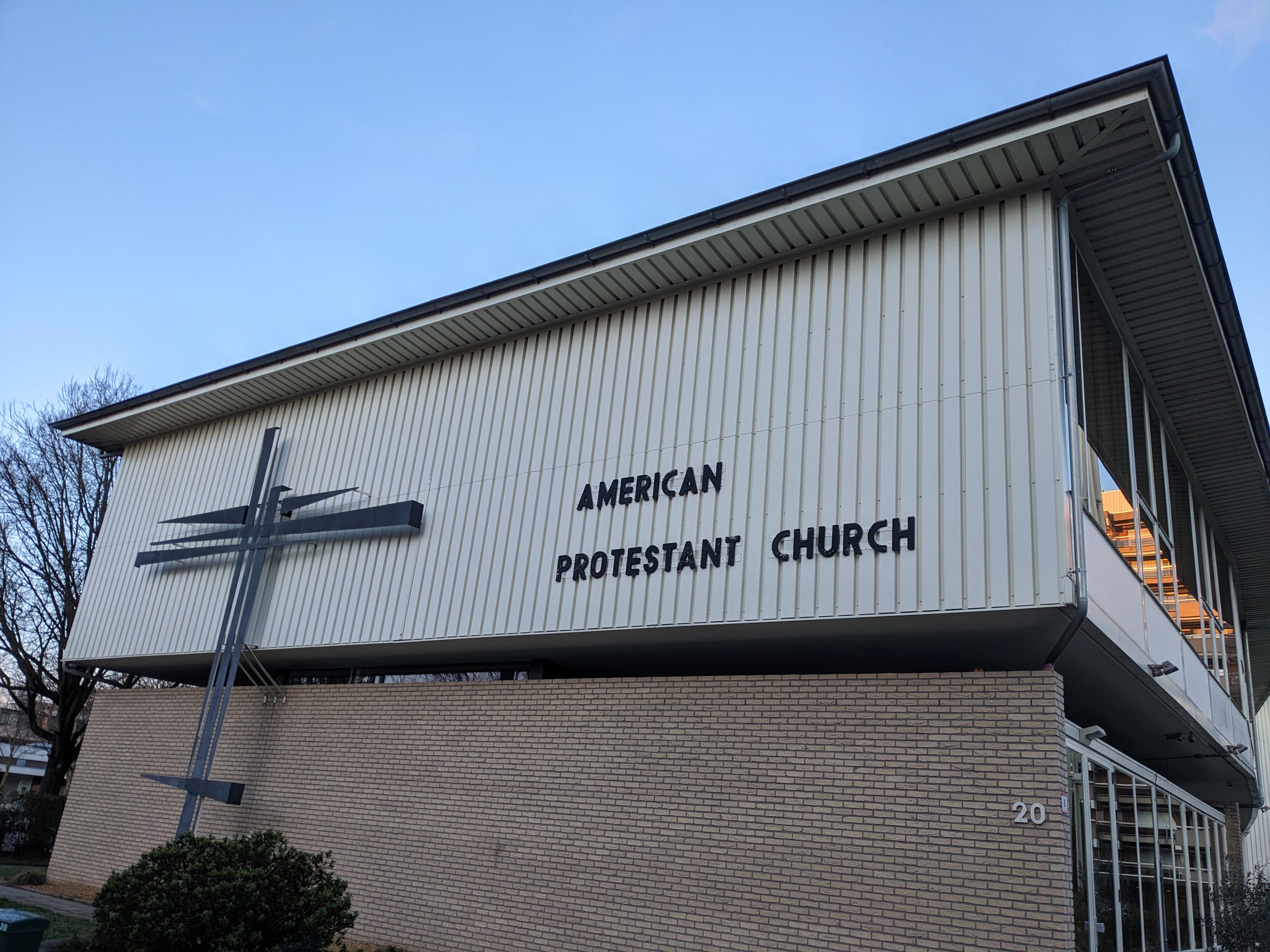
After Zürich, I served one more international congregation. I was interim pastor of the American Protestant Church of The Hague. In 2022, early in my time at the church, a family from Ukraine (mom, dad, and three teenage children) found their way to us. They told me that they had chosen our church over other options because of the word American on the building. To them, in that terrible spring, the word meant safety. It meant generosity. It meant welcome.
Not long ago a friend sent me a photograph of the building as it looks today. The bold capital letters are gone. The wall now reads, in small lowercase type, apch. The sign near the sidewalk says what it has said for years: “A Home for the Global Community.” The mission never changed. Only the word came down.
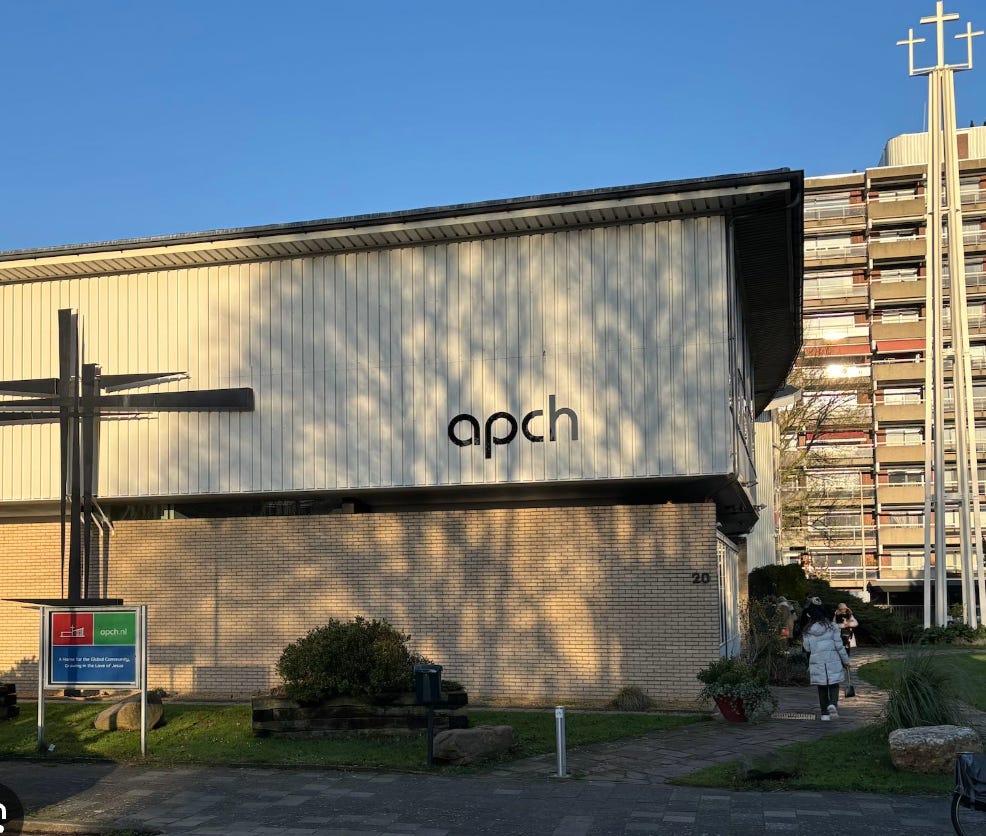
I understand the decision. The congregation is global; the adjective described its founding, not its present. And a church name doesn’t last forever. What American said to a Ukrainian family in 2022 and what it says to a passerby in The Hague today are evidently no longer the same thing, and that change is not the church’s doing. They read the times and responded. Sensibly.
But here is what I cannot stop thinking about: a word does not lose its meaning because someone unscrews it from a wall. It loses its meaning the same way it acquired it — slowly, over the years, through what people actually find when they walk toward it. To that Ukrainian family, American meant welcome because, somewhere along the way, enough Americans had made it true.
To be clear, I am not campaigning to put the letters back. The congregation I served in Zürich had the better name all along — the International Protestant Church. What that Ukrainian family walked toward was never really America. It was welcome, a meaning which the word, for a short stretch of history, carried. No church needs the adjective. Every church needs what it meant.
Which brings me back to Holland, Michigan, and the pews where everyone looks like me.
No necessity is coming for us, the way it came for Zürich and The Hague. No one will require our churches to become anything other than what they comfortably are. There is only that picture from Revelation — “a great multitude…from every nation, tribe, people and language” — and the uncomfortable knowledge that a frightened family, arriving here, would have to take our welcome entirely on faith. There is no word on any wall that can make that promise for us.
Comments
Nothing yet. Say the first thing.
Sign in to join the conversation.