
“Patients crave a partnership with their physicians who are as sensitive to their aching souls as to their malfunctioning anatomy. They yearn not for a tautly drafted business contract but for a covenant of trust between equals earned by the doctor while exercising the art of caring… modern health care with a human face.”
Bernard Lown, MD, The Lost Art of Healing - Practicing Compassion in Medicine
Good patient care is built on the relationships formed between unique and imperfect humans engaged in very different tasks. What brings these people together is the patient’s perception of illness expressed as symptoms that he hopes can be relieved. Physicians and other healthcare providers bring training and experience that offer the hope of professional assistance with the patient’s symptoms, illness, and plight.
The patient-physician encounter is foundational to all forms of medical practice. Therapeutic encounters are built on trust. Patients enter these relationships seeking relief from suffering. Doctors attend Medical School to learn specific facts about disease and general medical principles, many of which will evolve over a professional lifetime. Healthy patient-physician encounters also require empathy and a sincere effort to understand one another from each participant. Patient-care provider encounters can be:
· face-to-face versus via computer screen only or telehealth;
· significant physical exam versus minimal or no examination of the patient;
· procedure only versus communication and examination;
· high touch versus high tech (with or without artificial intelligence or AI).
In every case, care providers must bring more than factual knowledge and technical competence to the encounter. Patients must have more than their insurance card and great expectations.
All healthy human encounters require the establishment and maintenance of boundaries. The patient-provider encounter is unequal. The patient has the symptoms, the disease, and the plight. The patient will bear the benefits, risks, and costs of treatment. The patient brings most of the courage needed to face these realities. The provider brings knowledge, experience, and compassion. The patient-physician encounter requires more than a financial and/ or legal arrangement.
The invasion of the electronic medical record, the extent to which coding and billing have usurped the original purpose of the medical record, and the widespread use of search engines by patients have all led to a form of triangulation: the patient-computer-care provider encounter. The intrusion of multiple computer interfaces and artificial intelligence (AI) into the patient-doctor relationship is potentially more disruptive than the usually well-intended involvement of family members and/ or surrogates.
When we become patients (or ill), we all desire accessible and affordable care from providers, clinics, hospitals, and healthcare systems, in whose competence and compassion we can trust. In the United States, we do not have either an insurance-based or government-run healthcare system that provides healthcare for all of our citizens. The partial adoption of fee-for-service payment models has required insurance companies, hospital corporations, management firms, pharmaceutical companies, and regulatory agencies to become enmeshed in the patient-care provider matrix, as opposed to the almost quaint, historic relationship between a doctor and her patient.
The patient-doctor encounter has had to allow for additional stakeholders. All of these stakeholders are increasingly involved with patient care decisions. The ability of a single provider to influence insurance companies, pharmaceutical and device manufacturing firms, hospital management, and even professional organizations and licensing boards is limited. Nonetheless, both patients and care providers must often cope with the mandates of these diverse groups.
Physicians can often choose the healthcare systems, hospitals, and clinics in which they practice. I chose systems, and wherever possible, colleagues, mentors, and heroes who were most aligned with my views on medical ethics and professionalism. My preference for salaried rather than fee-for-service systems of delivery is reflected in my reluctance to think of my patients as clients, and in my efforts to avoid financial conflict of interest, as much as possible. My favorite healthcare system in which to practice has been University-affiliated, Veterans Affairs (VA) hospitals. I was able to resolve many personal conflicts by working within the Veterans Affairs (VA) healthcare system. Avoiding financial conflict of interest issues during the heyday of percutaneous coronary intervention (dilating for dollars) is an important example. Another benefit of my working in the VA healthcare system was the relative ease with which I obtained excellent psychiatric care when I needed it, without interference from practice, hospital, system, or insurance carriers. I was able to resolve internal conflicts about several American Wars while finding purpose in caring for American Veterans (my Peace Corps), working in the VA. Additional University-VA practice advantages included: teaching medical, nursing, pharmacy, therapy, and technology students and trainees, and participation in clinical research. The VA Research Service is one of the most productive medical research systems in the world.
Patient care involves specific rewards, risks, and costs to each care provider. I derived my greatest rewards from the relationships with patients and other care providers. My veteran and non-veteran patients were among my best teachers. They taught me courage, fortitude, patriotism, and moral values. My patients, family, and colleagues made me want to become a better doctor and a better person.
Practicing medicine is associated with costs. More hours and years are required in education and training to become a physician than for many other professions. The costs of education often include the assumption of monetary debt that may take years to repay. Cost versus reward assessment requires continuous reevaluation of one’s values and goals throughout one’s career.
There are physical and psychological hazards associated with the practice of medicine. All care providers must deal with uncertainty, patient suffering, and patient death. Psychological risks of depression, divorce and parental alienation, substance abuse and addiction, burnout, and even suicide can arise from these stresses. Provider burnout, suicide, and reluctance to enter the profession are all contributing to a healthcare manpower shortage. Avoiding or ameliorating these hazards requires finding purpose in one’s work and developing healthy coping strategies.
Depression, substance abuse, burnout, and suicide are occupational risks for all physicians. All of these mental-health issues are exacerbated by performing surgical procedures with potential adverse outcomes. I chose interventional cardiology with an emphasis on high-risk patients in both my research and practice. The emergency care for patients who were at high risk of death was associated with a heightened anxiety of responsibility, and often with feelings of guilt for adverse outcomes.
My medical career included depression, substance abuse (alcohol), and a protracted and difficult effort to be a father during an unamicable divorce and its consequences. I needed individual psychotherapy to deal with a nearly career-ending injury and the psychosocial stresses that followed. Antidepressant medication and group therapies such as Divorce Recovery, Men’s Movement, and parenting classes also helped. I learned that the willingness to ask for help and to accept help were among the most important survival skills I could develop.
My medical career was inspired, in large part, by the practices of my father, a surgeon and general practitioner, and my stepmother, a pediatrician. My father, who also served as a ship’s surgeon in the Pacific theater of World War II, and my stepmother both practiced medicine for 50 years in central Pennsylvania. I recognize that there are many important differences between my parents’ America, my America, and the America of my children. But I remember my father and my stepmother enjoyed their medical practices, even while they faced the stresses of patient suffering and death. I think they resolved this seeming paradox primarily based on their views of medical professionalism. Due to their modeling, I have sought a medical morality and sense of professionalism based on compassion for human suffering, altruism to try to ameliorate suffering, and an ethics of “Do not do to others what you do not want done to you”. I have often come up short. I am imperfect. The continued effort made my practice of medicine worthwhile.
My goal in writing this book, Patient Physician Encounter, is to share the gratitude and sense of meaning I derived from my forty-seven years of medical practice, my calling, and my patient encounters. I hope that readers may improve their patient-physician encounters, and more patients may find relief from medical suffering to the limits of contemporary science.
Godspeed.
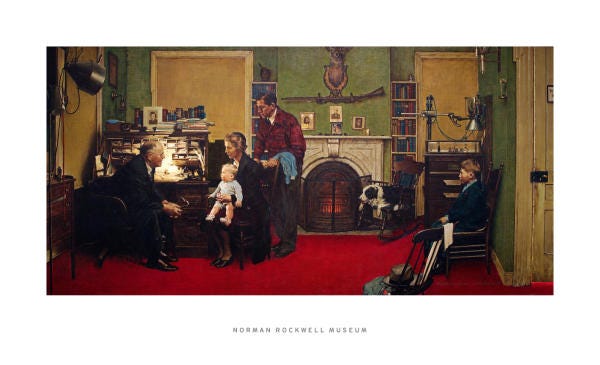
A print of this Norman Rockwell painting was displayed in the lobby of my father’s medical office in Harrisburg, Pennsylvania, for all of the fifty years he practiced.
No posts
Comments
Nothing yet. Say the first thing.
Sign in to join the conversation.