
LandSpace Press Release
Via Google Translate
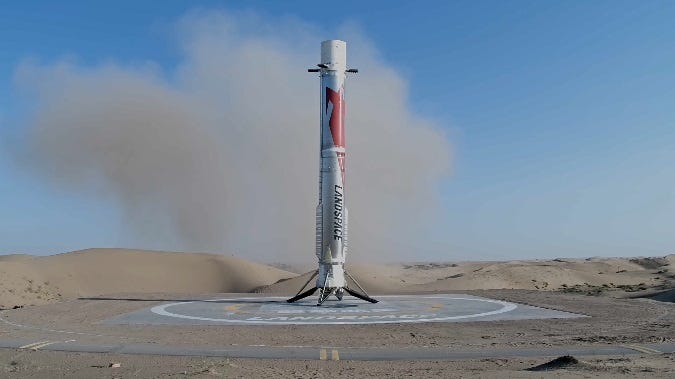
At 7:35 AM Beijing time on August 19, 2026, the Zhuque-3 reusable Y2 carrier rocket was launched from the Dongfeng Commercial Aerospace Innovation Test Zone. Approximately 137 seconds after liftoff, the first and second stages separated, and the second stage continued its flight, accurately sending the Honghu 03 satellite, independently developed by Hongqing Technology, into its predetermined orbit. At approximately 7:41 AM, the first stage successfully soft-landed at the Zhuque-3 landing site in Minqin County, Gansu Province, according to the predetermined procedure, marking a complete success for the flight test mission.
This mission marks China's first successful recovery of a first-stage reusable launch vehicle using landing legs, and also China's first successful land-based recovery of a first-stage orbital-deployed launch vehicle. It is a crucial flight test for the Zhuque-3 rocket, marking its transition from recovery technology verification to engineering reuse verification. The mission further validated the design correctness and product reliability of the Zhuque-3 reusable launch vehicle system, verified its first-stage recovery capability and engineering level, and accelerated China's commercial reusable rocket program into the engineering verification phase.
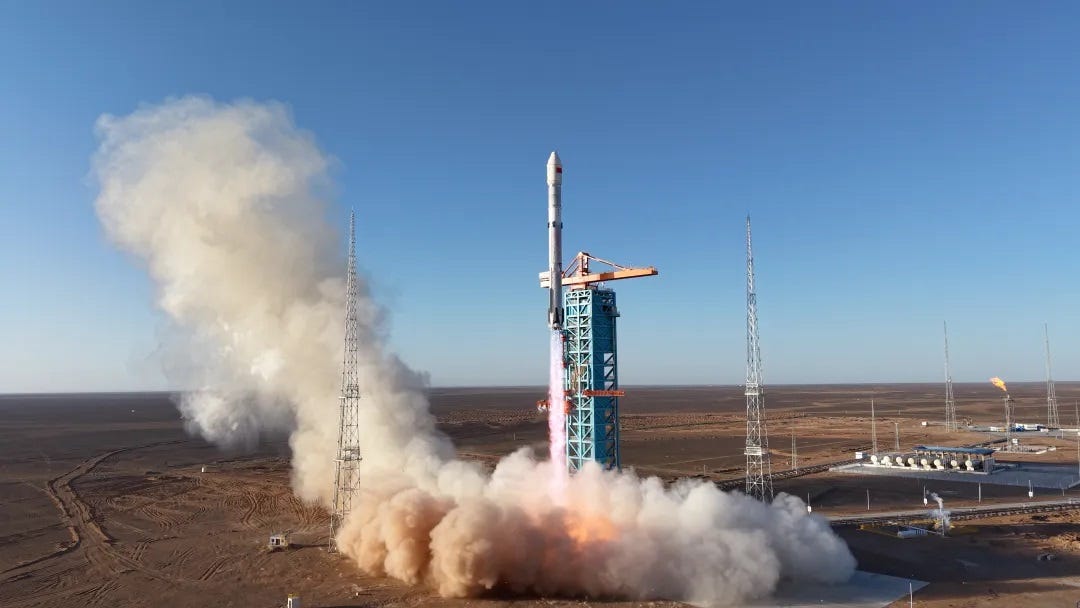
After the first and second stages separated, the first stage entered the return phase according to the predetermined flight procedure, successively completing key maneuvers such as high-altitude return attitude adjustment, reentry ignition powered deceleration, aerodynamic gliding control, landing ignition deceleration, and landing legs deployment for cushioning, ultimately landing stably with the help of the landing legs. The mission systematically verified the entire process of the first stage returning to the land landing pad from high-speed flight.
Based on the data and engineering experience obtained from the Zhuque-3 Y1 flight test, the Zhuque-3 Y2 rocket underwent several targeted optimizations to key aspects of reusable flight. The landing propulsion system was simplified by reducing the number of landing ignition engines, further improving system design and reliability. The onboard autonomous safety control system added a landing point prediction function and optimized the return control strategy, further enhancing the safety and autonomous control capabilities of the recovery flight process. Addressing the complex force and heat environment of the reentry process, the design for resistance to extreme force and heat environments during reentry and its protective features were optimized, further improving the rocket’s environmental adaptability and reliability during the reentry phase.
In light of the characteristics of this launch mission, Zhuque-3 Y2 also carried a non-pyrotechnic stacking and compression release device independently developed by LandSpace, further verifying the working performance of the relevant technical solutions in a real flight environment, and strongly supporting the subsequent large-scale constellation networking, batch rapid deployment and launch efficiency improvement.
Zhuque-3 is a new-generation reusable liquid oxygen-methane launch vehicle independently developed by LandSpace. It has established a technological system for reusable launch vehicles in terms of overall design, propulsion system, return control, stainless steel body manufacturing, and ground support. This mission lays a solid foundation for subsequent recovery, maintenance, reuse flights, and commercial applications. LandSpace will continue to advance the iteration and engineering verification of reusable technology, helping my country further improve its low-cost, high-frequency, and highly reliable space transportation capabilities, providing new capacity support for my country’s large-scale constellation networking and large-scale commercial launches.
No posts
Comments
Nothing yet. Say the first thing.
Sign in to join the conversation.