
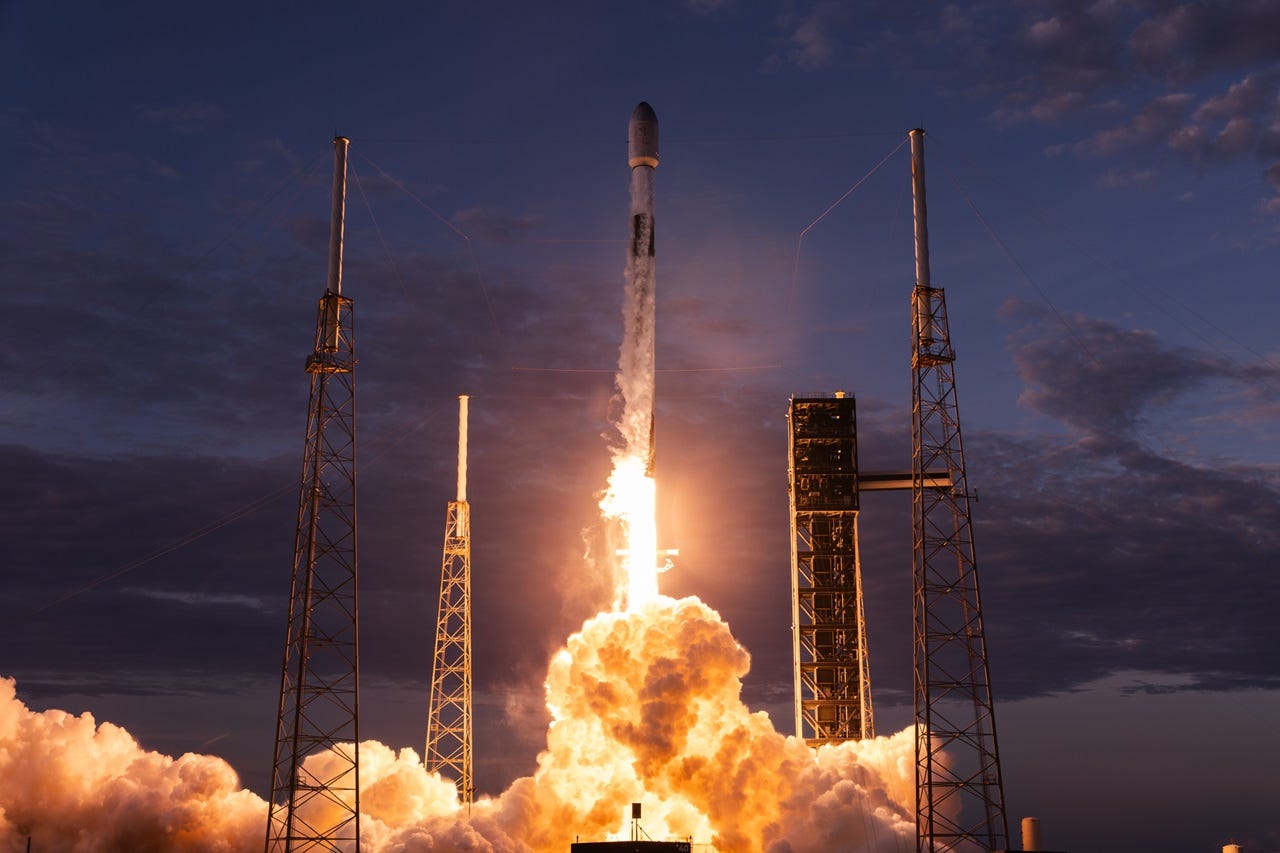
The Trump Administration has announced plans to waive 13 environmental laws covering commercial space launches and recoveries in a move it claims is necessary to keep America preeminent in space but which environmentalists say is illegal.
“America won the first Space Race, and we can do it again -- but only if we get government red tape out of the way. That’s why President Trump has charged USDOT with unlocking the final frontier and re-establishing the United States’ dominance in space,” Transportation Secretary Sean Duffy said in a press release. “Thanks to President Trump’s leadership, we are supercharging commercial space activity, slashing costs, and strengthening America’s competitive edge in this vital field.”
The DOT said the waivers involve “laws applicable to licenses to operate a launch site, licenses to operate a reentry site, experimental permits, and licenses to operate launch and reentry vehicles.” The laws include:
42 U.S.C. §§ 4321 et seq. National Environmental Policy Act (NEPA);
49 U.S.C. § 303(f) U.S. Department of Transportation Act;
16 U.S.C. §§ 1531 et seq. Endangered Species Act;
33 U.S.C. §§ 1251 et seq. Clean Water Act;
16 U.S.C. §§ 1451 et seq. Coastal Zone Management Act;
42 U.S.C. §§ 7401 et seq. Clean Air Act;
54 U.S.C. §§ 300101 et seq. National Historic Preservation Act;
16 U.S.C. §§ 1361 et seq. Marine Mammal Protection Act;
16 U.S.C. §§ 1801 et seq. Magnuson-Stevens Fishery Conservation and Management Act;
16 U.S.C. §§ 1271 et seq. Wild and Scenic Rivers Act;
42 U.S.C. §§ 4901 et seq. Noise Control Act of 1972;
33 U.S.C. §§ 401 et seq. Rivers and Harbors Act; and
16 U.S.C. § 1431 et seq. National Marine Sanctuaries Act.
The public can comment on the proposed waivers here. The comment period ends on Aug 31, 2026 at 11:59 PM EDT.
In its announcement, DOT said “requirements that are needed to protect public health and safety, property, national security, or U.S. foreign policy interests would not be impacted” by the waivers. Precisely what that means in practice remains to be seen.
The move comes as Elon Musk’s SpaceX is nearing a deal with the state of Louisiana to purchase 130,000 acres of land and coastal marshes on the Gulf Coast for the construction of a new spaceport. The facility would complement SpaceX’s launch complexes in California, Florida and Texas.
“We strongly oppose the proposal [waivers] and believe it is illegal and that we can overturn [it] eventually in court. It is pretty clear that it only benefits two companies and two billionaire/trillionaires. It is payback for services rendered by both Jeff Bezos and Elon Musk,” said Brett Hartl, government affairs director for the Center for Biodiversity, in an email.
Musk is planning to spend $100 to $120 million on the midterm elections to keep Republicans in control of Congress. The billionaire spent nearly $300 million supporting President Donald Trump and Republicans during the 2024 election.
The notice of the proposed waivers takes particular aim at the National Environmental Policy Act (NEPA). It’s not clear whether the entire law will be waived.
“I would say it is probable that they would try to [completely waive NEPA]. Just noting that I doubt that all 13 laws would apply to building of the spaceport, but those that are likely to apply I assume they will try to waive those laws there,” Hartl wrote.
Under NEPA, an environmental impact statement (EIS) was required when SpaceX wanted to launch Falcon 9 rockets from its Starbase spaceport in Texas. A less rigorous environmental assessment (EA) was required when SpaceX switched to launching much larger Starship rocket from the facility instead.
It could take 18 months or longer to do an EIS for a new spaceport in Louisiana. The EIS would need to be written then released for public comment. The Federal Aviation Administration (FAA) would then render a decision with conditions on the use of the site.
Hartl said the proposed waivers would be one of the biggest rollbacks of environmental laws in recent decades.
“The border wall waivers are worse and have been used to them maximum extent to waive all environmental laws fully,” Hartl wrote. “There are probably a fair number of laws with limited waivers around out there, but hard to know the full universe. I would say that this is one of the largest waivers in the past 60 years, probably top 2 or 3, but not number 1. And I don’t have time to do the research to confirm that I am not missing anything from way back in the day.”
The DOT cited a Supreme Court decision, Seven County Infrastructure Coalition v. Eagle County, Colorado, as justification for its decision to waive 13 environmental laws.
In that case, the Seven County Infrastructure Coalition applied to the U.S. Surface Transportation Board for approval to construct an 88-mile long railroad line in Utah’s Uinta Basin. The purpose was to connect oil fields in the basin to the national rail network, which would allow the crude oil to be shipped to refineries on the Gulf Coast.
After holding six public meetings and collecting more than 1,900 comments, the Board prepared a 3,600-page EIS that analyzed numerous impacts of the railway’s construction and operation. Relevant here, the EIS noted, but did not fully analyze, the potential environmental effects of increased upstream oil drilling in the Uinta Basin and increased downstream refining of crude oil.
The Board subsequently approved the railroad line, concluding that the project’s transportation and economic benefits outweighed its environmental impacts. Petitions challenging the Board’s action were filed in the D. C. Circuit by a Colorado county and several environmental organizations. The D. C. Circuit found “numerous NEPA violations arising from the EIS.
The Supreme Court decided 8-0 that the EIS did not have to evaluate increased pollution from the oil fields and the refineries. The focus could be on the impact of the 88-mile long railroad.
While the ruling narrowed the scope of an EIS, the decision included language about what the court believed are the excesses of NEPA.
A 1970 legislative acorn has grown over the years into a judicial oak that has hindered infrastructure development “under the guise” of just a little more process. A course correction of sorts is appropriate to bring judicial review under NEPA back in line with the statutory text and common sense.
The DOT seized upon that language to justify waiving 13 environmental laws that apply to space operations.
And just as the Supreme Court recognized a need for a ‘course correction’ in the judicial review of NEPA, so too has DOT and FAA identified a need for course correction in application of NEPA and other related laws to the commercial space licensing and permitting process.
“Their justification is extremely flimsy, mostly because they have nothing else factual to rely upon,” Hartl said.
No posts
Comments
Nothing yet. Say the first thing.
Sign in to join the conversation.