
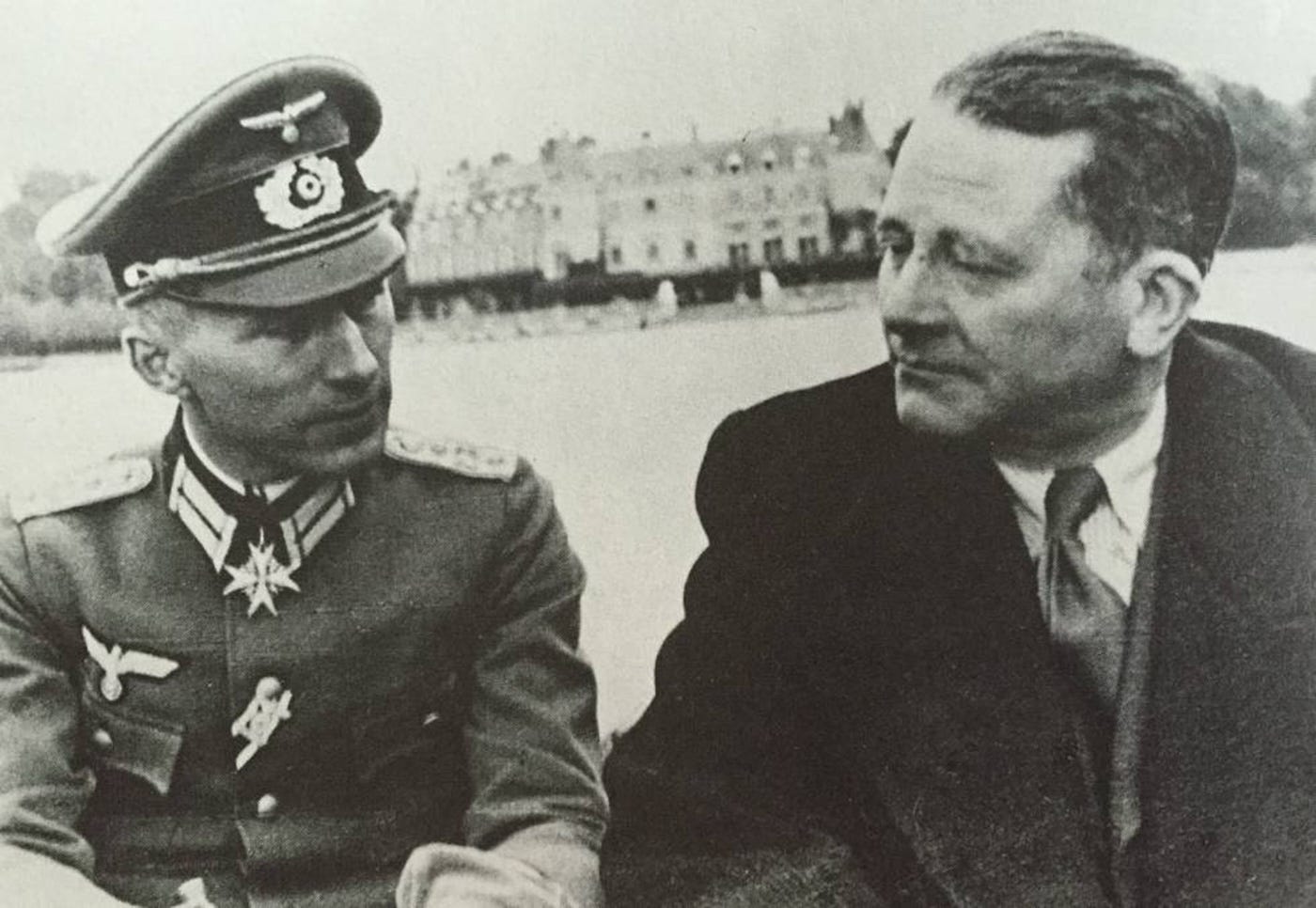
Carl Schmitt (R), Crown Jurist of the Third Reich
Peter Thiel and Sam Wolfe, I suggested in Part 1, like some new Paul and Silas team, seem to be pursuing an apostolic itinerary devoted to generating among Christians a greater sympathy for Thiel’s political and economic agenda. I am open to correction, since I don’t profess to know everything necessary to a full assessment. I do know a few things however, somewhat academic things, that may be of help to those wondering how an “obscure” passage in which Paul speaks of a restrainer or katechon came to be front page news. It’s not all Thiel’s doing. In our own itinerary we turn next to Carl Schmitt, the man who provided the modern template for those with katechonic aspirations.
Schmitt was an admirer of Thomas Hobbes, who looked for peace in the midst of civil war and found it, theoretically, in a new vision of sovereignty. Three centuries later, situated between world wars, Schmitt looked for order in the midst of the Weimar chaos and found it in the same place. He began to think of the sovereign both as a divinely established bulwark against chaos—nothing new there—and also as a cure for the disease he called “eschatological paralysis;” that is, for the fear that puts an end to meaningful political action.
The Roman Empire had served thus in its day, argued Schmitt. The Holy Roman Empire had performed the same service in the mediaeval era. The Third Reich could do so in the modern era, in which a more radical cure was demanded. Everything must now be brought under the aegis of the state, and the state under the aegis of the party, and the party under the aegis of a person. So he lent his support to Hitler’s National Socialism and became its foremost political theorist.
After the war, Schmitt neither retracted nor repented, though by then the whole world had been choked with blood and Germany had collapsed into rubble. His putative restrainer had proved indistinguishable from an antichristic hegemon, and in its wake had come more war, not peace and security. Yet with remarkable stubbornness he still insisted in 1950 that “belief that a restrainer holds back the end of the world provides the only bridge between an eschatological paralysis of all human effort and so great historical power as that of the Christian Empire of the Germanic kings.”
“I believe in the katechon,” he said, but what exactly did he believe about the katechon? In chapter eight of Alexander Dugin and the Future of Russia, Dustin Byrd observes that Schmitt—whose project Dugin has taken up on behalf of Russian empire—had been collecting materials “on the problem of the κατέχων or κατέχον” from the early 1930s, describing this as “the most important question” of his political theology. Byrd’s evaluation is worth noting:
Unlike the Christian theologians before him, who understood an individual, institution, or even the Holy Spirit to be the divinely appointed delayer of the apocalypse, Schmitt accelerates the process—already started by John Calvin’s own depersonalized interpretation of the katechon—to divorce the concept from a divinely appointed position in the singular, [attaching it instead] to a ‘metahistorical’ force in the plural, one that structures the dialectic of history within each epoch.1
Schmitt’s katechon, in other words, is a political abstraction with a complex set of historic instantiations. There are restrainers for every era, as in Joachim there are antichrists for every era. Distinguishing them can be difficult, however. They might even include figures such as Hitler or Putin, the sort of man who can specify the enemy and so determine the friend, which according to Schmitt is the truest work of the sovereign: a work that justifies his suspension of the rule of law and the substitution of his own word as law.
But just here a basic problem appears. One man’s restrainer is another man’s antichrist. And the reason for this fluidity is that the standard of measurement—Christ himself—is nowhere in view. Where that is the case, abstraction reigns, something Vladimir Solovyov pointed out in War, Progress, and the End of History, with its concluding “Short Tale of Antichrist.”2 Even good and evil become ideational and programmatic, disconnected from moral choices inherent in particular acts. Killing a Jew, for example, because he is a Jew, becomes thinkable.3
Now, we must not mistake Schmitt’s talk of a katechon, or of eschatological paralysis, for a reopening of the bureau of eschatology shuttered by the Ritschlians towards the end of the nineteenth century. That is the very thing not being allowed to happen. Warding off chaos and catastrophe may be a moral or military or political act, but it is not per se an eschatological act. It is not supposed to bring about the end, but to prevent it. Neither does it require any serious consideration of last things in their biblical frame of reference. It is an exercise in political theology, not biblical theology.
It was Schmitt’s colleague and friend in Bonn, Erik Peterson, who wanted to reinvigorate eschatology and to close instead the bureau of political theology that for two centuries had done brisk business in Germany. Peterson knew what went on there. It was a place, as Karl Barth said, for drafting God into the service of the national cause; that is, for justifying a political course of action through the retooling of biblical language and a transfer of divine sovereignty into human hands.
In “Monotheism as a Political Problem” (1935), Peterson argued that “the doctrine of the divine monarchy was bound to founder on the trinitarian dogma, and the interpretation of the pax Augusta on Christian eschatology.” The kind of unity in which the church believes entails (to interpolate a phrase from the Pseudo-Dionysius) an “elevation, and conversion, and communion, and union” with the tri-personed God. It cannot be used to justify empire. It can lend no comfort to architects of a Reich. Trinitarianism puts paid to “every ‘political theology’ that misuses the Christian proclamation for the justification of a political situation.” That kind could only exist “on the basis of Judaism and paganism.” A footnote credited Schmitt with reintroducing it.
Though a quiet rebuke, a sharper is difficult to imagine. It was a full decade after Peterson’s death in 1960 that Schmitt’s retort appeared, delayed no doubt by the latter’s disgrace in the post-war period. In previous works, Schmitt had argued that a modern understanding of the state rests on the secularization of theological concepts. Reprising that argument in Political Theology II, he upped the ante, insisting that theology and political theory are but two sides of the same coin, and that trinitarianism had re-minted nothing.
Only it was not so. Trinitarianism was not and is not the theology of professors or politicians, but of pastors and saints and martyrs. It was and is the theology of liturgy and sacrament, the theology of baptism, both by water and by blood. The martyr in particular, as Peterson attests in “Witness to the Truth” (1937), knows that all sovereignty belongs to God and his Christ; that human determinations about what is or is not lawful, or good, or necessary, cannot stand proxy for divine determinations; that resisting evil means obeying God rather than men and has nothing to do with fearing catastrophe or postponing the end.
The martyr, then, is himself a katechon, a restrainer of the mystery of lawlessness. Not by seeking to delay the end, but by seeking to arrive at the end. His soul, hidden under the heavenly altar as his bones are hidden under the earthly, cries out: “How long, O Lord, how long?” And his blood, as Tertullian said, is to the church like seed.
The martyr is not the katechon, however, the one of whom Paul speaks and we shall speak. We will not press on to Paul, however, without speaking first of Giorgio Agamben. For if Thiel’s debt to Schmitt is evident in his own confusion of politics and theology—in his misuse of the Christian proclamation “for the justification of a political situation”—he has also a debt to Agamben.
Agamben is not only an eminent contemporary philosopher, but a serious reader of Paul. Like Peterson, he is a critic of Schmitt’s belief that 2 Thessalonians 2 can be used to build a Christian doctrine of power. But Agamben has a surprise for us. The katechon is not a friend, but an enemy. That is why Paul says it must be “taken out of the way.”4
I can sense your incredulity. “What? Does the katechon not resist lawlessness with law?” Yes, it does, but that’s the problem. For according to Paul the messianic achievement (Agamben likes that sort of language) is to render law inoperative. Conversely, the katechon’s achievement is to obscure the fact that law is inoperative and that worldly powers can no longer save us.
In the form of institutions such as church or state, the katechon purports to save us by accruing all the old power of law to itself. It claims sovereignty over us, restricting both our freedom and our responsibility. When it pretends to a certain modesty, restraining itself, it does so only to deceive, to keep the game going. On Agamben’s view, all concretions of power are idols that prevent men from recognizing their true situation. A katechon is, in that sense, already an antichrist.5
Agamben has another surprise as well. He reserves his harshest criticism, not for Schmitt, but for Peterson. He directs it at the same target chosen by Barth. Barth and Peterson had been colleagues and friends at Göttingen in the early twenties, but developed differences after the latter’s conversion to Catholicism in 1933. These differences were principally in the fields of angelology and ecclesiology, where Barth (who was en route to a purely ethical view of the sacraments) lost all patience with Peterson. Peterson wanted a liturgically rich view of the church that did not suit his protestant palate. It does not suit Agamben’s palate either.
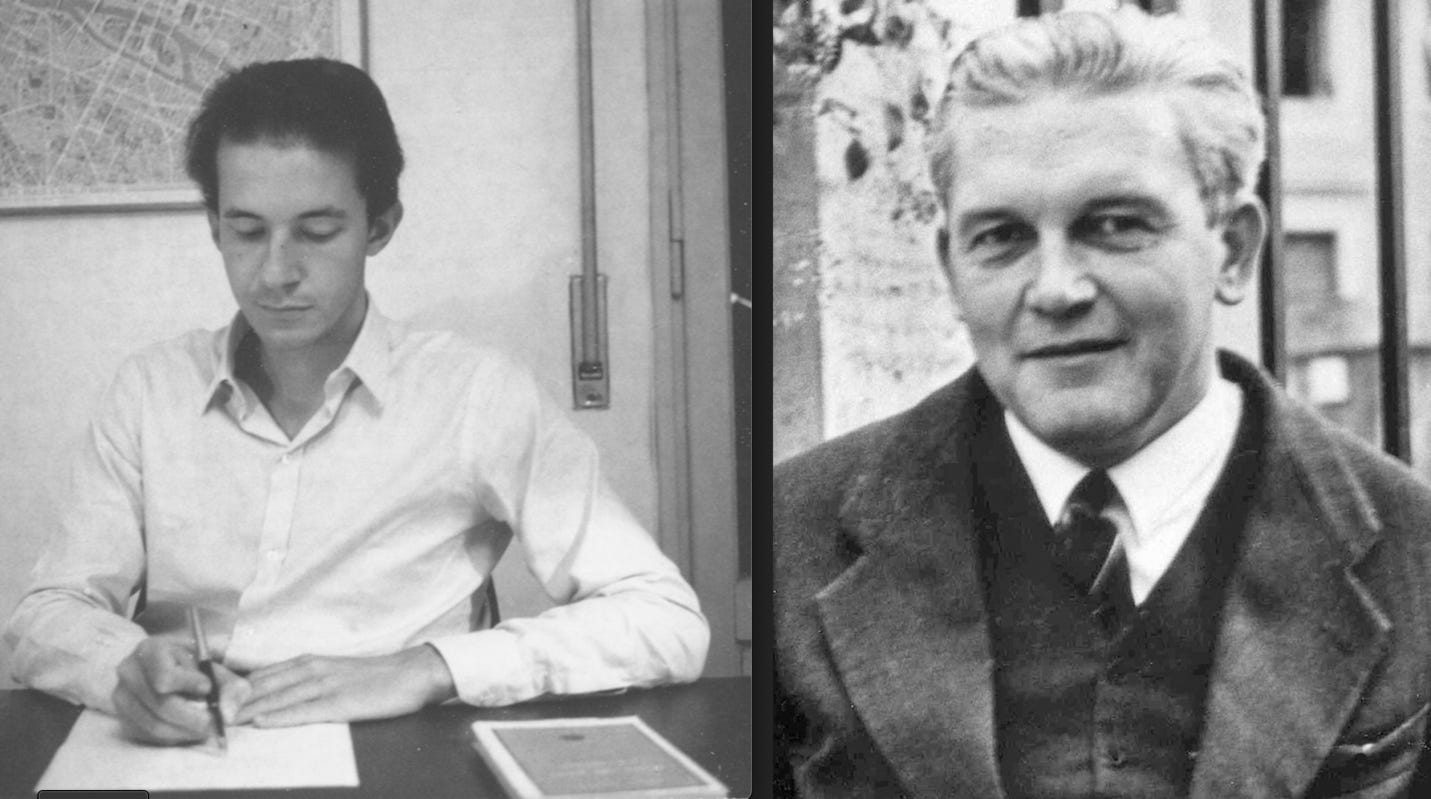
Agamben in younger days (L) and Peterson (R)
Peterson’s ideas were set out in his “Book on the Angels,” which appeared in the same year as “Monotheism as a Political Problem.” Barth attacked the one, but not the other. Agamben’s The Kingdom and the Glory (2007) attacks both. It is a dazzling lexical tour designed to blow up the whole package.6 On Agamben’s reading of 2 Thess. 2:9, Paul is warning us that the mysterium iniquitatis is the working of Satan in every power, not (as in most translations) “with all power.” But Peterson, by repristinating the liturgical world view of Pseudo-Dionysius, propagates nothing if not a theology of power. He does not, as he claims, shake the dust of Schmitt’s political theology off his sandals; politics and theology are again conflated by way of a doctrine of sovereignty. Peterson is lauding power politics by proxy, having dressed them in ecclesiastical garb. He, too, is shilling for the Führerstaat.
Agamben, like Barth, is outraged by Peterson, or by the man he mistakes for Peterson. Agamben wants to recover Paul, who insists that every power has been disarmed by Christ. Peterson has been trying to re-arm them; this must be stopped. It is not with any Dionysian theology of glory that the eschatological bureau is to be unlocked and reopened. The key that must be used is Paul’s doctrine of the deactivation of worldly dominions and authorities, whether angelic or human. Even “God,” from whom they purport to derive their sovereignty, must be deactivated, for it is only in hell that he continues to lend them support as instruments of punishment.7 And how do we escape this hell? By a deliberate profanation of the sacred. We must take back for our own use and enjoyment what they have falsely taken from us.8
Well, you say, I don’t know what this means or what it might have to do with Thiel. Let’s start with what it means. In the chapter of Kingdom and Glory entitled “Angelology and Bureaucracy,” Agamben insists that “the theologia gloriae is what we might call a blank page in the arguments of the theologians.” It dazzles the eye because it is empty. By way of a doctrine of resurrection and ascension, it projects into eternity the very hierarchy of power that Christ leveled to the ground when he was lifted up on the cross. It is not merely katechonic but antichristic to try to raise it up again.
That is not quite what Peterson is doing, of course. Agamben thinks he is doing it, just as he thinks Dionysius wrote his Celestial Hierarchies primarily to exalt the clerical hierarchy, because that is how things inevitably look to one who has imprisoned himself, as Agamben has, in the immanent frame—that frame in which God is not distinct from the world, but with the world has a bright and a dark side, “angel” being a cipher for the former and “demon” for the latter. The dark side, he complains to Peterson, cannot simply be expunged.
Which is certainly true. Hence the cross. Hence the martyr who witnesses to the cross and, just so, to the true glory he seeks. The secret of the martyr is “Christ in you, the hope of glory.” The secret of Agamben’s theologia grammatica, if I may say so, is that a blank page is the only kind of page there is, once we turn past the page on which is writ the terrible truth that “the idea of eternal government (which is the paradigm of modern politics) is truly infernal.”9
Sergei Prozorov applauds Agamben’s “bracing” insight that the world is neither perfectible nor reparable. It cannot be transcended and it cannot be overcome. “A politics based on a messianic re-interpretation of 2 Thessalonians 2 is the very opposite of utopianism, promising no bright future but only the reappropriation of the existent.” In that reappropriation nothing changes but the realization that the world is “truly and fully ours.” We no longer find ourselves attending the empty throne of sacred powers, whether this-worldly or other-worldly. We cannot appeal to God or to the hosts of heaven, and we ought not appeal to that of which they are theological simulacra. And yet, says Prozorov, though “we can never go back on nihilism and its naturalization of history,” it does not follow “that the horizon of redemption itself is to be annulled.” We can redeem ourselves from the katechon by mobilizing against it “the vacuity of the eschaton itself,” which has no fixed content. We can live authentically by looking within ourselves, to our own free decisions, for what we will be and do, rather than to those who promise us, in exchange for obedience, a protection and redemption they cannot deliver.10
I admire Agamben both for his learning and for his tactical brilliance; for his courage also. Wherever Agamben goes, the wars of the katechon are fought in earnest.11 Moreover, I agree with him on certain practical matters. We ought to recover the distinction between natural and positive law, hence also between legitimacy and mere legality. We ought to recognize that the idea of endless governance that pervades modern politics is infernal. The ceaseless hum of bureaucratic providence to which we are today exposed is surely a foretaste of hell. Yet Agamben, on my view, is fighting on the wrong side. It is immanentism that has deprived us of the very distinctions whose loss he laments. And whatever is to be said of Peterson’s antidote to Schmitt, Agamben’s own antidote (to judge by Prozorov) only deepens the difficulty. The politics of profanation is also theurgic; it seeks to conjure power, albeit a different sort of power, through the manipulation of ideas and images.
This is not the place to expand on that, save by an illustration, which I will provide in just a moment. But if it is true, as Prozorov claims, that we can never go back on nihilism, must we not admit that nihilism itself has become a katechon? Whether, with Hobbes and Schmitt, we regard the katechonic function positively—as the lesser evil of an all-powerful sovereign that postpones the greater evil of political chaos—or, with Agamben, we regard it negatively—as the greater evil of propping up a false hope that postpones the lesser evil of realizing there is no hope—do we not propound a counsel of despair? Putting a brave face on it is all fine and well, but men must live in hope or not at all.
Now, how are we to situate Thiel in all this? Thiel would seem rather to counsel faith and hope, or at least optimism. I can’t help but wonder, however, whether he too—perhaps he especially—is pursuing the politics of profanation.
Thiel has noticed that Agamben has tried to enlist Benedict XVI in his own cause, a daring tactic indeed. In the current issue of First Things, Thiel and Wolfe have lent their aid, proffering the flattering fiction (invented by others) that “only a Silent Generation thinker like Agamben even came close to understanding him.” They take up Agamben’s theory about the abdication, as propounded in The Mystery of Evil: Benedict XVI and the End of Days. And why not? If the future is truly and fully ours, surely the past also will submit. In any event, if they are to fulfill their apostolate to Christians, persuading them that there is an urgent need to go in search of the brave new world the espy in Thiel’s palantir, they require support from a recognized religious authority. Benedict will do nicely. He not only joined his recent predecessors in sounding an alarm about “the end of days,” he resigned his post as chief katechon.
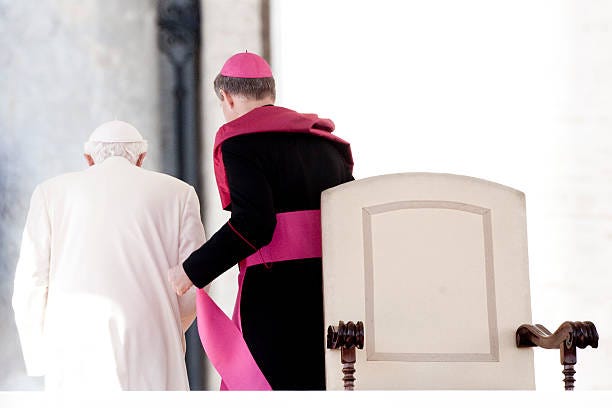
source
Benedict, they say, fell short of his duty. He was on the right path and did the right thing, but he did not ring the alarm as vigorously as he ought to have. He did not cry out in the streets of Rome that the end of the age is upon us. That, too, is a clever and daring tactic. Do not ask what he meant by the end of the age or why he thought it was closing in on us. Do not try to clarify your own vision of Christ or Antichrist or the work of a katechon. Just posit Benedict’s agreement and chide him for not being a little braver. Attribute this to the “philosophical reticence” of an academic. He was Bavarian, after all, not Italian.
I will suggest something still less original. Benedict did not want to repeat the mistake the Christians in Thessaloniki had made. He knew very well that the hour is late. He knew that the institutional church had become weak and deeply corrupt. He anticipated the humbling of the church and the shaking of the whole world. He felt the rumbling of a coming earthquake, perhaps even the earthquake to end all earthquakes. He had access to the Vatican’s equivalent of those super-sensitive detection devices, with their miles of underground cables, that operate in the Tuckaleechee Caverns. He knew the signals were dire. But he no longer knew how to exercise, or no longer felt the strength to exercise, his own role of restraining lawlessness in the church. So he resigned.
One may think, as I think, that he ought not to have resigned. One may think, as Agamben thinks, that it was a perceptive, even an heroic, gesture. One may contend, as Thiel contends, that the gesture should have been accompanied by a more forthright explanation. But one should not be deceived by Agamben, or by Thiel in his appeal to Agamben. Their talk of “the end of days” is not like that of Benedict, for it is not like that of Paul or of Jesus. It is a profanation.12
A common feature of katechon discourse in Schmitt, Agamben, and Thiel, as in that of almost everyone who makes recourse to them, is that the katechonic function passes over from restraint of the mysterium iniquitatis to delay of the end. That is not without precedent in the tradition, or altogether wanting for textual support. It is nonetheless a major mistake to let it slip by unremarked. 13
In Schmitt, who thinks delay of the end good, it makes possible a focus on political sovereignty and on his justification of the sovereign as the one who determines what iniquity is and what, under the circumstances, it is not. Otherwise put, “delay of the end” covers a multitude of sins by the sovereign.
In Agamben, who thinks delay of the end bad, it makes possible the reversal in which the katechon does an evil rather than a good work, not cooperating with Christ but contesting Christ. Agamben is the existentialist angel crying out, “This is ‘now-time.’ There shall be no more delay!”
In Thiel, as in both Schmitt and Agamben, it makes possible a sense of urgency and a demand for radical change. It also justifies profanation, a break in the biblical oeconomia through a rearrangement of symbolic values. For this break Benedict becomes poster boy, though Francis might have served better.
Here we ourselves must make no mistake, if we want to understand what the wars of the katechon are all about. This break, this rupture of complacency by means of symbolic shock, is the parousia. The Christian who means to imitate Benedict must turn from the eschatology of imminence—which in practice entails perpetual deferral of the end, since the Christ who is supposed to appear at the end never actually does appear—and embrace instead an eschatology of immediacy in which another “Christ” can appear: the better side of one’s self, say, the side prepared to act decisively in the moment to strike a blow for liberty, however construed.14
That may require liberation from the church. It may require pursuit of strange new possibilities, not only in biblical interpretation but also in manner of life, whether on the biological or the political level. For Thiel (though not for Agamben) these possibilities include things that accelerate the transhumanist program. Unless I have missed my guess, it is for the sake of that program that Thiel is battling, as Mattia Ferraresi puts it, “for the return of apocalyptic thinking, a profound shift in how we understand history, power, and the limits of human agency.”
Paolo Benanti is much closer to the truth when he accuses Thiel of operating with a concept of history that is “neither linear nor eschatological in the Christian sense,” hence with an imminence merely of the fin de cycle sort. Thiel is also operating, as he himself explained to Ross Douthat, with a concept of nature as intrinsically flawed. Which means, perforce, that he is operating with a vision of salvation as the overcoming of nature. Nature is not a katechon in the positive sense, holding us back from disaster. It is a katechon in the negative sense, delaying the realization of our christic potential.15
This is not a new course, then, but a going-round-again on the old course, with new bells and whistles. It is a resumption of the paganism Christianity always opposed. The approach is one that cannot accommodate biblical eschatology, which is both restorationist, hence not linear, and perfectibilist, hence not cyclical. The genuine novelty of the latter accounts for the fact that the biblical authors themselves frequently aim at symbolic shock; only they do so without violation of what Northrup Frye called “the biblical code.” They do so in support of the economy of salvation, not as an assault on it.
St Irenaeus knew all that; it is where he begins his great work, Against All Heresies. Benedict knew it also, though not perhaps as well. Thiel either does not know it or, like Agamben, does not want to know it. The latter trickster undoubtedly assumes a katechonic stance against Paul, professing to clarify the obscure but instead obscuring the clear, when he writes:
What interests the Apostle is not the last day, it is not the end of time, but the time of the end, the internal transformation of time that the messianic event has produced once and for all, and the consequent transformation of the life of the faithful.
Delightfully succinct in expression, diabolically ambiguous in meaning! Read it as you please, but confess that this opposition, this “not, not” of Agamben’s, is not Paul’s.16 Paul, without being any the less interested in internal transformation here and now, is very much interested in the last day as a future day of transformation both internal and external. The parousia he has ever in view is not one that can be hidden from view.
This is already plain in the final two chapters of the first letter to Thessaloniki, to say nothing of the first two chapters of the second letter. It is clear from the letter to Philippi, which he wrote soon afterward, telling his brethren that he was pressing on toward that day and warning them against false teachers who would divert them from it, depriving them of “the upward call of God in Christ Jesus.” It is clear also in his epistles to Corinth and to Rome, as in his correspondence with Timothy and Titus. We cannot treat all that, but we can treat one chapter of it: the chapter that exposes the “now!” tactic for the diversion it is. The reader may be glad to hear that there will be no more delay.
Part 3
Op. cit. 144. The phrase, “delayer of the apocalypse,” is one to which we will return.
“What is one to say of this singular figure?”, asks James Traub. “Perhaps the most remarkable thing about Schmitt’s work is its persistence. He was a reactionary, an antisemite, a fascist. He wrote with undisguised admiration for Joseph de Maistre and Louis de Bonald, Catholic monarchists who despised the Enlightenment and regarded man as irretrievably wretched. He thrilled—there’s no other word—at the irruption of popular fury through the ‘crust’ of rational life. He founded politics on the willingness to kill and die. And yet here we are, in the moment of Schmitt’s revival. Perhaps he was just too brilliant and inventive to disappear altogether.”
2 Thess. 2:7, as Agamben renders it. When in Part 1 we portrayed Thiel as an aspirant katechon, we were thinking of that role in a positive sense. Agamben wants us to think of it in a negative sense. That makes rather a puzzle of the fact that Thiel leans on Agamben in “The Pope and the Antichrist.” We’ll try to solve that puzzle shortly.
On Agamben’s scheme of things, as recapitulated in The Mystery of Evil (2017), the Anomos or Lawless One resembles the Christ, who by rendering law inoperative establishes “a zone of lawlessness” for him to inhabit. He is seen to resemble the Christ, whether cooperatively or uncooperatively, only as and when the Katechon—the church or the state or some other institutionalizing obstruction—is removed from the line of sight. This makes possible an authentic decision about him that the Katechon has slowed or delayed. Arguably, these three dramatis personae, as Agamben calls them, are really one, an undivided trinity in which “the very structure of time” is revealed, and the structure of the person as well, the question of whose freedom is thus raised and resolved. Agamben denies that his scheme is mere psychology. He claims that it is Pauline, and tries to ground it in the singular event of the crucifixion of Jesus, lest it float away into gnosticism. In my estimation, he fails.
“The Book on the Angels: Their Place and Meaning in the Liturgy” (1935), together with other works of Peterson I have mentioned, will be found in Theological Tractates, edited by Michael Hollerich, whose introduction should not be overlooked. Barth’s uncharacteristically intemperate response to the former is found in CD III.3 at §51.3.
See Kingdom and Glory, 162–64.
Recall David’s hungry soldiers consuming the sacred loaves from the Tabernacle. They are restoring what has been protected by sanctity to ordinary use and enjoyment, and it is not unfitting that they do so. They are not profaning for the sake of profanation. But where what has been sanctified is no longer holy, either because it has failed to be what it ought to be or because it is attempting to be what it ought not to be, then deliberate profanation is both fitting and necessary. See Agamben’s The Mystery of Evil, 37ff.
Kingdom and Glory, 164ff. Unlike Peterson, Agamben does not confess the resurrection and ascension of Jesus; therefore he cannot follow the same trajectory of hope.
Prozorov’s article is entitled “The Katechon in the Age of Biopolitical Nihilism.” Biopolitical nihilism is a type of nihilism that attempts, in the absence of eschatology, to achieve social and political order through restraints or controls that, in the name of protection, strip the person of his dignity and liberty. This is self-defeating, of course, for it only engenders more conflict. Agamben and Prozorov reintroduce eschatology as an antidote, but the eschatology in question is, as it must be, an anti-eschatology. (See again n. 5 above and my earlier essay, “Engaging Agamben on the Time that Remains.”)
For a blow struck from the other side, see Christoph Schmidt’s “The Return of the Katechon: Giorgio Agamben contra Erik Peterson.” Schmidt reminds us that, when the bureau of eschatology was closed, it wasn’t abandoned altogether. It was preserved as a museum adjacent to the bureau of political theology, providing on loan concepts such as the katechon. Agamben, he contends, became convinced that Peterson had appointed himself curator of its artifacts and was trying to put a stop to these loans; he accused Peterson of being a katechon and sought to replace him as curator. Schmidt reverses the charge.
The profanation is achieved by abstraction. Observe that the underlying constructs of Thiel and Agamben at first seem quite different, with conflicting symbolic values.
AGAMBEN: Christ (freedom) — Katechon (slavery) — Antichrist (return to freedom via ‘zone of lawlessness’)
THIEL: Antichrist (enslaving order) — Christ (chaos and disaster) — Katechon (freedom by escape from both)
What remains the same is that both gesture towards freedom only in symbolic terms, borrowed from Paul. That way substitutions can be made at the level of particulars.
For example, Agamben in Mystery of Evil, 9f.: “The katechōn, who restrains the end, has by contrast been identified by the Fathers with two opposed powers: the Roman Empire and the Church itself” (italics added).
You ready yourself for this if you learn with “Benedict” to see the church as Tyconius saw it: as a bipartite body having a celestial side and an infernal side, an angelic side and a demonic side, locked in perpetual combat. If you also see the world that way—the church being a mirror of the world—you can be as Christ to the world. Agamben notes that, unlike Tyconius, Augustine did not posit two opposing sides to the church but posited rather two opposing cities, the church and the world. But that doesn’t suit Agamben, nor does it suit Thiel, for both are immanentists. Everything has a celestial and an infernal side.
Here is the passage in full (Mystery of Evil, 13f.), which answers well enough to Schmitt’s worry about “eschatological paralysis,” but, as so often, makes Paul say only what Agamben wants him to say:
It is an integral part of the sense of last things that they should guide and orient action in penultimate things. Paul, who always refers to messianic time with the expression ho nyn kairos, the ‘now-time,’ never stops reminding us of this, admonishing the Thessalonians not to be disturbed by the immanence of the parousia. What interests the Apostle is not the last day, it is not the end of time, but the time of the end, the internal transformation of time that the messianic event has produced once and for all, and the consequent transformation of the life of the faithful. The mysterium iniquitatis of the Second Epistle to the Thessalonians is not a supratemporal enigma, whose sole sense is that of putting an end to the history and economy of salvation: it is a historical drama (mystērion in Greek means ‘dramatic action’), which is underway in every instant, so to speak, and in which the destiny of humanity, the salvation or fall of human beings, is always at stake.
In the second sentence, note the use of “immanence” rather than “imminence;” in the final sentence, note the phrase “underway in every instant.” Later he says, while criticizing (not unjustly) the paralysis of the church, that “the eschaton, the last day, coincides with the present” (38). And it does, in fact, but only sacramentally. In Agamben the whole business is existential, not eucharistic.
© D. B. Farrow 2026
No posts
Comments
Nothing yet. Say the first thing.
Sign in to join the conversation.