
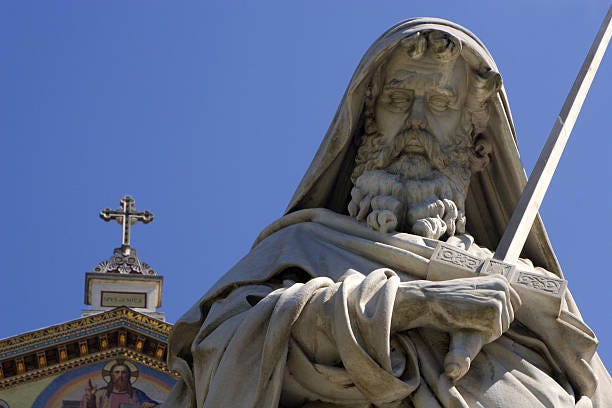
Basilica of St Paul Outside the Walls (C4)
Read Part 1 and Part 2.
In The Kingdom and the Glory Giorgio Agamben reminds us that Ernst Troeltsch put down the “mainly closed” state of the eschatological bureau to the fact that “the thoughts that constitute its foundations have lost their roots.” I would say rather that the men thinking thus have lost their roots. At all events, the re-opening of that bureau through contemporary katechon and antichrist discourse, including Agamben’s, has been on some other foundation than Paul’s.
I will go even further. At the end of his days, the late David Cayley (may he rest in the peace of Christ) wrote an article entitled “The Apocalypse Has Begun: Ivan Illich and René Girard on Anti-Christ.” In it he records Girard’s observation that the posture of modernity is one of criticizing Christianity with Christianity, while failing to acknowledge the source of the critique. This, says Girard, yields an odd sort of imitatio that is “at the same time a total betrayal.” And so it is here. Though Paul is acknowledged, Paul is betrayed. His katechon, his restrainer, is made over into something quite different from the one he has in view.
We come at last, then, to Paul himself, to learn what he actually says in the second chapter of 2 Thessalonians, which Sergei Prozorov describes as “one of the most intensely political texts in the Western tradition.” The description is apt, so long as we understand that the foundation of Paul’s own thought is to be found in the prophets of the Old Testament and in the teaching of Jesus in the Olivet Discourse. And that Paul’s thinking throughout is christological—that it follows from the confession of Jesus as messiah and Lord. Paul is not doing politics for politics’ sake. He is explaining to his converts things that belong to what he later calls “the whole counsel of God.”1
To grasp his explanation, we need to understand at least a little about the two letters to Thessaloniki. In my Brazos commentary I have tried to help with that. Here I can offer only the barest sketch of his argument in the chapter in question, after setting the stage by highlighting several errors commonly made in the reading of it. Having corrected these errors in the process of exposition, I will conclude, not with some new speculation about the katechon, but with a word of encouragement to those who have not altogether lost their roots.
The Thessalonian letters do not appear anywhere near the beginning of the New Testament. They appear exactly midway among its twenty-seven books. But 1 Thessalonians is almost certainly the first extant piece of Christian writing. It was written circa AD 50, pursuant to the aborted mission of Paul and Silas to Thessaloniki, an important provincial capital in the Roman empire. Acts includes a brief account of their visit, which ended abruptly after mob violence was stirred up against them. They were, it was said, men who had been “turning the world upside down” by proclaiming a king other than Caesar.
The charge was true, after a fashion; the violence was uncalled for, if one troubled to understand the fashion. They had made their entrance into Thessaloniki as ambassadors of a foreign king, yes, whom they called Kyrios Iēsous. And they came with a sword, though they came in peace, the sword they bore being no ordinary sword. It was the sword that St John would later see, in the opening vision of the Apocalypse, protruding from the mouth of Jesus.
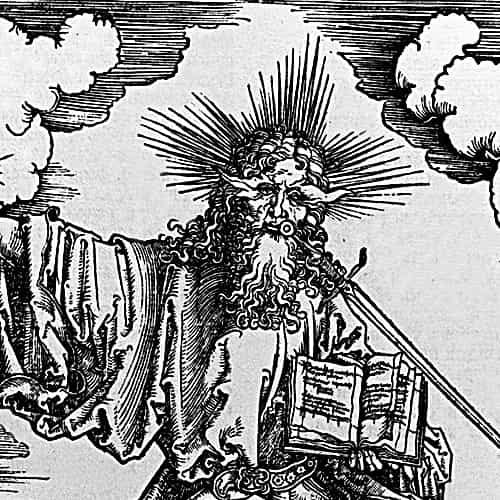
Dürer
This sword divided Jew from Jew and gentile from gentile, while uniting Jew and gentile on the one side and on the other. Only one side was violent, and it wasn’t their side. But when violence broke out, Paul and Silas went on their way promptly, so as not to provoke further violence. Concerned for the converts they had left behind, they wrote, perhaps from Corinth, a letter to instruct them further in their new faith and to encourage them to stand firm despite the persecution they were suffering.
In that letter Paul speaks about the nature of Christian hope, insisting that it is a hope—nay, a promise—even for their dead. He speaks of the day on which Kyrios Iēsous will make his parousia or royal appearance, the day on which the dead will rise, and all will receive their just reward. He urges them meanwhile to carry out their duty as soldiers of Christ and citizens of his coming kingdom, which will put the world right side up. They are to live as people of hope, sharing the gospel of hope. The trio of virtues that we call the theological virtues sings in the opening lines of this letter for the very first time: “We give thanks to God always for you all, constantly mentioning you in our prayers, remembering before our God and Father your work of faith and labor of love and steadfastness of hope in our Lord Jesus Christ.”
Shortly afterward, however, someone began agitating that it was now-time; that Christ was coming and there would be no more delay. Imminence was made over into immediacy, the readiness of the Judge into man’s readiness for judgment. So Paul wrote again, explaining that this was nonsense, to which they must pay no attention. There would be some delay, for which there was very good reason. The delay was not really delay at all but rather the proper outworking of God’s plan.2
In the first chapter of this second letter, Paul underscores the justice of God in permitting a time of suffering in which doing one’s duty may be very difficult. He makes clear that those who have done their duty will not be deprived of their reward and that the wicked will not escape judgment. Even Caesar, when visiting a subject city, divides between the loyal and the disloyal, meting out justice, however imperfectly. Would man’s true Lord do less? And would he not render, unlike Caesar, a true and perfect judgment?
The apostles, says Paul, have been boasting of the Thessalonians’ endurance in the tribulations to which they were appointed. That endurance would count as evidence on the day of the royal visit, the day of “the disclosure of the Lord Jesus from heaven with his mighty angels in flaming fire, meting out vengeance on those refusing to recognize God and to obey the gospel of our Lord Jesus.” These, he soberly declares, “will suffer the penalty due them—eternal destruction, banishment from before the face of the Lord and from the splendour of his might, when he comes on that day to be magnified among his holy ones and to be marveled at among all who have believed.”3
In the second chapter, Paul goes on to explain the plan of God for the times in which we live. This was something he had begun explaining during his mission to their city, but would now finish explaining, if only in broad outline. It is this outline we need to see, if we hope to understand his talk of a restrainer or katechōn.
I mentioned mistakes on the reader’s part that make seeing difficult. The main mistakes are these:
The first is to assume that when Paul speaks in verse six of to katechon, and in verse seven of ho katechōn, he is speaking of the same thing, that these terms have the same referent. This creates much confusion, lending itself to the second error.
The second we identified already at the end of Part 2. It is the habit of saying that the restrainer, ho katechōn, delays the end, as if delaying the end were his goal or object.
The third is to suppose that apocalypsis—a word that, like parousia, appears three times in this short chapter—refers to something catastrophic, rather than to something being clearly revealed for what it actually is, so that justice may be done and be seen to be done.
The fourth is to forget that Paul is always and everywhere expounding scripture, not inventing clever ideas as if he himself were merely a political philosopher.
The fifth is to overlook the fact that he is writing pastorally, and that his pastoral purpose is neither to dampen nor to excite his readers’ eschatological enthusiasm, but rather to channel it properly, so as to cultivate another virtue—the virtue of patience.
These five lead to a sixth, in which the others are recapitulated. To let Prozorov speak for the majority, “since the notion of the katechon does not occur anywhere else in the Scripture, the interpretation of this passage remains somewhat ambiguous.” We ought to concede neither the prodosis nor the apodosis in that sentence, which together allow for all manner of diversionary tactics. For the restrainer does appear elsewhere in scripture, and the text is not ambiguous in its main points.
We may concede, however, that the text is somewhat cryptic in composition, given the circumstances under which it was written. Its reader must bear in mind that he is joining a conversation already in progress: a conversation that began in person, continued in a first letter, and is being extended in a second. Its translator will have to acknowledge that translation already entails interpretation. The translation I will offer here comes with minor modifications to what appears in my commentary.
Here is the first paragraph, in which is rebuffed “now-time” speculation of the kind then current in Thessaloniki, and in which is also predicted an extreme version of what in Part 2 we dubbed the politics of profanation:
But we beg you, brethren, with respect to the parousia of our Lord Jesus Christ and our assembling around him, that you not quickly be shaken from your senses or disturbed, whether by spirit or by word or by letter, supposedly from us, purporting that the day of the Lord has come. Let no one by any means deceive you, for it shall not come unless the apostasy comes first and the man of lawlessness, the son of destruction, is himself disclosed—the one adopting an adversarial stance and exalting himself against everything said to be deity or an object of reverence, even to seating himself in the temple of God as if he were God. Do you not remember that while I was with you I was telling you these things?
Note the eucharistic allusion in the opening sentence. The parousia of Jesus, his royal visitation, is that to which every formal assembly of his people points. It is that which is anticipated when the gathered church joins decorously the unceasing liturgy of the angels: Holy, holy, holy, Lord God of hosts! Heaven and earth are full of Thy glory! Hosanna in the highest! When it takes up the words that rang in Jesus’ ears on his way to the cross, the words he said he must hear again from the lips of God’s people, with sincerity, before he would manifest himself a second time: Blessed is He that cometh in the Name of the Lord! Hosanna in the highest! It is an orderly assembly in the Spirit, under apostolic authority, to make this eucharistic acclamation that constitutes the company of the baptized as an ekklēsia, an embassy or outpost of the divine kingdom of light and joy among the dominions of darkness and woe that men have made for themselves.4
Taking a few liberties, we may paraphrase as follows Paul’s advice to those who gathered thus in Thessaloniki, who would have heard his letter read to them in that very setting: “Please, brethren, remain calm. There is, in the plan of God, a great deal yet to happen before our final gathering to our Lord at his coming in glory. Recall the widespread apostasy of which he warned, as I told you. We are not so far along as that; indeed, our mission has barely begun. As for the revelation of that man of sin who will betray the Son of Man with a kiss before the whole world—that too has still to happen. It is not yet time, then, for those momentous events of which I wrote in my previous letter. It is not time for the parousia of our Lord, for the resurrection of the dead, for the great assize. We know you are suffering and waiting eagerly for deliverance from the hand of those who hate you. But the day of the Lord is not yet. You must persevere.”
Building on the foundation laid in the previous chapter, where he has argued the justice of God in permitting the trials they are undergoing, Paul takes his argument further in the second paragraph, which I translate thus:5
And now you see the reason for delay [to katechon]: that he [the man who seats himself in God’s place] should be revealed in his own proper time. The mystery of lawlessness is already at work, to be sure, but there is one presently restraining it [ho katechōn] until he withdraws from the fray [heōs ek mesou genētai]. Only then will the lawless one [ho anomos] be revealed, the one whom the Lord Jesus will destroy with the breath of his mouth, whom he will bring down by the display of his own parousia—that one whose parousia is according to the working of Satan, with all demonic power and with false signs and wonders and with every wicked deceit, [a parousia] suited to those who are perishing for want of love of the truth, which they did not receive that it might save them. For this very reason God sends upon them a deluding influence, that they might credit the lie, so that through it they should be judged—all those who have not believed in the truth but have instead taken pleasure in unrighteousness.
This rendering avoids the first two errors. To katechon does not refer to the restrainer. It refers to the delay of judgment, the delay that requires patience on the part of the faithful.6 The Lord is ready even now to come in judgment. (That is what we mean when saying that his coming is imminent.) He will not do so immediately, however, for other things must happen first. The gospel must go out to all the world, that the man who is to be saved may be ready for salvation and that the man who is to be judged may be ripe for judgment. Both objectives require time; neither the city of God nor the city of man is built in a day. It is the latter objective on which Paul focuses here. It is not easy for man to seat himself in the place of God, not in such a way as to deceive the whole world. The world must first be readied for that.
Ho katechōn (not neuter but masculine, not impersonal but personal) does refer to the restrainer. It refers to the one holding back the forces at work in the advancing mystery of lawlessness so that they do not, pro tempore, do all the damage they otherwise would. Were they not restrained, they would run amok, and the whole plan be frustrated. The man who perfects lawlessness, the man on whom the perfect wrath of God is to fall, would never appear. But he must appear. The restrainer does not restrain so that he should never appear, but so that he should appear in his proper time.7
The mystery of lawlessness arises already in the garden of Eden, with the appearance of the serpent. It percolates throughout the world until the day of judgment. Before the day of judgment a last champion of lawlessness emerges to do the serpent’s bidding. Okay, you say, but surely all this lies in the realm of symbol or myth. Paul, I respond, is not thinking only symbolically or mythologically. He is also thinking historically and christologically. He is thinking of what Jesus said on the Mount of Olives and of what became of him in the garden there. Just as Judas stepped forward in the dusk enveloping Gethsemane, at the head of a band of soldiers and riot police, another like him will stand forth in the dusk enveloping the whole world at the end of the age. Once again, his disciples will flee away naked, if they are able to flee at all. For that one shall work a similar iniquity, on a vast scale, causing the ranks of the martyrs to swell mightily.
No doubt the one in question, the lawless one we call antichrist, will seem for a time the very embodiment of ambiguity, but it is through his appearance that all ambiguity will be resolved. For God will expose him for what he actually is. He will be unmasked by God, and the mystery of lawlessness unmasked with him. Catastrophes there will be, but his apocalypsis will be no catastrophe. For only when it has happened will the messiah himself step forward, not to accept a kiss and to suffer a second time, but rather to destroy him with the sword of his mouth. He will issue the command to strike, the command he did not issue when he told Peter to put up his sword.
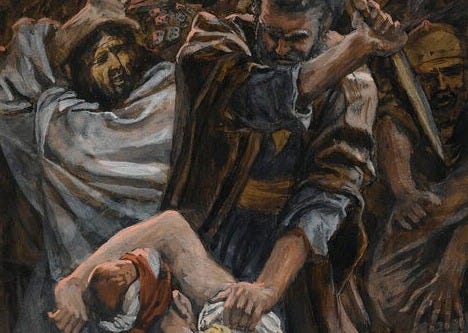
Tissot
The striking will be done by the katechon. We’ll come to that, but we must speak first of this business about the anomos seating himself, Caiaphas-like, in the temple of God.
The book of Ezekiel, priest and prophet, opens with a stupendous vision of the glorious throne of God, and of “one like a son of man” seated upon it. It is in the light of this vision that Ezekiel is sent forth to announce the doom of Jerusalem and of Solomon’s temple. With “a sharp sword” he testifies that the city’s fate is sealed, for the reform under Josiah has come to naught. The law of God is ignored and lawlessness has gone about as far as it can go. The people of God, who were to receive the dominion Adam lost when he was expelled from Eden, have instead become like the Canaanites. The measure of their iniquity is full.
In the eighth chapter, Ezekiel receives another vision. He is lifted up between heaven and earth and brought to the temple, which is full of idols, and to “the seat of the image of jealousy, which provokes to jealousy.”8 He is asked: “Son of man, do you see what they are doing, the great abominations that the house of Israel are committing here, to drive me far from my sanctuary? ”
And he brought me to the door of the court; and when I looked, behold, there was a hole in the wall. Then said he to me, “Son of man, dig in the wall”; and when I dug in the wall, lo, there was a door. And he said to me, “Go in, and see the vile abominations that they are committing here.” So I went in and saw; and there, portrayed upon the wall round about, were all kinds of creeping things, and loathsome beasts, and all the idols of the house of Israel. And before them stood seventy men of the elders of the house of Israel. . . Each had his censer in his hand, and the smoke of the cloud of incense went up. Then he said to me, “Son of man, have you seen what the elders of the house of Israel are doing in the dark, every man in his room of pictures? For they say, ‘The Lord does not see us, the Lord has forsaken the land.’” He said also to me, “You will see still greater abominations which they commit.”
The city and the temple are destroyed by the Babylonians shortly after this, during Ezekiel’s lifetime. He then prophesies a divine work of restoration in which his exiled people may hope, including a new temple impregnable to corruption. The themes of his prophecies are taken up after the exile by later prophets, including Daniel, and are still being pursued in the closing chapters of the Revelation to John.
What Paul has to say must be situated in the context of this tradition. He knows that Jesus displayed the same zeal for the sanctuary that God displays in Ezekiel 8. He knows that Daniel speaks, and Jesus with him, of an “abomination that brings desolation” by provoking God to wrath.9 He is fully aware that the mystery of lawlessness is a mystery that incites satanic jealousy of the house of God and the things of God; that it habitually seeks out the place where the law of God resides and God is worshiped, to ensconce itself precisely there.
If that sounds like something Tyconius would say, or Ivan Illich for that matter, so be it. Neither was altogether wrong, even if neither was altogether right. Dig in the wall of the temple, and there it is—the mystery of lawlessness. Paul, who on the road to Damascus himself experienced a vision like Ezekiel’s, did not expect this to change. He warned constantly of false teachers, of sexual predators, and of wolves that would not spare the flock. The coming of the messiah had guaranteed the collapse of the mystery of lawlessness and the demise of the man of lawlessness, but God had not yet done away with either. Rather he had made it possible for the mystery of lawlessness to be fulfilled, and for the man of lawlessness to take his seat in the house of God, not in hidden niches only, but openly and defiantly. Only then would final judgment would fall.10
God judges nothing before its time. There can be many preliminary judgments, but no question of a final judgment, until the full measure of iniquity is reached. It was so with the Canaanites. It was so with the Israelites. It will be so at the end of the age. The mystery of lawlessness must mature to the point where it produces the man of lawlessness: the sort of man whose lawlessness is cleverly disguised as law; the sort of man whose violence is called “peace and security” or “dying with dignity;” the sort of man who has so aligned himself with Satan that he wishes to be worshiped as God, and who insists that others fulfill his wishes, even in the very house of God.
You will ask me how lawlessness can mature. Lawlessness, after all, is nothing but the absence of law where law ought to be, or rather of obedience where obedience ought to be. There is no nature here, no good thing created by God with a view to its coming to maturity—apart from the agency of the agent himself, that is, which cannot come to maturity like that! Is lawlessness not self-destructive, a restrainer unto itself by virtue of its disastrous effects? My answer is that lawlessness matures—and this belongs to its mystery, though in its irrational rebellion against God, who is all good and deserving of all our love, it is already a mystery—as men, who long ago learned to pervert natural goods, learn to profane spiritual goods also. It matures as they learn first to profane the law, then to profane the gospel.
In hell the absence of a good is settled and final. In hell nothing changes; the fire of its loss is unquenchable. Where a good continues to be available, however, things can and do change. Men get better by receiving it or worse by rejecting it. If they reject, they always mimic reception, simulating the good in question, for they cannot escape the terms God has set in the giving of it.11 For their lawlessness, they require law; and for the perfection of their lawlessness they require the gospel, “the perfect law of liberty.” In simulation of the latter they resort to making and cancelling law at will. They render law itself arbitrary and irrational. Sometimes they multiply it to the point of absurdity. They live still in the sphere of law, but they lack liberty through the law, which becomes an instrument of oppression.
The gospel of the kingdom, let it be said, is like leaven that passes through the whole lump. It is a mystery capable of uniting a man in himself, and of uniting as one all who willing to be united. Conversely, it is capable of dividing a man against himself and of uniting in a counter-kingdom all who refuse the gospel. The lawlessness of those who reject the perfect law of liberty does not remain wholly negative. It gains the capacity to amount to something definitive and deserving of final judgment, to coalesce into a kingdom of lies from which will emerge an image of jealousy that provokes the divine wrath, an abomination that brings desolation.
This counter-kingdom God will utterly destroy in the hour of its completion. God will judge with an irrevocable judgment. For without this judgment of the lawless and their lawlessness, there can be no final salvation for the righteous and no adequate revelation of the glory of God to every creature. But the leavening takes time. And the restrainer restrains during that time, lest the loaf of lawlessness inflate too fast and too far, collapsing upon itself before all is accomplished.
Does the state not restrain also? In principle, yes; in practice, only where it respects natural law and conscience, working with rather than against those well-ordered social institutions that it exists to defend, exercising its mandate for justice with due modesty under God. But the state, like everything political, is a form of restraint always itself in need of restraint.12 And will the church provide what it needs, restraining the restrainer? Yes again, in principle; but in practice it may be too feeble, or have succumbed itself to corruption by the mystery of lawlessness. It has light to offer, but its lantern can be removed. It has salt to savour, but it can lose its savour. In any case, neither church nor state is the restrainer Paul has in mind. He is not speaking of institutions. He is speaking of one who restrains—of one who will continue to restrain until he is told to refrain from restraining, one who will then stand aside.
While the cryptic phrase, heōs ek mesou genētai, is variously translated, the viable options come to much the same thing. When the lump is fully leavened, the oven will be fired and the restrainer will step back. To revert to the military metaphor, he will withdraw from the fray and leave the field to the man of lawlessness.13 But who is this one who restrains without needing restraint and who obeys when told to refrain?
The answer to that question is not to be found in a statesman or pontiff. It is to be found in the passage to which Jesus alludes when he says: “So when you see the desolating sacrilege, spoken of by the prophet Daniel, standing in the holy place (let the reader understand), then let those who are in Judea flee to the mountains. . . For then there will be great tribulation, such as has not been from the beginning of the world until now; no, and never will be.”
Paul, who in his brief mission to Thessaloniki had already begun explaining this dominical warning to the church he founded there—why do pastors today fancy that their charges need not wrestle with it?—has the same passage in view. It is a passage in which Daniel, while recounting his visions of the end of the age, speaks of a great conflict and of unparalleled trouble.
At that time Michael, the great prince who has charge of your people, shall arise. And there shall be a time of trouble, such as never has been since there was a nation till that time; but at that time your people shall be delivered, every one whose name shall be found written in the book. And many of those who sleep in the dust of the earth shall awake, some to everlasting life, and some to shame and everlasting contempt. And those who are wise shall shine like the brightness of the firmament; and those who turn many to righteousness, like the stars for ever and ever. But you, Daniel, shut up the words, and seal the book, until the time of the end. Many shall run to and fro, and knowledge shall increase.
Mark well: knowledge shall increase—not wisdom, not virtue, not repentance and faith, just knowledge—in these voyages to the end of the world. But mark this also, for it will help you see here what Paul is seeing. At the end of the first sentence, where the Revised Standard Version has “shall arise,” we may read “shall stand aside.” As Colin Nicholl observes, the Hebrew word, like the Greek word with which the Septuagint translates it, can have either sense.14 In context, it has both senses. Michael will arise and remove himself. He will cease his work of restraining the enemies of God and his covenant with Israel. That is why there will a time of unparalleled trouble, a time of trouble for the nation of Israel and for the whole world.
In Daniel 10, the man speaking with Daniel in his visions, the man with the body like beryl and the face that flashes like lightning, tells him that Michael has come to help in the struggle with the prince of Persia and has been left there temporarily for that purpose. “There is no one with me,” he says, “who contends against these princes except Michael, your prince.”15 But in Daniel 12 we learn that Michael will not always contend. As protector of the covenant people, he prevents the mystery of lawlessness from breaking out into the open prematurely and crushing that people entirely. He performs his task faithfully, not only in the days of the exile but also in the days of the prince of Greece, and afterwards of Rome. But he will be instructed to decamp—to make a tactical withdrawal, so to say, permitting the lashing out of lawlessness at just the moment God wills. Then will be the parousia of the false messiah, of whom we have already heard in Daniel 7. His boastful tongue will lay claim to heaven and earth. His deluded disciples will hold the field. They will take his side against the faithful.
He shall speak words against the Most High,
and shall wear out the saints of the Most High,
and shall think to change the times and the law;
and they shall be given into his hand
for a time, two times, and half a time.
But the court shall sit in judgment,
and his dominion shall be taken away.
To whom will it be given? It will be given to the Son of Man, who will now be unveiled as well. Accompanied by Michael and his host, he will come openly to confront the false messiah, whose star, having risen slowly over centuries, has suddenly blinded the world with its dazzling light, such that men believe not what is written in the book of truth, but instead credit the lie being told them. They will be led to their doom by means of it.16 Then will appear from the true messiah, coming from the throne of God, and passing like lightning from east to west the promised judgment will fall. But deliverance will come to the faithful, who with joy will enter the kingdom that will have no end.
This vision passes from Daniel through Jesus to Paul, then on to John, who in the first chapter of the Apocalypse sees the same man who appears in Daniel 10 and hears from him the same message, which has on him the same effect as it had on Daniel. The man confirms the book of truth, from which none may add or subtract. John learns the man’s name, or rather he already knows it. It is the name of the one who holds the keys of death and Hades, the one in whom the faithful share “the persecution and the kingdom and the patient endurance”—the one whose Name is above every name, who sits on the throne of God not because he thought to seize it, but because God invited him to do so.
At the head of the hosts surrounding that throne, Michael has his place of honour. Paul is speaking of him. Michael did not restrain the prince of this world or the powers of the age that conspired to kill Jesus, for the lawlessness by which the Lord of Glory was crucified God had determined to turn to his saving purpose. But Michael has prevented those powers from eradicating every trace of Jesus, and will do so while the age lasts. At its end, however—so Daniel is informed—their power will grow and “the power of the holy people” will be shattered. Only when the latter are at the end of themselves will everything belonging to the mystery of God, as revealed to the prophets, be fulfilled.
The mystery of lawlessness will run its course when Michael withdraws.17 Yet Michael’s work is not done when he withdraws. There is still that awful business requiring the sharp sword of the katechon—the business of wreaking vengeance on those who refuse to acknowledge God and to obey the gospel of Jesus. When the command is issued by Jesus, Michael will strike and none will stay his arm.18
In the Apocalypse, John provides us with the final iteration of the vision, which contains two key moments of conflict. The first takes place in connection with the ascension of Jesus. “Now war arose in heaven, Michael and his angels fighting against the dragon; and the dragon and his angels fought back, but they were defeated, and there was no longer any place for them in heaven.” The second takes place in connection with the parousia of Jesus, as the victory in heaven is duplicated on earth. When the time comes for the decisive contest, the signal is given and the final battle is joined:
Then the angel whom I saw standing on the sea and the land raised his right hand to heaven and swore by him who lives forever and ever, who created heaven and what is in it, the earth and what is in it, and the sea and what is in it: “There will be no more delay, but in the days when the seventh angel is to blow his trumpet, the mystery of God will be fulfilled, as he announced to his servants the prophets.”
When this battle is done, the mystery of lawlessness will evaporate, like Barad-dûr in Tolkien’s great tale, and the work of restraint will be over. Those dreamers who, as Jude says, “defile the flesh, reject authority, and slander the glorious ones,” will be no more. Creation will be refounded on the terra firma of ceaseless praise to God, under a hierarchy of holiness. Agamben’s objection notwithstanding, that hierarchy will indeed “be a hymnology.” For the hymnic nature of all creation, directed in person by its Lord and leiturgos, shall be revealed in all its splendour and voiced in all its power and rejoiced in all its magnificence, unto ages of ages, world without end.19
The reader, I trust, is able now to see that all six errors have been addressed. Paul is not being coy about the katechon. He is appealing to an established figure in holy writ, of whom the Thessalonians have already heard, so as to strengthen their grasp of the times in which they live and their resolve to endure. But is that figure anything more than a figure? Is an “archangel” anything more than a dramatic representation of the divine word or will or power?
If books such as Ezekiel and Daniel were all we had to go on, that question might be difficult to answer. Apocalyptic literature views mundane history from the standpoint of heaven. In doing so, it must deploy figures and symbols that both reveal and conceal. Even in canonical works, it cannot be assumed that the named figures are actual agents, but neither can it be assumed that they are not. That judgment must be made book by book and vision by vision, on the settled assumption that the economy of creation and salvation comprises both men and angels.20
Suppose we put “Michael” down for a symbol rather than for a saint. Of what is he a symbol? Of God’s protective hand, perhaps. But will we also say, then, that in Gethsemane, when Jesus rebukes Peter by pointing out that his Father has placed legions of angels at his disposal, he is merely putting up the language of myth against the menace of the mob? Or that when he talks about angels gathering the elect from the four winds on the day of the world’s doom, he is speaking only figuratively? Who or what will gather them? Will they make their own way to that great assembly that will never disassemble? And what of the liturgy, which names Michael in a place of high honour alongside Mary and John the Baptist? What of Satan, for that matter, whom the baptized renounce? This whole line of thinking inevitably reduces biblical cosmology and angelology to symbolic psychology, collapsing into gnosticism.
St Peter warns against those who “are not afraid to revile the glorious ones.” For them everything is symbolic, hence nothing is truly sacred. Paul tells us that the gatherings of the church must be decorous just because of the angels. Neither apostle is writing in an apocalyptic genre. Both are writing pastoral letters urging us to wait patiently for the fulfillment of the promises of God. Both are fully confident that the coming of the Son of God, not in “the appearance of a man” but now as a man, has broken the biblical code and made plain what the prophets saw and understood only in figures. Things said to puzzle even the angels themselves can now be declared.
“I heard,” writes Daniel, “but I did not understand.” When he asks for understanding, he is told that the matters in question “are shut up and sealed until the time of the end.” Not so with Paul. When Paul asks for understanding, it is granted him, for the time of the end has already begun, though it has a long way to go. “I know a man in Christ,” he says to the Corinthians—ceding nothing to Ezekiel or Daniel when it comes to revelations—“who fourteen years ago was caught up to the third heaven . . . and heard things that cannot be uttered.”21 Paul does not try to utter them. But when he says in his second letter to the Thessalonians, “and now you see”—now you know the basic scheme of things and why it takes time to unfold—he is far from ignorant of that of which he speaks. And of Michael he has already spoken in his first letter:
Now we do not wish you ignorant, brethren, concerning those who sleep, lest you grieve for them as others grieve who have no hope. For if we believe that Jesus died and rose, so also we believe that God, through the same Jesus, will bring to life with him those who sleep. Indeed we assure you, by dominical promise, that we who live and remain until the parousia of the Lord shall certainly not precede those who have fallen asleep—that the Lord himself, with a mighty cry, with the voice of the archangel and with the sound of the trumpet of God, shall descend from heaven and the dead in Christ shall rise up first. Then we, the living who remain, shall together with them be caught up “with the clouds” so as to welcome the Lord in the air. And, just so, we shall ever be with the Lord. So comfort one another with these words.22
No, Michael cannot be reduced to a symbol. He is not merely a personification of some aspect or exercise of divine power. He is someone whom the people of God rightly venerate, someone to whom they can and do look for aid and comfort in their vocation to endure to the end, someone whose sword will be unsheathed in their defence before all is said and done. In doing so, they “appeal to another sphere of being,” as Solovyov puts it. Indeed, they know they must do so, for they know that evil is not something that will simply fade away of itself. Evil must be fought, and help is needed in the fight.23
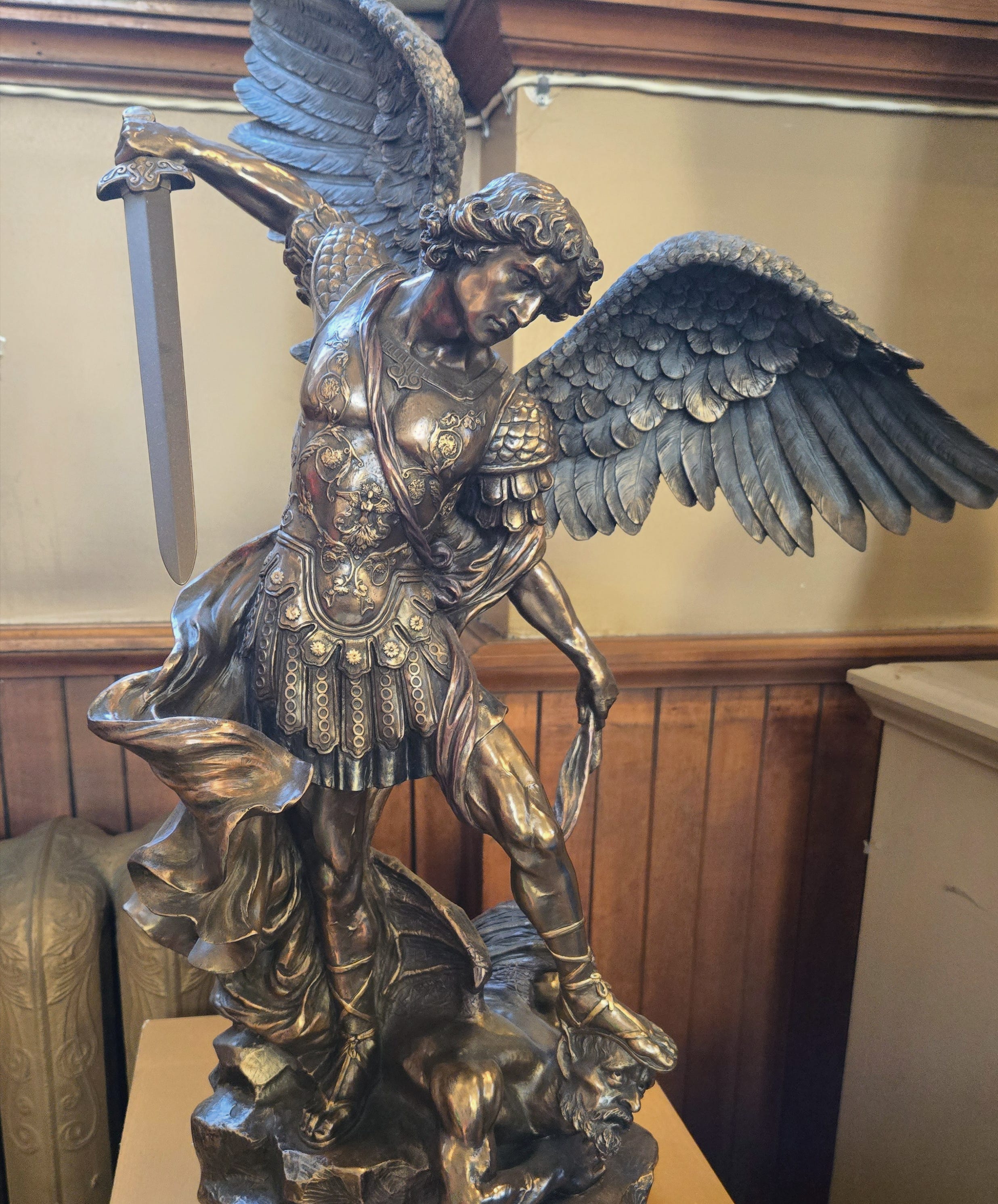
St. Michael the Archangel, defend us in battle!
Be our defence against the wickedness and snares of the Devil.
From the days of Pius IX, when consciousness of the percolating mystery of lawlessness began to grow and, with it, an uneasy feeling that the church’s situation in the world was again becoming precarious—that what Jesus called “the times of the gentiles” were drawing to a close and that matters still sealed were about to be unsealed—appeals for Michael’s help have been given special prominence among Christians.24 Such appeals are not attempts to delay the end but expressions of a desire to be properly prepared for the end. The one who seeks to delay the end has forgotten Peter’s counsel to hasten the end by living a life of holiness and godliness. Either that, or he belongs to those whose strategy is to deny that there will be an end.
By now, however, you may be thinking that my own strategy is to delay the end of this essay. I will bring it to an end by returning it to its beginning. For a very long while now, we moderns have been pursuing our Baconian course, seeking “the knowledge of causes, and secret motions of things, and the enlarging of the bounds of human empire, to the effecting of all things possible.” We have busied ourselves with experiments of every imaginable kind. We have even begun creating man–machine chimeras and other such marvels, with barely a moment’s moral reflection or consideration of the consequences. And still we are urged on to strange new possibilities, to be realized through some hitherto unknown tekhnē, thinking thereby to evade the Scylla of tyranny and the Charybdis of chaos. We are inundated daily with deceiving influences, flattered incessantly with the lie that we deserve to live as gods. Yet wickedness multiplies and the love of many grows cold.
Has the restrainer already received orders to decamp? Perhaps he has, or soon will. The moral and political madness by which we have been overcome, the chaos and corruption in the church, the slaughter of innocents and of innocence, the roiling of the sea of nations with hatred of Jews and Christians, all point to it. Yet we have not come to the end of days, even if we have come to the beginning of birthpangs. We still have work to do and we can still call on St Michael in support of that work. For if his decamping presages defeat, it is not the defeat of heaven it presages, but the defeat of hell.25
© D. B. Farrow 2026
That Paul did not yet have the Olivet Discourse in the form we have it—Matthew 24 and Luke 21—does not mean that he did not have it all. To read Paul without reference to Jesus is like reading the prophets without reference to Moses. Cf. Acts 20:17ff.
On questions of dating and authorship, consult my commentary. Suffice it here to say that the theory that 2 Thessalonians is a much later document, from another hand than Paul’s, is all of a piece with the theory this letter discredits; viz., that no one expected any delay, and that the fact of delay created a crisis among Christians that had to be covered up, a crisis eventually resolved by inventing “the church” as an institutional presence in the empire.
2 Thess. 1:9f. (translation mine)
Compare 1 Corinthians 10–14.
There are of course no paragraphs, nor indeed punctuation, in the original text. I have split the text between vv. 1–5 and 6–12.
The Greek is: καὶ νῦν τὸ κατέχον οἴδατε, “and now the delay you understand,” or “now you know the cause of delay,” the cause that is specified in the follow purpose clause: εἰς τὸ ἀποκαλυφθῆναι αὐτὸν ἐν τῷ ἑαυτοῦ καιρῷ, “that he should be revealed in his time.”
Agamben, in one of his several attempts at rendering the passage offers this: “And you know what is now restraining him, so that he may be revealed when the time comes. For the mystery of lawlessness [mystērion tēs anomias, which the Vulgate translates as mysterium iniquitatis] is already at work, but only until the one who now restrains it is removed. And then the lawless one [anomos, literally “the without-law”] will be revealed, whom the Lord Jesus will eliminate with the breath of his mouth, rendering him inoperative with the manifestation of his coming.” (The Mystery of Evil, 20) But this does not take account of the fact that the underlying verb, κατέχω, can mean either to restrain or to detain; that is, to delay. We should not read, “what is now restraining [him],” but “what is delaying [judgment].”
This image is not identified, but it signifies satanic jealousy of God and the demonic lusts of those defiling the house of God. In return, it provokes the zeal of God for that house, the house Solomon built for God’s glory.
While Ezekiel points to the profanation of the first temple, Daniel points to the profanation of the second by the Seleucid king, Antiochus IV Epiphanes, who slaughtered a pig on its altar and erected his own image in the likeness of Zeus (or Zeus’s image in the likeness of himself) within the temple courts. Antiochus also caused the people of God to profane themselves by abandoning the laws of Moses. This led to the Maccabaean revolt and to a purification of the temple, but also to a regime that another priest-turned-prophet, John the Baptist, would condemn as corrupt—the regime that, under Annas and Caiaphas, sat in judgment on Jesus for prophesying the temple’s demise.
“I will deal with them in wrath,” says God to Ezekiel, and the same promise is made by Jesus at his trial: “You will see the Son of Man sitting at the right hand of Power, and coming with the clouds of heaven.” Though this prophecy by Jesus pertains to the destruction of the second temple in AD 70, it also pertains to the destruction to come upon the world at the end of the age. With Mark 14:53–65, compare 1 Thess. 5 and 2 Thess. 1–2.
We may take the so-called “transwoman” as indicative of the type. He has decided that he, and not God, is maker of male and female, and he demands that others approve of the demonstration he offers. In some jurisdictions, one can be incarcerated for refusing to approve. An image of jealousy indeed, though not yet the image.
Contrary to common opinion, Augustine does not commit himself in The City of God (book 20) to the view that the state is the katechon, though he does say that it would not be a preposterous mistake to look to the state. Be that as it may, it would certainly be a precipitous mistake, for it would attribute to politics what politics cannot of itself deliver.
The qualifying clause can be attached instead to the man of lawlessness, so as to mean something like: “until the anomos steps forth into the open.” But that rendering would make no appreciable difference to the argument, for the whole point of the restrainer’s withdrawal is to make possible this very development.
See Nicholl, From Hope to Despair in Thessalonica; cf. Farrow, 1 & 2 Thessalonians, 252.
The vision was about “a great conflict,” and it concerned “days yet to come.” The great conflict would come at the end of a long course of conflict, already begun, the same course described by Jesus in Matthew 24 and Luke 21.
“Multitudes, multitudes, in the valley of decision!” (Joel 3:14). And before the decision to enter that valley, a decision about the promise being made and the one making it—one, who like Hananiah, makes the peoples “trust in a lie” (Jer. 28:15ff.).
See Dan. 12:5ff.; cf. Rev. 12:7ff. and Matt. 24:9ff. “Then they will deliver you up to tribulation, and put you to death; and you will be hated by all nations for my name’s sake. And many will fall away, and betray one another, and hate one another.”
The fate of Antiochus foreshadows this: “And at the latter end of their rule, when the transgressors have reached their full measure, a king of bold countenance, one who understands riddles, shall arise. His power shall be great, and he shall cause fearful destruction, and shall succeed in what he does, and destroy mighty men and the people of the saints. By his cunning he shall make deceit prosper under his hand, and in his own mind he shall magnify himself. Without warning he shall destroy many; and he shall even rise up against the Prince of princes; but, by no human hand, he shall be broken.” (Dan. 8: 23–25; cf. 2 Maccabees 9.)
See Rev. 10:1–7 and 20:7–14, together with the book’s final chapters.
God “has constituted the service of angels and of men in a wonderful order,” as the collect for the commemoration of the fourth-century Roman basilica named for St Michael observes.
1 Thess. 4:13–18; cf. Dan. 7:13f., where ‘clouds’ points to the hosts of heaven that attend the throne of God as the Son of Man receives his dominion.
The “vital question” we must answer, he says in his preface to War, Progress, and the End of History, is whether evil is only “a natural defect, an imperfection disappearing of itself with the growth of good,” or rather “a real power, possessing our world by means of temptations, so that for fighting it successfully assistance must be found in another sphere of being.” The book is a defence of the latter position, as is the present essay.
Though I am not aware that this is so among Jews, I see no reason why it shouldn’t be. Michael, after all, as Denys avers in Celestial Hierarchies 9—a text Agamben cites critically against Peterson’s theologia gloriae without recognizing its significance for debate about the identity of the katechon—was “named by the Word of God as archōn of the Jewish people.” Do pious Jews not pray to God Almighty, the Lord of Israel: “May Michael be at my right hand, Gabriel at my left hand, before me Raphael and behind me Uriel, and above me the divine presence of God”? If the church from Jews and gentiles also looks to Michael, it does so because men from every nation now share in the covenant goods Michael is sworn to protect.
Here is the conclusion to the chaplet approved by Pius in 1851:
O glorious prince St. Michael, chief and commander of the heavenly hosts, guardian of souls, vanquisher of rebel spirits, servant in the house of the Divine King and our admirable guide, you who shine with excellence and superhuman virtue deliver us from all evil, who turn to you with confidence and enable us by your gracious protection to serve God more and more faithfully every day.
Pray for us, O glorious St. Michael, Prince of the Church of Jesus Christ, that we may be made worthy of His promises.
Almighty and Everlasting God, Who, by a prodigy of goodness and a merciful desire for the salvation of all men, has appointed the most glorious Archangel St. Michael Prince of Your Church, make us worthy, we ask You, to be delivered from all our enemies, that none of them may harass us at the hour of death, but that we may be conducted by him into Your Presence. This we ask through the merits of Jesus Christ Our Lord. Amen.
No posts
Comments
Nothing yet. Say the first thing.
Sign in to join the conversation.