
My longer term subscribers might recall this post, where I wrote about my friend in ICU, and how she lived despite all odds.
Well, this week my friend Elinor dropped this phenomenal, part memoir, part history piece “The Art of Intensive Care” published by Wellcome Collection. She recounts that same near-fatal illness when severe pneumonia and sepsis led to respiratory failure, and her life saving treatment and care in intensive care, including ECMO an advanced life-support technology.
I wanted to highlight it to you, in case you’ve not seen it elsewhere. It is a beautiful testament to the role of ICU nurses and their clinical expertise, how they preserve the dignity and personhood of their patients through everyday acts. The article also traces the history that helped establish the model for the modern ICU which included the continuous observation of critically ill patients.
Despite my closeness to the person behind the story, it is (in the words of another mutual friend) “an incredible contribution to the care discourse” and important, I think, in a time when so many of us feel the opposite about healthcare. You don’t have to talk long with someone about their health and treatment to hear about the terrible neglect they have received from clinicians, who don’t seem to listen or care. Now, the reality is that they very much do care (few enter the medical profession to perform heartless hostility) but many are exhausted, burnt out, understaffed and under-resourced, working 12 hour shifts, and often without an appropriate break.
Amazing then, to gain this insight from Elinor—and to know that at the acute end of healthcare, at its most technological, in that liminal space of ICU where patients have little or no agency, the care given keeps the human at its centre.
Reading “The Art of Intensive Care”, I found myself returning to a phrase from my 2019 book-length poem Bettbehandlung, where I wrote:
biomedical personhood that is a mingling of existence & non existence
Take a look at this, my white board from 2018:
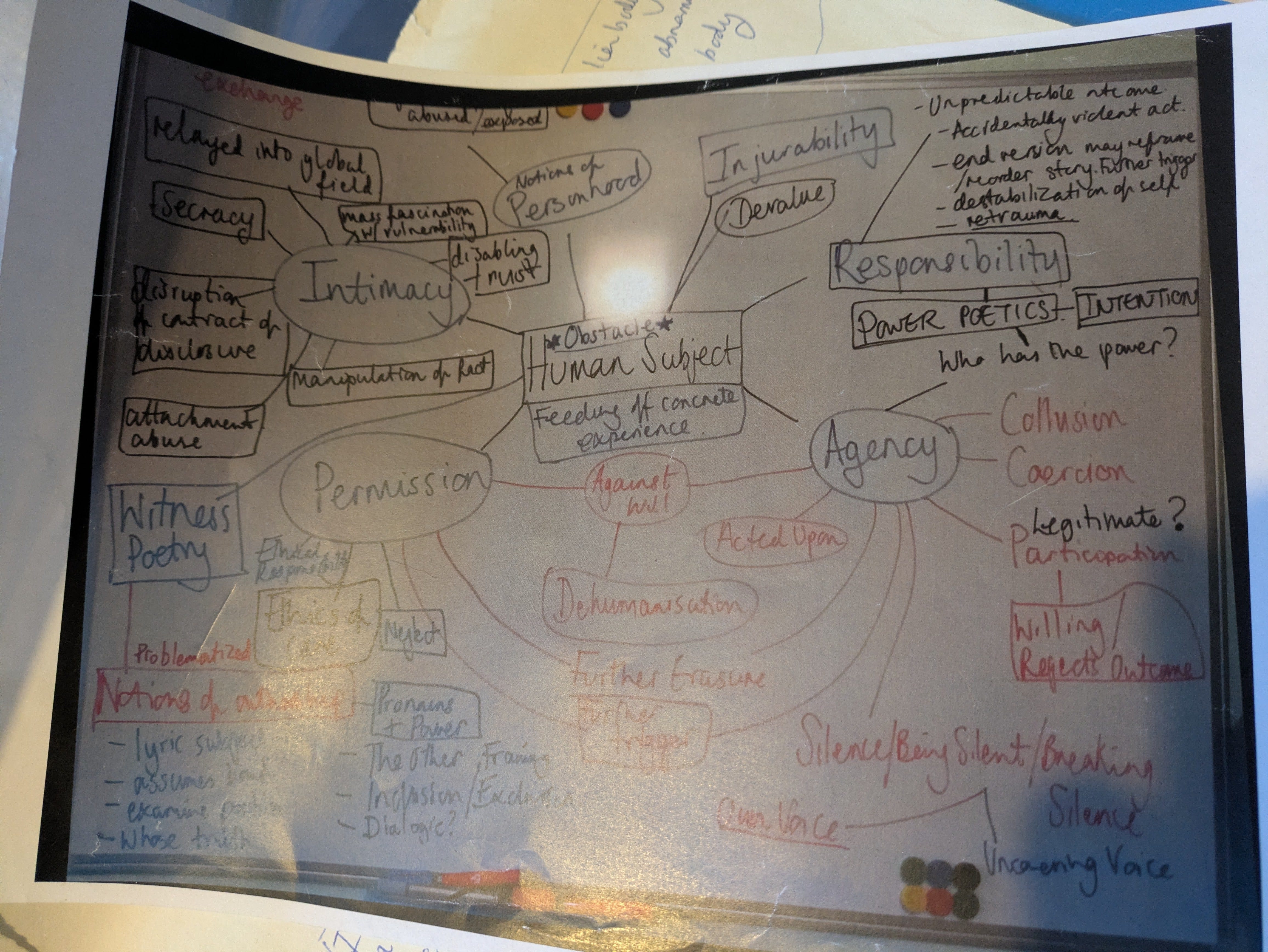
At the time, I was grappling with how it is to be suspended between selfhood and objecthood, feeling present and absent at once. I find myself now returning to those questions on agency, permission, human subject, personhood, injurability, witness, voice: what becomes of personhood when agency is lost? What does it mean to be a human subject when you are acted upon rather than acting? How is dignity preserved in the strange territory between voice and silence, presence and absence?
The answer Elinor’s essay offers is unexpectedly hopeful — good care refuses reduction. Personhood does not disappear in intensive care. It is carried, witnessed and protected by others.
Thank you for reading! Please have a read of this important and beautifully written essay: “The Art of Intensive Care” published by Wellcome Collection!
Comments
Nothing yet. Say the first thing.
Sign in to join the conversation.