
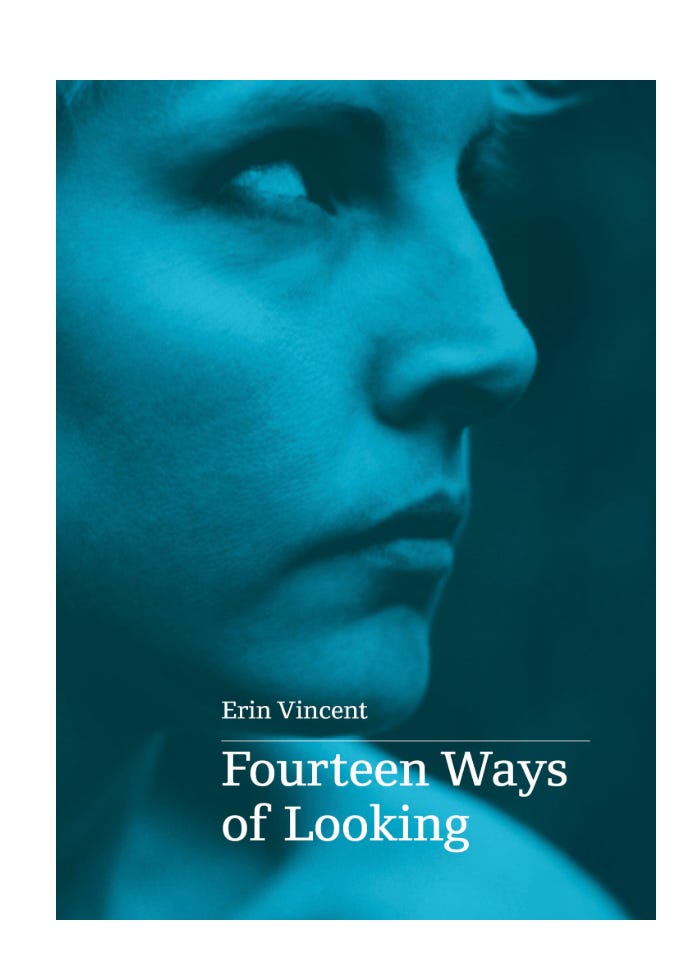
Last night I read 14 Ways of Looking by Erin Vincent, a series of vignettes tracing the many ways the number 14 echoes through her life following the death of her parents in the year she turned fourteen. In the aftermath of that loss, she begins noticing the number everywhere and leans into the pattern, gathering anecdotes about writers, philosophers, artists, and actors (to name a few) for whom the number 14 also carries some significance, whether as an age, a date, or a month tied to a formative event.
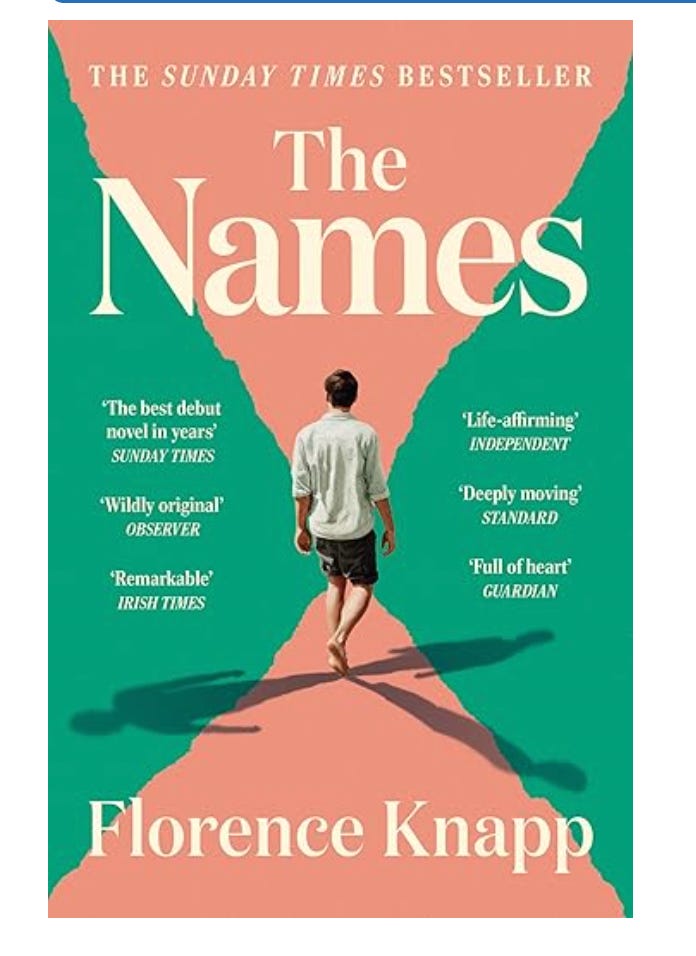
Another book I’ve been reading recently is The Names by Florence Knapp, which gives different versions of the same story, except each speculative plot line depends on the name the protagonist has given to her baby when at the registry office.
Then there is The Solution to Ben’s problem by Bonnie Jo Campbell. The numbered solutions present as escalating thought experiments which map the mental terrain of entrapment, rage, exhaustion, love, masculinity, addiction, and helplessness. Except every option (often given as an instruction) externalises an impulse that is morally, emotionally, or practically impossible, forming a psychological inventory. The “you” implicates the reader, universalises the experience and mimics intrusive cognition.
14 Ways of Looking, The Solution to Ben’s Problem and The Names all use a methodology of accumulation: Some are factual, others speculative, thought experiments, memories, and obsessive repetitions that circle the same idea from different angles.
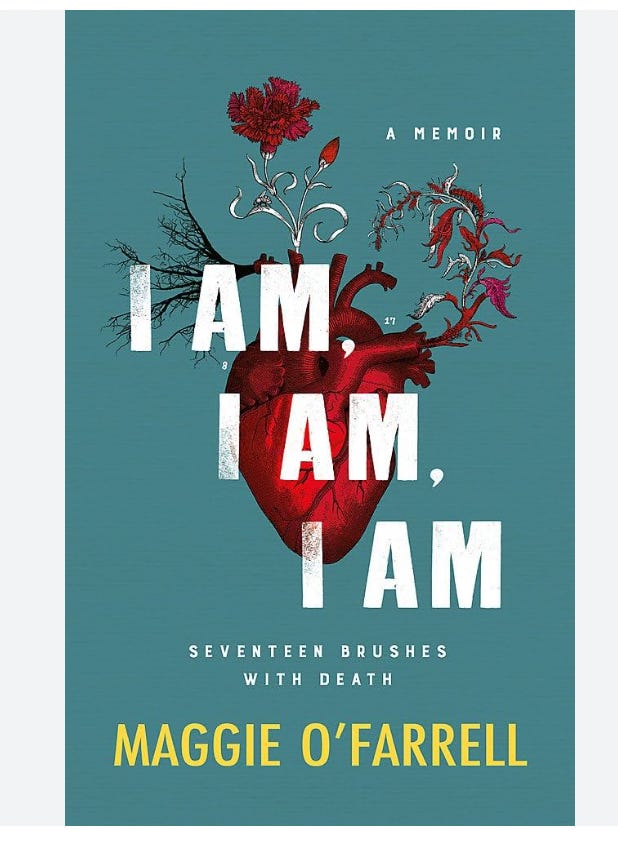
While writing this, I’m reminded of I am I am I am: Seventeen Brushes With Death (Maggie O’Farrell) which is memoir, but dedicated to documenting every instance where the author nearly died through illness, childbirth, accident or via more sinister encounters.
I’m also reminded of Model City by Donna Stonecipher, a work of 288 vignettes, with each beginning with ‘It was like… ’
It was like slowly becoming aware one winter that there are new buildings
going up all over your city, and then realizing that every single one of them
is a hotel.
*
It was like thinking about all those empty rooms at night, all those empty
rooms being built to hold an absence, as you lie in your bed at night, unable
to sleep.
*
It was like the feeling of falling through the ‘o’ in ‘hotel’ as you almost fall
asleep in your own bed, the bed that you own, caught at the last minute by
ownership, the ownership of your wide-awake self.
*
It was like giving in to your ownership of yourself and going to the window,
looking out at all the softly illuminated versions of the word ‘hotel’
announcing their shifting absences all over the city.
Again, accumulation and recurrence become the compositional method. Stonecipher builds meaning through repeated encounters with infrastructure, public language, architecture, transit systems, and urban planning. You might expect the repetition to become exhausting, but because after ‘It was like” she uses shifting gerunds e.g. “giving” “feeling” “thinking” “becoming” and then qualifies the nouns with philosophically precise, psychologically loaded modifiers (“wide-awake self” “shifting absences” “softly illuminated versions”). By doing so, she alters the emotional atmosphere of the text, making the city feel surreal and uncanny.
Of course, these methodologies are not identical. Some rely on accumulation and cataloguing, others on branching narratives, recursive hypotheticals, repetition, serial observation, or constraint-based variation. For example, in the texts I’ve spoken about:
14 Ways of Looking = numerological accumulation
The Names = branching narrative permutation
Ben’s Problem = hypothetical escalation
Model City = serial observational recurrence
I Am I Am I Am = thematic cataloguing
Thinking about methodology has also made me aware of how often it is a turning point in creative writing classrooms: it is usually one of the first moments a student begins thinking consciously about how a reader moves through a text. As the framework of a project becomes more attentive to visual structure or grouping by theme, device, repetition, or procedure, you can see students beginning to think more consciously about the reader’s experience and how meaning is shaped through form as much as content. And part of that lesson is that methodology helps generate rather than operating as an organisational device. Many writers use procedure not just to shape material but to discover material they could not access otherwise.
In my previous Substack post, Matt Bell’s An Index of How My Family Were Killed, I wrote that there is much to be learnt from techniques associated with methodological writing. I also tackled methodologies in this post, looking at the influence “How to Look at Mexican Highways” by Mónica De La Torre had on my last publication.
One of the things I love most about methodological writing is that feeling that I am in the writer’s hands: there is a sense that the work is being carefully held and shaped, even when it is fragmented or uncertain.
I also love that these methods are happening simultaneously in underground and alternative literary spaces, as well as in the work of major, well-established writers. Methodology, then, is a shared compositional impulse cutting across scale and prestige.
I suppose I’ve been thinking about all this because some of my own projects have recently felt a little directionless. I’ve been wondering how a methodology might function not only as a way of generating new ideas, but also as a kind of compositional discipline. Something that keeps me moving through a piece rather than abandoning it at the first moment of uncertainty or the familiar feeling of hmmm, I’m not sure where to go now…
Thank you, as always for subscribing and reading. This post is public, so feel free to share it on your social media accounts or send to anyone you think may be interested.
If you aren’t a paid subscriber, liking and sharing my content (if it speaks to you) is a small way of helping me continue writing these posts, and it helps me generate new audience.
Comments
Nothing yet. Say the first thing.
Sign in to join the conversation.