
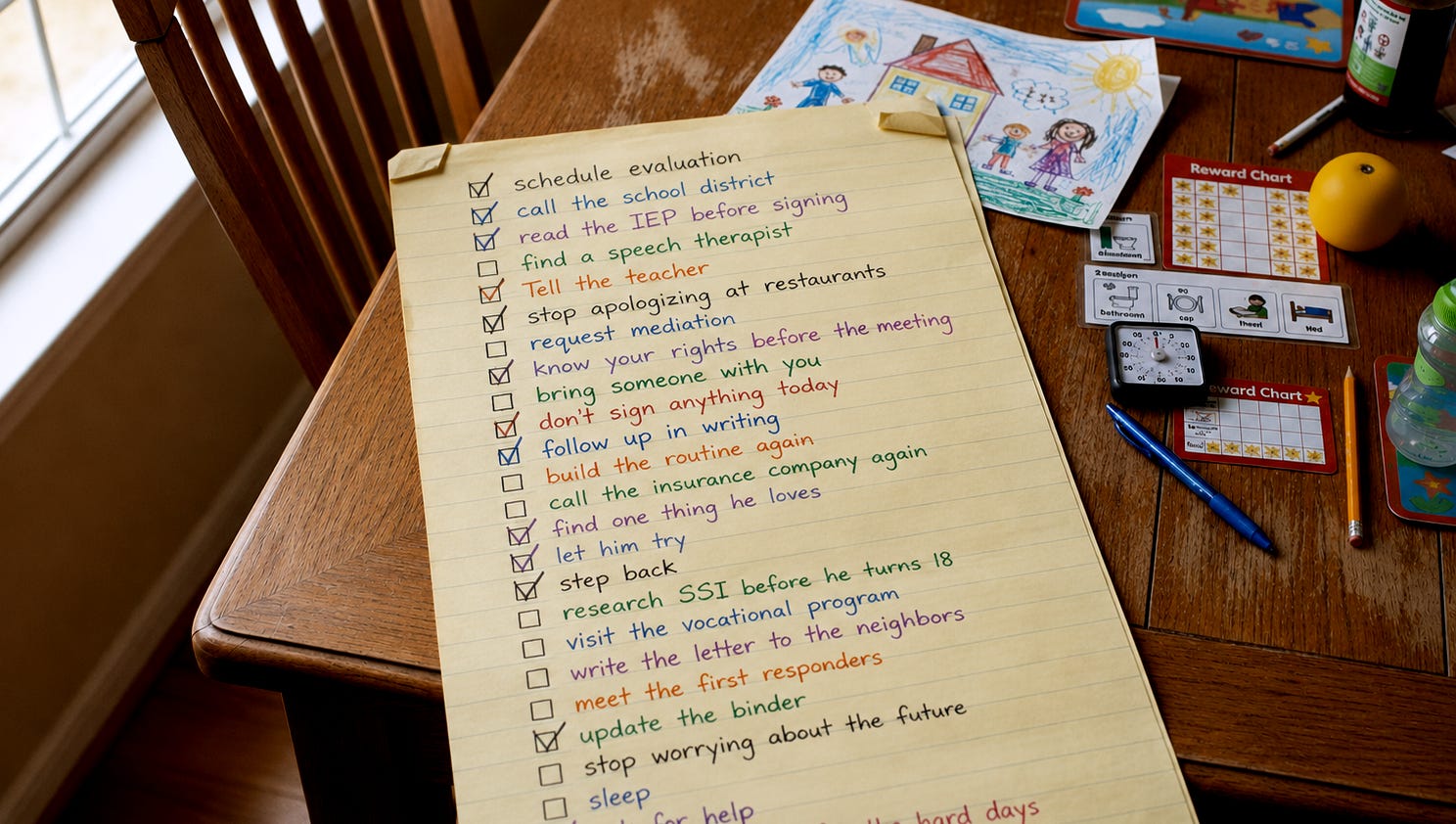
I have been writing about autism for eighteen years.
The blog started in 2007. Daily posts. Real life, unfiltered — the IEP battles, the waiting rooms, the victories nobody saw coming, the losses nobody warned me about. More than three million families have read it. The National Institutes of Health archived it as a permanent educational resource. Not because it was polished. Because it was true, and true was what families needed and couldn’t find anywhere else.
When I started writing, I believed something. I believed that if enough of us fought hard enough — locally, at the state level, in federal hearings, in every room that would let us in — things would be meaningfully better for the families coming behind us. Not perfect. Better. I testified. I co-founded organizations. I sat on boards. I delivered testimony that became policy. I built coalitions. I did everything I knew how to do, for as long as I knew how to do it, because I believed the arc was moving.
Nick is 28 now.
And I have to tell you the truth about what I see from here: with the exception of early standardized intervention programs — which are genuinely better, and that matters — families today are not better off. In many cases they are worse. The services that should exist don’t. The ones that do have waiting lists so long they become a different kind of no. Schools are still fighting families instead of funding what children need. The transition cliff is still there. The housing crisis for adults with disabilities is not improving. The caregiving workforce is collapsing.
I did not expect to arrive at this moment devastated. I expected to arrive here relieved.
I am not relieved.
That devastation — and I am going to call it what it is — is part of why I am writing a book. Because the systems didn’t fix themselves the way I believed they would. Because twenty-seven years of advocacy produced real change in some places and almost none in others. Because families are still reaching out to me every single day with the same questions I was asking in 2000, in the same state of confusion and fear and isolation that I was in, and I cannot keep telling them to wait for something better to arrive.
Something better is not arriving on its own.
So I built what I could build right now. A free guide. Twelve chapters. A bonus chapter. Structured, practical, toolkit-driven — delivered in the time it actually takes to need it, which is not someday. It is today. It is the week after the diagnosis. It is the morning before the IEP meeting you don’t know how to walk into. It is right now.
That is how this series was born. Not as a plan. As a response to families who could not wait — and neither could I.
What this series covered. And what you missed if you weren’t here.
This is not a summary. It is an accounting. Because if you found this post first and haven’t read the chapters, you need to know what is waiting for you — and why each piece of it was built.
Chapter 1 — The Diagnosis: The Blueprint You Didn’t Know You Built. The moment the future you had been quietly constructing gets replaced by one you don’t recognize. Not what autism is in a clinical sense — but what it feels like to hear it for the first time, in a fluorescent-lit office, with a child who is nineteen months old and a prescription pad between you and the rest of your life. I told you what I thought in that moment. What I got wrong. What I would tell myself if I could walk back into that room. Every parent who has ever been handed a diagnosis needs this chapter. It was written for the drive home afterward.
Chapter 2 — Grief, Identity & Letting Go of the Blueprint. The grief that doesn’t look like grief. The dangerous comfort of academics — the way I clung to test scores because they made me feel like I belonged with other mothers in a world that was rapidly separating from mine. The night I finally understood the long horizon. This chapter is about the identity shift that nobody puts in the pamphlet.
Chapter 3 — Executive Function & Cognitive Regulation. What executive function actually controls — and why the meltdown you witnessed this morning is not a behavior problem. It is a neurological one. This chapter gives you the language to stop personalizing what is not personal, and the tools to start building systems that work with your child’s brain instead of against it.
Chapter 4 — Understanding the IEP Without Fear. The IEP is not a favor. It is a legal document. And the moment you walk into that room not knowing that, you have already lost ground. This chapter covers the mediation that changed everything I knew about my own rights — the principal who didn’t know the law, the turning point, and exactly what you have at that table that they are counting on you not to know.
Chapter 5 — Avoiding Learned Helplessness. The subtle slide from support into limitation. The difference between “he won’t” and “he can’t” — and why that distinction is the most important one you will make in your child’s education. High expectations are not cruel. Lowering them is.
Chapter 6 — Letting Go of Parental Overprotection. The pool I didn’t buy. The illusion of control. The first time I stepped back and what it cost me to do it. Independence requires risk calibration — not the elimination of risk, which is not possible, but the honest evaluation of which risks build a future and which fears are mine to carry, not his.
Chapter 7 — What Is Autism? How to Explain It to Others. “But isn’t he too smart to be autistic?” “He just needs more discipline.” “Isn’t everyone a little autistic?” This chapter is about the conversations you will have for the rest of your life — with strangers, with family, with people who mean well and do damage anyway. It gives you the language to correct without exhausting yourself, and to protect your child’s dignity in rooms where it is under quiet assault.
Chapter 8 — Ignorance Hurts: Advocacy, Bias & Social Reality. This is the chapter I had to write and the one that will be hardest to read. Because this guide does not pretend that every family navigates this system from the same starting point. When racism and ableism collide — in the classroom, in the IEP room, in every institutional setting where someone looks at your Black or brown child and makes a calculation — the stakes are not the same. The bias is not the same. And the advocacy required is not the same. This chapter names what too many guides leave out: that the room your child is standing in is not a neutral room, and preparation means knowing that before you walk in.
Chapter 9 — Puberty: Boundaries, Safety & Raising a Man. The shift no one warns you about. The aggression nights. The race reality — what it means to be raising a Black man with autism in a country that has already decided who he is before he opens his mouth. The safety planning that has to happen before anything goes wrong, because after is too late.
Chapter 10 — Adulthood & Transition: The Cliff No One Tells You About. The diploma ends services. Most parents don’t know this until it happens. This chapter covers the entitlement cliff, guardianship, SSI, housing, employment, and the hardest planning of all — what happens when you are no longer here. I did not write this chapter to frighten you. I wrote it because not writing it would be a betrayal of every family who lost ground they didn’t know they had.
Chapter 11 — Education Track Strategy: Diploma, Certificate & The Strategic Window. The decision that shapes everything that comes after it — and that most families make without understanding what they are deciding. The age 22 rule. What a certificate of completion is, and is not. The strategic window that closes quietly while you are focused on something else.
Chapter 12 — The Glass Child: Supporting the Sibling Without Pretending It’s Equal. The sibling who was there the whole time. Transparent, present, and in too many families — unseen. This chapter is about the child who learned to need less because the need beside them was so much louder. The imbalance love couldn’t fix. The grief that doesn’t get named because it isn’t the diagnosis. The explosion that finally came when my eldest was 31 — “I HATE HIM. HE RUINED MY LIFE. EVERYTHING IS ALWAYS ABOUT NICK.” And what I said back, because there was nothing to say that made it untrue.
If you have a sibling in your home right now who has gone quiet — who asks for less, who guards the door, who says “it’s okay, Mom” before you’ve finished the sentence — this chapter was written for them. And for you.
The Bonus Chapter — Be Afraid, Be Very Afraid: Raising a Black or Brown Man with Autism in America. The chapter I almost didn’t write. The one that required me to go somewhere I had been avoiding. Because some of what I have watched happen to families who look like mine cannot be explained by disability alone. And silence about that — in a guide that claims to prepare you — would be its own kind of lie.
What you told me across this series.
These are not testimonials. They are evidence that this work reached the people it was built for.
“I shared it with a friend who has a son that is autistic. He agreed with you and said that he and his wife are having issues regarding how much help is too much. I know it gave him a lot to think about.”
“How do you put all of this into words? These are the things I want and need to say but they are all scrambled inside me. You are so clear.”
“Donna, thank you always for your insightful information. I too have these moments of anxiety when I think about Chris’s future. He’ll be 56 this year and I am 82 now.”
“Thanks, Donna. I used to weep silently when I read those annual holiday letters — friends talking about kids going off to college. Now it’s grandkids. My friends brag about their grandkids never realizing how hurtful this can be. I will never have grandkids. But I have a wonderful son who tries hard to be a good person. I love him for who he is.”
That last one. Read it again.
She is 82 years old. Her son is 56. She is still in this fight. Still reading. Still trying to do right by him. If you think this work has an expiration date — if you think there is a point at which the preparation stops mattering — read that comment one more time.
There is no finish line. There is only doing it as well as you can, for as long as you are here.
Where we are now.
Nick is twenty-eight. He volunteers at the Los Angeles Zoo three days a week. He rides horses twice a week. He has a paid job. He takes piano and art lessons. He laughs with his whole body. He is surrounded by people who know his name — neighbors, first responders, colleagues — people I introduced him to deliberately, before anything could happen that would require them to decide who he was in a moment of fear or confusion.
He did not get into the vocational school where a principal decided his ceiling was a government check. He got somewhere better, through a longer and harder road.
He has never had an encounter with law enforcement.
I do not believe that is luck. I believe it is the accumulated weight of twenty-seven years of deliberate preparation — the binder, the visit to the police station when he was six, the neighborhood letter, the forty-hours-a-week fight, the IEP battles, every phone call I made from every parking lot where someone had just said no.
Preparation is not pessimism. It is the highest form of love.
If you are at the beginning.
Start with Chapter 1. Not because it is first, but because it is the chapter about the moment the blueprint shifts — when the future you had been holding in your mind gets replaced by one you don’t recognize yet. Every parent who has ever been handed a diagnosis in a fluorescent-lit room needs that chapter. It was written for the drive home afterward. For the floor you may end up sitting on that night. For the moment before you know what to do next.
Then read them in order. They build the way the journey builds — diagnosis to testing to services to school to adolescence to adulthood. Each chapter stands on its own. Together, they are the guide I needed when I was you.
The series is complete. The book it will become is called Autism Day by Day: A Parent’s Guide to Advocacy, Independence, and Adulthood. It will contain everything in these pages and more — expanded chapters, full memoir, complete toolkits, worksheets, appendices, resources organized by state. It is coming.
But this guide exists because families could not wait. Because every day that the book is still being written, someone is sitting in that fluorescent-lit office, or in that parking lot, or on that floor. And they needed something in their hands right now.
This is that something.
If this series found you at the right moment — forward this post to the parent who is sitting in the waiting room today. Not as information. As company.
And if you are not yet subscribed, this is where to start. Twenty-seven years of lived experience. No filters. No inspiration. Just the map I had to build myself, handed directly to you.
— Donna | Autism Day by Day
No posts
Comments
Nothing yet. Say the first thing.
Sign in to join the conversation.