
Jump straight to the guidebook?
He does not know. That is the sentence I carry with me every single day. Not because he has autism. Not because he needs support. Not because he cannot always understand what is happening around him. Because Nick does not know the world can be dangerous. He does not know why I sometimes move between him and a stranger without thinking. He does not know why I notice the police car before he does. He does not know why I watch certain interactions a little more closely than other parents might. He does not know that some people will decide who he is before he ever opens his mouth. And I hope he never does.
That is the part that is difficult to explain.
Every parent knows fear. We know the fear that arrives with a diagnosis. The fear of wandering. The fear of a seizure in the middle of the night. The fear of sitting in a specialist’s office and realizing your life has just been divided into before and after. The fear of wondering what will happen when you are gone and immediately pushing the thought away because you cannot survive it yet. Those fears belong to all of us.
But there is another fear that belongs to some of us.
For years, I thought autism was the thing I needed to fear. The language loss. The seizures. The vulnerability. The uncertainty. I did not yet understand there would be another fear waiting for us. One that grew as Nick grew. The fear of knowing your child cannot recognize danger when it arrives. Cannot read a threat. Cannot see the calculation being made about him. And may greet the person who means him harm with the same open smile he gives someone he loves.
Very few people talk about what happens when both realities live inside the same child. What happens when a child who cannot recognize danger is growing up in a world that may already see him as dangerous. That gap — between who he is and what the world decides he is before he speaks a single word — is not a behavioral problem. It is not something an IEP can fix. It is what happens when two vulnerabilities collide in the same body in a world that was never trained to hold both of them at once.
It is the specific, compounding place where autism and race meet and produce something neither one creates alone. Not addition. Multiplication. A third kind of risk that has no name in most systems, no checkbox in most assessments, and no training in many of the rooms where decisions about our children get made.
I have spent 27 years trying to protect my son from a reality he cannot see. I have been writing about it since 2008. And I am still writing about it today because it is still happening — on sidewalks, in schools, and in the fraction of a second that has cost lives.
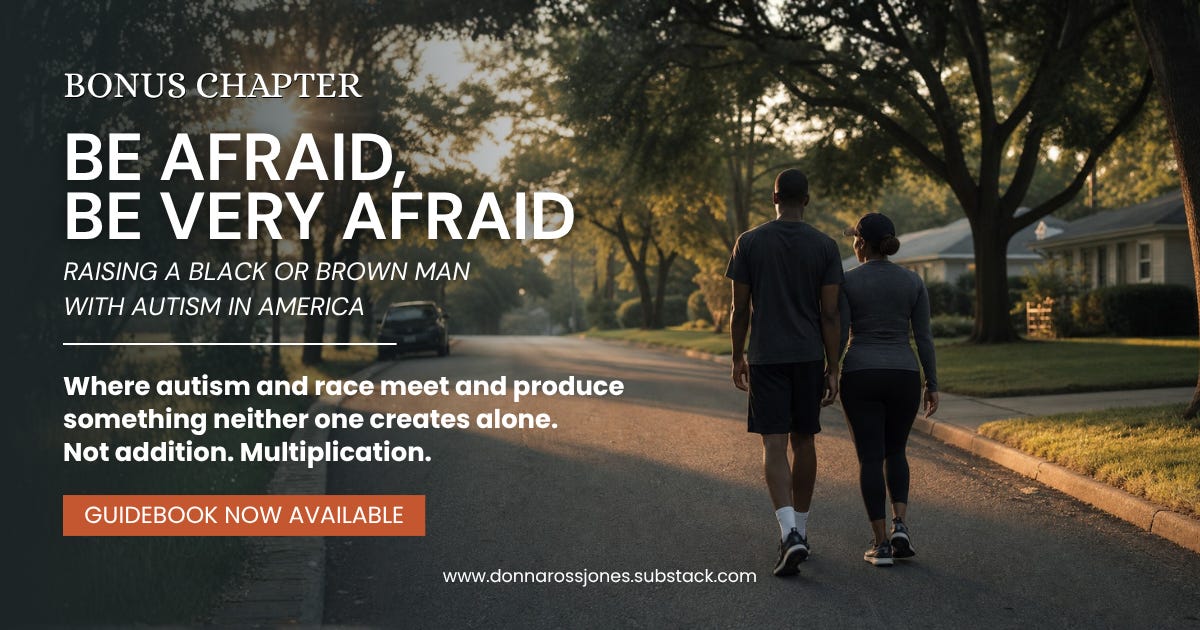
This chapter is for every parent who lives with a fear that has two faces. The fear that belongs to autism — the wandering, the inability to read danger, the child who trusts everyone because he has no architecture for distrust. And the fear that belongs to race — the awareness that a Black or Brown man’s body is read as a threat before he says a single word. That the 911 call will be taken differently. That the officer arriving on scene is working with assumptions your son cannot counter and does not even know exist.
These fears are not the same. But they live in the same body. And when they collide — in a school hallway, in a community program, in a traffic stop, in a moment that takes less than a second to go wrong — the consequences are not abstract. They are suspension. Arrest. Bodily harm. Imprisonment. Death.
That is not hyperbole. That is the documented destination of the child who did not get the right diagnosis, did not receive the right services, and moved through a world that saw his behavior before it ever saw him.
I wrote this chapter because that destination is not inevitable. But it requires preparation that no one hands you. You have to build it yourself, before you need it — before the moment arrives that makes you wish you had.
This is that preparation.
It was 2021. A Tuesday morning, I think, though I am not certain — mornings had blurred together by then, each one built from the same materials. The routine. The careful assembly of Nick’s day before it could become something harder. We went out early. That was by design. Early mornings belonged to us. Before the heat. Before the crowd. Before the part of the world that stared.
Nick walked just to my left, the way he always does — beside me, not behind, not ahead — his sneakers hitting the sidewalk in a rhythm I know the way I know my own heartbeat. I had my phone in my pocket and my eyes moved the way they always move: the street in front of us, then Nick, then back. Watching the body the world would read before it ever asked a single question about the mind inside it.
Then I heard the engine. Not passing. Staying. Too close and too slow for someone looking for an address.
Before the sound had even translated into thought, my hand went to Nick. I moved him closer to my body. I placed myself between my son and the street. A mother’s reflex. Older than language.
Then I turned around.
A large black pickup truck. Two American flags mounted in the truck bed, flapping hard. The driver’s eyes found mine before I found his. In the moment I registered that look — the deliberateness of it, the absence of embarrassment, the intention — I understood exactly what this was.
He revved the engine. He sped past us close enough that the exhaust reached my skin before the sound faded.
I stood on a sidewalk in my own neighborhood with my hand still on Nick’s arm, and I thought: He does not know who Nick is. He saw one thing. He decided everything from that one thing.
And Nick — Nick, who has never in his life understood that someone could mean him harm — did not even notice.
He was already looking down the street, probably at a bird. Probably smiling.
That is the specific terror. Not that the world is dangerous. Every parent knows that. The terror is that your child cannot recognize the danger. That the same openness that makes every room better for his presence — that trust, that absence of any architecture for distrust — is what leaves him structurally exposed in a world that has already made its calculations.
Nick checks two boxes that do not add. They multiply.
The first box is the one this country has been fighting over since before either of us was born. He is a Black man. A large Black man who moves through the world without the careful social performance that keeps Black men safe — the calibration of posture, voice, deference — that becomes second nature for survival. Nick does not calibrate. He is simply himself, completely, at all times. He walks toward people because he likes people. He smiles at strangers with a directness that reads as confident or confusing or challenging depending entirely on who is doing the reading.
The second box is autism. Significant, lifelong autism. Nick does not understand what a crime is. He does not have a spider sense for when something is off. He does not know that when a police officer yells Stop, the correct response is to stop. He might laugh. He might flap his hands. He might keep walking, because the command did not translate into something his brain received as what it was.
In the fraction of a second before someone decides who Nick is — a fraction of a second that has cost lives — Nick has no way to communicate what is happening inside him. He will not look afraid. He will not look compliant. He will look like himself. A large Black man who is not responding the way they expect.
These two boxes do not add. They multiply.
Three days after the truck, I made a sign.
I printed it on 8x11 sheets of paper and taped it to Nick’s shirt while he stood there, blissfully unaware of what I was doing or why. The sign said, in part: I do not know the world is a scary place, so my mom made this to try and keep me safe. I lack the ability to anticipate danger. I am almost always smiling. I think all people are going to be nice to me. Please help me be safe.
I needed Nick to be seen as a person before he could be seen as a threat. I needed my neighbors to know who he was before anything happened that would require them to decide. I needed to create a safety net he could not build for himself.
I posted it and I prayed.
The next morning I woke up to hundreds of responses. We know Nick. We haven’t met him yet, but we look forward to it. We’ll be on the lookout. One neighbor offered books her son might like.
That flood — prayed for, not promised — reminded me of something I needed to be reminded of: it is individuals who make the difference. Not systems. Not institutions. Not politics. People choosing to show up for each other.
That does not fix what is broken. But it builds the net that catches our children while we wait for something larger to change. The net is not nothing. The net is what kept Nick safe that week.
This is the part no one explains.
The danger that Black and Brown autistic children face is not a single incident. It is a system. It begins in the first institution our children enter — the school — where autism behaviors are routinely misread as conduct problems in Black boys. Where the wrong diagnosis produces the wrong services. Where the wrong services produce the wrong trajectory. Where the trajectory has a name: the school-to-prison pipeline.
It continues in community settings, where a child who cannot make eye contact is labeled defiant. It continues in first responder encounters, where officers are not trained to distinguish behavior rooted in autism from indicators of guilt or threat — and where that gap falls disproportionately on Black autistic youth. It continues in employment, in healthcare, in every room where someone reads the body before asking about the mind.
I have been writing versions of this chapter since 2008. I am still writing it today.
What I did not fully understand at the beginning — what I had to learn slowly, painfully, and through things I should not have had to experience — is that the fear does not go away. But fear without a plan is just suffering. And suffering without action is a luxury no parent in this position can afford.
The specific data on misdiagnosis rates for Black and Brown boys — and what the wrong label costs in developmental terms
The school-to-prison pipeline: documented numbers, mechanisms, and how it begins with a single mislabeled behavior
The decisions I never should have had to make — including the one that broke something in me after George Floyd’s death
Where the bias lives and where it does the most damage: school, community, employment, law enforcement
What I did before the truck — and after it
A set of concrete, actionable preparation steps: 911 database registration, first responder introductions, the safety card, the neighborhood letter, IEP safety goals
Five worksheets: the Dual Vulnerability Profile, the First Responder Introduction Plan, the School Advocacy Checklist, the Community Safety Net Builder, and the Safety Blueprint
If this felt familiar — if you have stood on a sidewalk in your own neighborhood and done the calculation I described — this chapter was written for you.
Not to multiply your fear. You are already afraid. To confirm that the fear is documented, verified, and measured in outcomes. And to hand you the plan that lives next to it.
Forward this to a parent who is raising a Black or Brown child with autism and trying to figure out what to do next. Not as information. As relief.
And if you are not yet subscribed to Autism Day by Day, this is a good week to start. This is the guide I needed when I was you.
Donna Ross Jones is a 27-year autism advocate, the CEO of Transition Music Corporation, a Top 100 music publisher, and the author of Autism Day by Day: A Parent’s Guide to Advocacy, Independence, and Adulthood. Her blog has reached more than three million readers and is archived by the National Institutes of Health.
No posts
Comments
Nothing yet. Say the first thing.
Sign in to join the conversation.