

I became interested in Stoicism over a quarter of a century ago, after completing my philosophy degree at Aberdeen University in Scotland.
One of the very first things I learned from the Stoics was that our beliefs shape our emotions to a much greater extent than we normally assume. I also learned that the beliefs that cause anxiety tend to be maintained by two core factors:
Catastrophic thinking: “Something awful is going to happen…”
Lack of confidence in coping abilities: “…and I’m not going to be able to handle it!”
I call this dual-factor cognitive model a neurotic sandwich. For many years, I was eating that sandwich every day, until I learned how to apply the techniques we’re going to practise today.
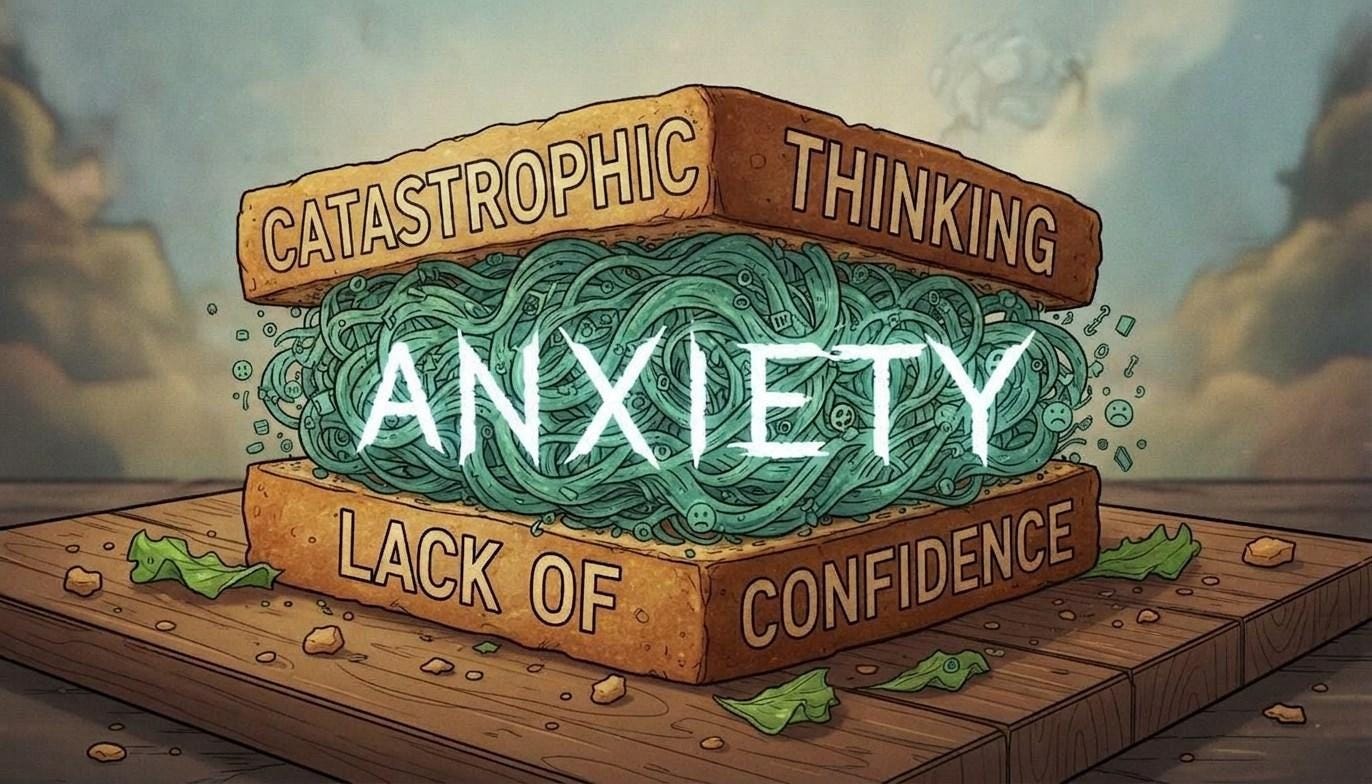
Later, as a therapist, I learned just how many of my clients were eating the same sandwich.
When we spoke, clients would tell me about how anxious they were. They’d describe how awful it felt, how unhappy it was making them, and how it was ruining their lives.”
Then they’d look at me and say “But I can’t help it, it’s just how I feel!” I’d reply; “That doesn’t sound like much fun… but it’s not just how you feel, is it? It’s also how you think!”
You don’t just feel anxious; you also think anxious, and act anxious. (As Albert Ellis, the founder of Rational Emotive Behaviour Therapy used to say.) And although some of your thoughts and actions are automatic, involuntary, or reflex-like, others are voluntary, which means you can change them.
In this lesson, you’ll learn to distinguish automatic thoughts and feelings from the responses you can influence, and then practise stepping back from anxious thoughts instead of identifying them with reality.
The dual-factor model of anxiety I just described was introduced in the 1960s by Richard Lazarus, one of the leading experts in the field of stress research.
He called these two aspects of anxious thinking:
Primary appraisal of threat.
Secondary appraisal of coping.
Researchers have found that the primary threat appraisal tends to be pretty fast and automatic. The secondary coping appraisal is often marginally slower and more conscious, although they both usually have an automatic quality.
While this model influences all of cognitive behavioural theory (CBT), Lazarus wasn’t the first person to say this. Chrysippus, the third head of the Stoic school, said something remarkably similar — over two thousand years earlier!
In Chrysippus’ lost book the Therapeutikon, he is believed to have claimed that during an episode of a strong emotion like anxiety, it is often difficult to change your judgment about how good or bad something is — the threat appraisal.
Rather, it was usually easier to change a second type of judgment, one about how it is appropriate or necessary to respond, including whether you can cope with and tolerate the feelings.
Similarly, consider the Enchiridion or Handbook of Stoicism, which is more or less a manual on how to apply Stoic philosophy, consisting of sayings written down by one of Epictetus’ students. Epictetus calls automatic thoughts “impressions”, and he encourages his students to challenge both types.
For instance, the famous opening sentence of the Enchiridion reads:
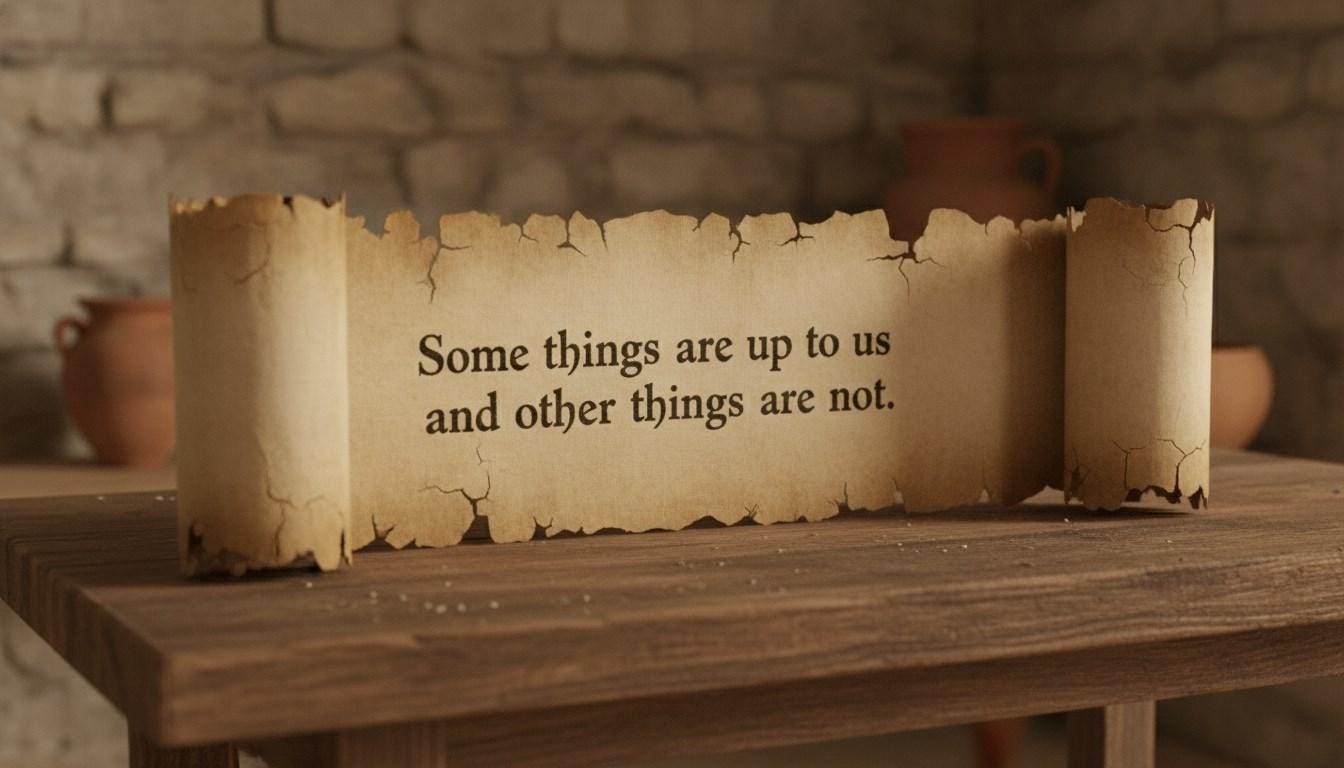
That is the crux of this lesson, and your starting point as a trainee Stoic under Epictetus.
The Stoics believed we could change our feelings by changing our thinking, although the Stoics also recognized that some thoughts (our initial impressions) are not up to us. Modern CBT has arrived at essentially the same conclusion.
We’ll start by exploring the way we think about anxiety.
We tend to understand emotions such as anxiety based on our folk psychology, which is what psychologists and philosophers call the default set of psychological assumptions we all inherit from our language and culture, assumptions about the mind and emotions, and so on.
The folk psychology of anxiety is sometimes called the hydraulic model. It assumes anxiety is like an invisible energy that builds up within us, like water pressure, and that it can be pushed down or bottled up, can burst out, or can be channelled into certain courses of action.
That’s not how anxiety works, though.
If we want to learn how to cope with it properly, we need to work on improving our understanding of how emotions like anxiety are formed. If we start off with misconceptions about how anxiety works, we’ll struggle to figure out how to cope. First, therefore, we need to recognize that different types of anxiety respond to different strategies.
Second, and perhaps more importantly, we need to understand that anxiety is composite.
Think of it like a recipe you might use to bake a cake.
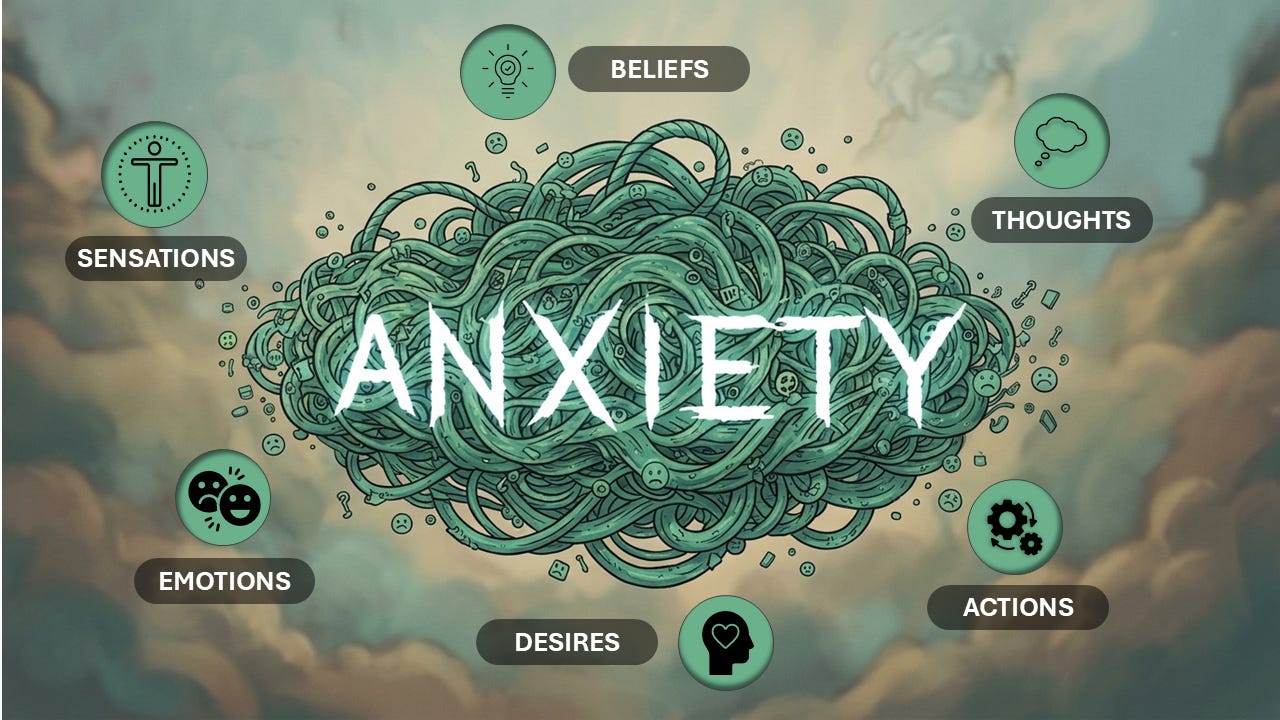
If anxiety can be separated into its ingredients, we can work to distinguish between those ingredients and respond to them differently, because they function differently from one another.
The first and most important distinction you can make is between the bits that are up to you, and the bits that are not.
In my experience, many people waste their energy struggling against the involuntary or automatic ingredients of anxiety. They’ll focus on their heart rate, shaking hands, and other physical sensations, and will neglect to take full responsibility for the voluntary aspects, like how they focus their attention, what they say to themselves, and the actions they take, or don’t take, in response to those involuntary feelings.
It’s better to focus your energy on developing mindfulness of what’s actually going on when you become anxious or worried.
Notice what happens to you and what you are doing, what’s automatic, and what’s potentially under your voluntary control.
Activity: 5-Minute Meditation
We’ll illustrate this concept in a short 5-minute meditation known as the Benson Method.
This technique was named after Herbert Benson, a professor of medicine at Harvard in the 1970s and author of the bestselling book The Relaxation Response.
Benson was one of the first researchers to demonstrate, under controlled laboratory conditions, that even very simple techniques could reliably lower heart rate, reduce blood pressure, and release muscle tension.
His work helped establish the modern understanding that we can deliberately activate the parasympathetic nervous system. We can call this “downshifting” the stress response. Benson tested a wide range of meditation and relaxation practices in his lab, and the method we’re about to use is the simplest one known to reliably induce the relaxation response.
It’s easy to learn, easy to teach, and has decades of research behind it.
Activity Instructions
Take five minutes and do the following:
Choose a centring phrase.
This can be any word or short phrase you choose, as you won’t need to think about what it means during the exercise. A neutral phrase or word like the number “one” will work; though Benson reported that using a personally meaningful phrase resulted in people maintaining the practice more consistently with improved relaxation. I tend to pick the word “patience” as my centring phrase. It works quite well for most, and it resonates with the notion of contemplating our supreme good in Stoicism.
Close your eyes and pay attention to your body.
As you breathe, don’t try to change anything and don’t try to prevent anything from changing. Just do one thing.
Each time you exhale, repeat your chosen word in your mind.
Be patient, and if your attention wanders, or other thoughts cross your mind, so what? It doesn’t matter. As you breathe, keep returning your attention to your breathing and the centring phrase you’re repeating. This word will serve as your centering device. Take your time, and lengthen the word’s pronunciation slightly in your mind. You may find that by doing so, your breathing naturally slows down.
Repeat this focused breathing activity for about 5 minutes. When you’re done, slowly open your eyes.
Return your attention to the room around you, and as you do, continue to bring some of that self-awareness with you into what you’re now experiencing.
Activity Reflection
First, reflect on how you feel.
Have your breathing and heart rate slowed?
Do you feel less tension in your muscles?
What was happening in your mind during the activity? Did you have thoughts, images, or feelings that popped into your mind spontaneously? How did your chosen phrase impact those thoughts?
Now, let’s expand on that.
Think about which aspects of this exercise were up to you, and which were not.
Focusing on your breathing and saying the phrase were both up to you, which we’ll call voluntary thought processes.
We’ll call the thoughts, images, or feelings that popped into your mind spontaneously automatic thought processes.
What about your heart rate and muscle tension? We’ll consider those to be a automatic sensory responses.
How did this activity affect you?
It’s possible that the Benson method helped you to relax muscular tension, reduce nervous arousal, or calm automatic thoughts. However, I believe that the most important benefit is that it helps you to distinguish more clearly between voluntary and automatic thought processes.
If that’s possible in just a few minutes, what do you think might happen if you did something like this consistently for 10-20 minutes each morning, for the next few weeks?
In this lesson, you’re learning techniques that’ll help you to shift your perspective, so you experience your thoughts in a different way than normal.
When applying the Benson Method, we used a voluntary thought — the repeated word — as a centring device, returning to it every time we exhaled. There are several other ways you could shift perspective on your thoughts.
For example, you could use self-talk and clearly state to yourself in your mind “Right now, I notice myself having the thought ‘What if something awful happens? How will I cope?’”
This shift in perspective is called cognitive distancing in cognitive therapy and verbal defusion in behaviour therapy. Some people also call it cognitive defusion. It has other names too. In psychology, there’s a law that we have to have at least six names for the same thing!
Remarkably, the Stoics also practised a similar strategy, and they called it withholding assent. The word “assent” is a poor translation, though, of the Greek word synkatathesis, which means something more decisive, like casting an official vote, or arriving at a firm conclusion, or, in this context, hastily treating a misleading impression as if it were reality.
Now, paid subscribers will be able to practise defusion with me in an audio activity called the Leaves on a Stream exercise, and to continue to apply these strategies throughout their daily practice, using the accompanying Stoic Anxiety Worksheet.
Think of an anxious thought you had recently. Sharpen your awareness of the distinction between your subjective thought and the objective event. What changes for you — emotionally or otherwise — when you pause and describe your initial interpretation as something you added to the experience?
“Back then, in that situation, I added the thought that…”
For example, “Back then, yesterday at work, I heard a customer criticize me, and I added the thought ‘that’s awful’ and ‘How will I cope!’”
Paid subscribers can share their example in the comments, along with anything they noticed when they stepped back from the thought. You can use a hypothetical example or omit any personal details.
Upgrade to paid subscriber to unlock the rest of this lesson, including the 13-minute guided Leaves on a Stream exercise and the Stoic Anxiety worksheet.
To access the exclusive content below, subscribe to this newsletter. We’re offering a 25% discount, for a limited period, for new paid subscribers.
Comments
Nothing yet. Say the first thing.
Sign in to join the conversation.