

The early pioneers of behaviour therapy said that therapy, insofar as it involves training in coping skills, can be divided into two distinct phases:
Skills Acquisition
Skills Application
We live in a world now where people drink from a veritable firehose of self-improvement content online. Most of the clients I see today have far more exposure to self-help content than people did before the Internet. They’ve often done lots of skills acquisition. They’ve been doing meditation, visualization, journaling, affirmations, and so on, for years, often in a fairly disciplined way. But they still have problems, such as worry and anxiety, and they end up knocking on the doors of therapists…
In other words, people are drowning in self-help content, but it isn’t actually helping them. Why?
I think there are several reasons, but one of the most important ones is that although they’ve done a lot of skills acquisition they’ve done little or no application of those skills to real life problems. There’s usually a huge deficit when it comes to putting things into practice for real, because we naturally tend to avoid activities or situations that make us anxious. Avoidance is the world’s number one most popular emotional coping strategy, and have no doubt, avoidance is sneaky! Most people are much more avoidant than they realize because it comes in many subtle forms. Procrastination, for instance, is really just a fancy word for avoidance!
Consider the scenario that follows. The striving-to-be-Stoic statue has a number of fears and worries. They journal regularly, but don’t do much else. They’re not sure why journaling doesn’t seem to be working. Sound familiar?
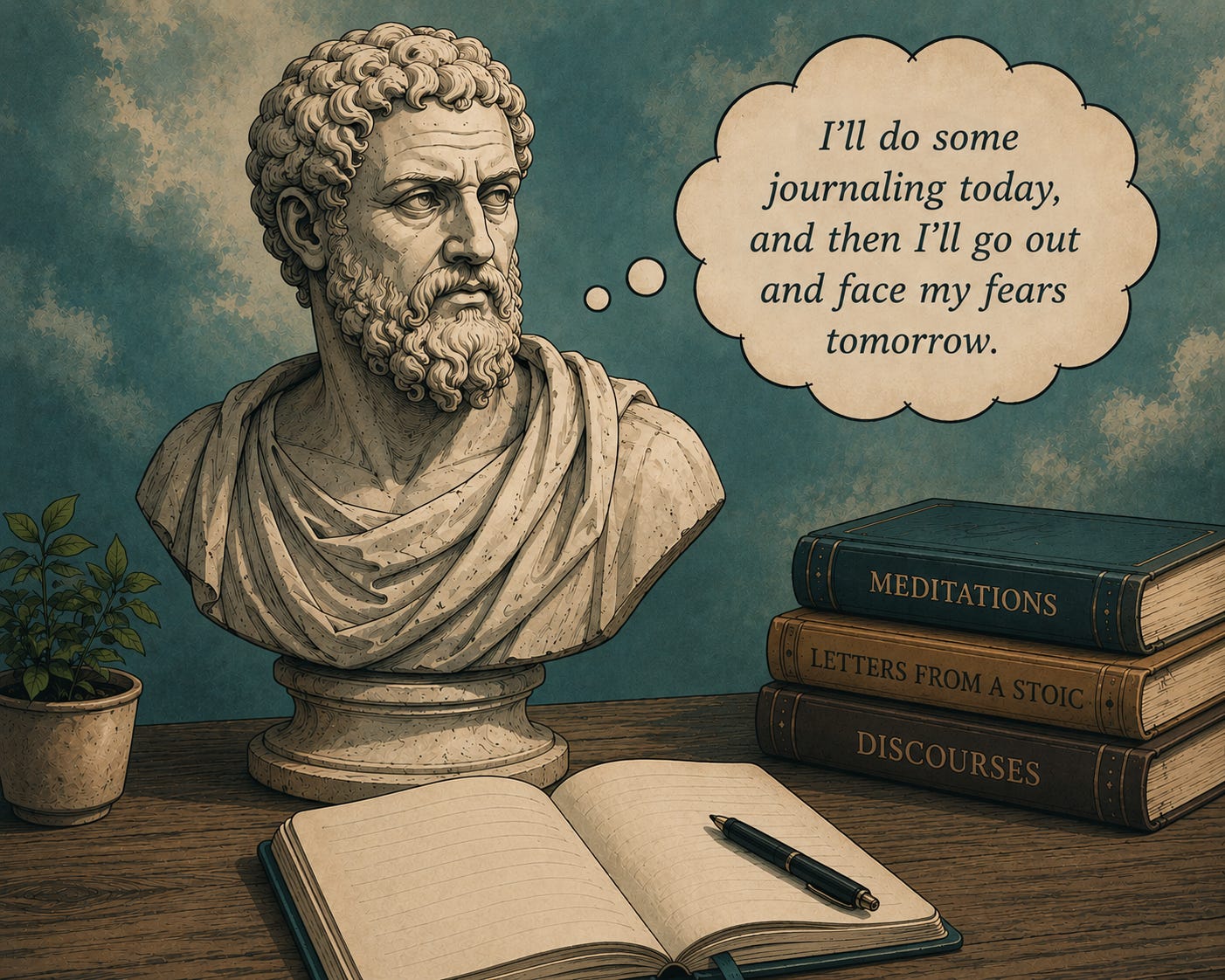
Journaling can be great, and maybe you’re great at doing it. But if this sounds at all familiar, maybe you should consider whether you’re actually using journaling to help you get out of your comfort zone and face your fears.
Clients in therapy often ask how they can ensure that the skills they learn in sessions won’t be forgotten when they’re facing situations that make them anxious out in the real world. For example, I can sit and meditate until my heart’s content, but if I leave those cognitive skills on the yoga mat and then return to the world and immediately revert back to catastrophic thinking and avoidance, a whole lifetime of meditation may end up being of little or no value in terms of how I actually live my life. I call this the problem with compartmentalizing skills.
There are several solutions to this problem, but we’re going to focus on one that the Stoics figured out well over two thousand years ago.
I learned from the Stoics that our thoughts contribute to our anxiety but that we can change how we respond to them by using techniques we now call cognitive defusion. If we want to develop emotional resilience, we need to be ready for misfortune, and not caught off-guard. I also learned from Stoicism that we can prepare ourselves in advance for the situations that typically provoke our anxiety, through a technique called premeditatio malorum in Latin, the premeditation of something bad, or premeditation of adversity. Another Stoic, Posidonius, seems to have used the Greek word proendēmein, meaning “inhabiting in advance”, to describe the same technique. As this technique involves rehearsing ways of coping through new ways of thinking and acting, you might simply call it mental rehearsal.
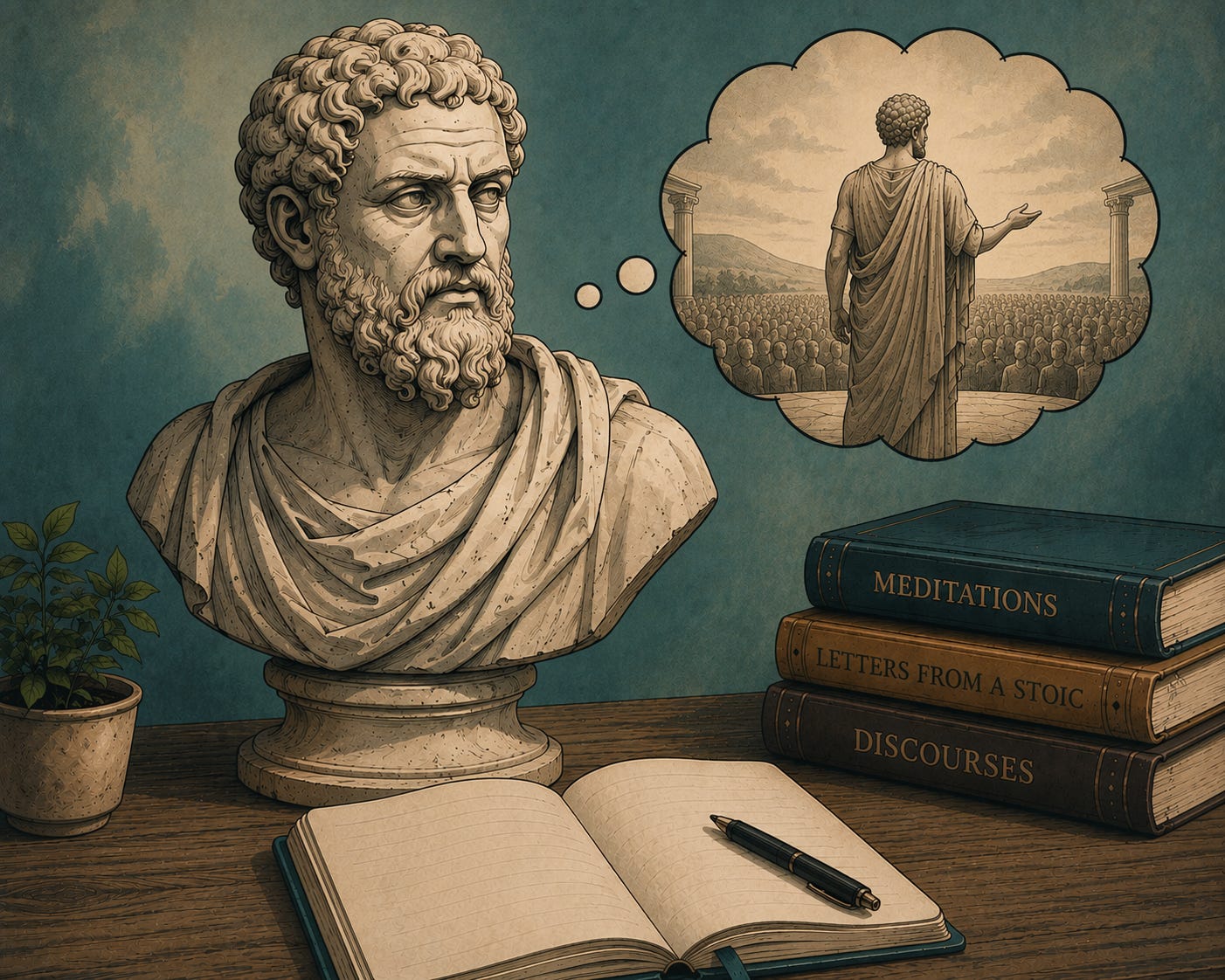
In modern psychotherapy, there are many variations of mental rehearsal. One of the most fundamental approaches used for anxiety is called imaginal exposure, where in a sense we do nothing, or rather do the minimum, except face our fears patiently, actively accept the discomfort, and wait for our feelings to subside naturally.
Activity: Imaginal Exposure
Let’s try this out in a 5-minute activity.
Safety First
For imaginal exposure exercises, choose a situation that causes only mild and manageable discomfort, not your worst fear or a traumatic experience.
If you experience panic attacks, dissociation, trauma-related symptoms, self-harm urges, or severe or overwhelming distress, do not use this exercise to confront difficult material without guidance from a qualified mental-health professional.
If the exercise becomes overwhelming or you feel unsafe or disoriented, stop and return your attention to your present surroundings.
In Lesson 1, you learned the Benson Method: focusing on your breathing and repeating a word or short phrase on each out-breath. This time, we’re going to upgrade that exercise by adding one crucial new ingredient: imaginal exposure.
Rather than using the exercise to get rid of anxiety, you’re going to deliberately bring a mildly anxiety-provoking situation to mind and practise accepting whatever feelings arise. Think of this as relaxing into anxiety, rather than trying to relax it away.
For safe practise, choose a situation that evokes mild, rather than severe, anxiety—something manageable that allows you to rehearse your coping skills without feeling overwhelmed. This approach of starting with smaller challenges and gradually working up to more difficult ones is sometimes called stress inoculation training.
Traditional inoculation against infectious diseases works by voluntarily exposing your body to small quantities of a weakened virus in order to stimulate the creation of antibodies that can strengthen your natural immune response to future infection. Stress inoculation works by voluntarily exposing your mind to manageable doses of stress to strengthen your ability to use emotional coping responses when future stress occurs. In other words, whereas traditional inoculation can help you build up your immune system, stress inoculation can help you build emotional resilience.
Activity Instructions
Take at least five minutes and do the following:
Settle into the method.
Close your eyes and pay attention to your breathing, just as you did in Lesson 1. Don’t deliberately change your breathing.
Each time you exhale, repeat your chosen centring phrase slowly in your mind. (In the previous lesson, I suggested using the word “patience” but noted you should feel free to choose another word or short phrase.)
Continue like this for roughly a minute.
Bring a mildly anxiety-provoking situation to mind.
Now imagine yourself in a situation that you tend to worry about or avoid, one which makes you feel mildly anxious.
Imagine that it’s happening right now. You don’t need to visualize it perfectly. Just pretend for a few moments that you’re really there, and that’s what’s really happening.
Notice what you would see, hear, and feel, including any subtle feelings of stress or discomfort that it triggers.
Keep saying your centring phrase on the out-breath.
As you continue imagining the situation, keep returning your attention to your breathing.
On each exhalation, repeat your chosen word or phrase slowly in your mind.
Let the word remind you of the attitude you’re practising: I don’t need to get rid of these feelings. I can accept them, allow them to come and go freely, and just let them run their course naturally.
Relax into the anxiety rather than trying to relax it away.
Notice whatever happens automatically. Perhaps you notice muscle tension, a faster heartbeat, butterflies in your stomach, warmth in your face, or anxious thoughts.
Don’t try to suppress or control these reactions.
As you breathe out and repeat your centring phrase, notice any urge to struggle against the experience, such as holding your breath, tensing your body, or wishing the feelings would disappear.
Let go of that struggle as best you can, and allow the feelings to come and go naturally while you remain with the imagined situation. You are not trying to make yourself calm; you are practising being patient with whatever feelings are already there.
Stay with the scene for a little longer.
Continue imagining the situation while repeating your centring phrase on each out-breath.
If your anxiety increases, that’s okay. If it decreases, that’s okay too. Neither is the goal of the exercise.
The important thing is that you are practising staying with the experience instead of avoiding it, and discovering that you can tolerate the feelings.
Return your attention to the present.
After at least five minutes in total, and perhaps ten if you prefer a longer exercise, let the imagined scene fade.
Slowly open your eyes and bring your attention back to the room around you.
Before moving on, notice what, if anything, changed—not only in the intensity of your anxiety, but in your attitude toward it and your confidence in your ability to cope.
How did this activity affect you?
The ancient Stoics observed that emotions often fade naturally over time. We laugh at a joke, but we don’t keep laughing forever, because it gets old after a while. We grieve over a loss, but time is a great healer, and the initial intensity of grief naturally diminishes over time. The same thing happens with anxiety. As we saw earlier, the Stoics knew that there are two types of belief that cause anxiety:
Our belief about how awful the situation is.
Our belief about our inability to cope with it.
Chrysippus reckoned that when people are experiencing an emotion it’s easier to change the second belief, which today we call the coping appraisal. In fact, the very decision to face your fears in imagination forces you to challenge beliefs such as “I can’t cope” or “I can’t stand these feelings” and to replace them with the belief that you can endure the discomfort, and you can cope with your emotions, even if that simply means sitting with the feelings for a while, giving up avoidance and worry, and allowing the discomfort to run its course.
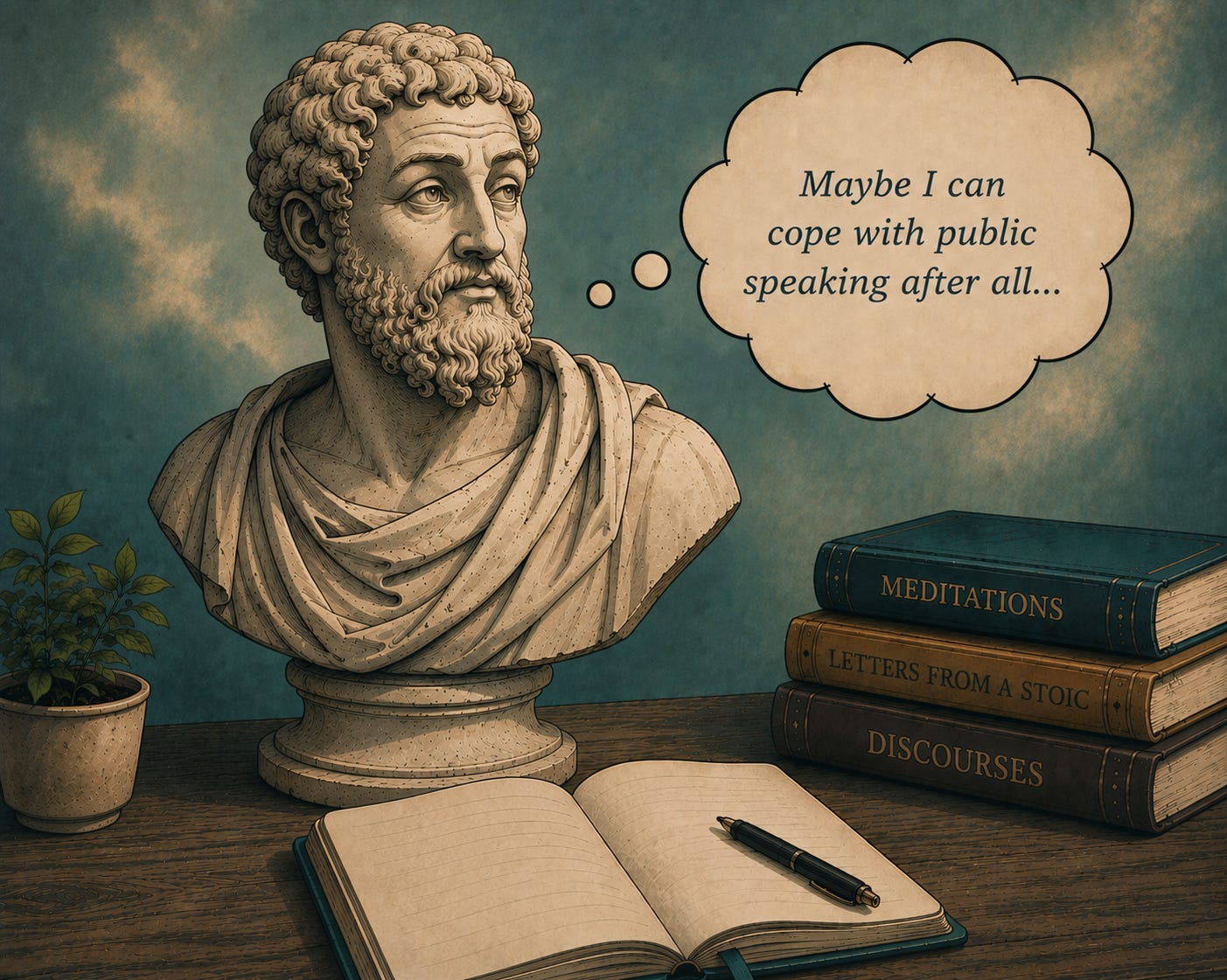
By facing your fears, you develop what Albert Ellis liked to call High Frustration Tolerance or High Discomfort Tolerance. You prove to yourself that you can endure feelings you may previously have felt like avoiding, and you create a sense of confidence, which is really the core of emotional resilience.
What’s one situation you tend to worry about or avoid? Suppose you had faced similar situations countless times already and increased your tolerance of the associated discomfort until your attitude became: “I may not like this situation, but I can cope with how it feels.” How might becoming more tolerant of anxiety and discomfort help you in the long run?
Paid subscribers can share their thoughts in the comments, including anything they noticed during the exercise. You can use a hypothetical example or omit any personal details.
Paid subscribers can then continue below with the Mental Review exercise and the accompanying Stoic Mental Rehearsal worksheet.
To access the exclusive content below, subscribe to this newsletter. We’re offering a 25% discount, for a limited period, for new paid subscribers.
Comments
Nothing yet. Say the first thing.
Sign in to join the conversation.