
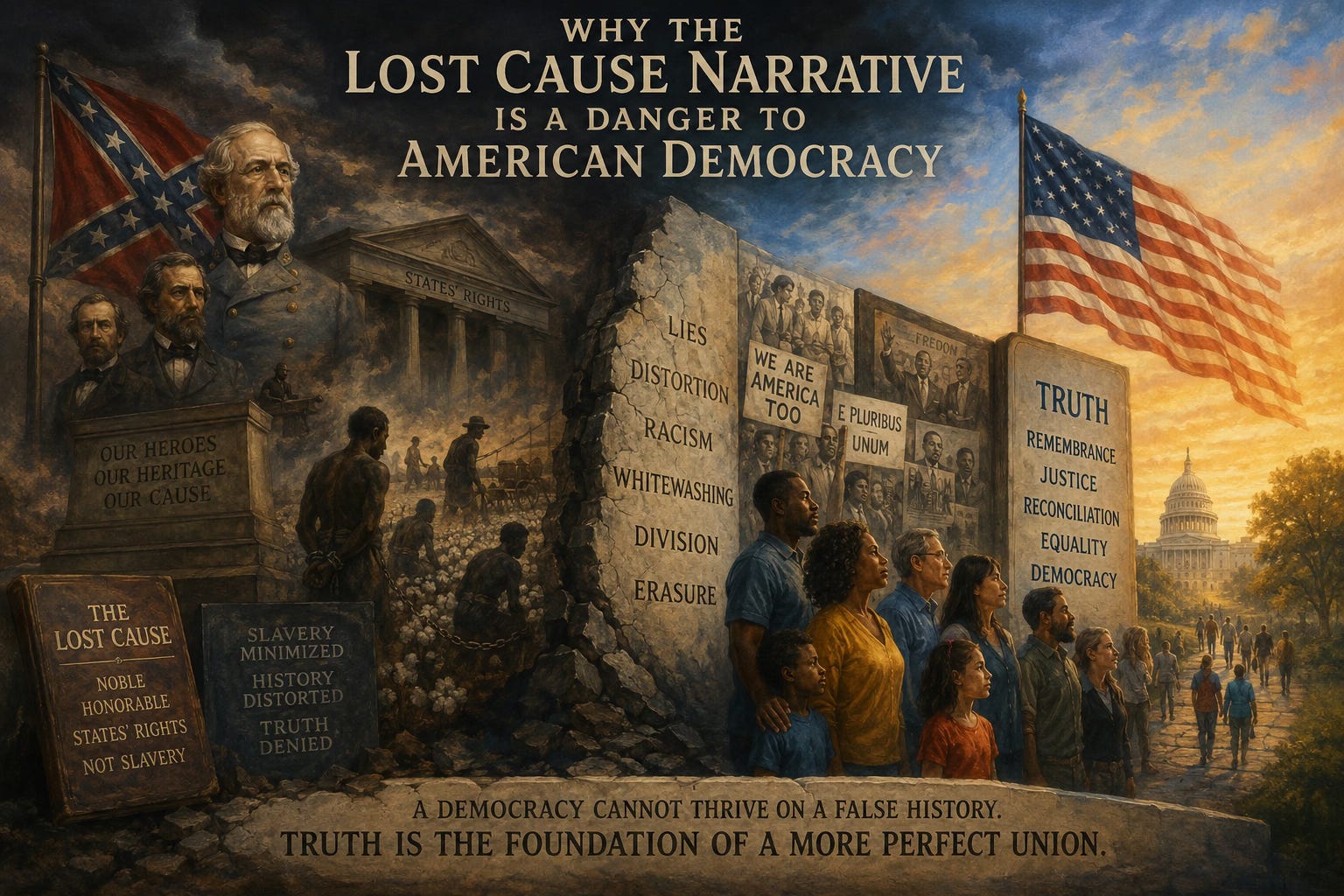
Political, philosophical, and theological ideas are powerful. They can ignite flames that, once spread, grow into wildfires, giving birth to movements, inspiring social change, and even fomenting revolutions. Ideas shape history. They influence cultural consciousness, public memory, political behavior, and a society’s understanding of itself.
One of the most disquieting developments in contemporary America is the resurgence of ideas associated with the Lost Cause narrative, a distorted interpretation of the Civil War and the Confederacy that threatens America’s continuing struggle toward egalitarianism, civic tranquility, democratic integrity, and human flourishing.
What is the Lost Cause narrative?
The Lost Cause is a revisionist interpretation of American history that emerged after the Civil War and gained particular influence during Reconstruction and the decades that followed. It created a false and romanticized narrative about the Confederacy and the causes of the Civil War. According to this mythology, the Confederate cause was noble, Southern society was honorable and harmonious, and the war was fought primarily over abstract principles of states’ rights rather than the preservation and expansion of chattel slavery.
This narrative profoundly distorts the historical record.
The Lost Cause minimizes the central role of slavery in secession, obscures the brutality of human bondage, and romanticizes a social order built upon racial hierarchy. Principal leaders of the Confederacy, including Robert E. Lee, were elevated into almost mythic figures and portrayed as paragons of nobility, courage, and virtue. Monuments were erected in their honor, public spaces were named after them, and generations of students, particularly in the South, were exposed to educational curricula that presented an adulterated account of Southern history.
The consequences of this mythology were never merely academic. Historical narratives shape political possibilities. When a nation falsifies its past, it becomes vulnerable to repeating its deepest moral failures.
In an NPR interview, Princeton University professor Eddie S. Glaude Jr., a distinguished scholar of African American studies, argued that elements of the Lost Cause narrative are being revived in our present political moment. This concern deserves serious attention. The underlying impulses of the Lost Cause can be discerned in aggressive efforts to sanitize American history, minimize the enduring consequences of slavery and racial oppression, and pressure museums, universities, schools, and other cultural institutions that are committed to telling painful truths about the American experience.
Such efforts are dangerous because democracy depends upon an informed citizenry capable of confronting historical reality. The Lost Cause narrative is severely flawed and must be countered, not with another mythology, but with truth.
The overwhelming historical record demonstrates that chattel slavery, an exceedingly violent, dehumanizing, and morally abhorrent institution, stood at the center of the sectional crisis that led to the Civil War. The declarations of secession issued by Southern states, the speeches of Confederate political leaders, and the Confederate constitutional order itself provide compelling evidence that the preservation of slavery was fundamental to the Confederate project.
The Lost Cause mythology often invokes “states’ rights,” but this raises an unavoidable question: states’ rights to do what?
In the central political crisis of the era, Southern secessionists sought to preserve a racial and economic order in which millions of African Americans could be legally enslaved, bought and sold, separated from their families, subjected to violence, and denied the most basic dimensions of human freedom.
Abraham Lincoln understood slavery to be a profound moral contradiction within the American experiment. In 1854, he declared:
“I hate it because of the monstrous injustice of slavery itself. I hate it because it deprives our republican example of its just influence in the world.”
Lincoln’s election in 1860 terrified many Southern political leaders because they feared the growing power of a political movement committed, at minimum, to restricting the expansion of slavery. Although Lincoln’s own views and policies evolved over time, his election represented a profound threat to the future of the slaveholding order. For secessionist leaders, this was an existential crisis. Their response was withdrawal from the Union and the formation of a Confederacy explicitly committed to protecting a racial hierarchy rooted in human bondage.
This is precisely why truthful historical narratives are vital to the flourishing of democratic societies.
Truth allows nations to understand their past, learn from their failures, and move toward what Lincoln called “a more perfect Union.” Truthful narratives create the possibility of national repentance, not repentance as empty guilt, but repentance in the deepest theological sense of metanoia: a turning of the mind, heart, and collective life toward a more righteous way.
A mature democracy does not require its citizens to hate their country. Nor does patriotism require historical amnesia. Indeed, genuine patriotism possesses the moral courage to love a nation enough to tell the truth about it.
We can celebrate the soaring ideals of the Declaration of Independence while acknowledging that millions were excluded from its promise. We can honor the achievements of the American republic while confronting the horrors of slavery, Indigenous displacement, segregation, racial terror, and systemic injustice. We can cherish the Constitution while acknowledging the long struggle required to extend its blessings more fully to those whom history pushed to the margins.
This is not hatred of America.
It is the work of democracy.
The Lost Cause narrative is dangerous because it substitutes nostalgia for history, mythology for truth, and racial innocence for moral accountability. It encourages citizens to imagine that the deepest injustices of the past were either exaggerated, incidental, or unrelated to the political institutions that shaped the nation. Once a society becomes comfortable falsifying the past, it becomes easier to justify injustice in the present.
Truthful narratives, by contrast, are the soil in which egalitarianism can grow. They enable a people to confront inherited injustice, widen the boundaries of belonging, and continue the unfinished work of liberty and justice for all.
For Christians, the commitment to truth is not merely political or academic. It is theological.
Jesus declared in the Gospel of John:
“You will know the truth, and the truth will make you free.”
John 8:32
These words should challenge every attempt to manipulate history for ideological purposes. Freedom cannot flourish indefinitely upon foundations of falsehood. Democracy cannot remain healthy when citizens are taught comforting myths instead of difficult truths. Reconciliation cannot occur without remembrance, and genuine healing cannot take place where historical wounds are denied.
Therefore, let us remain committed to telling the truth about our history, even when that truth is painful. Let us resist seductive mythologies that romanticize oppression. Let us teach our children a history mature enough to hold both achievement and atrocity, courage and cowardice, liberty and bondage, triumph and tragedy.
For only a people courageous enough to confront the truth of their past can build a more just future.
And perhaps, in that sacred and democratic labor, we may discover anew the enduring promise of Christ:
“You will know the truth, and the truth will make you free.”
Donald E. Williams is a United Methodist pastor and Duke University graduate. He completed his doctorate at Duke University in 2022 and is the author of An Investigation Into the Relationship Between Aristotelian Eudaimonia and Christian Discipleship: A Thomistic Perspective, Wipf and Stock Publishers and other books.
Website:
http://www.virtuespromise.com
No posts
Comments
Nothing yet. Say the first thing.
Sign in to join the conversation.