
Dear Community,
There are books that belong to us. Books written from our neighborhoods, in our languages, carrying the words our mothers whispered over us before school. Getting those books into the hands of our children should be the easy part. It isn’t always.
I need to tell you about a Friday night and eight phone calls.
The books we had purchased to give away to families for our Lil’ Readers program were not going to arrive in time. Lil’ Readers is how we get books into the hands of Latino children in Washington Heights, not as a transaction but as a declaration that these stories belong to them. So the evening before our Mother’s Day event I started calling bookstores. Not one or two. Eight. Manhattan to Brooklyn to Queens and into New Jersey. Books Are Magic, Books of Wonder, Kew and Willow, Mil Mundos. Store after store told me the same thing in different words. But it was Barnes and Noble that stopped me cold. Not one of their East Coast locations was stocking it. A debut picture book by an Afro-Dominican author from Washington Heights, and not a single Barnes and Noble on the entire East Coast had it on their shelves for Mother’s Day weekend.
I asked how a book gets onto their shelves. The answer was almost too simple to be real: someone orders it, it enters the algorithm, it trickles down. So I ordered five copies on the spot.
Each call made me more certain of something I already knew. But before I tell you why, I need you to understand what we were fighting for.
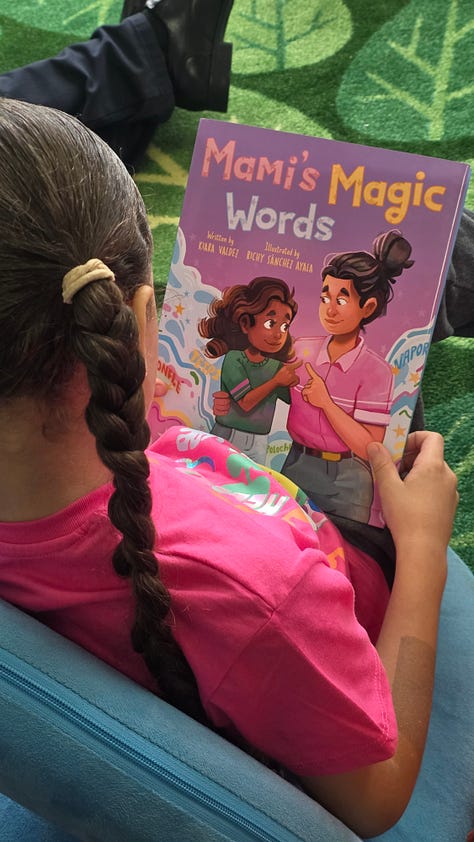
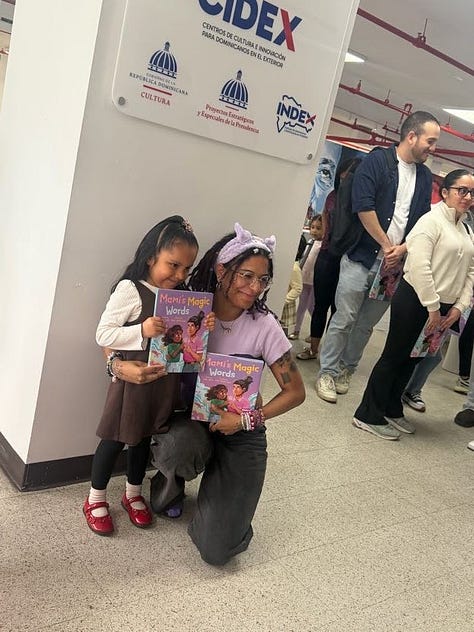
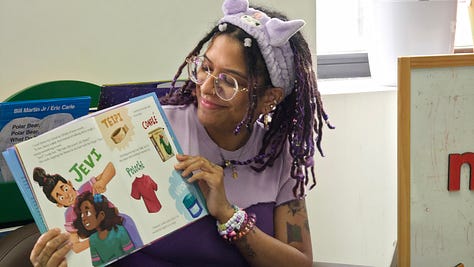
Mami’s Magic Words is Kiara Valdez’s debut picture book. If you grew up in a Dominican household it will reach into your chest and find something you forgot was there. It’s the story of a girl named Karena whose teacher asks the class to share words that spark magic. Karena doesn’t hesitate. Her answer is poloché, a word her mami whispered that very morning like a spell to smooth the wrinkles from her shirt. The teacher tells her it’s not a real word. And so Karena sets out to prove that the words our mothers gave us, vaporú, confle, jevi, the ones that live in our kitchens and our mornings and our bodies, are as real as anything in any dictionary. That they hold history. That they hold love. That what could be more magical than that.
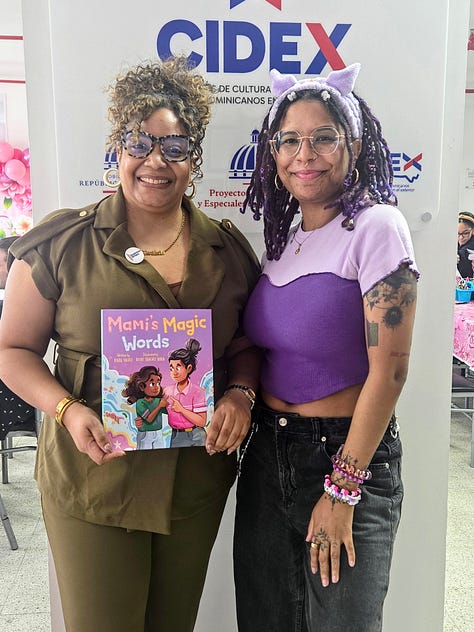
Kiara is Afro-Dominican. She’s from Washington Heights. She came back to her own neighborhood to share this book with the families who would recognize every single word on every single page. And here is the part that should make you pause: Kiara is not just an author. She is a graphic novel editor at a major publishing house. She knows this industry from the inside. She understands better than most how books move through the system, how they get selected, how they get shelved, how they get seen. And even with all of that knowledge, even with a book this beautiful, this necessary, this rooted in who we are, the system still couldn’t be bothered to put it on a shelf.
The book was illustrated by Richy Sánchez Ayala, who was born in the Dominican Republic. Author and illustrator, both Dominican, both pouring their history into every page. This is as Dominican as a book gets. And still.
And Mami’s Magic Words is not alone. This is what we need you to understand. When Lissette Norman’s publisher went on strike right as Plátanos Go with Everything was debuting, we co-organized her book launch with Word Up and sent mass emails to schools so her author visits could still happen. When Alyssa Reynoso Morris was working ten times harder than her publisher to get visibility for her work, we showed up to help wherever we could. When Alianza Dominicana reached out asking for a list of children’s books to stock their new library, these titles were on it. When the Department of Education asks us for Dominican authors and book titles, we send them an entire list. We fight for each one. Not because one book is more deserving than another, but because every single one of them is proof that our children exist, that our stories are worth telling, that a Dominican girl sitting in a classroom or a library or a living room deserves to look up from a page and find herself there. Kiara’s book matters. So does Lissette’s. So does Alyssa’s. So does every Dominican book that has ever had to fight its way onto a shelf. That fight does not end. Neither do we.
This is why DWA exists. Not just to celebrate writers when everything goes smoothly, but to show up on a Friday night making call after call when the system doesn’t, because the families in Washington Heights deserved to sit in that room with a woman who looked like them, who came from where they came from, and watch their children hold a book that says: the words your mami gave you are real.
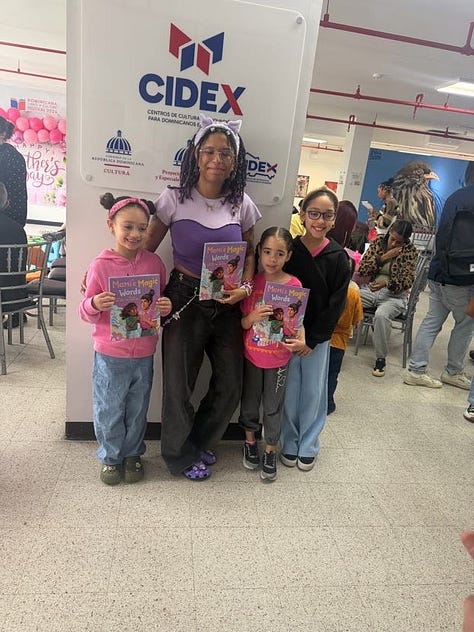
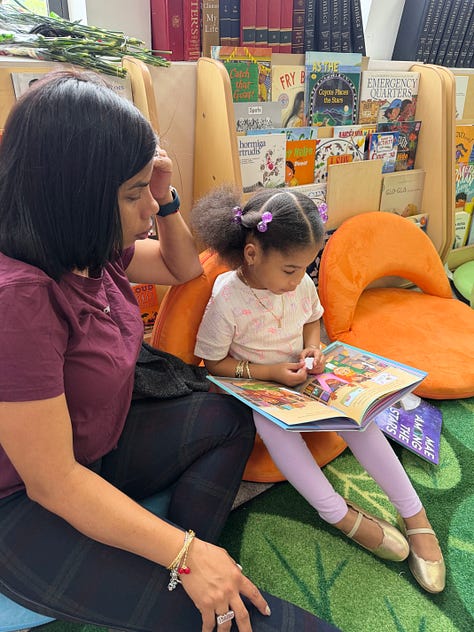
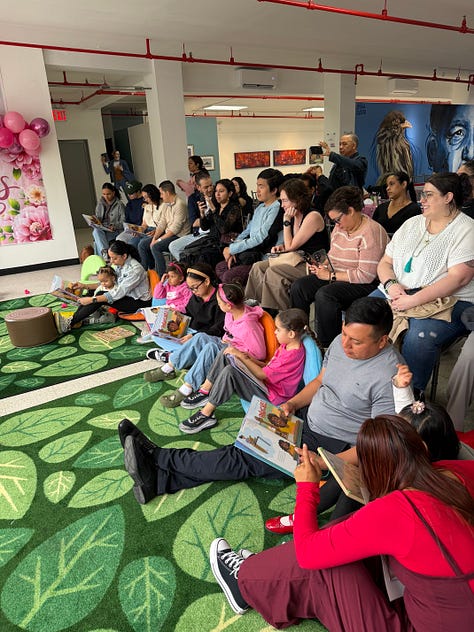
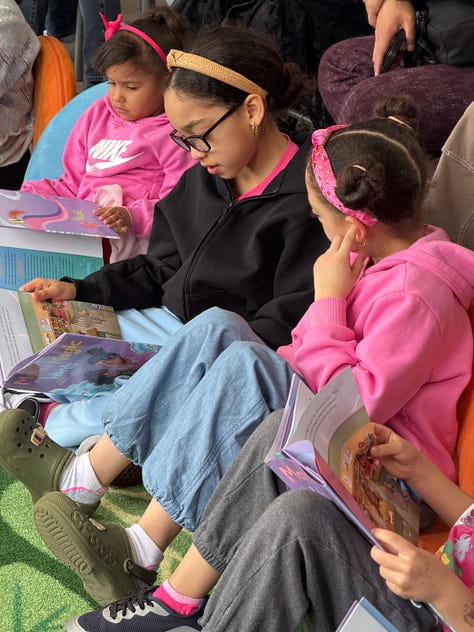
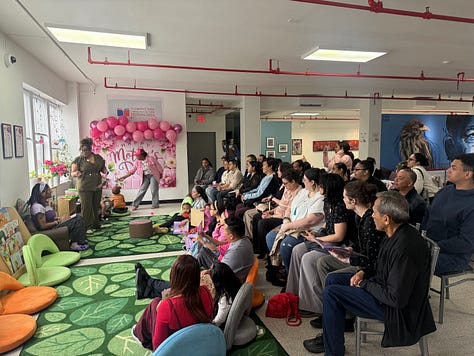
Kiara brought her own copies. The Lil’ Readers room was full. This is what that program is built for, not just putting books in small hands but creating the kind of moment where a child looks up from a page and finds the author sitting right there, someone who grew up on the same streets, who heard the same words in the same kitchens. Children sat on the floor turning pages. A grandmother leaned over to read alongside her grandchild. And then a mother in the room began to cry. She said that for years she had felt invalidated for using these words, made to feel that they were incorrect, that they did not belong in proper speech. But these are the words her family uses to understand one another. These are the words that hold her world together. A picture book had just told her, in front of her children, that she had been right all along. That is what representation does. Not just for children, but for the mothers who have spent years being made to feel that their language, their culture, their way of moving through the world was somehow less than. When a child sees herself in a book, her mother sees herself too. And sometimes that is the thing that heals.
The event happened, and it was everything it was supposed to be, because we made sure of it ourselves.
That is the work. That is always the work.
And here is where you come in.
Big bookstores do not take risks on books they are not sure will sell. They are not in the business of belief. They are in the business of certainty, and certainty is measured in pre-orders, in requests, in the quiet but undeniable signal that a community is paying attention. If we do not make noise, they will stay silent. If we do not walk in and ask, they will never order. If we do not show up for these books, the books will disappear. Not because they weren’t good enough, but because no one told the algorithm they mattered. That is not a publishing problem. That is a community problem, and it has a community solution.
Consider this: this year, only three or four Dominican picture books are being traditionally published. Three or four. In a year. For a community of millions of children who deserve to see themselves on shelves, that number is not a gap. It is an emergency. And when even those few books cannot find their way onto a Barnes and Noble shelf, we have to ask ourselves what we are willing to do about it.
And the consequences of that silence are real. When a Dominican book does not sell in its first few months, publishers take note. They use those numbers to make decisions about the next acquisition, the next Dominican author sitting across the table from an editor, the next story waiting to be told. Every copy that goes unbought is quietly used as evidence that our communities are not worth investing in. We cannot let that be the story they tell.
When you buy a book on Amazon, it counts as a sale but it doesn’t tell a bookstore that the community wants it on the shelf. When you walk into your local bookstore and ask for a title they don’t carry, that request gets recorded. When enough people ask, the book gets ordered. When it gets ordered, it enters the system. When it enters the system, the next family who walks in looking for something that looks like them might actually find it. That is how the algorithm learns what matters, not from what we click at midnight, but from what we ask for in person, with our voices, in the stores that exist in our neighborhoods.
Think about what it means for a child to grow up never seeing themselves in a book. To sit in a classroom surrounded by stories where no one looks like them, speaks like them, or knows the words their mami uses. Now think about what it means when they do. One book can shift something. Not just for the child holding it, but for every adult in the room who never had that moment themselves and is watching it happen for the first time. That is what is at stake every time we choose to show up for these books or choose to look away.
So here is what I am asking. Walk into your local bookstore this week. Ask for Mami’s Magic Words by Kiara Valdez. If they have it, buy it. If they don’t, request it, and then buy it when it arrives. Buy it for the niña in your life. Buy it for the classroom that doesn’t have it yet. Buy it for the little girl who will one day raise her hand in class and say a word her mami taught her, and needs to already know, deep in her bones, that word is real.
Can’t make it to a store? Order it now. Mami’s Magic Words is available wherever books are sold. Every order signals to the industry that this book matters, that our stories matter, that Dominican children deserve to see themselves on shelves. Click the link and get your copy today.
And when you have it in your hands, follow Kiara at @Dezinpub and let her know her community showed up.
The books that belong in our communities will only get there if we put them there. Juntos, we are the algorithm. Share this piece with someone who needs to read it, tag us at @dominicanwriters, and if you are not already part of our community, subscribe to this newsletter so you never miss a story like this one.
The Dominican Writers Association (DWA) is a 501(c)(3) literary arts organization dedicated to amplifying Dominican voices and supporting writers across the diaspora. Through workshops, literary events, mentorship, and publishing resources, DWA creates spaces where Dominican stories can be written, shared, and celebrated, helping ensure Dominican narratives remain visible in the literary and cultural landscape. Visit www.dominicanwriters.org.
📬 Subscribe to our newsletter at dominicanwriters.substack.com for interviews, event recaps, and storytelling that reflects nuestra comunidad.
📚 Support featured authors by buying, reviewing, and requesting their books at your local libraries. Buy Dominican books here.
🤝 Connect with us on Instagram and TikTok @dominicanwriters
🎥 Watch our writing workshops on YouTube
💛 Share this newsletter with your reader friends and help us reach more people who love Dominican books and stories.
🌐 Learn more about our work at dominicanwriters.org
Comments
Nothing yet. Say the first thing.
Sign in to join the conversation.