
Yesterday, the central bank announced March figures for the consumer price index. The BCRD press release began noting that, for both headline and core (by its measure) inflation, priced rose by 4.6% over the past 12 months. This is less than the top of the bank’s target range of 3-5%, and this was said with more than a hint of satisfaction.
Then, however, the Bank set about comparing February to March. OK, we know there has been an oil price shock. But in terms of consumer prices, the impact has been minimal. Yes, gasoline prices were raided by 5% in March—but that’s the only increase we have seen in years. The bank pointed out that “transport” prices were up by a full percent. This is a broad category—one sixth of the index—but gasoline is a modest part of it. But the transport data provides a nuance to that story.
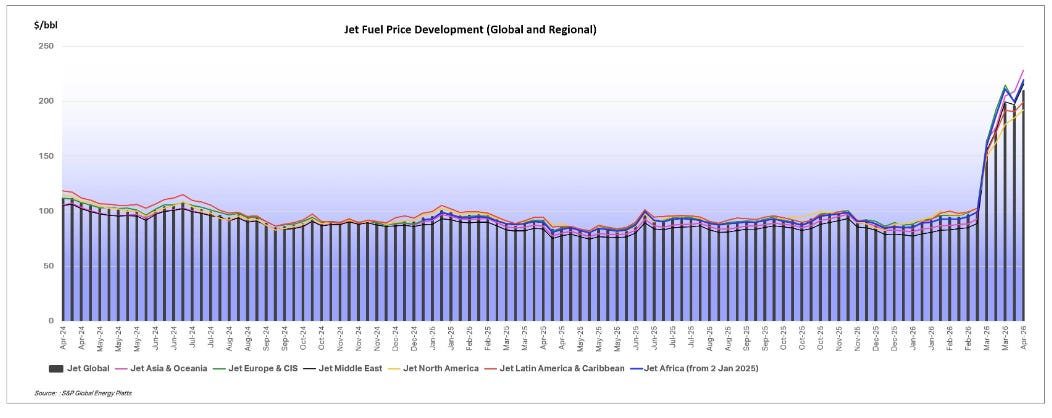
The Ministry of Industry & Mines sets gasoline prices administratively each week.[1] Airlines, however, pay the real cost of fuel (international prices plus a regulated distribution markup). Just between the first week of March and the first week of April, international prices for jet fuel went up by 33%.[2] The difference between pump prices (up 5%) and international prices (up, let’s say, 33%) has been absorbed by the government, so far. Of course, consumers don’t buy jet fuel, so it’s not in the CPI. But what IS in the CPI is airfares, which jumped by 22% from February to March. Jet fuel only makes up about ¼ to 1/3 of airline variable costs, so the fuel price increase alone is not enough to explain all of the rise in ticket prices, but should explain most of it.
Let’s now go back to the inflation indicator I use for assessing the contribution of monetary policy to inflation, the so-called Trimmed-Mean Inflation, where we remove the items that each month have gone up or down the most, mainly for idiosyncratic reasons rather than as the result of monetary actions. And we see from this that, this month, trimmed-mean inflation has remained fairly steady at around 3.8%:
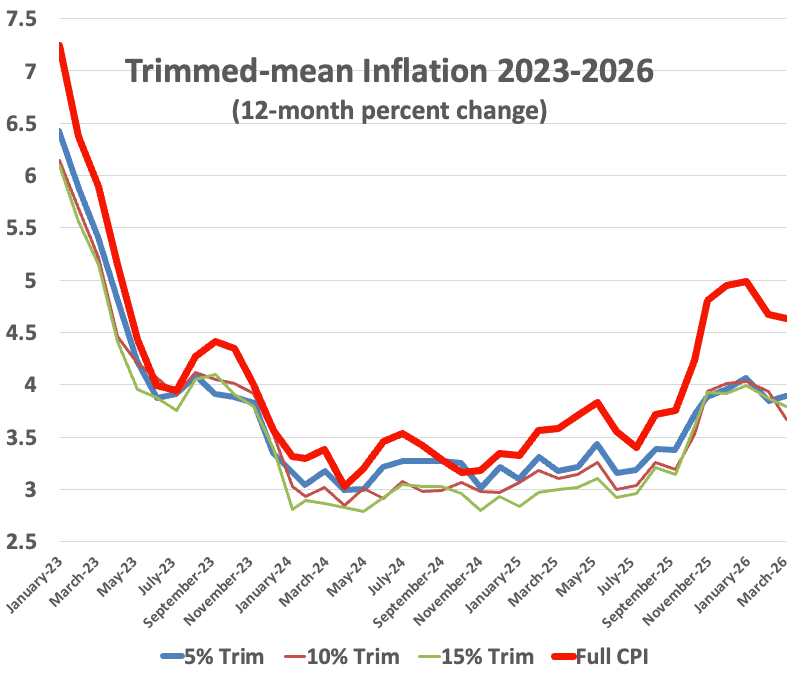
This is substantially lower than the headline inflation faced by consumers in real life, which does include the lingering effects of last autumn’s storms: tubers yuca and malanga (yautia) still show large price increases (though plaintain prices fell sharply in March). Salt cod, which has its own story, also remains 42% above last March prices. But that 22% increase in airfares is the sixth largest increase among CPI items since March 2025 (and a 21% increase from February).
What can we conclude? So far, the impact of the oil shock has been contained, and the government has so far been able to keep a lid on inflation. But for how long? The 5% increase in gas prices is costing the government dearly. And the initial push to get businesses to absorb their cost increases seems to be falling apart. I will write again shortly looking more broadly at the impact of the Iran war on the Dominican economy. From our current vantage point, though, it seems clear that any upcoming inflation will come more from the supply shock than from monetary policy.
[1] Theoretically, all fuels are priced using a formula that reflects import costs, but in practice pump prices have not been adjusted for world prices or exchange rate changes since 2022, with the government absorbing cost increases and pocketing cost declines.
[2] Source: https://www.iata.org/en/publications/economics/fuel-monitor
No posts
Comments
Nothing yet. Say the first thing.
Sign in to join the conversation.