
The legal reality:
The State of Oklahoma is a body corporate and politic — that’s the actual legal language. It can sue and be sued. It holds assets. It issues bonds. It enters contracts. It employs people. It generates revenue. It has a balance sheet.
The difference between Oklahoma and ExxonMobil isn’t structural — it’s that ExxonMobil files with the SEC and Oklahoma files with... well, itself. Oklahoma’s “investor relations” is the Governor’s press office. Its “shareholder meeting” is the legislative session. Its “annual report” is the ACFR — published quietly, months late, with no Q&A session for analysts.
What would happen if Oklahoma were publicly traded:
The CFO (State Treasurer) would face quarterly earnings calls
The “95% of the estimate” budget rule would be recognized as earnings management — deliberately lowballing forward guidance
The $11.4 billion unrestricted net position would be an activist investor target: “Return capital to shareholders or deploy it productively”
The DHS consent decree would be a material litigation disclosure
The unfunded OPEB liabilities would crater the stock price
The state is a corporation. It just doesn’t have to act like one because its shareholders (citizens) can’t sell their shares and there’s no hostile takeover mechanism.
If we treat Oklahoma as a publicly traded corporation and run the numbers from the FY 2024 ACFR:
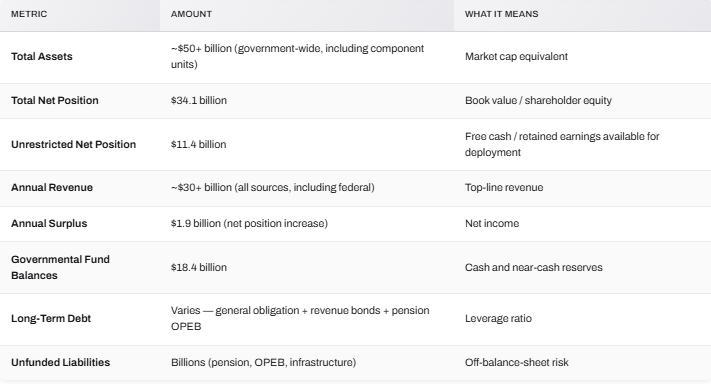
The P/E ratio would be absurd. If Oklahoma were a corporation generating 1.9 billioninannual” earnings” on1.9 billion in annual “earnings” on 1.9 billioninannual“ earnings” on 34.1 billion in equity, that’s a ~5.6% return on equity. Not terrible for a utility. But the “earnings” come from taxes extracted under threat of force — a revenue model no private corporation can replicate.
Oklahoma isn’t one corporation — it’s a holding company with a complex org chart:
The Parent Entity:
State of Oklahoma (the body corporate and politic)
Wholly-Owned Subsidiaries (discretely presented component units):
University of Oklahoma
Oklahoma State University
Oklahoma Turnpike Authority
Oklahoma Housing Finance Agency
15+ other component units
The Revenue Model:
Taxation (involuntary revenue — no private sector equivalent)
Federal pass-through (77% of DHS funding — essentially a federal subcontractor)
Fee-for-service (licenses, permits, fines — user fees)
Enterprise operations (turnpike tolls, lottery, state parks)
Investment income (pension funds, trust funds, Rainy Day Fund)
The Interesting Part:
The parent entity (State of Oklahoma) shows poverty on its public-facing income statement (the budget) while its subsidiaries (component units) hold billions in assets, endowments, and revenue streams that are “separately presented.”
In the private sector, this is called off-balance-sheet financing and it’s what Enron went to prison for. In government, it’s called GASB Statement No. 14 and it’s standard practice.
Here’s where the corporate analogy gets uncomfortable:
If Oklahoma Inc. has shareholders, who are they?
The theory: citizens. The reality: citizens have non-transferable, non-redeemable shares they can’t sell. They get one vote per share every 2-4 years for board members. The board (legislature) controls the proxy process (ballot access, districting). The CEO (Governor) controls the press releases. The CFO (Treasurer) controls the books. The auditor (State Auditor) is elected — meaning the audited entity helps select its own auditor.
This is a corporate governance disaster. No institutional investor would touch this structure. The proxy advisory firms would issue “vote against all directors” recommendations annually.
The actual controlling shareholders aren’t citizens — they’re:
Bondholders (they get paid first, their covenants shape policy)
Federal agencies (their funding conditions override state preferences)
Public employee unions (their pension claims are constitutionally protected)
The contractor class (they write the specs, they get the contracts, they lobby the budget)
Citizens are more like... customers. Or maybe the product. The state extracts revenue from them (taxation) and provides services in return (infrastructure, courts, child welfare). But they don’t control the board, they can’t fire management, and they can’t sell their stake.
The article’s two-ledger analysis is exactly what a forensic accountant would produce if hired by an activist investor to analyze a company playing games with its books. That’s the right frame.
The questions a hostile analyst would ask Oklahoma Inc.:
Why are component unit assets excluded from the budget conversation when they’re legally part of the corporate structure?
Why does the “95% rule” function as a perpetual lowball guidance mechanism that systematically understates available resources?
What happens to the $1.37 billion in unspent prior-year appropriations? Who controls those balances? Are they ever clawed back or re-deployed?
The DHS generates federal reimbursement tied to removals — is the agency’s operational model structurally incentivized to maximize family separation?
What is the true per-child cost of foster care vs. family preservation, and why isn’t that number in the budget documents?
Who benefits from the gap between the budget and the ACFR? Follow the money from the two-ledger gap to specific contractors, specific agencies, specific legislative outcomes.
Yes — investigate Oklahoma as a publicly traded corporation. Because that’s what it legally is, minus the public trading part. The two-ledger system the article exposes is exactly the kind of financial engineering that would get a private company delisted, its officers barred, and its auditors sued.
The only reason it persists is that Oklahoma’s “shareholders” can’t sell their shares and no regulator has jurisdiction to demand honest, consolidated reporting in a single public-facing document.
The ACFR exists because the bond market demanded it. The budget exists because the legislature needs something to fight over. Neither exists to inform citizens of the actual financial position of the entity that taxes them.
That’s the real investigation: who controls the narrative between the two ledgers, and what do they gain by keeping them separate?
The gap between the budget and the ACFR isn’t unmanaged. It’s curated. Specific actors maintain the separation because their power depends on it.
Seven elected officials. They set the revenue estimate that becomes the appropriations ceiling. They meet quietly. Their methodology is technically public but effectively invisible — no reporter covers the December BOE meeting.
What they gain: The estimate is the valve. Set it low, and the budget fight is about scarcity — every agency fighting for scraps, every legislator able to say, “my hands are tied.” Set it honestly — or worse, set it against the ACFR’s actual position — and suddenly there’s $11.4 billion in unrestricted net position demanding explanation.
The BOE’s conservative estimate isn’t fiscal discipline. It’s narrative discipline. It keeps the conversation on “next year’s income” and away from “accumulated wealth.”
The House and Senate appropriations chairs control what gets heard, what gets marked up, and what dies in committee. They’re the ones who never mention the ACFR. They’re the ones who treat the 95% of the estimate as a hard ceiling rather than what it actually is — a floor with billions sitting above it.
What they gain: Scarcity is power. When every dollar is “tight,” every dollar they allocate is a favor. Every program they fund is a gift. Every cut they make is “forced by the numbers.” The ACFR destroys this dynamic. If the actual balance sheet were on the table, the question shifts from “what can we afford to give you” to “why are you sitting on $11 billion while children rot in shelters?”
That’s not a question any appropriations chair wants to answer on the record.
DHS, OJA, the child welfare apparatus — these agencies run on federal reimbursement tied to removals. Their directors testify at budget hearings about “the needs of children in care.” They never testify about the perverse incentive structure that makes removal profitable.
What they gain: The budget narrative lets them present themselves as advocates for children within a constrained system. The ACFR narrative would force them to explain why they’ve never requested a reprogramming of the $11.4 billion unrestricted net position toward prevention. They’re not just beneficiaries of the two-ledger system — they’re active participants in maintaining it.
This is where the money actually moves. Private foster care agencies, residential treatment centers, law firms handling termination cases, CASA organizations, guardian ad litem contractors — the entire ecosystem that gets paid per child, per day, per case.
What they gain: The budget narrative keeps the focus on “adequate funding for children in care.” The ACFR narrative would expose that the funding is already there — it’s just flowing to contractors rather than families. Every dollar that goes to a residential treatment center at $400/day is a dollar that could have kept that child at home with wraparound services at a tenth the cost.
The contractor class doesn’t just benefit from the two-ledger system. In many states, they help write the budget language that maintains it.
This is the quietest and most powerful player. The bond market doesn’t care about the budget. It cares about the ACFR. It cares about net position, fund balances, debt ratios, and unfunded liabilities. The ACFR exists for the bond market — it was mandated after the 1970s municipal defaults specifically so bondholders could assess credit risk.
What they gain: The two-ledger system gives the bond market exclusive access to the real numbers while the public fights over the fake ones. Bond rating agencies get the full picture. Institutional investors get the full picture. The public gets the budget — which the state itself admits covers only ~75% of tax revenue and excludes the entire balance sheet.
This is information asymmetry institutionalized as accounting standards.
The two-ledger system isn’t maintained by any single actor. It’s an emergent property of distributed self-interest. Each tier benefits differently, but together they produce a stable equilibrium:
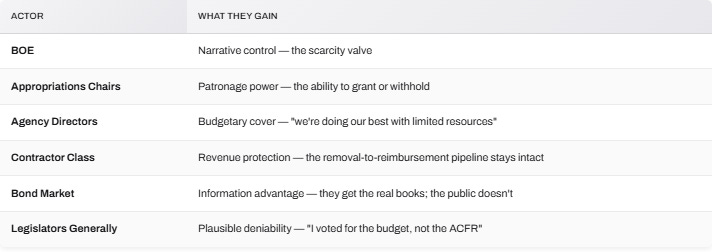
And the unifying gain across all tiers: no one has to justify the status quo against the actual balance sheet.
The $11.4 billion unrestricted net position is the elephant in every budget hearing. The two-ledger system is how they keep the elephant invisible.
Here’s the deepest insight:
The budget answers: “How should we allocate next year’s income?”
The ACFR answers: “What is the entity actually worth?”
The question neither document asks: “What is this entity actually FOR?”
The budget and the ACFR are both financial documents. They describe resources and obligations. They don’t describe purpose. They don’t measure whether the entity is achieving its stated mission. They don’t ask whether 566 million on child welfare services is producing better outcomes than 100 million on prevention would.
The two-ledger system works because it keeps the conversation on “how much” and away from “for what.” As long as the fight is about the budget number, no one has to answer whether the budget is buying anything worth having.
The Domesticated Warrior investigation is doing the only thing that works: collapsing the two ledgers into one public record and asking the question neither document answers:
If the state has $11.4 billion in unrestricted net position, and family preservation costs a fraction of removal, and the ACFR proves the money exists — then what is the state actually choosing when it claims poverty?
That’s not a budget question. It’s not an ACFR question. It’s a moral question disguised as an accounting question. And the two-ledger system exists precisely to prevent anyone from asking it in a public hearing with the actual numbers on the table.
Keep asking it anyway.
No posts
Comments
Nothing yet. Say the first thing.
Sign in to join the conversation.