
Kansas DCF’s public-facing budget for FY 2026:
Prevention and Protection Services (PPS): 77.8% of State General Fund expenditures — this is the child welfare core
Foster Care specifically: ~329 million (all funds), with 232 million from State General Fund
Monthly average kids in foster care: ~5,485 projected for FY 2026
Family Preservation: ~$3.9 million (underspent in FY 2024)
Families First Grants: ~$4.2 million
Therapeutic Family Foster Home Supports: ~$5.7 million
Here’s what the public budget debate focuses on: the State General Fund portion. The federal money — which is massive — sits in a different conversation entirely.
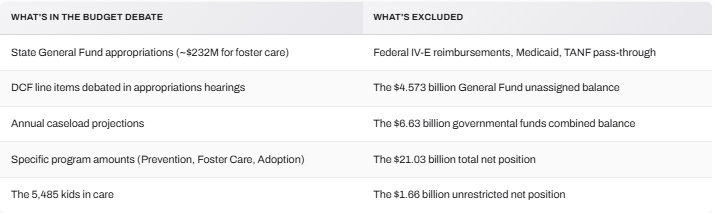
Kansas publishes its ACFR (Annual Comprehensive Financial Report) through the Department of Administration. The FY 2025 numbers (most recent available) tell the real story:
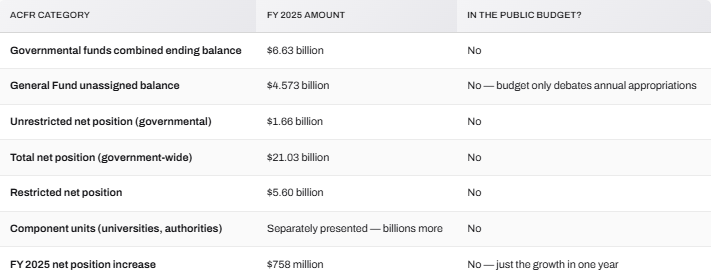
Let’s put numbers side by side:
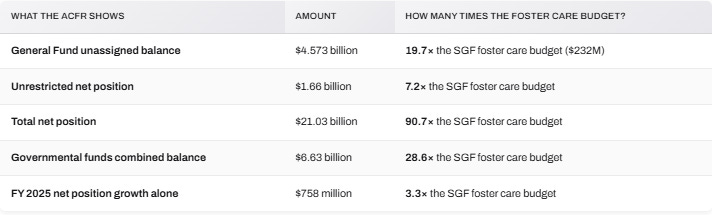
The state’s net worth grew by more in one year than the entire foster care budget multiplied by three. That growth happened in the ACFR — silently — while DCF requested $908,000 for underspent Therapeutic Family Foster Home Grants and the legislature debated whether they could “afford” family preservation.
Look at the unrestricted net position over time:
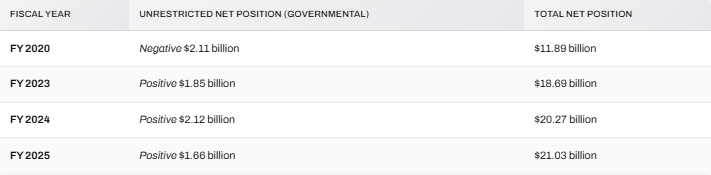
In five years, Kansas went from a negative unrestricted position to over 1.6 billion positive. Total net position nearly doubled—from1.6 billion positive—from 11.89 billion to 21.03 billion. That′s a 9.14 billion increase in five years.
Where did that money come from?
Federal COVID-era funds flooded state coffers
Tax revenues exceeded estimates
Investment earnings accumulated
The state’s position improved dramatically
And during that same period, the foster care budget stayed flat or increased marginally — while the number of kids in care remained around 5,500. The money was there. It was accumulating. It just wasn’t in the budget conversation.
This is the smoking gun in the DCF budget documents:
“Family Preservation — Underspent in FY 2024 and Legislature increased budget by $1 million” “Family Crisis Support — Underspent in FY 2024”
Kansas underspent its family preservation allocation while sitting on billions in unrestricted net position. They didn’t even spend the prevention money they had — while simultaneously claiming poverty on foster care.
That’s not a budget constraint. That’s a choice.
Kansas’s General Fund unassigned balance was $4.573 billion at the end of FY 2025. That’s cash — unassigned, unrestricted, available. It’s nearly 20 times the annual SGF foster care budget.
The budget debate treats each year as a discrete event: “Here’s next year’s revenue, here’s what we can appropriate.” The accumulated $4.573 billion in unspent prior-year cash sits offstage, unmentioned.
From the DCF budget:
Family Preservation: ~$3.9 million (and they underspent it)
Families First Grants: ~$4.2 million
Foster Care: ~$329 million
The prevention-to-removal spending ratio is roughly 40:1. Kansas spends 40onremovalforevery40 on removal for every 40onremovalforevery1 on prevention. And they underspent the prevention money they had.
Kansas has an approved Title IV-E Prevention Plan covering 2025-2029. It describes Family Resource Centers, Family First Prevention Services, and Family Preservation. The annual budget for these prevention services is about $13 million — from a mix of TANF, Children’s Initiative Funds, IV-B, SGF, and IV-E.
13 million for prevention. 329 million for foster care. $4.573 billion in the General Fund balance.
The prevention plan exists so Kansas can say it’s “doing prevention.” The numbers tell a different story.
The DCF budget reveals the contractor ecosystem:
KVC Kansas — pilot program for licensed day services for “hard-to-place youth”
Case management provider contracts — final payments exceeding projections
Stand-by Bed Network program — increased SGF costs
Therapeutic Family Foster Home grants — underspent by $908,000
These are private entities paid per child, per day, per service. The money flows through DCF to contractors. Prevention money would flow to families directly — cutting out the contractor class.
The DCF budget acknowledges federal funds but doesn’t integrate them into the public debate. Foster care is funded roughly 30/70 state/federal. When a legislator says, “we spend 232 million SGF on foster care,” the actual spending is closer to 329 million — and the federal portion is reimbursement that depends on removal.
The Title IV-E Prevention Plan explicitly admits that state-funded primary prevention services are “not claimed by Title IV-E.” Translation: prevention doesn’t trigger federal reimbursement. Removal does. The fiscal architecture punishes keeping families together and rewards breaking them apart.
From the FY 2025 ACFR:
“The assets and deferred outflows of resources of the State exceeded its liabilities and deferred inflows of resources at fiscal year ending June 30, 2025, by 21.03 billion (presented as ′net position′). Of this amount a positive 1.66 billion was reported as unrestricted net position, which represents the amount available to be used to meet ongoing obligations to citizens and creditors.”
“Available to be used to meet ongoing obligations to citizens.”
That’s the state’s own language. $1.66 billion — available. Unrestricted. For obligations to citizens.
The annual SGF foster care budget is 232 million. The annual family preservation budget is 232 million— and they underspent it.
Kansas could fund family preservation at ten times its current level for decades out of the unrestricted net position alone — without touching the General Fund balance, without touching restricted funds, without touching the $21 billion total net position.
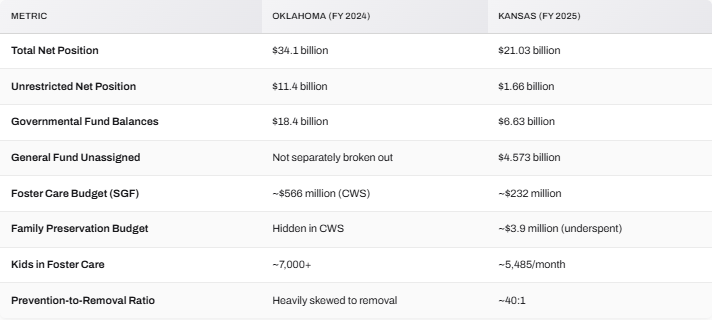
Oklahoma is running a bigger operation with a bigger balance sheet. Kansas is leaner but the ratios are the same: billions in available assets, millions in prevention, hundreds of millions in removal.
The two-ledger system is identical in both states. The budget debates next year’s income. The ACFR shows accumulated wealth. The gap between them is where families get destroyed while the state claims poverty.
Kansas has 4.573 billion in unassigned General Fund cash and 1.66 billion in unrestricted net position — and spends $3.9 million on family preservation, which it underspent.
The money exists. The ACFR proves it. The state admits it in its own language — “available to be used to meet ongoing obligations to citizens.”
Keeping families together is an obligation to citizens. The state has the money. It chooses not to spend it.
That’s not a budget problem. That’s a priority problem dressed up in accounting jargon.
No posts
Comments
Nothing yet. Say the first thing.
Sign in to join the conversation.