
By Domesticated Warrior
There’s a particular kind of gaslighting that happens when you ask a state legislator why they keep funding a system that destroys families. They’ll sigh. They’ll lean back. They’ll tell you it’s complicated. They’ll say their hands are tied by federal funding requirements. They’ll say they’d love to fund family preservation, but there’s just no money. They’ll say reform sounds great in theory, but the budget is the budget.
We have read Oklahoma’s budget. Both of them.
We are here to tell you: they’re lying. Not misleading. Not mistaken. Lying. And will be proven with their own documents.
Every state keeps two financial pictures. The first is the budget — the public-facing document legislators debate on C-SPAN and reporters summarize in 400 words. It shows revenues, expenditures, shortfalls, and the annual drama of what gets funded and what gets cut.
The second is the Annual Comprehensive Financial Report — the ACFR, formerly called the CAFR. This is the state’s actual balance sheet. Assets, liabilities, investments, fund balances, the whole corporate accounting treatment. It’s published every year, filed with the state, and almost never discussed in public.
The budget is what they want you to see. The ACFR is what they actually have.
Oklahoma’s FY 2024 ACFR, published December 2025, tells a story the budget hearings never will.
Let’s start with the number that makes everything else make sense.
Oklahoma’s total net position — assets plus deferred outflows, minus liabilities and deferred inflows — is $34.1 billion.
Of that, $11.4 billion is unrestricted. That means it’s not tied to pensions, not pledged to bondholders, not locked in trust funds. It’s money the state can spend — on anything — right now.
The governmental funds alone show a combined ending fund balance of $18.4 billion. Of that, $10.2 billion is “committed” — meaning the legislature has designated it for specific purposes, which the legislature can also un-designate with a vote. Another $2.9 billion is “restricted” by external requirements. And $341.3 million is completely unassigned — just cash sitting there with no strings at all.
The net position increased by $1.9 billion in FY 2024 alone — a 5.9% jump in a single year.
Oklahoma is not broke. Oklahoma is not struggling. Oklahoma is sitting on a mountain of wealth that grows by billions annually while legislators claim they can’t afford to keep families together.
Now let’s look at the other side of the ledger — the Department of Human Services Budget Performance Review for FY 2024, filed with the Oklahoma Senate.
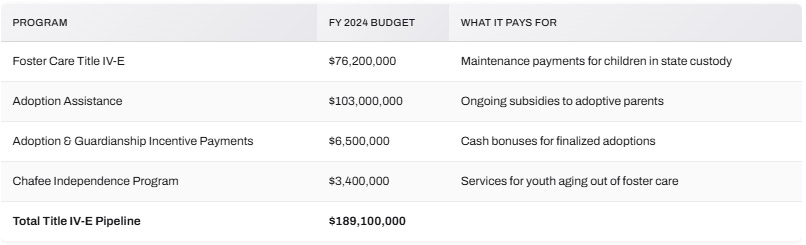
Child Welfare Services — the division that investigates families, removes children, places them in foster care, and processes adoptions — has a total budget of $566.4 million.
Within that, the Title IV-E federal reimbursement pipeline breaks down like this:
And the prevention program — the Family First Prevention Services Act money that’s supposed to keep families together, so children never enter foster care?
$1,203,015.
That’s not a typo. One point two million dollars for prevention. One hundred eighty-nine million for removal and termination.
For every dollar Oklahoma spends preventing family separation, it spends $157 on separation and termination.
This is where the corruption stops being abstract and becomes arithmetic.
Oklahoma’s FMAP — the Federal Medical Assistance Percentage that determines how much of every dollar gets reimbursed — is 67.08%. That means for every dollar the state spends on Title IV-E eligible costs, Uncle Sam sends back 67.08 cents. The state only covers 32.92 cents.
Now apply that to the actual foster care rates.
Oklahoma pays foster parents a maintenance rate based on the child’s age:
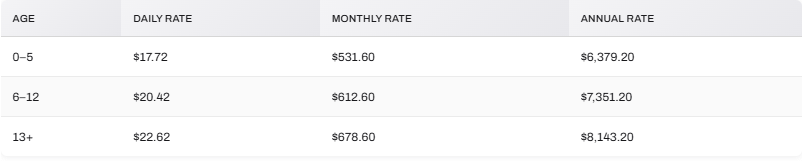
These rates haven’t been raised since July 2018. Oklahoma pays foster parents less per hour to raise a traumatized child than it costs to park a car in downtown Oklahoma City. But the foster parent’s stipend isn’t where the money is. The money is in the federal reimbursement on every dollar the state spends.
Take a single infant, removed at birth, placed in foster care:

The state pays $2,100 to house that child for a year — and collects $4,279 from the federal government. On maintenance payments alone.
But maintenance is only part of the claim. Administrative costs — caseworker salaries, court expenses, agency overhead — are all rolled into the Title IV-E drawdown. A single child in foster care can generate $7,000 to $8,500 in federal reimbursements per year, of which the state only puts up about a third.
Now follow that child through termination of parental rights and adoption:
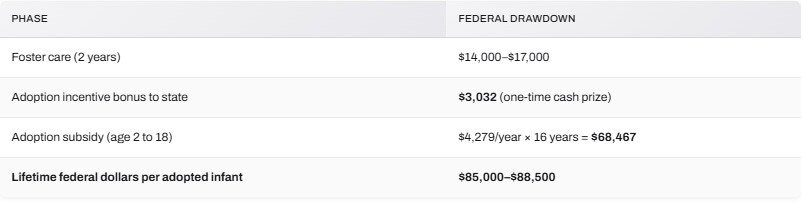
That’s per child. Oklahoma finalized 2,144 adoptions in FY 2024. The future federal revenue commitment from that single year’s adoption cohort runs somewhere between $180 million and $190 million — money that will flow into the state treasury over the next two decades, almost entirely invisible in any single year’s budget.
Now compare the alternatives:

A prevented removal generates zero federal dollars. A finalized adoption generates an eighty-five-thousand-dollar federal annuity.
The math is not ambiguous. The math is a moral indictment.
Let’s pause on that adoption incentive payment line item. CFDA 93.603 — Adoption and Legal Guardianship Incentive Payments. Oklahoma budgeted $6.5 million for this in FY 2024.
This is bonus money. Separate from the ongoing subsidy reimbursements. Separate from the administrative cost claims. The federal government literally writes Oklahoma a check for hitting adoption targets. The more parental rights you terminate, the more children you move through the adoption pipeline, the bigger the bonus.
At 2,144 finalized adoptions, that works out to roughly $3,032 per child in pure incentive money. The state gets a commission for permanently severing the parent-child bond.
There is no equivalent bonus for reunification. There is no incentive payment for keeping a family intact. The federal government does not cut Oklahoma a check when a child goes home.
The Family First Prevention Services Act was signed into law in 2018 with much fanfare. For the first time, states could draw Title IV-E funds for prevention — mental health services, substance abuse treatment, in-home parenting programs — without removing a single child. Reformers hailed it as a paradigm shift.
Oklahoma’s FY 2025 draw for prevention services: $1,203,015.
Compare:
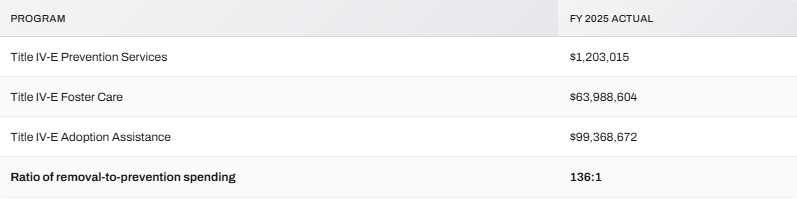
For every dollar Oklahoma spent trying to keep families together, it spent $136 on separating them. The FFPSA “reform” is a press release. The money still flows to removal because the money has always flowed to removal, and the entire administrative apparatus — the caseworkers, the contractors, the evaluators, the agencies, the billing systems — is built to process removals, not prevent them.
Oklahoma leaves federal prevention dollars on the table. Not because it can’t access them. Because accessing them would require retooling a machine that everyone in the machine is paid to keep running.
The Constitutional Reserve Fund — what everyone calls the Rainy-Day Fund — is the most politically useful piece of Oklahoma’s balance sheet, because it lets legislators perform fiscal responsibility while families burn.
The Rainy-Day Fund is inside the ACFR’s governmental funds balance. From the FY 2024 ACFR:

That $1.4 billion is part of the $18.4 billion governmental fund balance, which is part of the $34.1 billion total net position, which includes the $11.4 billion unrestricted net position.
The Rainy Day Fund isn’t extra money on top. It’s a subset — a constitutionally walled-off slice of the larger hoard. But the walls have doors, and the doors have keys, and the keys are held by the same people who claim their hands are tied.
Oklahoma’s Constitution (Article X, Section 23) governs the Rainy-Day Fund:
Deposits: Any General Revenue Fund collections that exceed the State Board of Equalization’s estimate get automatically swept into the Rainy-Day Fund — until the balance hits 15% of the prior year’s General Revenue Fund certified appropriations.
Withdrawals — three triggers:
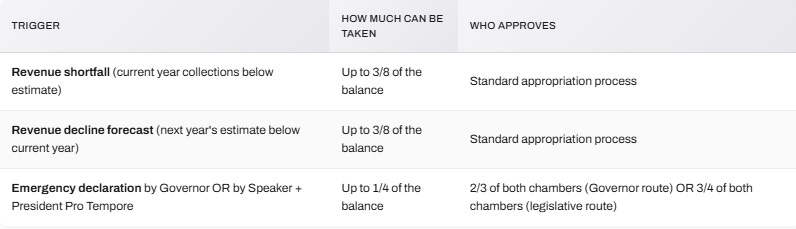
There’s also a fourth trigger — up to $10 million for tax incentives for at-risk manufacturers — that’s never been used.
The FY 2024 ACFR shows the fund at $1.4 billion as of June 30, 2024. But by the Governor’s FY 2026 Budget Book, the combined reserves picture had grown:

And that’s just the dedicated reserve funds. The Governor’s budget also identified:
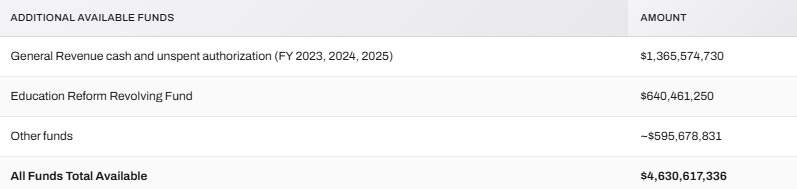
The state is sitting on $4.6 billion in identified, available, unspent money — above and beyond the normal appropriations — just from these reserve and carryover accounts. And that’s before you even get to the rest of the unrestricted net position in the ACFR.
Here’s the trap door.
The Rainy Day Fund can be tapped when the Governor declares an emergency and two-thirds of the legislature concurs. At $1.4 billion, one-quarter is $350 million — accessible with an emergency declaration.
Question: Is the systematic removal of thousands of children from their families, the conversion of those children into federal revenue streams, the payment of cash bonuses for terminating parental rights, and the deliberate starvation of prevention services — is that an emergency?
The legislators who vote for the DHS budget every year apparently don’t think so. Or more precisely, they don’t want to call it one, because calling it an emergency would require them to do something about it.
But watch what they do declare emergencies for:
Revenue shortfalls during oil downturns
Natural disasters
Public health declarations
Budget gaps that threaten agency operations
The family court cartel is not an emergency because acknowledging it as one would force a confrontation with the contractor ecosystem, the federal reimbursement pipeline, and the political donor class that depends on both. Easier to call it “complicated” and keep voting for the budget.
One-quarter of the Rainy-Day Fund — accessible with an emergency declaration and a supermajority vote — is $350 million.
Recall our prevention-first budget:
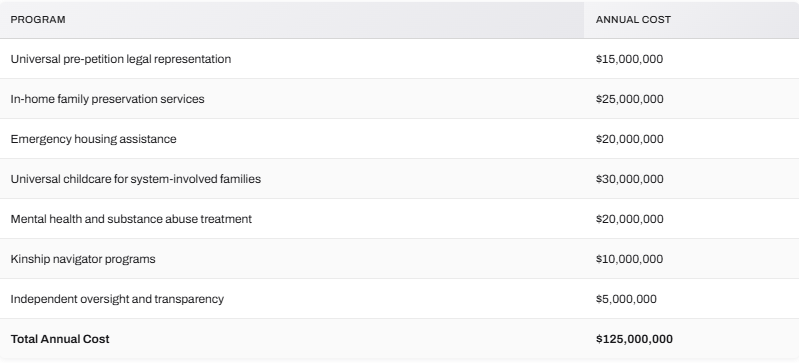
$350 million funds the entire prevention-first system for 2.8 years. That’s enough time to stand up the programs, demonstrate the outcomes, reduce the foster care population, shrink the Title IV-E dependency, and transition to a sustainable model — all without touching the rest of the ACFR’s unrestricted net position, without raising taxes, and without cutting any existing service.
Or consider this: the entire state share of the Title IV-E pipeline — the money Oklahoma actually pays out of pocket for foster care and adoption assistance — is about $60 million per year. The Rainy-Day Fund alone could cover that for nearly six years while the state transitions away from the federal reimbursement model entirely.
The Rainy-Day Fund serves a specific political function: it lets legislators perform fiscal conservatism while avoiding hard choices.
During boom years, they brag about deposits. “We’ve filled the Rainy Day Fund to record levels!”
During budget hearings, they point to it as proof of responsibility. “We’ve prepared for the future!”
When asked to spend it on families, they suddenly discover constitutional restrictions. “Our hands are tied — the fund can only be used for specific triggers.”
But the triggers exist. An emergency declaration requires political will, not a constitutional amendment. Two-thirds of the legislature can authorize a draw. The Governor can initiate the process with a signature.
The Rainy Day Fund has been tapped before — during the 2003-2004 revenue downturn, nearly the entire balance was spent to maintain service levels. The mechanism works. The question is what counts as an emergency worth spending it on.
A budget shortfall that threatens agency operations? Emergency.
The systematic destruction of thousands of families for federal reimbursement? Not an emergency.
Now let’s return to that ACFR number. $11.4 billion in unrestricted net position.
What could Oklahoma do with that money if it chose families over the federal pipeline?
The federal share of the foster care and adoption pipeline is about $122 million per year. Oklahoma could tell the federal government thanks but no thanks, fund the entire child welfare system with state dollars, and set its own rules — no removal requirements, no adoption quotas, no incentive bonuses.
How long would $11.4 billion last at that burn rate?
93 years.
And that’s assuming zero investment returns. At a conservative 4% annual return, the portfolio generates $456 million per year — nearly four times the federal drawdown. The state could fund child welfare entirely off the interest and never touch the principal.
Here’s what a prevention-first system would actually cost:
$125,000,000 per year — the itemized budget above.
That’s $65 million more than the state’s current Title IV-E state share — a rounding error on an $11.4 billion balance sheet. Funded entirely from investment returns, it leaves $331 million in annual surplus — forever.
Oklahoma could keep accepting federal Title IV-E money for existing cases while funding universal prevention with state dollars. Total new spend: $125 million per year. Funded from investment returns. Surplus: $331 million per year. No tax increases. No budget cuts. No federal permission required.
The money exists. The math works. The prevention model is cheaper in the long run and morally unassailable in the short run. So why won’t they do it?
Because the current system is not a failure. It is a revenue model.
If Oklahoma funded family preservation with its own money:
The federal drawdown stops. No more $122 million annual reimbursement. The money would still be spent — but the state would pay directly instead of being paid by the system. The treasury loses a revenue stream that has been flowing for decades.
The contractor ecosystem collapses. Private foster care agencies bill $43.86 per day per child — nearly double the traditional rate. Therapeutic foster care, contracted group homes, private adoption agencies, court-appointed evaluators, supervised visitation monitors — all of them bill the state, and all of those bills are reimbursed at 67.08% by the feds. A prevention-first system shrinks that market by hundreds of millions of dollars. These contractors donate to legislative campaigns. They employ constituents. They have lobbyists.
DHS shrinks. Fewer removals mean fewer caseworkers, fewer supervisors, fewer administrators. The agency’s budget, headcount, and political power contract. Bureaucracies do not voluntarily shrink themselves. The people who run DHS have spent their careers building the current system. They are not going to dismantle it.
The adoption bonus pipeline dries up. No more $3,032-per-child incentive checks. No more performance metrics tied to termination throughput. The entire ASFA-era machinery — the Adoption and Safe Families Act of 1997, with its adoption quotas and bonus structures — runs on finalized adoptions. Prevention produces fewer of them.
The political donor class loses a revenue source. The family law bar. The contractor lobby. The public sector unions whose membership swells with every agency expansion. All of them fund legislative campaigns. All of them benefit from the current system. Prevention-first means fewer billable hours, fewer contracts, fewer dues-paying members, fewer campaign contributions.
Here’s what makes the Rainy-Day Fund particularly damning in context:
Layer 1: The state has $4.6 billion in identified reserves and unspent carryover — cash on hand, above and beyond normal appropriations.
Layer 2: The state has $11.4 billion in unrestricted net position — assets that could be deployed for any lawful purpose.
Layer 3: The state has $1.4 billion in a constitutionally protected Rainy Day Fund — with legal mechanisms to access up to $350 million for emergencies.
And yet legislators claim there’s no money for family preservation. They claim they’re dependent on the Title IV-E federal pipeline. They claim reform is “fiscally impossible.”
The money is not just available. It’s sitting in three separate piles, each of which could fund a prevention-first child welfare system for years. The legislators who claim poverty are standing on a mountain of cash, looking families in the eye, and saying there’s nothing they can do.
Here is what the documents prove, in black and white:
Oklahoma has $11.4 billion in unrestricted assets — documented in the FY 2024 ACFR, published by the Office of Management and Enterprise Services, signed by the State Comptroller, filed with the state.
Oklahoma spends $189 million on the removal-to-adoption pipeline — documented in the FY 2024 DHS Budget Performance Review, filed with the Oklahoma Senate.
Oklahoma spends $1.2 million on prevention — documented in the FY 2025 DHS BPR, same filing system, same agency.
The federal reimbursement rate is 67.08% — documented in the Federal Register, November 2023, effective October 2024 through September 2025.
Adoption generates six-figure federal annuities per child while reunification generates nothing — derived from the published foster care rates, the published adoption subsidy rates, the published FMAP, and simple arithmetic.
The state could fund universal family preservation forever on investment returns alone — derived from the ACFR’s unrestricted net position, a 4% conservative return assumption, and the itemized prevention budget above.
The Rainy-Day Fund holds $1.4 billion with legal emergency triggers to access $350 million — documented in the Oklahoma Constitution, Article X, Section 23, and confirmed in the FY 2024 ACFR.
The state has $4.6 billion in identified reserves and unspent carryover above normal appropriations — documented in the Governor’s FY 2026 Budget Book.
These are not estimates. These are not projections from some think tank. These are the state’s own numbers, published by the state’s own agencies, filed with the state’s own legislature.
A legislator who votes for the DHS appropriation is voting for a system where:
A prevented removal generates $0 in federal revenue
A finalized adoption generates $85,000+ in federal revenue
Adoption incentive bonuses pay $3,032 per child as a cash prize for terminating parental rights
Prevention services receive 1/157th the funding of removal and termination
The state sits on $11.4 billion in unrestricted assets while claiming poverty
The Rainy-Day Fund holds $1.4 billion with accessible emergency triggers
Private contractors bill $43.86/day while foster parents get $17.72/day
The investment portfolio earns more in a single year than the entire federal drawdown
This is not a broken system that needs reform. This is a functioning revenue model that produces exactly what it is incentivized to produce: separated children, terminated rights, finalized adoptions, and a steady flow of federal reimbursements into the state treasury.
The legislators know. They have the same documents I have. They vote on the same budgets I’ve cited. They sit through the same hearings where these numbers are presented.
They know that the money exists to do this differently. They know that prevention is cheaper, more humane, and fully fundable without raising taxes. They know that every child removed is a child converted into a revenue stream.
They know. And they vote for it anyway.
That’s not governance. That’s not pragmatism. That’s not “working within the system.”
That’s corruption — documented, itemized, and signed by the State Comptroller.
At the next town hall, the next committee hearing, the next fundraiser, ask them this:
“The Rainy-Day Fund has $1.4 billion. The Revenue Stabilization Fund has $663 million. Unspent carryover is another $1.37 billion. The ACFR shows $11.4 billion in unrestricted net position. You have legal mechanisms to access all of it. And you spend $157 on removal for every $1 on prevention. At what point does the destruction of Oklahoma families count as an emergency worth spending money on?”
They won’t answer. Because the answer — “it’s not an emergency when the victims are poor, isolated, and don’t write campaign checks” — doesn’t play well on camera.
The Rainy-Day Fund proves the money exists. The emergency triggers prove it’s accessible. The refusal to use it proves the choice.
It’s not raining hard enough for the people inside the Capitol. It’s flooding for everyone else.
The ACFR and the BPR are public records. Anyone can download them. Anyone can read them. Anyone can walk into a legislator’s town hall, hold up the printouts, and ask the question.
Make them answer. On camera. In public. On the record.
The money proves the corruption. The corruption proves the choice. And the choice can be unmade — but only if voters make the current choice politically more expensive than changing it.
Domesticated Warrior is a reader-supported publication. To receive new posts and support this work, consider becoming a free or paid subscriber.
Sources:
Oklahoma FY 2024 Annual Comprehensive Financial Report (OMES, published December 2025)
Oklahoma FY 2024 DHS Budget Performance Review (Oklahoma Senate, filed January 2025)
Oklahoma FY 2025 DHS Budget Performance Review (Oklahoma Senate, filed January 2026)
Governor’s FY 2026 Budget Book Summary (OMES)
Federal Register, Vol. 88, No. 223 — FMAP Rates for FY 2025 (November 21, 2023)
Oklahoma DHS Foster Care Reimbursement Rates Schedule (current as of FY 2024)
Oklahoma Administrative Code § 340:75-7-52 — Foster Care Maintenance Payments
Oklahoma State Adoption Assistance Program rates (OKDHS, updated February 2024)
HHS Child Welfare Outcomes Data — Oklahoma (ACYF, FY 2024)
Title IV-E Programs Expenditure and Caseload Data 2024 (Children’s Bureau, published May 2026)
Oklahoma Constitution, Article X, Section 23
Oklahoma State Board of Equalization — FY 2025 Certification Packet (June 2024)
No posts
Comments
Nothing yet. Say the first thing.
Sign in to join the conversation.