
By Domesticated Warrior
If you’ve spent any time in the child welfare world, you’ve probably heard the same heartbreaking story over and over:
“My attorney never returned my calls.”
“I met my lawyer five minutes before court.”
“They never asked what I wanted.”
“They seemed to be working with DHS instead of representing me.”
Unfortunately, these complaints aren’t rare.
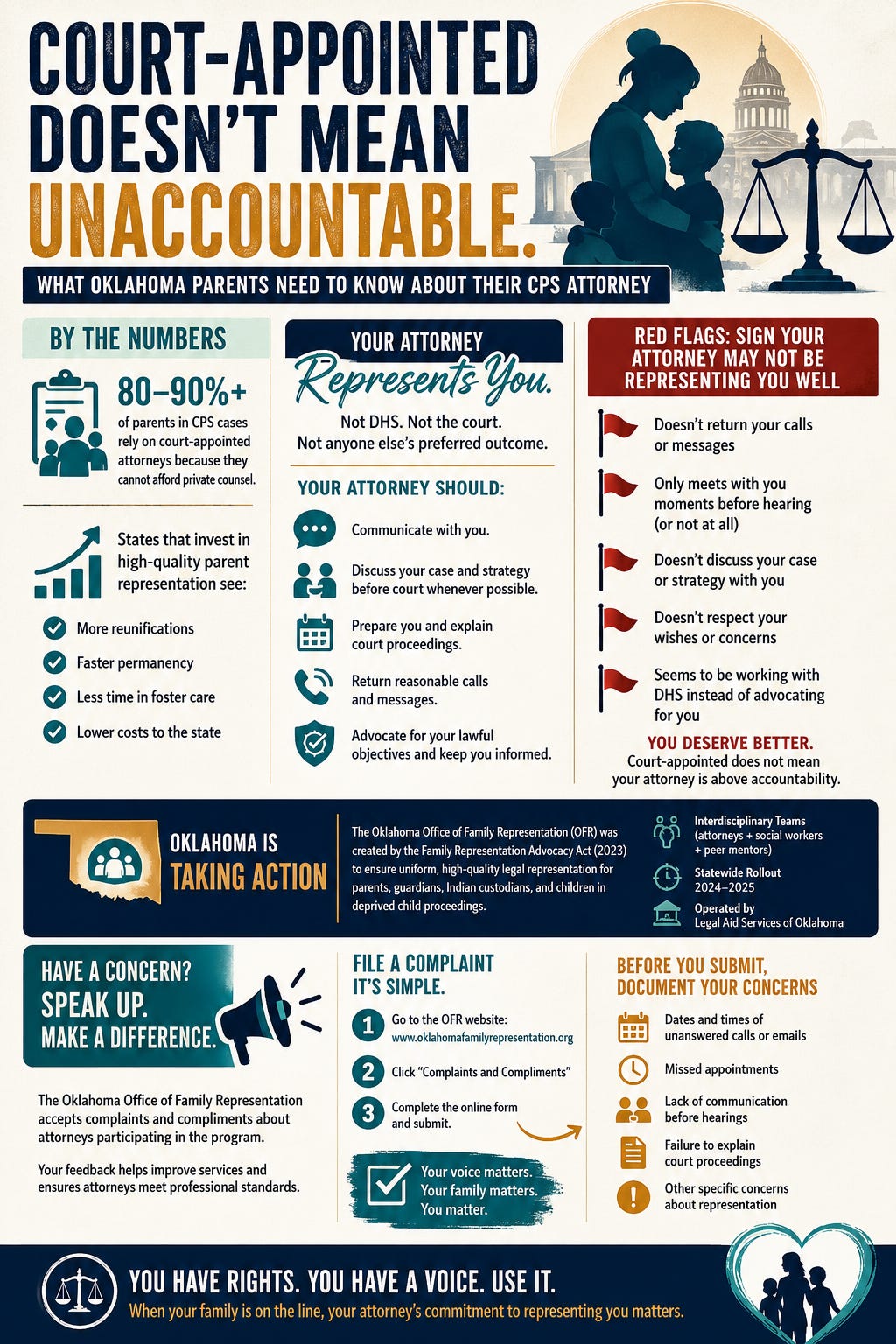
Nationally, an estimated 80–90% of parents involved in Child Protective Services (CPS) cases rely on court-appointed attorneys because they cannot afford private counsel. While many appointed attorneys are dedicated advocates working under enormous caseloads, parents frequently report feeling unheard, uninformed, or unprepared throughout the court process.
Research from multiple states has consistently found that when parents receive high-quality, well-resourced legal representation early in a case, outcomes improve.
Studies of parent representation programs have found:
More children safely reunify with their families.
Cases reach permanency more quickly.
Children spend less time in foster care.
Fewer children are removed unnecessarily.
States often spend less money overall.
Quality legal representation isn’t simply about winning hearings—it’s about ensuring parents understand the process, their voices are heard, and the court receives all relevant information before making life-changing decisions.
Oklahoma has taken significant steps to improve legal representation for families.
In 2023, the Legislature enacted the Family Representation Advocacy Act, creating the Oklahoma Office of Family Representation (OFR) within the Administrative Office of the Courts.
The OFR’s mission is clear:
Ensure that qualified parents, legal guardians, Indian custodians, and children receive uniform, high-quality legal representation in deprived child proceedings.
The program, operated through Legal Aid Services of Oklahoma, utilizes interdisciplinary teams that may include:
Attorneys
Social workers
Peer mentors
The goal is simple: improve advocacy and improve outcomes for families.
Court-appointed does not mean your attorney is exempt from accountability.
Your attorney represents you—not DHS, not the court, and not anyone else’s preferred outcome.
While attorneys must provide honest legal advice and cannot pursue unethical or unlawful objectives, they are expected to:
Communicate with you.
Explain court proceedings.
Discuss strategy before hearings whenever possible.
Return reasonable communications.
Advocate for your lawful objectives.
Keep you informed about your case.
If you consistently cannot reach your attorney, only meet moments before hearings, or believe your concerns are not being heard, there is a process available to raise those concerns.
The Oklahoma Office of Family Representation accepts both complaints and compliments regarding attorneys participating in the program.
Parents who have concerns about communication, professionalism, or representation can submit information directly through the OFR.
You can access the official complaint form here:
Oklahoma Office of Family Representation – Complaints & Compliments
Submitting a complaint does not automatically change your attorney or affect your court case, but it provides the OFR with information that may be used to review concerns, improve services, and ensure attorneys are meeting professional expectations.
If possible, document your concerns.
Examples may include:
Dates and times of unanswered phone calls or emails.
Missed appointments.
Lack of communication before hearings.
Failure to explain court proceedings.
Other specific concerns about representation.
Specific, factual information is generally more helpful than broad statements of dissatisfaction.
No attorney can promise a particular outcome.
No attorney can ignore the law or present false information.
But every parent deserves an attorney who communicates, prepares, advises, and advocates.
The creation of the Oklahoma Office of Family Representation reflects an effort to improve representation for families. If you believe that standard is not being met, Oklahoma has provided a mechanism for families to speak up.
Because when your family is on the line, your voice—and your attorney’s commitment to representing it—matters.
No posts
Comments
Nothing yet. Say the first thing.
Sign in to join the conversation.