
Returning to the greatest city on earth has been disorienting. Much of the blame for that falls not upon New York but upon myself, as usual, since I took an immediate assignment to pen a column for Cultured mag’s Critics’ Table on Frieze and other events around town. Assessing my comeback, I’d call it a solid 7 (psych ward 11). The Fish Out of Water device ended up feeling a little strained; maybe I could have lost the first two paragraphs. But hey, I was rusty, and it was good for some nice lines along the way.
Then, promptly when that was done, I dashed halfway across the country for the opening of Mary Ellen Carroll’s long-overdue survey at the Contemporary Arts Museum Houston. The show is great; editors, do you exist? Would you like a lengthy, well-informed review of a crucial show by one of the most unduly overlooked artists of the last thirty years? Drop me a line.
One surprise of my now-month back is the continuing currency of my friend Josh Kline’s essay “Fuck You, New York!” (No, that’s not the real title.) It’s surfaced often, bounding across social media and various publications and popping up in conversation—I got a message about it just yesterday. I dove headfirst into la vague Josh IRL ten days ago at Saint Marks Church-in-the-Bowery when Klaus Biesenbach hosted a salon/potluck (yes, you read that right) featuring a conversation between Kline and himself. Fresh off his zone-flooding media triumph with Florentina Holzinger at Venice, Biesenbach shockingly pivoted to a no-press, no photo-or-recording policy for the occasion. When someone pointed out that I therefore couldn’t write about the event, I was shocked: Naturally I see myself as my own unique brand of artiste. Thus I can’t tell you what Klaus and Josh discussed. All I can report that there was lots of pizza and the notorious essay was promoted to be, alongside Josh’s career, half the conversation.
In “New York Real Estate and the Ruin of Contemporary Art,” Josh clearly dug into a topic that no one had quite broached in such a way. But people’s inability to move on from it weeks later has suggested to me, in a state newly resensitized to “the discourse,” that people in the art world have no imagination and nothing to talk about. Should I move? Should boomers die? Are images real? Are they enchanted? Do they hate me? Are galleries my mommy? Is criticism my friend? It’s all traffic on the same roundabout, into which Josh ably piloted his semi, cutting off all other traffic. Not that I don’t take a spin or two on there myself, honking at the other drivers—I’m doing it right now. I’m well aware that of my key tropes is to look around at other writers and tell them they’re doing it wrong. Me, the anti-influencer, transparent as always.
In any case, the fact that Kline’s eminently pragmatic and lucid, unambiguous statement evinced so much “debate” is a sign that the critical sphere is not, as it is frequently conceived, etiolated. It’s bloated, too big. If saying the rent is too damned high is all it takes to drive conversation for a couple months, it means people have nothing else to talk about. You’re an outlet, I’m an outlet, we’re all outlets, and we have a lot of airtime to fill.
The real essay à la Josh that I’d like to read (and if I missed it, send it along) is the one that says, Fine, if you can’t hack New York, leave; we don’t want you here. If it’s too expensive, move somewhere you can afford health care and a mortgage and see how it goes. You can teach kids in afterschool programs to fingerpaint or do some woodworking and meanwhile see how your practice evolves in a void, how many curators and gallerists come knocking on your door. You can’t get anywhere of note without an intimate connection to the mechanisms that structure the economy of contemporary art. So be prepared to bankrupt yourself in the greatest city on earth. If you don’t like that state of affairs, well, just remember, practically any writer or artist you’ve heard of was rich or a servant to a royal court.
What’s gone underrecognized with the economic thrust of the Josh convo is the question of narrative. What is the point of being an artist, anyway? And how does it relate to the way art history is constructed and will evolve in the future? Suppose you dial off the narrow frequencies monitored by contemporary art. You could get lucky: Tastemakers of the future could discover you and you could be rewarded, belatedly, with some small measure of cash and recognition before you die. But it’s also very possible, given the way things look at the moment, that the institution of art history as we know it will cease to be dominant or just plain crumble and thus the game you’re playing will have its whole table overturned. Some other kind of history, mutant or entirely new, will arise.
Again, if you’re lucky—and most likely if you’re making garish objets or glorified screensavers that appeal to tech billionaires—the authors of tomorrow might recognize you as the significant contributor to the advancement and/or preservation of culture that you are, depending on their relative balance of accelarationism and revanchism that day. Maybe you and your friends can cleverly (or witlessly) contribute to the development of this entirely other power structure that creates its own canon and endows its own narrative, and it is there that you’ll be rewarded in a more timely fashion. Consider moving to Austin, or Sherman Oaks? Someone’s got to be the John Berger of PraegerU.
I’m not saying that these are my dastardly, cartoonish opinions, of course, or that we shouldn’t try to address New York’s problems, right structural social injustices, etc. But I’d rather read all that than more A/B-test, let’s-shave-this-a-little-differently commentary.
Given my premise that people just mise-en-abyme each others’ ideas to death, I should certainly be criticized for bringing up Kline’s essay yet again. Have I found a new point to make? I could shut up as well. But hypocrisy is what makes us human; hypocrisy is the difference between us and the LLMs. Meanwhile, let’s hear it for our hometown New York Knicks!
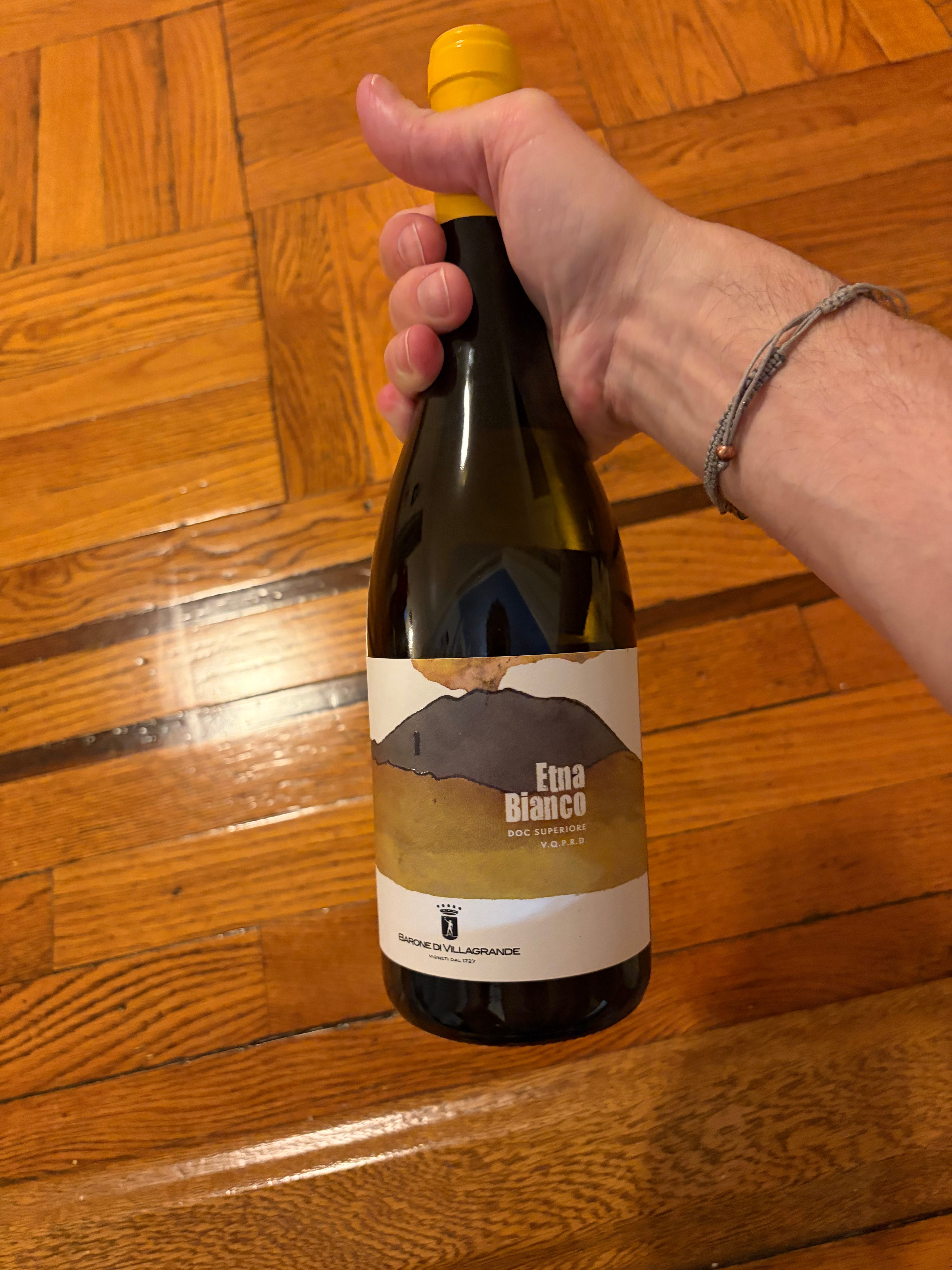
Barone di Villagrande Etna Bianco Superiore 2024. It’s official: I’m a oeno-professional now. The first-ever Spigot wine event took place May 2 at Bill Cournoyer’s space The Meeting.
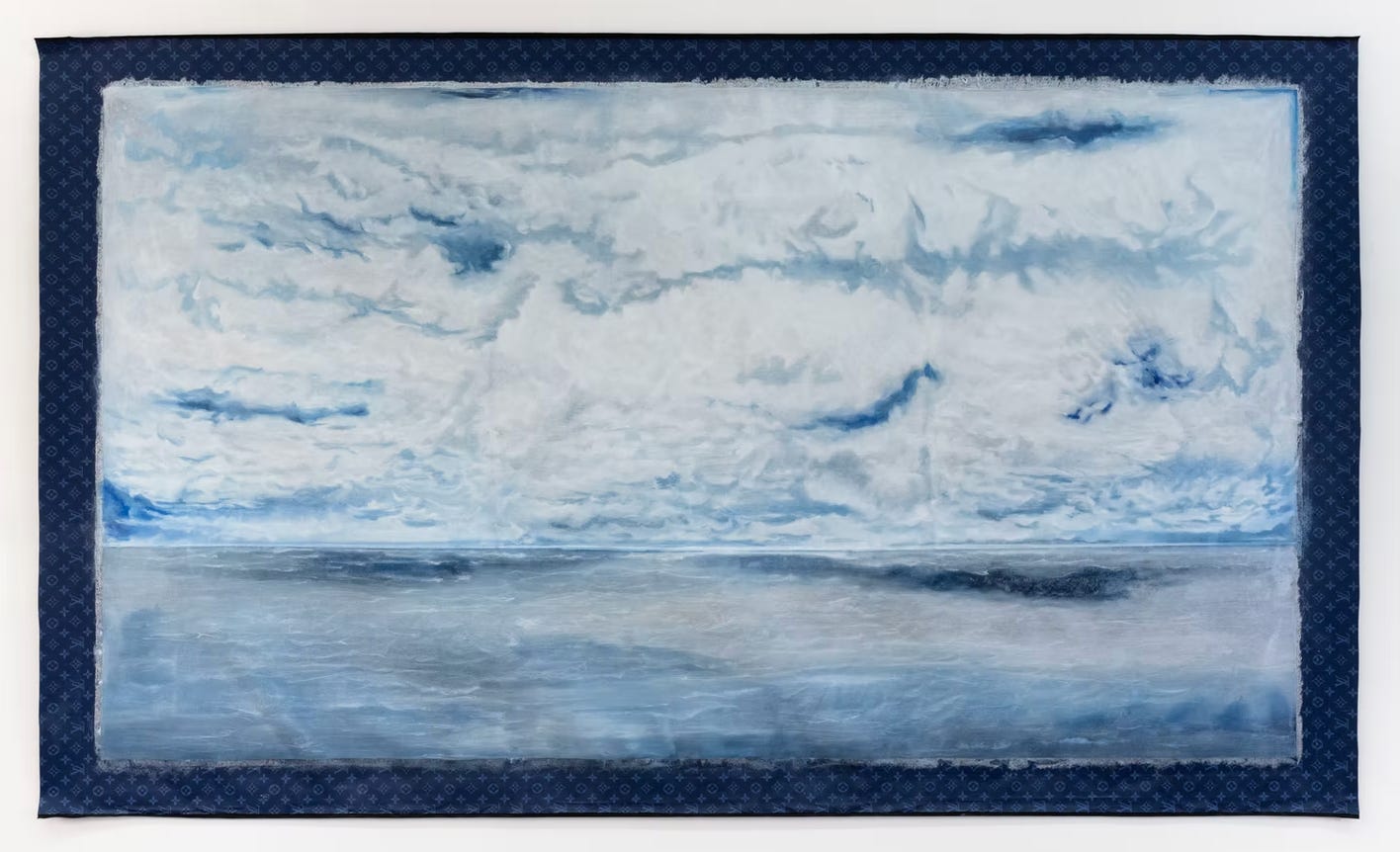
The tasting was to celebrate my friend Viola Yeşiltaç’s exhibition there (for which I happened to write the press release). The show, titled Seascapes (After Paul Thek), touched on themes like global commerce, travel, lineage, and authenticity. Viola’s installation was a conceptual-poetic riff on Thek’s travels and works that intertwined with her own transits of Cologne, Istanbul, and New York City.
Thek and Peter Hujar, you may have noticed, are having a real moment these days in NYC and beyond. The former is currently the subject of shows at Pace and Buchholz, the latter at Ortuzar and the Morgan Library. Both are valorized in Andrew Durbin’s new book The Wonderful World That Almost Was. The modality of the paintings in Viola’s show traces to the pair’s travels in southern Italy, where Thek famously began painting seascapes on old newspapers. Examples of that lifelong pursuit are on view in the Buchholz exhibition.
Given the convergence of geographies in Viola’s show at the Meeting, the best way to toast it seemed to be with wine from Italy. I looked for wine from Thek’s fave idyll Ponza, not exactly well known for its DOCGs. That proved practically impossible. A more promising locale was Sicily, also a key destination for Thek and Hujar. The duo visited the catacombs of Palermo together in 1963, which led to two great bodies of work: Hujar’s surreptitious photographs of the catacombs’ occupants, which would eventually appear in his Portraits of Life and Death (1976), and Thek’s meat pieces, which he began making soon after.
The wine I eventually chose is one I consider to be a great bargain: Etna Bianco. It comes from the other side of the island from Palermo, on the eastern coast near Catania (which happens to be the namesake of a great bakery in Ridgewood). That’s Etna as in Mount Etna, the most active stratovolcano in the world, which continues to erupt on occasion, most recently last summer.
An Etna Bianco has to be at least 60 percent carricante, a grape indigenous to Sicily and grown basically nowhere else. While I hate to get all terroir, Villagrande’s Etna Bianco Superiore does make a great illustration of the concept. It really does taste like the elements of the place it comes from—admittedly a funny twist for Viola’s work, given its more complex relationship with geography. The salt you taste in the wine has wafted in on the breeze from the Ionian Sea; the mineral crunch comes from the Vulcan-churned soil heavy on decomposed lava, ash, and sand. The particular example I chose, Barone di Villagrande, had notes of narcissus and sage, according to some observers at the event, and was characteristically acidic but not tart. It’s a perfect summertime wine and you can get it for under $25 even in New York City.
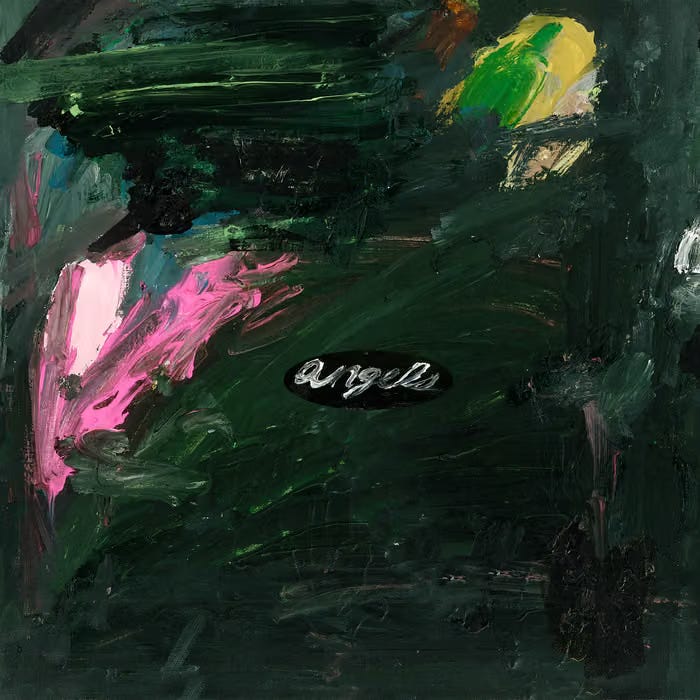
Asphalt Green—Angels in America. It’s not just Charli doing it: Rock music is back. Angels in America has a new album out.
I discovered AiA maybe eight years ago, at a Sunday night show at Company gallery that coincided with the Oscars. For some reason I thought seeing a performance by an unknown band would be a great way to catch up with a friend I hadn’t seen in a while, Sarah J., among whose many charms is being up for more or less any odd thing.
That was Angels in America’s Uptown Funk era (that’s their 2018 record, not the Mark Ronson / Bruno Mars tripe), when the duo was producing fuzzed-out quasi-rock, leaden but also floating; machinic, leaning heavy on the drum-machine pads; rippled through with a chill; like a dreamier, post-industrial Royal Trux, with an air of dissolution both psychic and aural that I’m a sucker for.
On the new Asphalt Green, which runs 26 minutes, the ’90s spirit-animal balance has shifted toward David Berman and Bill Callahan, with the band inflecting their ambience with occasional country-rock gestures. The tunes pop out more clearly like a nice vein; the music is less something I want to lie on the floor listening to after washing down a tablespoon of Borneo red with some grapefruit juice. Which all makes Asphalt Green more pointed, more human, more crafty, less smitten with the dire romance of youth that you think just might kill you.
The music maintains a Trux-y experimentalism, in tracks like the scouring diptych “VFW” and “VFW pts 2+3”; the screwy spoken intro à la truckercore AM radio to the gorgeous “Doubtful Realm,” which is a bit like a Berman song persistently pricked by icy giallo guitars (“You were born to collapse / You were born to decay”); the gratuitous layered vocal ramble on “Angels Online,” whose searing keyboard opening and spooky background vocals give it its own subtly unsettled touch. No matter how familiar the gesture of a bass slide or a melody that resolves, the songs never go down easy. Asphalt Green don’t sound terribly contemporary, which is probably the most contemporary thing of all.
After the show at Company, Sarah and I went to find a place where we could get some drinks and watch the Oscars but that also wouldn’t be super annoying. The best we could do was the TV in the back at Lucky Jack’s, a thin barroom that rails between Orchard and Allen Streets—the too-rare bar with two entrances—where we tuned into victories by either (woof) The Shape of Water or The Green Book. Thank you, Sarah! We’re once again overdue to hang out. I’m a gross sentimentalist, but the only thing that can crack open the iron maiden around my heart is a pop melody with a minor-key drift and friends like you.
No posts
Comments
Nothing yet. Say the first thing.
Sign in to join the conversation.