
Imagine baking a test batch of cookies to try out a daunting recipe, using fewer ingredients and wonky shapes that ooze out and melt into the corners of the pan, only to be told your test run tray has become beloved around the world before you even have the chance to put in the finalized batch.
That was Toby Fox’s RPG, Undertale, which he made to prepare for the development of Deltarune.
The Background:
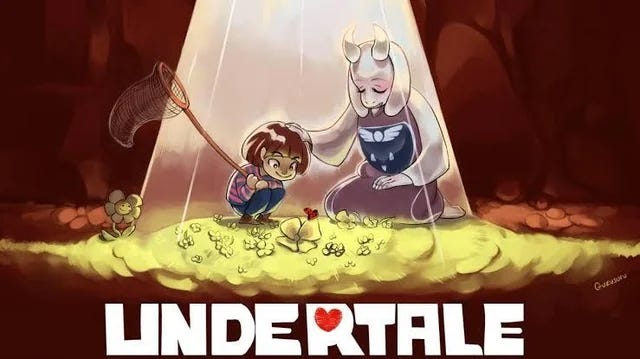
Undertale was developed with the industry wisdom that you should make a smaller game before attempting something grand. Toby wanted to make Deltarune since his actual fever dream of its ending, and prepared for the mountainous task by cutting his teeth on a smaller game. But Undertale drew in a global fanbase that made it a huge success all on its own.
(Alongside its size grew its fandom, and with it came the feasts and fights in the halls of Tumblr. Interestingly, Toby met Temmie on the platform, who went on to do the bulk of the spritework for Undertale and stuck with him into Deltarune. The designs for enemies in chapter 1 of Deltarune were also inspired from the blog of an artist he liked.
“Tumblr ruined Undertale!”
No, dear gamer…Tumblr created Undertale.)
Story-driven and short, Undertale is a rough-cut gem of a game. Toby intended it that way: little on polish and heavy on personality to the game’s benefit, like leaving some dirt on your vegetables when you eat them to boost your immune system. It’s a solo journey for Frisk, the protagonist, yet it never feels lonely. On the game design side, it’s laid out as a series of rooms, and Toby did a wonderful job at ensuring every room brings something new to explore. You want to spend time with this game, soak in the gorgeous music and wacky characters and intriguing worldbuilding. While the plot meandered a little in places, I never needed it to be perfectly written. I just wanted to enjoy the variety of flavors you could taste in a single narrative bite (that’s not even getting into the core message of choice and player agency rolled out during its many routes). The atmosphere is also thick with sincerity. Like laying on the floor with Nabstablook, it’s a game to vibe with…up to the conclusion, which squeezes your heart in a way you can feel long after it releases its grip.
And now, like slices of Butterscotch Pie, we are being given Deltarune piece by piece. Deltarune is the parallel story of Undertale, and what lay beneath it in Toby’s mind. Many characters make a return in a modern American-style setting, with fresh faces to help it still feel like it’s own game rather than a simple AU.
I’ll admit that I missed the Deltarune Chapter 1 hype train. I was busy abroad, traveling the UK on board a real train, enjoying adventures away from my desk after launching my own visual novel in the same month. I didn’t get the chance to really dig into it beyond my first take of thinking it had the same style of humor and endearing character moments (though on the whole a little less engaging than Undertale.)
It didn’t come to mind again until Chapter 2 was released during 2021, when I like many others had ample time to sink into indoor activities. Likewise, that was when I felt myself completely grasped. The music was infectious as ever, the dynamic of the core friend trio tightened, a sweet potential romance between two characters flickered, and the story further hinted at something deep buried beneath the delightful silliness. For the first time since the world shut down, Deltarune Chapter 2 made me feel something greater than my room. It collected a bunch of my creative kindling turned cold by the state of the world, and lit up a fire in my heart. I was suddenly filled with new motivation for working on my own stories, and intrigue for this one. I needed to know what this game was, what it wanted to say, and what it could be.
Chapter 3 and 4 came out this year after a three year wait, carrying players into the second half of the story. And with it comes my thoughts on what makes Deltarune especially unique in the game world: not the unfolding meta story and not the character’s subversions of classic tropes, but the process with which it is being created, and how that has informed the experience of the game for both creator and player.
The Deep Dive:
Deltarune is an episodic story generally covering the full stretch of a day (or a night) in each chapter. It is set in a small town with dips into various make-believe style worlds rather than a huge sprawling underground kingdom. But it’s a story with heavy stakes lurking beneath the modern wackiness, and shadows that stretch long behind the warm surface light.
The mileage of the two games is the same, but the direction is different. In Undertale, players journey far. In Deltarune, players journey deep.
Deltarune has been building up towards a conclusion that Toby has been hungry to share ever since he dreamt it up (quite literally). I can only imagine how big his appetite for telling this story has grown over the years. I once talked to one of my writer friends about the “burden of an untold story”. For some storytellers, the task is just in the writing, completing a manuscript that can be brought to query. For myself, I often finish writing early in the creative process, but the task of worldbuilding remains as I work with my artists and composer to construct the game environment in a way that builds on the script. But it’s not a heavy or negative burden. It’s a galvanizing urgency that pushes you forward into creating your work rather than thinking about it, and provides fuel for long-term projects.
With release dates often years apart, players have a unique perspective of a story unfolding at a very slow pace. This allows for all kinds of theorizing in the community (of which I happily indulge in myself and am always eager to discuss with others.) Some may disagree with me, but I believe part of the joy of this story is having these pauses between chapters. Toby’s long “dissertation” process has become part of the game itself, nurturing a community that expands and contracts between releases and waits, holding in its core the hum of eagerness for the next treasure he unearths in his dig to completion.
While unintentional, the stretches of waiting can give players just a taste of the tension that the characters must feel within the narrative. What was once a lighthearted after-school quest has turned dire, as the end of the world approaches, and an undefined sacrifice is necessary to save it. But around the characters, the oblivious world wanders along at its normal pace. With each gap between chapters, these beloved characters are left in limbo, their fates unknown yet claimed to have been decided, and the player’s power to change the outcome unknown to everyone but the creator. This also makes the potential narrative payoff all the more sweet, and I think Deltarune would be a vastly different experience if played over a few days.
If I could talk to Toby about his game development process, I would love to know how closely Deltarune has adhered to his initial plan and how much changed because of this lengthy process. I know the bonus boss of the latest release is a very silly reference to the plethora of fan theories. There may be many other changes that the long development timeline informed; like the funkiest, tastiest cheese, it’s a fermentation process that enhances the natural flavors of the story into something truly delicious.
As the 10 year anniversary of Undertale is reached, I look back on a strange and sincere story, and feel grateful knowing it allowed Toby the resources and reach to tell another story where it all began. Remember my anecdote about missing the chapter 1 zeitgeist due to traveling the UK? The value of a “test game” and the lift they can give you is something I personally know, because I owe that incredible abroad adventure to the first game I ever made. It was a small choose-your-own-adventure made in inklewriter which I unearthed my old description of: “A short choice-based game where you are a protagonist given the chance to choose your own narrator. Go along with the stories they want to tell, or mess with them. Live happily ever after, fall in love, or die. End up with one of seven possible endings…just don’t forget who’s giving them to you.”
I never released Narrator publicly, but I used it in applying to a coveted internship with my favorite indie game studio, Failbetter Games. They’re the creators of a fantastic browser-based narrative game that I devoured the content of throughout high school, “Fallen London”. After some time, I figured I was lost in the sea of applicants vying for the position…until I got an email back from the company’s analyst, Adam. He said that I would need programming skills to fully benefit from an internship, but he greatly enjoyed my writing style and would like to hear from me again when I make a game that I’ve programmed. I took him up on that a few years later by sending over the demo of my first visual novel, not even sure if he would remember me. He did, and invited me to come visit the team in their London office. Following an introduction to the mad minds behind the studio and long animated discussion about making story games over a bowl of ramen, I was offered a desk in the Failbetter office to complete my visual novel under their indie mentorship program. Today, Adam is a friend of mine and the CEO of Failbetter Games, and I’ve done freelance writing for Fallen London. I owe Narrator for both pushing forward my career and giving me one of the most treasured experiences of my twenties.
The path of the indie game developer is a test of artistic endurance. It’s writing, music, art, and code, strung together in a way that mustn’t unravel at the slightest tug. To make a game so in-depth and over many years with active audience feedback and engagement throughout mimics the gruelling but rewarding process of a PhD student. Harder (yet more rewarding) still is when the journey isn’t for an accolade from a university, but the grand prize of fulfilling a heart-driven need to tell a story that must be told.
Happy birthday, Undertale. It ran so Deltarune has the chance to break the narrative sound barrier. I very much look forward to watching the full story emerge from the depths of Toby’s mind and into the light.
Today’s Tea: A takeout cup of Genmaicha from The Humanist Coffee + Matcha cafe. I’ve gotten very busy lately, and cafe visits are much appreciated when I need to go stretch my legs rather than stand and brew. While they have drinks from many different countries, I chose a Japanese blend to pair with the JRPG influence on Toby’s work.
Tea Drinking Stats: I got to the bottom/it got cold/I went back for a second cup (the hubris of choosing hot tea as your multitasking companion.)
No posts
Comments
Nothing yet. Say the first thing.
Sign in to join the conversation.