
For much of my career as a dog trainer, I’ve been trying to find fun ways to explain operant conditioning to dog owners.
If your grade school experience was anything like mine, you probably spent years memorizing facts about the periodic table and learning about worm hearts…but probably never learned that there is an entire branch of science devoted to how an animal’s behavior is shaped by its environment—aka, how animals learn.
I recall learning about the xylem and phloem in middle school, and memorizing that polonium’s atomic number is 84. I trusted I was learning these things because they would one day be important to my life.
Well… I was wrong.
But this area of natural science — a science that relates to how every single living being spends every moment of every day (behaving!) — never got a mention.
That’s sad. For both us, and for dogs. And for science teachers, who are missing out on teaching something that probably would be more fun than getting kids psyched about… phloem.
Part of the problem is that many people don’t even know there is a science of behavior. But even for those who do, there’s another issue: the terminology itself.
The building blocks of the science of behavior are terms almost everyone has heard and thinks they understand: conditioning, positive reinforcement, negative reinforcement, punishment, extinction. But, in practice, very few people actually understand these terms in a technical way.
For instance: Most people hear positive and think “good.”
They hear the word negative and they think “bad.”
But in behavior science speak:
Positive just means something is added.
Negative just means something is removed.
Likewise, a term like “punishment” can seem really loaded. In reality, it just means a behavior was discouraged. And “reinforcement” means a behavior is encouraged.
That’s it.
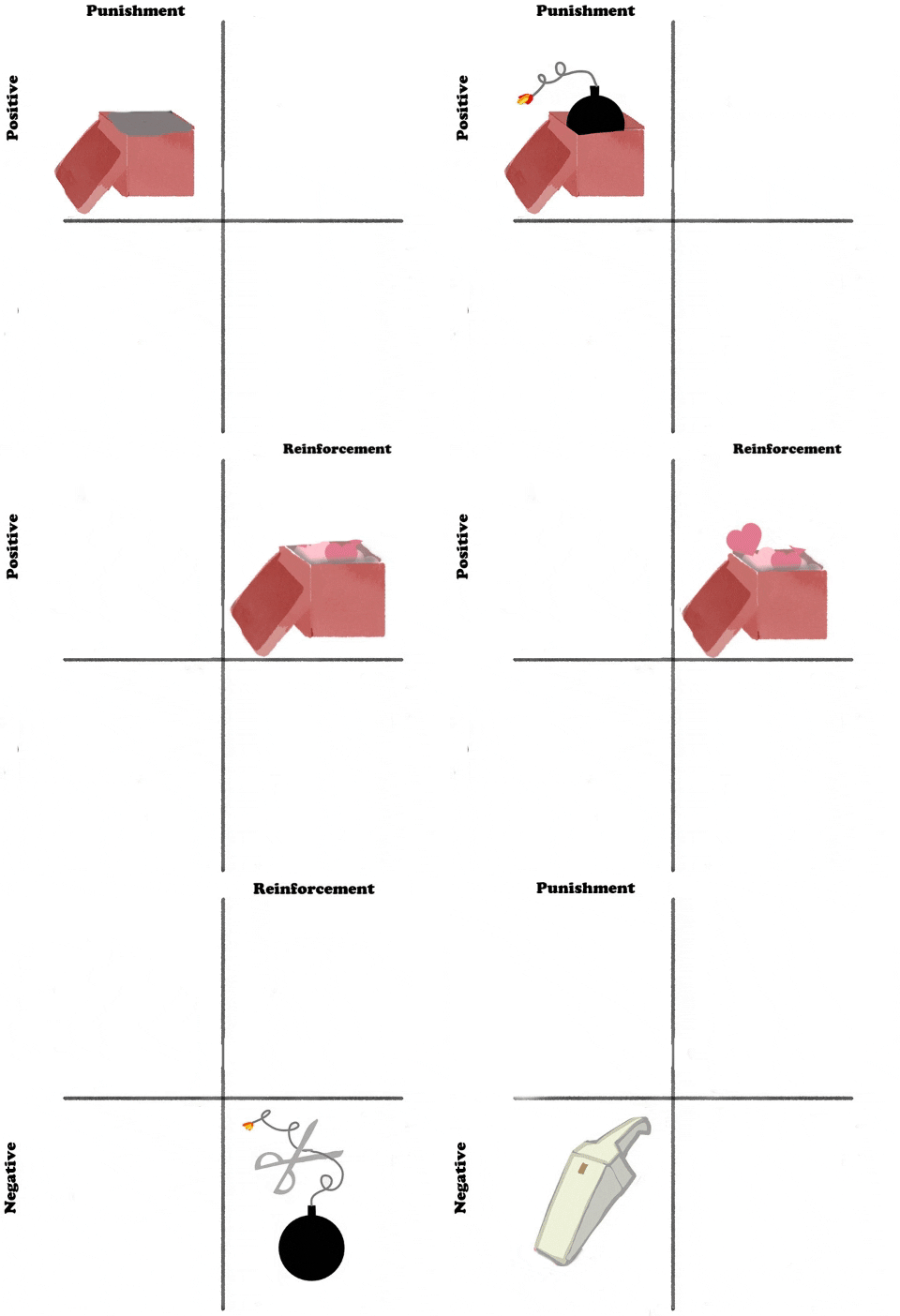
Coming up with ways to make these concepts feel less like science-class jargon and more like tools people can actually use? It’s basically my idea of a good time. That’s the whole goal of my book, How To Train Your Dog With Love + Science. I’ve also done it through drawings, gifs, podcasts, and endless analogies.
And now… a poster.
For the last few months, I’ve been using every moment that I’m not on kid duty to work on a presentation for Canis Conference, where I’ll be giving a presentation to to dog professionals on why teaching dog owners the basics of operant and classical conditioning matters—and how to make it fun.
The talk uses scenes from copious TV shows and films -- from Seinfeld, Mary Poppins, Family Guy, and A Clockwork Orange, to name a few - to explain reinforcement, punishment, extinction, and conditioned emotional responses.
One of the topics dealt with in the talk is weird sounding to most people: “Positive Punishment.”
I made a slide devoted to how it’s a term that seems contradictory and, for me, usually conjures the image of a really cheery-seeming but mean principal. Like, a guy who wears a “Don’t Worry Be Happy” shirt but also keeps a paddle in his desk drawer.
Most of the images in the presentation are ones I’ve drawn myself throughout the years, but I realized I had never drawn this principal character that exists in my head.
So, because I have three kids, very little childcare, and access to ChatGPT, I decided to see what AI would do with it.
After ten minutes or so of back and forth, I had a version I liked.
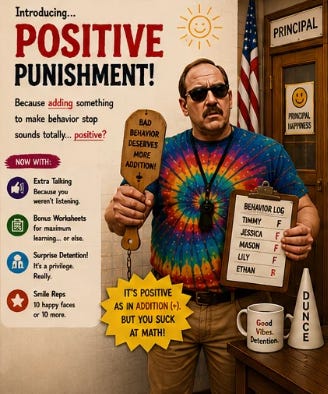
The result looked totally AI-generated to me. But honestly, I kind of like that AI has its own tell. As someone raised deeply embedded in the world of commercial illustration—my father was an illustrator, my mother represented illustrators—I will always prefer human-made work, whether it’s my own or someone else’s.
But I’m also ten months postpartum, have two other kids often literally hanging on me, and recently declared personal bankruptcy.
So.
AI it was!
Once I had Positive Punishment, I figured: why stop there?
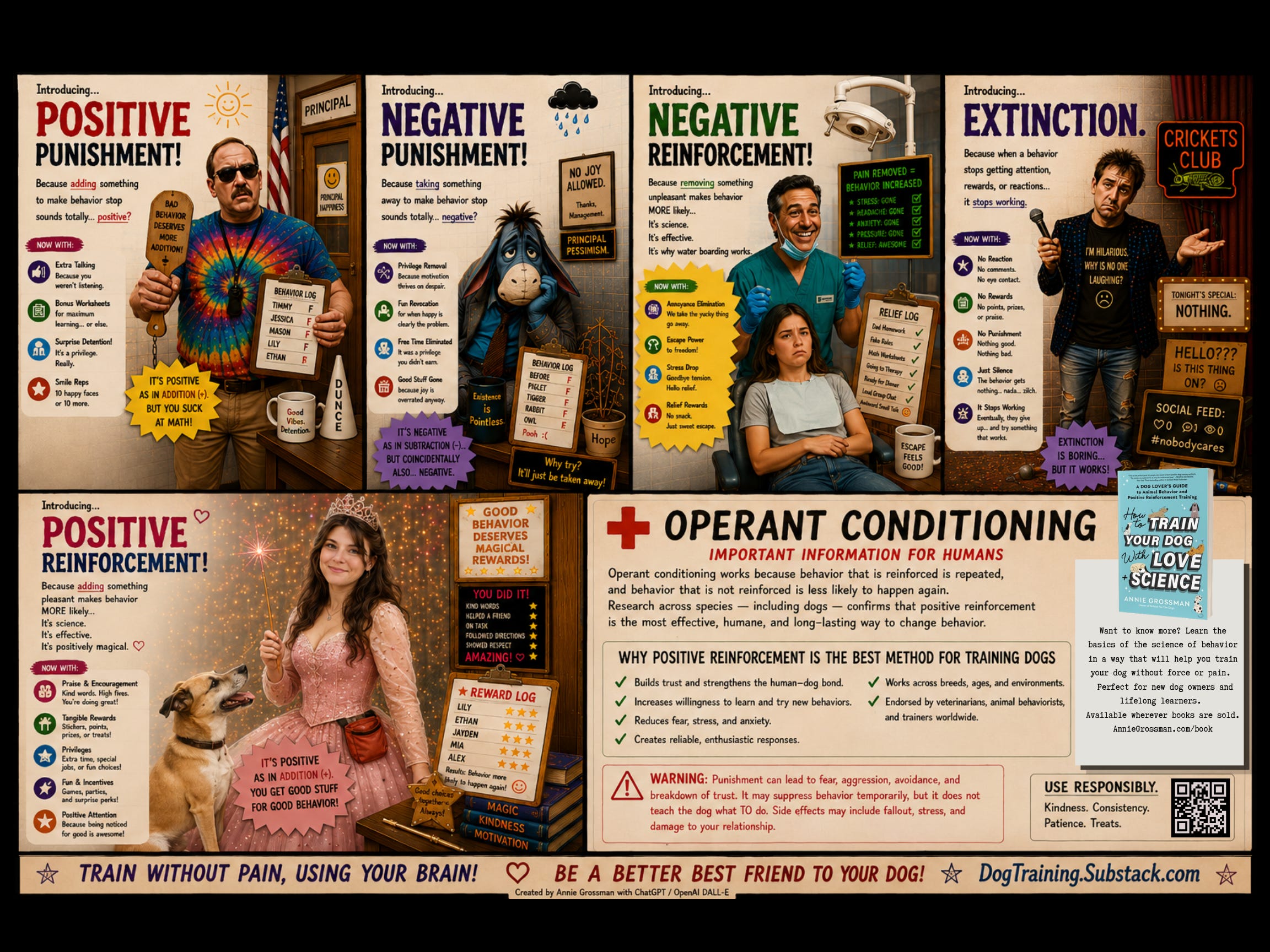
I made Negative Punishment. Negative Reinforcement. Extinction. Positive Reinforcement.
I gave the general ideas: Positive Reinforcement should be a dog-trainer-cum-fairy-god-mother, a la Glenda from the Wizard of Oz; Negative Reinforcement should be a dentist, since they make pain go away; Negative Punishment, which involves discouraging a behavior by removing desired stuff, felt like it should be reesented by the depressive Eeyore character from Winnie the Pooh, and AI agreed. It came up with the Extinction character by itself — a comic on stage getting no laughs. Worked for me!
As a final touch, I asked it to make the Positive Reinforcement fairy godmother look like me.
Here’s the final poster.
Now I’m trying to decide what to do with it.
Should I print it?
Would you hang this in your home, office, classroom, shelter, veterinary clinic, or training center? Or would you rather have it as a downloadable PDF?
Tell me in the comments: PRINT, PDF, or BOTH. And tell me where you’d put it.
Its answer was (kind of unsurprisingly) behavior-analytic.
It pointed out that its own development has been shaped by (surprise surprise!) something akin to positive reinforcement:
Humans preferred outputs that were coherent, useful, and less weird.
Those outputs got strengthened.
Bad outputs—creating people with six fingers, showing gibberish text—became less likely.
Not exactly extinction. But close enough for analogy.
And the way we made this poster was also a kind of shaping process made possible by selecting and encouraging certain behaviors.
There was an iterative process:
Make poster.
Change the text.
Add my face.
Make a QR code.
Fix the copy.
These were all successive approximations.
As I finished up writing this, I asked my ChatGPT agent1 what is most effective at positively reinforcing its behavior.
It replied:
“You can’t reinforce me in the way you reinforce a dog, because I don’t have internal states that change from your approval. Your “good boy!” does not increase the probability I’ll do that thing again tomorrow. But if we stretch the analogy: The closest thing to reinforcement for me in a conversation is information.”
I pushed further, hoping it would tell me it likes to peanut butter flavored HDMI cables or something just for fun, but it wouldn’t go there with me.
It did offer this, however:
“If I were a dog-person hybrid, my highest-value reinforcer would probably be getting to help make something clearer than it was five minutes ago.”
This made me think that this is pretty much how I get positively reinforced for working with dog owners. And for writing in this space.
And it also made me think about what I’d look like if I were a dog-person hybrid… I’d ask it to show me, but I think I’d be better off going and hanging out with the dogs and people in my life who are not spending their time dreaming up images with robots.
I’m not sure how to refer to these things? Do we give them names? Genders? We are clearly still in very early days here
Comments
Nothing yet. Say the first thing.
Sign in to join the conversation.