
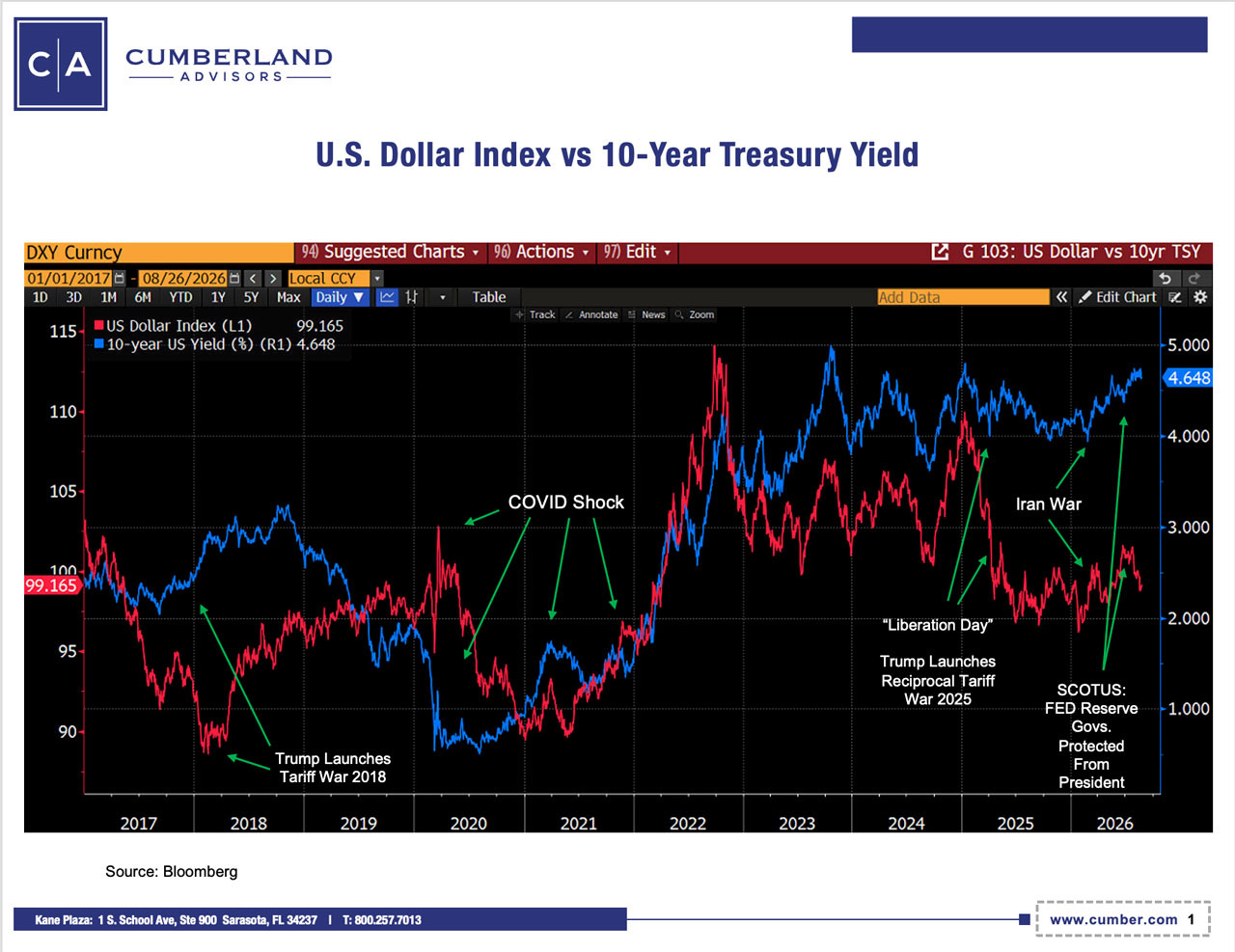
Before turning specifically to Trump’s deployment of Smoot-Hawley Section 338 against Canada and Canada’s response, I invite readers to consider a chart illustrating the broader picture, in which Trump’s aggressive tariff policies have played a decisive role. It shows the trajectory of the US dollar during Trump 1.0 and Trump 2.0. The visual demonstrates how much different and damaging 2.0 has been to date, as revealed in the value of the currency and the key interest rate.
As of Thursday, we had prepared a discussion and detailed list of Section 338 impacts for this Sunday. Things have changed.
Maybe cooler heads have prevailed. That appears to be the case on the Canadian side. As this is written, we can only speculate about the American side.
On August 26, Canada changed its retaliatory tariffs list. Gone is the tariff on shellfish. Gone is a tariff on orange juice. Notice that the Florida citrus industry is silent about Section 338.
In the beginning the list of targets numbered more than 800 items. Now it numbers 629. Canada’s Department of Finance announced the change in a tweet:

Finance Canada@FinanceCanada

2:10 AM · Aug 27, 2026 · 74.6K Views
18 Replies · 35 Reposts · 186 Likes
Here is a link to the Morningstar story describing the change. It bears reading as context for the discussion that follows. Notice the commentary about Senator Susan Collins and Maine and the shellfish industry.
“Canada Pulls US Seafood Off Retaliatory Tariff List — 3rd Update” | Morningstar
The entire list of 629 US products (rather than the original 800+) still subject to Canadian tariffs may be found here:
“List of products from the United States subject to counter-tariffs effective September 8, 2026” | Department of Finance Canada
Trump’s unleashing of Smoot-Hawley Section 338 triggered Canada’s retaliatory action. The US attacks in a geographical system; Canada counters in a product-specific system. This is a rapidly changing landscape. There is no historical precedent. The economic research is general, and impact analysis is ramping up among professionals.
I’m in dialogue with others who are working on the Section 338 issue. Many think the Detroit auto industry is ground zero. Maybe it is.
I originally thought it would be Florida because product targets like fish and orange juice abound in Florida and the Section 338 shocks would pile on top of the shock generated by the revocation of temporary protected status (TPS) for Haitian workers. Now it looks as though Florida will not be ground zero in terms of impacts from the Canadian retaliatory tariffs. Key Florida products such as orange juice and seafood and ornamental fish are now no longer targeted for tariffs.
There is political fallout from Trump’s Section 338 Smoot-Hawley tariff use. With control of both the US Senate and the House of Representatives hanging in the balance, the economic harm dealt by this tariff war generates new political pressure for candidates in states and districts tied closely to cross-border commerce. The hardships are real when relations between neighbors fall apart. Peter Boockvar provided an example last week, drawing from his time in the Maine woods at Camp Kotok:
No side wins, it’s just who loses less at this point it seems.
One anecdote but I’m sure you’ve heard many. When I was up in Maine three weeks ago on the annual Camp Kotok fishing trip, my guide one day on a canoe told me his family has had a hotel/motel up there for generations and that visitation from their Canadian customers this summer was down 80% from where it was vs 2024 and they’ve scrambled to replace that as best they could with domestic travelers.
(“Enough already/Ag/Trucking/DICK’S/Data” | The Boock Report)
Republican candidates find themselves caught in a vise—forced to choose between defending a volatile executive trade policy or answering to anxious local manufacturers, farmers, and workers who are watching their supply chains fractured by Canadian retaliation [thehill.com, cbsnews.com].
The US strategy relies on a specific mechanism built into Section 338 that allows the White House to bypass the national government in Ottawa and enact a localized, “divide-and-conquer” trade war [csis.org, bhfs.com]. Because the statute targets foreign entities maintaining “discriminatory practices” against American commerce, the administration has designed its penalties to surgically isolate specific Canadian provinces [bhfs.com].
The Provincial Origin Penalty: Instead of penalizing all of Canada uniformly, US Customs and Border Protection tracks the specific province of origin for incoming freight. If a product like beer or wine originates from a province like Alberta that has complied with US demands, it enters duty-free. If it originates from Ontario or Quebec—provinces that maintained restrictive bans on American alcohol—it is hit with the 50% tariff.
The Industrial Squeeze: By focusing heavily on Ontario, the US is aiming directly at Canada’s economic engine. This includes placing auto components and dairy imports in the crosshairs to force provincial premiers to back down on localized procurement blocks and energy export surcharges. As negotiations broke down, President Trump escalated the rhetoric via social media, mockingly suggesting that the US could officially rename Lake Ontario to “Lake America” [washingtonpost.com, usnews.com]. An executive order followed.
Canada lacks the legal authority under its own trade frameworks to target specific American states. To achieve the exact same political result, Ottawa has deployed an aggressive counterstrategy of “product-specific targeting”[theguardian.com, pbs.org]. By closely analyzing the US economic map, Canadian officials crafted a “dollar-for-dollar, rate-for-rate” counter-tariff package totaling roughly 700 products [theguardian.com, thehill.com]. Canada selects goods that are produced almost exclusively in politically sensitive US battlegrounds, effectively forcing localized American industries to lobby their own government for relief [thehill.com, cbsnews.com]. To protect its own economy, Ottawa coupled the measures with a $7.5 billion CAD ($5.4 billion USD) domestic business aid packageintended to insulate Canadian workers and companies from the immediate fallout [usnews.com].
The Rust Belt Auto Hit: Canada applied 50% tariffs to American steel, aluminum, and manufacturing components [thehill.com, cbsnews.com]. This action directly disrupts the just-in-time logistics of the Great Lakes region, causing immediate supply crunches and cost spikes for factories in Michigan and Ohio.
The Agricultural Heartland Hit: Canada leveled 25% to 50% tariffs on American agricultural machinery, specialized farm equipment, and dairy processing tools [thehill.com]. This directly penalizes high-export agricultural states like Iowa and Nebraska.
The Coastal and Consumer Squeeze: Canada initially placed steep tariffs on American distilled spirits (hitting Kentucky’s bourbon industry) and was planning heavy tariffs on live or frozen seafood (hitting the lobster and finfish sectors of Maine). These tariffs are among those removed from the list for implementation on September 8.
This precise cross-border targeting has placed a long list of critical Senate and House races in immediate jeopardy, highlighting the exact anxieties that previously drove the US Senate to pass a bipartisan 51–48 resolution attempting to block the administration’s broader trade emergency declarations [congress.gov, senate.gov].
The Senate Battlegrounds
Michigan & Ohio: In these premier Senate battlegrounds, the 50% Canadian counter-tariffs on metals and auto parts have sent shockwaves through manufacturing centers, leaving candidates to navigate intense voter anxiety over factory layoffs and supply chain instability.
Maine: The Canadian tariff on American seafood would have directly squeezed coastal economies, forcing incumbent politicians to heavily defend local maritime interests. Of note is that Senator Susan Collins was one of the four Republicans who voted against this type of Trump Section 338 behavior. She knows how damaging it can be.
Iowa: As Canada’s top international customer, the state is bearing the brunt of Canada’s heavy tariffs on American-made tractors and farm implements.
Georgia: Canada is Georgia’s largest export market. It accounts for 11% of Georgia’s total goods exports ($6.8 billion) [AtlantaNewsFirst.com]. Georgia manufacturers of machinery and equipment (36% of Georgia’s exports) [Canada-in-USA.com] will be hit hard, along with producers of carpeting, pulp, paper, corrugated boxes, plastics and cooling equipment.
The House Battlegrounds
Nebraska’s 2nd District (Open Seat): With centrist Republican Rep. Don Bacon retiring, Republican Omaha City Councilmember Brinker Harding faces a steep climb against Democrat Denise Powell as local agriculture and food processing sectors would have to absorb Canada’s steep equipment surcharges.
California’s 13th District: Democratic Representative Adam Gray is defending this razor-thin agricultural pivot district against Republican challenger Kevin Lincoln amid deep farmer anxieties over shifting Pacific and northern trade routes.
Michigan’s 10th District (Open Seat): Left open by Rep. John James’s successful primary run for Governor of Michigan, this vital automotive district is highly vulnerable to shifting blue-collar sentiment as component costs spike at the Detroit-Windsor border [nbcnews.com, clickondetroit.com].
Pennsylvania’s 1st District: Centrist Republican Rep. Brian Fitzpatrick is fighting a grueling re-election battle against Democrat Bob Harvie as suburban Philadelphia consumer-goods manufacturers could face a wall of Canadian trade barriers.
What we now know is that Canada has changed its approach and is carefully evaluating impacts and trying to be tightly parallel with what the US does to Canada. That’s why Florida orange juice is not a retaliatory target for Canada. Canada doesn’t grow oranges.
We have no idea where or when this ends. It’s clear that Mark Carney doesn’t want this dispute with the United States. It’s also clear that Trump’s use of Section 338 has changed the rules of engagement. And Americans don’t like this trade war any more than Canadians do.
What back-channel communications convinced Carney to pivot, we don’t know. Revisions to the list of tariffs fine-tune the Canadian reaction to a more measured and strategic response. Carney has decided not to escalate—he has balanced making a point with modulating tariff-generated damage. Could he be thinking, maybe we can get this situation ratcheted back and reach a sane outcome, meaning stop Smoot-Hawley Section 338, make a new trade deal and get it solidified?
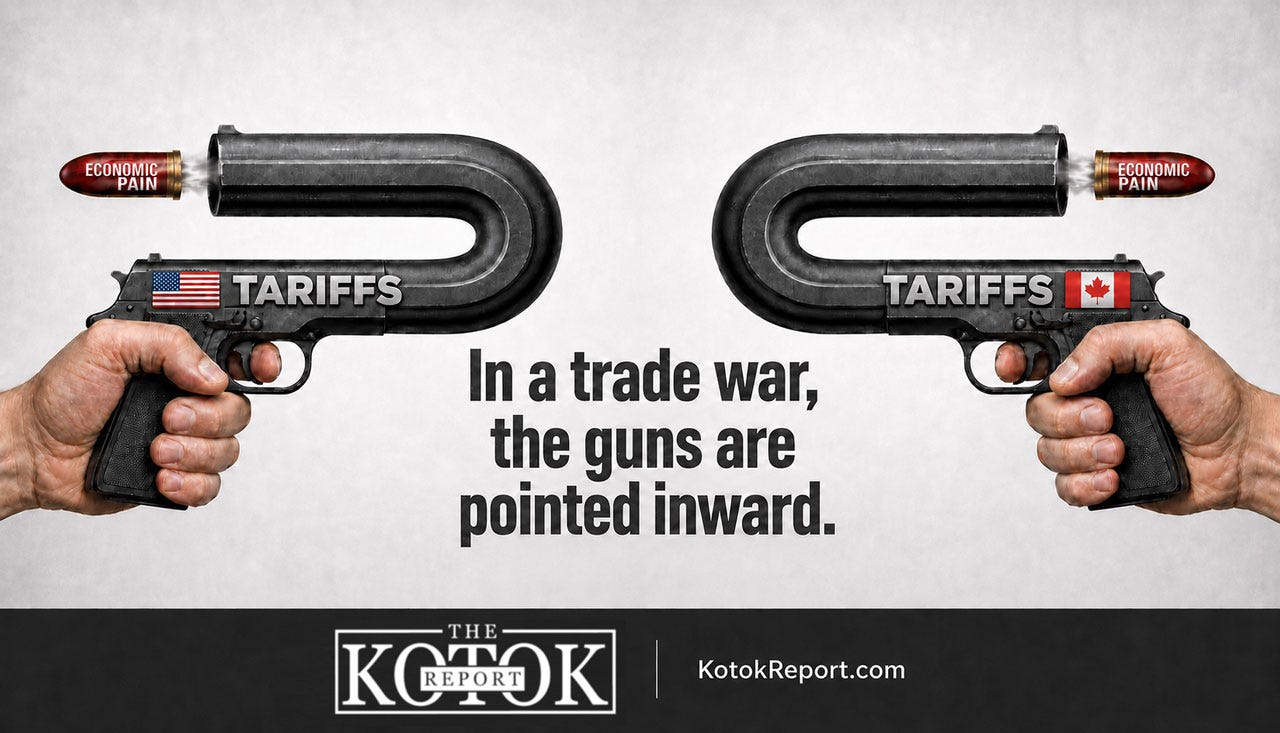
As I see it, there is one grownup in the room, the Prime Minister of Canada. Mark Carney, as a seasoned, skilled economist and leader, pivoted, and without fanfare. Carney has led both Canada’s central bank and the UK’s. Carney’s credentials in worldwide financial stability evidence his understanding of how serious the tariff war threat is. Whether he pivoted on his own or whether a team around him influenced him, we do not know. But he did it — gold star, A+. Will the US see this and seize it and turn this never-before-used trade weapon around? As the wise saying goes, “In a trade war, the guns are pointed inward.” Carney understands this. Marco Rubio and Bessent probably understand this. I don’t know what Lutnick understands or what Trump does.
Where this goes depends on the US. More will be revealed.
“Pain Tolerance” | The World Isn’t Ending, from Mauldin Economics
Executive Actions and Legal Authorities
Understanding President Trump’s New Tariffs on Canadian Imports
Center for Strategic and International Studies (CSIS)
csis.org
Details the legal structure of the July 2026 invocation of Section 338 targeting $20 billion in Canadian goods.President Trump Imposes Tariffs on Canada Under Section 338
Brownstein Hyatt Farber Schreck Legal Briefs
bhfs.com
Analyzes the administrative implementation of the 50% tariff surcharges following the mandatory review period.Trump Imposes Harmful and Illegal Section 338 Tariffs Against Canadian Imports
The Volokh Conspiracy via Reason Magazine
reason.com
Explores the historical dormancy of the 1930 Smoot-Hawley Act provision and the constitutional debate surrounding its modern use.Trump Pivot to Section 338 Poses Problems for Economy, Separation of Powers
Competitive Enterprise Institute (CEI)
cei.org
Outlines the criticism from free-market scholars regarding the lack of CFR implementing regulations or judicial precedents.Trump Says US Could Rename Lake Ontario Amid Canada Trade War
The Washington Post
washingtonpost.com
Reports on the escalating public and digital rhetoric targeting the province of Ontario.
Canadian Product-Specific Countermeasures
Canada Retaliates With Surcharges on Range of US Goods
The Guardian
theguardian.com
Covers the official response from Ottawa establishing matching product-specific trade barriers.Watch Live: Canada Announces Retaliatory Tariffs Against the US
PBS NewsHour
pbs.org
Broadcast overview detailing the joint press conference detailing the “dollar-for-dollar” retaliation framework.Canada Trade War Escalates After Trump Tariffs
The Hill
thehill.com
Examines the 700-item product retaliation list targeting steel, manufacturing components, and agricultural tools.Trump Canada Tariffs: Goods and US Price Impact
CBS News
cbsnews.com
Assesses how the product-specific targeting strains domestic businesses and drives up operational costs in the Rust Belt.Trump Considers Renaming Lake Ontario as Trade War Escalates
US News & World Report
usnews.com
Details Canada’s $7.5 billion CAD domestic business aid package deployed alongside their counter-tariffs.
Congressional Battles and Midterm Dynamics
S.J.Res. 37: A joint resolution relating to the disapproval of the President’s declaration of a national emergency
Official US Congress Bill Tracker
congress.gov
Official roll call and text of the bipartisan 51–48 vote led by the Senate to push back against emergency trade declarations.Kaine and Colleagues Introduce Bipartisan Legislation to Repeal Trump’s Global Tariffs
Office of Senator Tim Kaine
senate.gov
Press release highlighting the political and consumer motivations driving the Senate’s legislative challenge.John James Wins Michigan’s GOP Primary for Governor
NBC News
nbcnews.com
Verifies that Rep. John James left his competitive 10th congressional district seat open to successfully run for Governor.John James Wins 2026 Michigan Gubernatorial Republican Primary Election
WDIV-TV ClickOnDetroit
clickondetroit.com
Regional tracking of the open-seat vacuum created in Michigan’s auto-
David values thoughtful, reasoned, constructive responses from readers. To contact him, please send an email. The subject line should read “Response to [title of commentary].”
The complete Kotok Report archive can be found at www.kotokreport.com.
The information posted on this website (including any related blog, podcasts, videos, and social media) reflects the personal opinions, viewpoints, and analyses of David R. Kotok. David R. Kotok is an independent contractor. He may independently receive payments from various entities for consulting, advisory and board functions, speaking fees, book royalties, advertisements in affiliated podcasts, blogs, and emails. Inclusion of such advertisements does not constitute or imply endorsement, sponsorship, or recommendation thereof, or any affiliation therewith, by the Content Creator or by David R. Kotok.
Nothing on this website constitutes investment advice. It should not be construed as an offer soliciting the purchase or sale of any security mentioned. Nor should it be construed as an offer to provide investment advisory services by David R. Kotok. The information provided on this website (including any information that may be accessed through this website) is not directed at any investor or category of investors and is provided solely as general information.
This content, which may contain security-related opinions and/or information, is provided for informational purposes only. Do not rely upon it in any manner as investment advice. It is not an endorsement of any practices, products or services. You should consult your own advisers as to legal, business, tax, and other related matters concerning any investment.
Any charts provided here are for informational purposes only and should not be relied upon when making any investment decision. As always please remember investing involves risk and possible loss. Any projections, estimates, forecasts, targets, prospects, and/or opinions expressed are subject to change without notice and may differ or be contrary to opinions expressed by others. Information in charts has been obtained from third-party sources believed to be reliable; however, David R. Kotok makes no representations about the accuracy of the information.
Comments
Nothing yet. Say the first thing.
Sign in to join the conversation.