
When I was in college, I got enamored of a certain quote. “The test of a first-rate intelligence” said F. Scott Fitzgerald, “is the ability to hold two opposed ideas in the mind at the same time, and still retain the ability to function.”1
Sure, is this a beautifully worded way to let yourself off the hook? Well, like I said, I was in college. But is it also a kernel of wisdom I find myself returning to year after year? Oh yeah.
So, in that spirit, here are two opposing thoughts I’ve been holding in my mind lately, two things I think most writers can probably relate to:
A script should be stripped of as many extraneous elements as possible; everything that remains must contribute to the overall film.
And also:
The digressions and shaggy edges and unnecessary asides are the fun bits.
Simplicity is probably as unimpeachable a virtue as there is - especially in storytelling. Do less and it tends to count more. The thing that gets cut first is the thing that’s just there to be funny. It’s Occam’s Razor: Storytelling Edition - the simplest element is often the most effective.
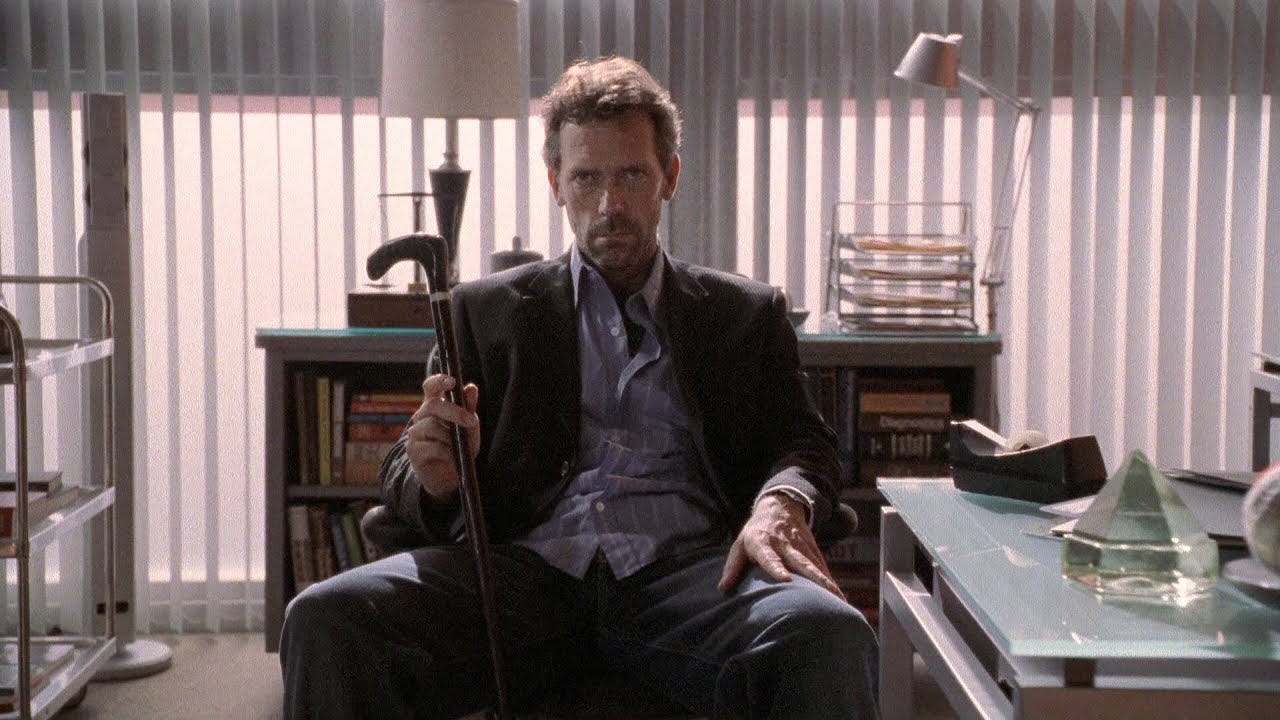
An example: my general philosophy on worldbuilding is that we should do as little of it as possible. Even if you’re writing an Arthurian romance or a sci-fi epic - you should do as little worldbuilding as you can get away with.
The reason is cognitive work. How much thinking and mental work on your audience’s part is useful to you as a writer? If you create ornate rules and regulations for life aboard a space-craft, at a certain point the audience will say ‘this sure is a lot of rules to remember’ and start checking out. The cognitive load you placed on them has grown too large.
Worldbuilding properly is a trade-off - you want to maximize the storytelling value while minimizing the cognitive load. If you set your film on a space-ship where, to pull an example out of thin air, all walking is outlawed - well, there are genuine story possibilities to that idea, ways it can shape characters as people and plots as dramatic movement. But when you start getting into the by-laws and the sub-regulations and the ornate implications…
Our job is to make sure the benefits of creating a world don’t start to sag under the weight of everything we’re forcing the audience to think through.
So yet again: be simple. Be razor-sharp. If some element of worldbuilding adds to the story, then great. But the most effective story, the one that allows us to focus on character and plot, is probably going to deploy only as much worldbuilding as it has to. It’s probably going to mention a few key details and keep the rest of the world as close to ours as possible. That way we’ll be able to reap the benefits of an alien world without distracting from character and incident.
Ray Bradbury has always been big for me. I remember where I was when I learned he died, and I certainly remember the year-long binge of his work that ensued. I still, to this day, have a video of him discussing his love for writing saved in my email. It’s from 2011. I will keep it saved until 2091, if email even exists by then.
I’m also a big Thomas Pynchon dork.2 When I was in college, I designed an independent study course that would focus on his books. I secured an adviser. After two months, my professor admitted to me that he hadn’t done the reading and we agreed to abandon the whole premise.
And of course, the very first essay on this platform - in fact, the idea that gave me the name for this whole endeavor - stemmed from my love for the works of Michael Chabon, from an idea I got when, mid-emotional-doldrums, I picked up THE YIDDISH POLICEMEN’S UNION.
One of the through-lines between these three writers? Their work is dense with detail and richness and strangeness. None of these men write cold, stark stories - they scribble digressions and madnesses and magics into the margins with the passion of Sergio Aragonés. They take their time. They go down rabbit holes. These three writers can turn a rabbit hole into a canyon - and then turn that canyon into a colosseum.
Well, yeah, Alex. These are novelists. They can do that. But in movies…
Well, OK, sure. I like Fincher a lot, but we can’t all make Fincher movies. Has anyone ever made a movie where there are digressions like that, where something doesn’t need to be in the movie but is half the pleasure of it?
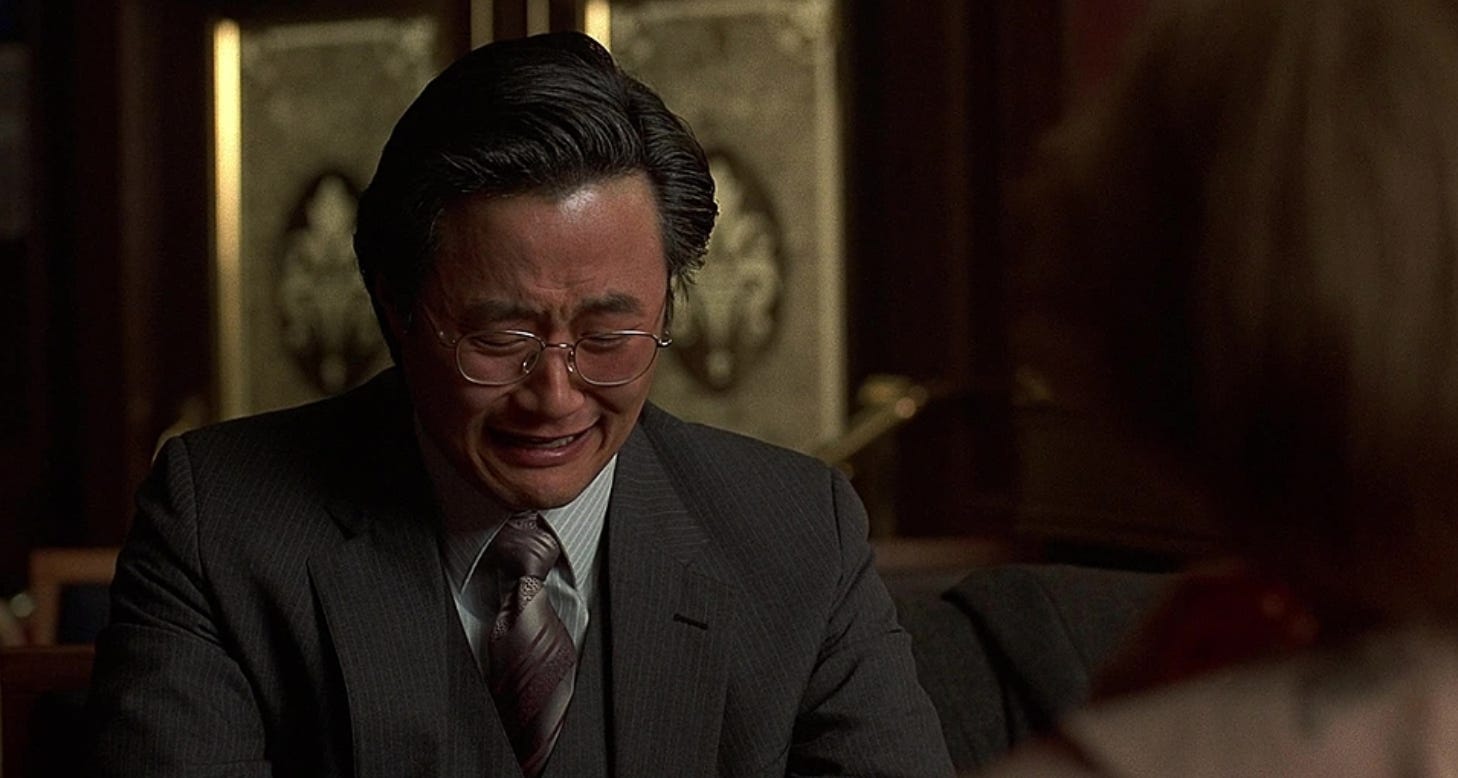
The Mike Yanagita sequence in FARGO is one of many, many examples we could all point to. Would anyone even want to watch a version of FARGO without Mike Yanagita?
Sure you could worry - What is this guy doing here? He doesn’t connect to the plot! You could cut him and the movie would work just as well! - and yet? And yet it’s unquestionably one of the most memorable scenes in a movie packed with memorable scenes. It’s part of the joy of it.
Half the fun is the digression, the tendency to get shaggy, to do strange things that don’t quite match up with what’s around them. Who would want to watch a movie that lacks that? Isn’t that what we go to stories for? To see something unexpected and strange and human? Isn’t that the purpose of art - something we don’t technically ‘need’ but deeply cherish?3
When I think about this problem - the conflict between a brutally minimalist sense of storytelling efficiency and a love for the shaggy-dog digression that makes storytelling worth it - do you know what I think about?
Why, an upside-down building in Pigeon Forge, Tennessee, of course.
This is WonderWorks, a science museum with several US locations. I’ve never been in - I was driving by the Pigeon Forge location after getting lost in the Great Smoky Mountains during a rainstorm, which is…a story for another time. But I’ve never forgotten it.
Storytelling, as I’ve said before, is a lot like architecture. It has to be sturdy and self-sufficient - and it has to be beautiful. It has to have both structure and whimsy. Buildings that rely solely on one or the other tend to collapse or get forgotten. Stories that rely on one or the other are the same.
WonderWorks manages to do both. That is a shaggy, strange, unexpected building. But it’s also 20 years old, and showing no signs of decay. It’s a local landmark. It’s “home to the world’s largest indoor ropes course”. You can think WonderWorks is silly - frankly, it is! - but what’s impressive is the way this deeply silly idea manages to bridge a few seemingly contradictory impulses.
So how do we bridge those differences? Maybe the solution is to ping-pong wildly between them in successive scenes, or to do a ‘simple’ draft and then a ‘shaggy’ draft. Maybe discovering the right - potentially very silly - idea will solve it all. But looking for that solution - for how you do two contradictory things at once - is probably the best definition I can come up with for a writer’s job.
And isn’t that half the fun?
This is from THE CRACK-UP, an essay that I find pretty haunting.
To all my fellow Pynchon readers: we’re dorks, and it’s OK to admit it.
What I mean here is that, though creativity is at the tip-top of Maslow’s hierarchy of needs, it sure feels like a life without it is lacking. It may not be ‘breathing, food, water, sex’ - but it’s still a need.
Comments
Nothing yet. Say the first thing.
Sign in to join the conversation.