
Candace Owens spent June 1–3, 2026, in Moscow with her husband and children before traveling to St. Petersburg for the St. Petersburg International Economic Forum (SPIEF). During that visit, there was a two-day overlap with Andrew and Tristan Tate, who arrived in Moscow on June 2.
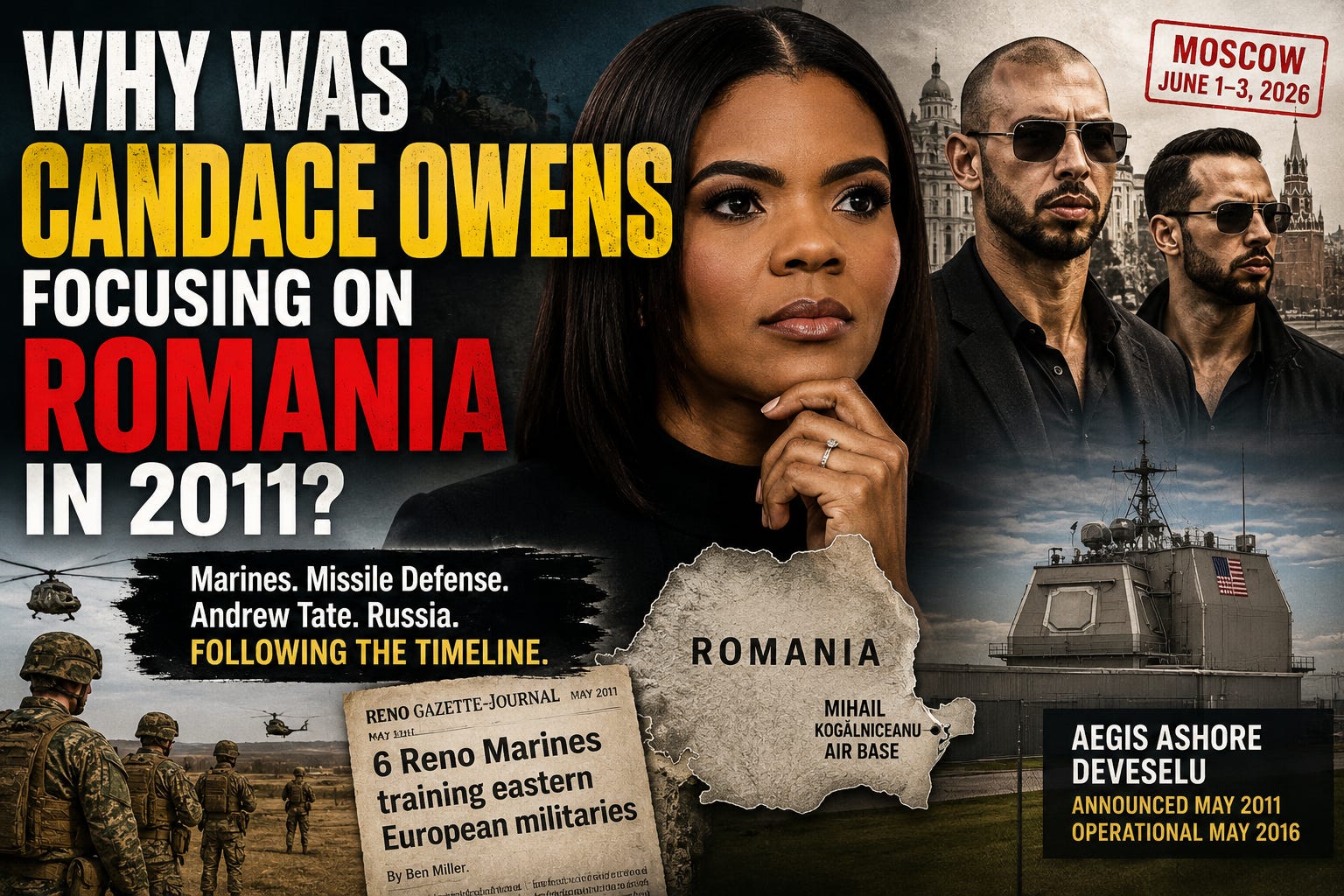
Just four months earlier, Owens released her Bride of Charlie series, targeting Erika Kirk, the widow of Charlie Kirk. Throughout the series, Owens examines Erika Kirk’s mother’s Pentagon contracts, Turning Point USA’s ties to the U.S. military, and Erika’s volunteer work with Romanian Angels near Romania’s Mihail Kogălniceanu (MK) Air Base.
One episode in particular stood out.
In Episode 6, Bride of Charlie: What Happened in Romania?, Owens devotes significant attention to events occurring in 2011. According to the episode listing, the program covers Romania, gambling, the Frantzve connection, an updated 2011–2012 timeline, TPUSA and mass shootings, before concluding with viewer comments.
One of the visual centerpieces of the episode is an old Reno Gazette-Journal newspaper clipping titled “6 Reno Marines training eastern European militaries,” written by Ben Miller in May 2011.
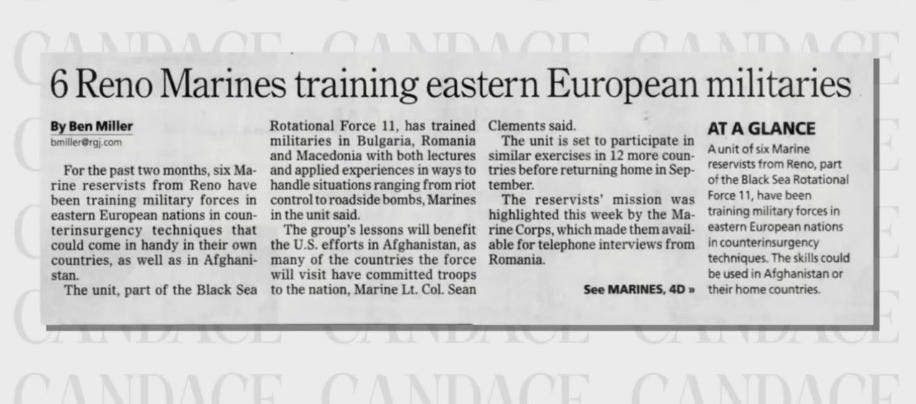
At first glance, it appears to be an obscure local newspaper article.
But why focus on that specific deployment?
The answer becomes more interesting when viewed in the broader geopolitical context of what was happening in Romania during 2011.
The Reno Marines featured in the article were part of Black Sea Rotational Force 11 (BSRF-11), a U.S. Marine Corps deployment operating in Romania from April through September 2011.
Marine Corps records place BSRF-11 at Mihail Kogălniceanu Air Base, where the unit arrived in April and later held its closing ceremony in September.
The Marines also trained extensively at the Babadag Training Area, where Romanian military records independently identify BSRF-11 as a multinational exercise involving regional partners.
Their mission extended well beyond ceremonial cooperation.
Marine Corps documentation shows BSRF-11 training Romanian and other Eastern European forces in:
Counterinsurgency
Peacekeeping operations
Weapons proficiency
Airborne operations
Small-unit tactics
Security cooperation across the Black Sea region
In other words, this was part of NATO’s effort to deepen military integration with Eastern European partners.
While those Marines were training across Romania, another strategic project was quietly moving forward.
In May 2011, the United States and Romania publicly announced that Deveselu Air Base had been selected as the future location of the U.S. Aegis Ashore Ballistic Missile Defense System.
Only a few months later, on September 13, 2011, Washington and Bucharest signed the Ballistic Missile Defense Agreement, establishing the legal framework for the installation.
Importantly, the agreement specifically states that U.S. and Romanian forces would cooperate in providing physical security for the missile-defense facility.
Construction began in October 2013, and by May 2016, Aegis Ashore became operational.
Viewed chronologically, the overlap is impossible to ignore.
April–September 2011: Black Sea Rotational Force 11 operates throughout Romania, including Mihail Kogălniceanu and Babadag.
May 2011: Romania is publicly selected as the future home of Aegis Ashore.
September 2011: The U.S. and Romania sign the Ballistic Missile Defense Agreement, including provisions for security cooperation.
October 2013: Construction begins at Deveselu.
May 2016: The missile-defense system becomes operational.
This does not mean the Marine deployment existed solely to secure Deveselu.
The evidence indicates these were two separate U.S.–Romanian security initiatives occurring simultaneously.
However, they were unfolding within the same broader strategic effort to strengthen NATO’s eastern flank in the Black Sea.
Marine Corps records confirm BSRF-11 was operating from Mihail Kogălniceanu and Babadag during the very months the missile-defense agreement was being negotiated and finalized.
That temporal overlap is a documented historical fact.
From Moscow’s perspective, 2011 marked a turning point.
The establishment of a permanent U.S. missile-defense presence in Romania became one of Russia’s longest-running security objections. Russian officials repeatedly argued that Aegis Ashore threatened Russia’s strategic deterrent, while NATO maintained the system was designed to defend against ballistic missile threats from outside the alliance.
Whether or not one accepts Russia’s characterization, Romania’s growing role within NATO undeniably elevated its strategic importance.
That makes Owens’ decision to emphasize this particular period noteworthy.
The question is not whether the Reno Marines were secretly building Deveselu—they were not.
The more interesting question is why an episode centered on Erika Kirk spends considerable time highlighting a Marine deployment that coincided with one of the most consequential NATO infrastructure projects in Eastern Europe.
The Romania timeline becomes even more intriguing when viewed alongside Andrew Tate’s rise in the country.
According to reporting by The Independent, Tate’s adult webcam business did not begin until 2012. That same year, he became widely known following the circulation of a video showing him striking a 15-year-old girl with a belt, which ultimately contributed to his removal from the television program Big Brother.
Less than a year after construction began at Deveselu, Andrew and Tristan Tate reportedly met with Romanian organized crime figure Mihăiță Doroftei, also known as “Polonezu” (”The Pole”), in 2014.
After Aegis Ashore was operational in 2017, the brothers relocated permanently to Bucharest, establishing themselves in a heavily fortified compound reported to be in Pipera, Voluntari, near Bucharest. While Andrew Tate publicly claimed Britain had “gone downhill,” the U.S. Embassy is also located in the Băneasa/Pipera area of northern Bucharest.
Separately, leaked banking records reportedly indicate the Tate brothers used Paxum, a payment processor previously associated with Wirecard’s ecosystem and widely used within the adult entertainment industry.
Wirecard’s former chief operating officer, Jan Marsalek, later emerged as one of Europe’s most wanted fugitives. British prosecutors have alleged Marsalek directed a Bulgarian spy network that conducted surveillance operations across Europe, including activities targeting journalists, dissidents, and Ukrainian military personnel.
These events involve different actors, different investigations, and different allegations. They do not establish operational links between the Tate brothers and Marsalek. They do, however, illustrate how Russia has repeatedly appeared in investigations involving organized crime, financial networks, and kompromat operations.
Romania’s strategic importance did not end with Deveselu.
In 2025, Romanian authorities detained six people accused of participating in an alleged coup plot with Russian support.
Romania’s anti-organized crime agency, DIICOT, said the group had been formed in 2023 and maintained links to Russia. Investigators alleged that two members traveled to Moscow in January 2025, where they met individuals who supported the organization’s efforts to seize state power.
The case serves as another reminder that Romania continues to occupy a critical position on NATO’s eastern flank and remains a focal point for both Western security cooperation and alleged Russian influence operations.
None of this proves that the Reno Marines were connected to a possible kompromat operation, Andrew Tate specifically moved to Romania because of a U.S. missile defense system that came online, or that Candace Owens’ documentary advances Russian objectives.
What the historical record does show is that she chose to spotlight a very specific moment in Romania’s history, then attended the St. Petersburg International Economic Forum (SPIEF) just months later. Andrew and Tristan Tate’s leaked banking records were tied to Paxum, an offshore adult entertainment bank that was Wirecard’s payment processor until 2020.
Owens highlighted a historical moment when U.S. Marines were expanding security cooperation across the Black Sea at the same time the United States and Romania were laying the foundation for one of NATO’s most strategically significant missile-defense installations.
Whether that focus was simply narrative framing or intended to draw attention to a broader geopolitical theme Russia opposed is ultimately a question for readers to consider.
—D.C.
Comments
Nothing yet. Say the first thing.
Sign in to join the conversation.