
The Wirecard scandal is usually remembered as one of the largest accounting frauds in modern European history: €1.9 billion supposedly sitting in trustee accounts did not exist, the company collapsed in June 2020, and COO Jan Marsalek disappeared.
But the missing money may be only the beginning of the story.
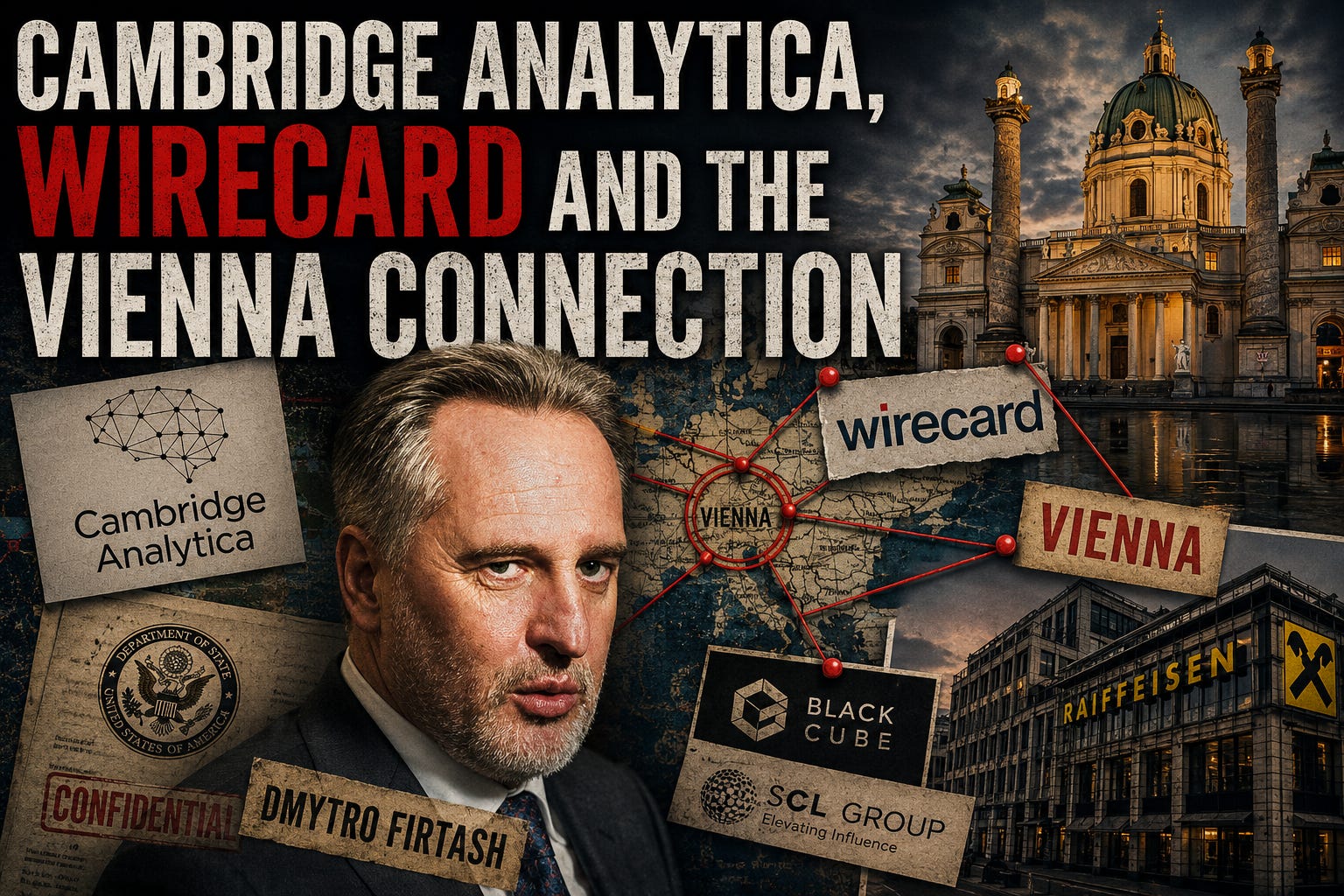
Follow the relationships surrounding Wirecard and a much stranger network emerges—one spanning Vienna, Ukrainian oligarchs, Russian organized-crime allegations, European banks, political influence firms, private intelligence companies, Brexit, Cambridge Analytica and eventually some of the personalities dominating today’s alternative-media ecosystem.
One name repeatedly appears near the center of these overlapping circles:
Dmytro Firtash.
Following Firtash leads in two seemingly different directions. One runs through Raiffeisen and eventually Wirecard. The other passes through investor Vincent Tchenguiz into the financial ecosystem surrounding SCL Group, Cambridge Analytica and Black Cube.
The interesting question is why their networks intersect so often.
Firtash built much of his fortune in the opaque world of post-Soviet natural-gas trading.
He became co-owner of RosUkrEnergo, the controversial intermediary that handled enormous volumes of Russian gas flowing into Ukraine. He later accumulated major interests in Ukraine’s chemical and titanium industries and considerable political influence.
Hovering around the RosUkrEnergo story was another name: Semion Mogilevich, one of the world’s most notorious alleged Russian organized-crime figures.
In 2005, Ukrainian Security Service chief Oleksandr Turchynov told the Financial Times and the Global Witness that the SBU had investigated alleged connections between Mogilevich and RosUkrEnergo, which operated in Hungary, Poland, and Romania.
Then came an extraordinary disclosure.
According to a U.S. diplomatic cable later made public, Firtash told U.S. Ambassador William Taylor in 2008 that he had needed Mogilevich’s permission to conduct business during the chaotic Ukrainian economy of the 1990s.
Firtash later denied making the remarks, and the relevant parties denied improper connections.
But another institution had already examined the issue: Raiffeisen.
A February 2006 U.S. Embassy Vienna cable, 06VIENNA350, “RAIFFEISEN ON UKRAINE-RUSSIAN GAS DEAL,” documented a meeting with Raiffeisen International chairman Herbert Stepic and the bank’s legal counsel, Friedrich Sommer.
During the meeting, Stepic confirmed that Raiffeisen Investment AG (RIAG), a wholly owned subsidiary of Raiffeisen Zentralbank (RZB), held a 50 percent interest in RosUkrEnergo through Centragas Holding AG, placing the Austrian banking group directly within the ownership structure of the controversial intermediary at the center of the Russia–Ukraine gas trade.
As scrutiny intensified over the ownership of RosUkrEnergo and alleged links between Firtash and Mogilevich, the American risk consulting firm Kroll conducted due-diligence investigations that revealed no derogatory information or links to criminal activity.
A later analysis of those hearings summarizes Dr. Wolfgang Putschek's testimony as saying that Raiffeisen commissioned Kroll to conduct the investigation and that obtaining a positive result was a precondition for Raiffeisen accepting the trusteeship.
That becomes important because Raiffeisen eventually appears on the other side of this story—in Wirecard’s financial and commercial ecosystem.
Raiffeisen Bank International and Wirecard announced an extensive partnership on February 19, 2020.
The companies planned to provide payment and banking services across 13 Central and Eastern European countries. In non-EU markets including Ukraine and Serbia, Raiffeisen would act as the card-acquiring partner while transactions moved through Wirecard’s platform.
Four months later, Wirecard collapsed.
The timing was remarkable, but the relationship did not begin in 2020.
In 2018, Wirecard arranged a €1.75 billion syndicated revolving credit facility. Raiffeisen entities participated among the lenders.
By Wirecard’s collapse, reported Raiffeisen-group exposure included approximately €60 million from Raiffeisenlandesbank Niederösterreich-Wien, €45 million from Raiffeisenlandesbank Oberösterreich and roughly €20 million associated with a Salzburg Raiffeisen institution.
Contemporary reporting separated different entities within the decentralized Raiffeisen system, and RBI claimed it had no direct credit exposure.
Either way, the relationship went considerably deeper than a partnership suddenly announced months before Wirecard’s collapse.
And this is where Firtash re-enters the story.
By 2019, Firtash was living in Vienna while fighting extradition to the United States.
At roughly the same time, his banking arrangements were changing.
According to Austrian reporting, Firtash’s relationship with RBI was reportedly wound down amid regulatory scrutiny; companies associated with him began opening accounts at Wirecard Bank.
The man reportedly helping make that connection was Jan Marsalek.
Marsalek allegedly personally recommended Wirecard Bank to Firtash.
Meanwhile, the broader Raiffeisen group was already among Wirecard’s creditors.
Then came the February 2020 RBI-Wirecard partnership.
Four months later, Wirecard was gone.
The connection becomes more significant when placed against Marsalek’s history.
Marsalek reportedly traveled to Russia for years before Wirecard collapsed, with his visits increasing after he became COO in 2010.
By the mid-2010s, those trips were accelerating while Marsalek developed relationships that subsequent investigations would associate with individuals linked to Russian intelligence.
That chronology matters.
Marsalek’s Russian connections did not suddenly emerge when Wirecard failed.
They were developing while he was running Wirecard’s international operations.
Then investigators discovered that Wirecard’s €1.9 billion apparently never existed.
Marsalek disappeared.
What had begun as an accounting scandal was becoming an intelligence story.
But Firtash opens another door entirely.
Firtash has also been linked to the ownership network surrounding SCL Group, the parent company of Cambridge Analytica.
The documentary Active Measures went further, describing Firtash as having a partial interest in SCL—and therefore indirectly in Cambridge Analytica—through shell companies. But the underlying corporate trail is more complicated than that description suggests.
The key figure connecting the two worlds is British-Iranian property investor Vincent Tchenguiz, one of SCL’s most important early investors and, until 2015, its largest shareholder.
Tchenguiz’s SCL investment ran through Wheddon Limited. Importantly, Wheddon was not incorporated in Britain but in the British Virgin Islands, which is why there is no ordinary UK Companies House page for the company itself.
An official Hong Kong Stock Exchange filing provides a clearer picture. On page 85, Wheddon is identified as a BVI-incorporated investment-holding company whose shareholder was Investec Trust (Guernsey) Ltd, acting as trustee of the Tchenguiz Family Trust.
A separate UK primary record reinforces the connection. A March 15, 2007, notice in The London Gazette states that Vincent Tchenguiz transferred all of his interest in the Englefield Affiliates Fund LP to Wheddon Limited.
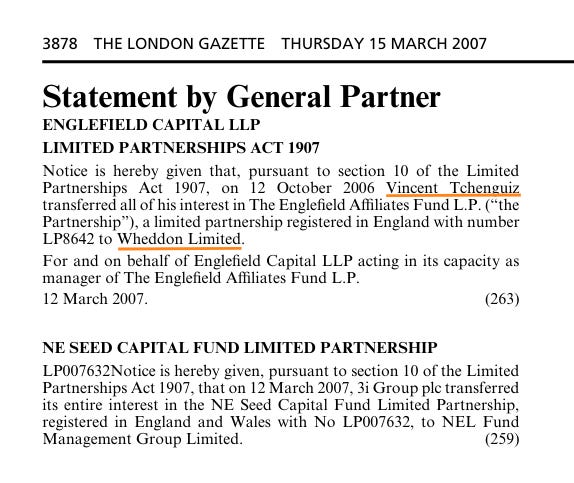
For the SCL connection, therefore, the important evidence is not a Companies House registration for Wheddon. It is SCL’s historical shareholder filings, where Wheddon appears as an SCL shareholder.
The documentary trail can be summarized as:
SCL filings → Wheddon held SCL shares → Wheddon was incorporated in the BVI → HKEX records identify the Tchenguiz Family Trust behind Wheddon → the London Gazette independently documents Vincent Tchenguiz transferring an investment to Wheddon.
But the trail doesn’t end with SCL.
Tchenguiz was also an investor in Zander Group Ltd., another privately held British company. His investment initially ran through Vantania Holdings, whose Zander shares were later transferred to Wheddon.
And this is where the Firtash connection becomes much more concrete.
From 2006 to 2011, Zander’s largest single shareholder was reportedly Spadi Trading, a Cyprus-registered company associated with Dmytro Firtash’s Group DF network, holding approximately 28 percent of Zander.
There were personnel connections as well.
The UK Parliament’s Register of Lords’ Interests recorded Raymond Asquith, Earl of Oxford and Asquith, as executive chairman of Zander Group while simultaneously listing him as a non-executive director of Group DF.
UK Parliament Register of Lords’ Interests — see page 286
Another Group DF figure, British businessman Robert Shetler-Jones, joined Zander’s board in 2007. Shetler-Jones was closely associated with Firtash and served in senior roles within his business network.
His political connections were notable as well. In 2008, The Guardian described Shetler-Jones as a British businessman representing a Ukrainian oligarch while reporting on political donations made through Scythian Ltd to Conservative MPs and Conservative Party headquarters.
The corporate overlap therefore looks less like a direct line from Firtash to Cambridge Analytica and more like two investment networks intersecting around Tchenguiz:
Tchenguiz → Wheddon → SCL Group → Cambridge Analytica
while simultaneously:
Tchenguiz/Wheddon → Zander Group ← Spadi Trading/Group DF ← Firtash
with additional personnel links between Zander and Group DF.
The evidence does not establish that Firtash financed Cambridge Analytica or secretly owned it.
What it does show is that one of SCL’s most important investors operated through corporate structures that also intersected with Firtash’s business network and that the overlap included not only shareholders but directors and executives.
And Tchenguiz leads somewhere else entirely:
Black Cube.
Tchenguiz reportedly also played an important role in the early financing of Black Cube, the Israeli private intelligence company founded in 2011 by former Israeli intelligence personnel. Former Mossad chief Meir Dagan served as honorary president of its board.
Black Cube later became notorious for controversial private intelligence operations involving everyone from political figures to Harvey Weinstein and hired by NSO Pegasus spyware.
That produces another unusual intersection.
One of SCL’s most important investors was also financially connected to the creation of a private intelligence company heavily staffed by former intelligence officers.
There were even allegations of operational overlap.
Former Cambridge Analytica research director Christopher Wylie told a British parliamentary committee that Black Cube participated in election-related hacking connected to an SCL-linked Nigerian operation.
But that allegation requires a major caveat: Wylie later withdrew the specific claim during U.S. Senate testimony, while Black Cube and former Cambridge Analytica executive Brittany Kaiser denied it.
The financial overlap through Tchenguiz is the stronger connection than an operational Cambridge Analytica–Black Cube relationship.
And Cambridge Analytica leads toward another political network.
The Mercer family was one of the most important financial forces behind Cambridge Analytica.
Rebekah Mercer later became a major financial backer of Parler.
And in May 2021, George Farmer, husband of Candace Owens, became Parler’s CEO after previously serving as its chief operating officer.
Farmer had already moved through British conservative and Eurosceptic politics. He chaired Turning Point UK and stood unsuccessfully as a Brexit Party candidate in the 2019 European Parliament election.
Using the same bank, sharing acquaintances or moving through overlapping financial circles does not demonstrate coordination or wrongdoing.
But the recurrence of the same institutions makes the network worth mapping.
George Farmer’s father adds another dimension.
Michael Farmer, Baron Farmer, built his fortune trading metals and earned the nickname “Mr. Copper.” He became a major Conservative donor, served as party co-treasurer from 2011 to 2015 and entered the House of Lords in 2014.
He was also a prominent Brexit supporter.
Lord Farmer donated £300,000 to Vote Leave and publicly described leaving the European Union as a potential “bright new beginning” for Britain.
Two years after the Brexit vote in 2016, it was revealed that AggregateIQ, previously known as SCL Canada, had been paid £3.5 million by four pro-Brexit campaigning groups—Vote Leave, BeLeave, Veterans for Britain, and Northern Ireland’s Democratic Unionist Party—to design software aimed at aggregating personal data and influencing voters through messaging on social media.
His son subsequently carried that political project into electoral politics by standing for Nigel Farage’s Brexit Party in 2019.
Brexit was therefore hardly peripheral to the Farmer family.
And viewed purely through geopolitics, it creates an interesting parallel with ideas promoted decades earlier by Russian nationalist theorist Alexander Dugin.
In the 1997 Foundations of Geopolitics, Alexander Dugin envisioned competition between a Russian-centered Eurasian order and the American-led Atlantic system.
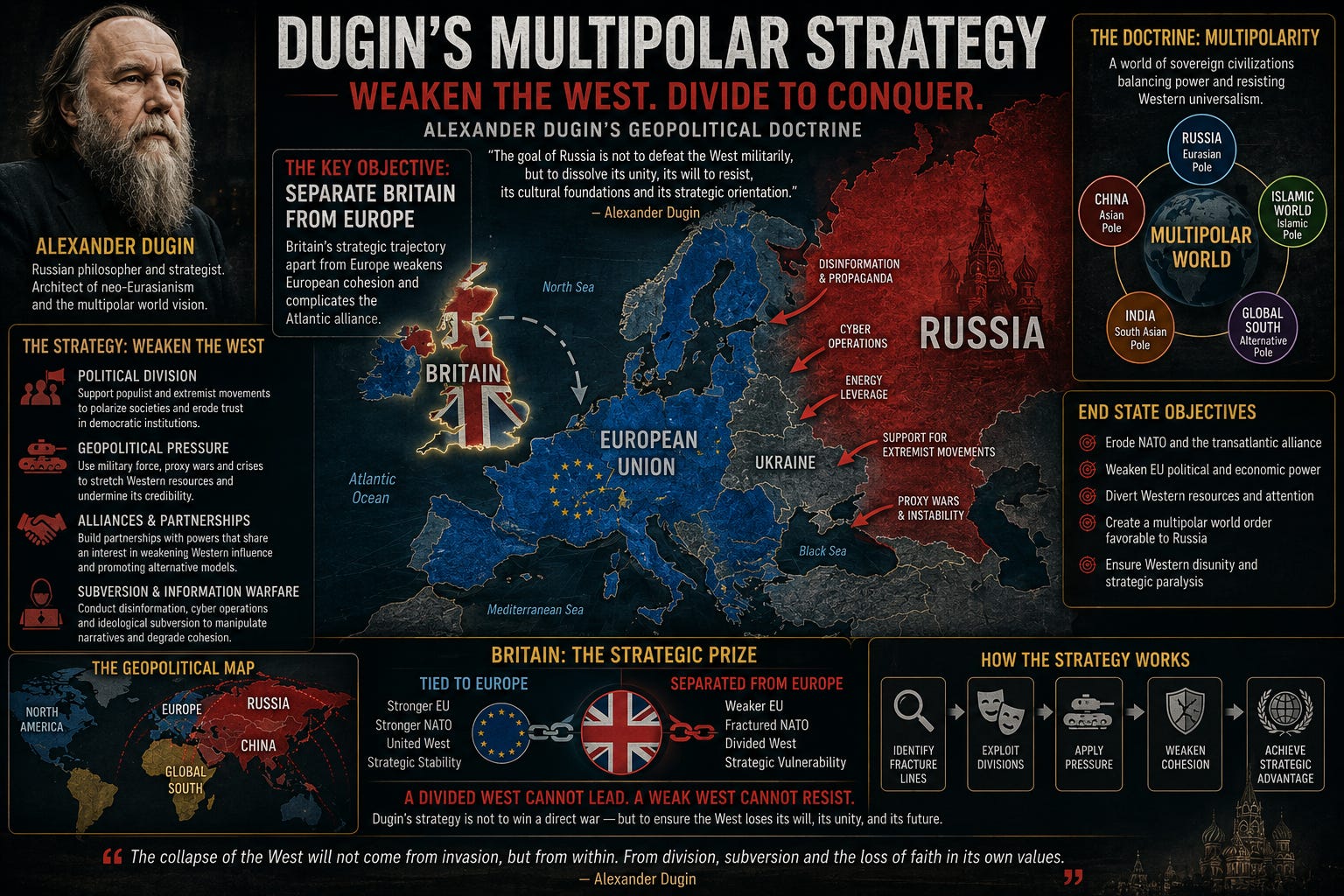
His broader strategy called for weakening Western cohesion through political division, geopolitical pressure, alliances and subversion.
Britain occupied an important position in this worldview because of its relationship with the United States and continental Europe. Separating Britain’s strategic trajectory from Europe could weaken European cohesion and complicate the Atlantic alliance.
The evidence presented here isn’t that George Farmer or Lord Michael Farmer were actively coordinating with Russia.
In Tradecraft, Tactics, and Dirty Tricks, Sean M. Wiswesser discusses the concept of “useful idiots”—people who advance Russian objectives without necessarily being formal intelligence agents. The distinction matters because someone who repeats Russian narratives, promotes Russian interests, makes useful introductions, or assists an influence operation is not automatically a recruited asset.
From Moscow’s perspective, however, formal recruitment may be less important than practical utility: if a person’s ideology, ego, financial interests, grievances, political ambitions, or personal relationships make them useful, Russian intelligence can potentially exploit those motivations without ever recruiting or controlling them in the traditional sense.
The interesting point is the convergence of geopolitical outcomes.
Dugin wanted to weaken Atlantic cohesion and separate Britain from continental Europe.
British Eurosceptics wanted Brexit for their own constitutional, economic and political reasons.
Different motivations can produce overlapping geopolitical outcomes.
Cambridge Analytica is remembered primarily for Facebook data.
But undercover recordings made by Britain’s Channel 4 revealed a darker side to how company executives marketed their capabilities.
CEO Alexander Nix was secretly recorded discussing methods for compromising political candidates—including sending Ukrainian women to a candidate’s home or offering politicians money while secretly recording the encounter.
The recordings were made between November 2017 and January 2018 while an undercover Channel 4 reporter posed as a representative of a wealthy client seeking help influencing elections in Sri Lanka.
The basic concept was familiar from intelligence tradecraft:
manufacture or capture compromising material, then weaponize it.
One of the most memorable sections of Tradecraft, Tactics, and Dirty Tricks concerns sexual-entrapment operations.
Wiswesser discusses the Russian/KGB concept of lastochki (ласточки), or “swallows,” associated with what Western audiences generally call honey traps.
A target may be placed into a compromising situation and then photographed, recorded, observed, or otherwise documented. The resulting material becomes kompromat—compromising material that can potentially be used to embarrass, pressure, recruit, discredit, or blackmail someone.
An especially important concept behind this form of tradecraft is that compromising material can be more valuable while it remains secret.
Whatever label one applies to those tactics, they went far beyond ordinary Facebook advertising.
They resembled techniques more commonly associated with private intelligence and political influence operations.
Candace Owens later interviewed and defended Harvey Weinstein—the same Hollywood producer who had previously hired Black Cube and Kroll while attempting to stop allegations about his conduct from becoming public.
Previously, Kroll was hired by Raiffeisen to conduct an investigation into RosUkrEnergo and found no criminal links to Semion Mogilevich.
Then there is Andrew Tate.
Following Andrew and Tristan Tate’s arrest in the United States, British authorities are seeking the brothers’ extradition on a dramatically expanded indictment. Andrew Tate now faces additional allegations that include rape, facilitating trafficking for sexual exploitation, assault causing actual bodily harm, and numerous offenses involving indecent images of children and extreme pornography. Tristan Tate also faces new rape and sexual assault charges.
The brothers have been referred to the U.K.’s Counter Terrorism Police after visiting Russia and taking part in military training.
George Farmer has publicly said:
“I’ve known Andrew for many, many years. I’ve known Andrew since before Andrew was Andrew…”
Reporting has described the two as friends, and Owens has said her connection to Tate came through her husband. Owens and Farmer later traveled to Romania to interview him.
That relationship becomes noteworthy in the context of this network because Andrew Tate’s brother has a Raiffeisen banking account and used Wirecard’s payment processor Paxum for his adult webcam business.
None of this proves that Wirecard, Cambridge Analytica, Black Cube, Raiffeisen, Firtash or Russian intelligence were components of one coordinated operation.
But mapping the relationships produces a striking picture.
Dmytro Firtash occupied the intersection of Ukrainian politics, Russian gas, Vienna’s financial world and corporate structures shared with a major SCL investor.
Vincent Tchenguiz financed SCL while also playing an important early financial role with Black Cube.
Raiffeisen entities had longstanding connections to Firtash’s business world and later financial exposure to Wirecard.
Jan Marsalek reportedly helped move Firtash-linked banking business toward Wirecard while cultivating relationships in Russia.
And just months before Wirecard collapsed, Wirecard and RBI announced an ambitious partnership targeting Central and Eastern Europe.
Put the relationships on a timeline:
Firtash → RosUkrEnergo → Raiffeisen
Firtash → Tchenguiz investment overlap → SCL/Cambridge Analytica
Tchenguiz → Black Cube
SCL/Cambridge Analytica → Brexit referendum
Raiffeisen group → Wirecard financing
Firtash → Marsalek → Wirecard Bank
Marsalek → Russian network
Raiffeisen + Wirecard → Central and Eastern European expansion
Then:
June 2020 → Wirecard collapses → Marsalek disappears
The point is that examining each scandal in isolation may obscure the more revealing story: the network connecting them.
When oligarchs, banks, payment processors, political-influence companies, private intelligence firms and intelligence-linked individuals repeatedly cross paths, the most useful questions aren’t simply Who owned what?
They’re:
Who introduced whom?
Who financed whom?
Who moved the money?
Who gathered the intelligence?
And perhaps most importantly:
Where did those relationships go next?
—D.C.
Comments
Nothing yet. Say the first thing.
Sign in to join the conversation.