
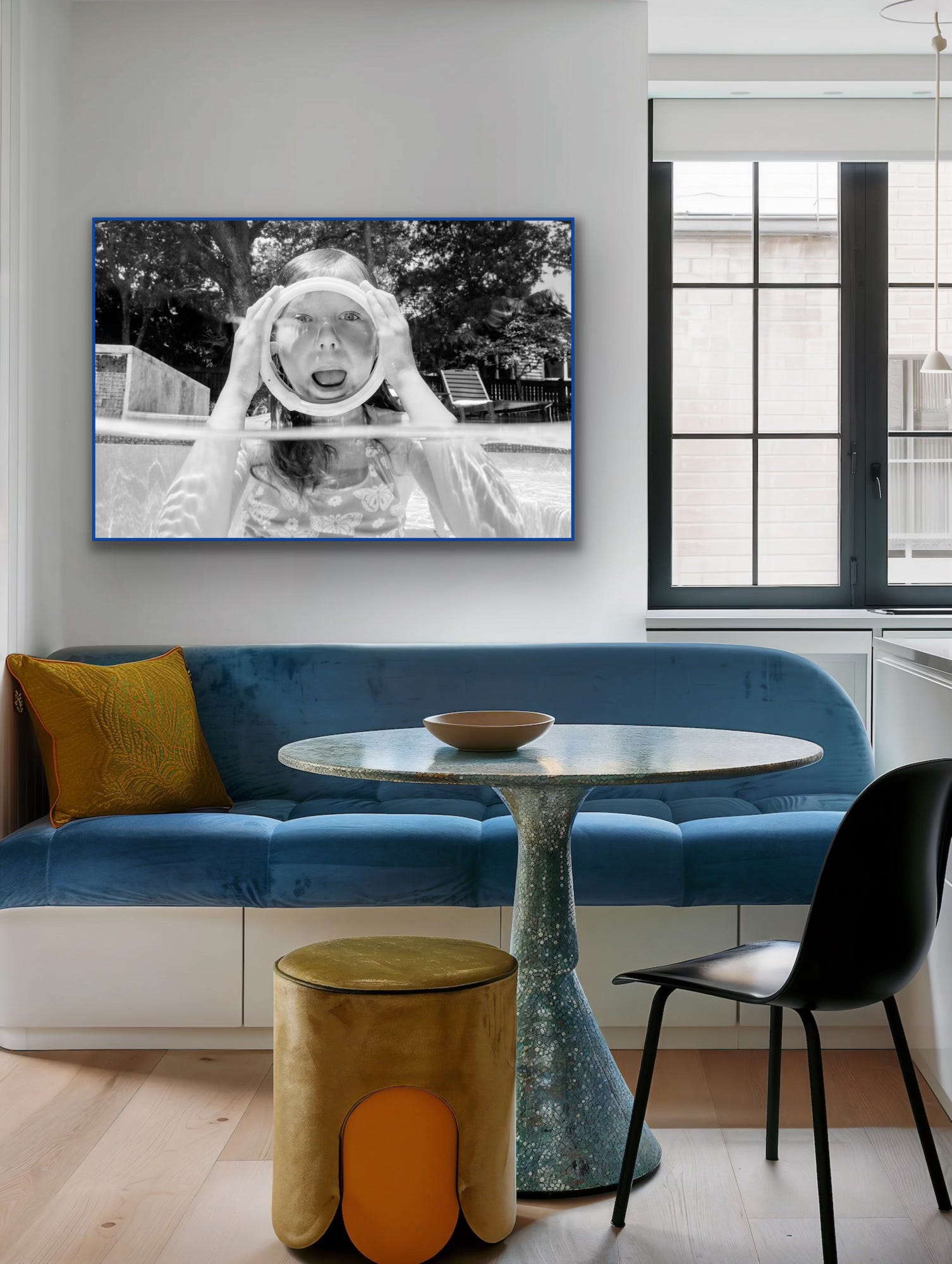
Dive into a lake in summer and you’ll feel it around 20 feet down.
The water temperature drops suddenly. Sharply. You’re swimming through warm water one moment and cold water the next, with almost no transition zone between them. This is a thermocline, an invisible layer where two different temperature zones meet but refuse to mix.
The physics is straightforward: warm water is less dense than cold water, so it stays on top. Cold water is heavier, so it sinks. And between them, there’s a boundary layer that resists mixing. The two temperatures can sit right next to each other, touching but not blending.
The psychology of thermoclines is about holding multiple states and the energy it takes to maintain that separation.
I’ve been thinking about this a lot lately.
About the invisible boundaries between different parts of my life that touch but don’t mix. Artist and business strategist. Creative and operator. The part of me that wants depth and the part that wants scale.
These aren’t opposites. They’re different temperature zones in the same system. And I’ve been spending enormous energy keeping them separate, maintaining the thermocline between them.
💭 WONDERING WHAT THIS LOOKS LIKE IN REAL LIFE?
Every DIVE IN session is different, but the framework is the same: create conditions where surrender becomes possible. If you're considering a session and want to understand what actually happens—from the moment you arrive to the moment you see your first image - download the preparation guide here.
Here’s what thermoclines teach us about holding multiple identities:
Separation is expensive. Every time you code-switch between different versions of yourself, you’re spending energy maintaining a thermocline. “Work me” vs. “home me.” “Professional me” vs. “creative me.” “The version I show clients” vs. “who I actually am.”
These boundaries aren’t protecting you. They’re exhausting you.
Integration doesn’t mean uniformity. When a thermocline dissolves, the water doesn’t become one uniform temperature immediately. It mixes gradually. Some areas stay slightly warmer, some slightly cooler. But the sharp boundary disappears. The resistance to mixing reduces.
You don’t have to be the same person in every context. But you can stop spending energy maintaining sharp divisions between versions of yourself.
Some boundaries need to stay separate. Not every thermocline should dissolve. Some temperature differences serve a purpose. Work and rest. Public and private. Professional and personal.
The question isn’t whether to have boundaries. It’s whether the energy you’re spending to maintain them is worth what you’re getting in return.
The work is knowing which boundaries to maintain and which ones are just costing you energy you could be using elsewhere.
In sessions, I create conditions for thermoclines to dissolve naturally. Enough time in the water for nervous systems to sync. Enough trust in the process for defenses to lower. Enough permission to be fully present without performing different temperatures for different family members.
I can’t force it. But I can stop reinforcing the separation. I can stop treating different emotional states like they need to stay in isolated layers. I can let the water do its mixing work.
Your turn: What thermoclines are you maintaining? What parts of your life are touching but not mixing?
This is the question beneath the surface.
Next post: Viscosity - Resistance Changes with Temperature
Comments
Nothing yet. Say the first thing.
Sign in to join the conversation.