
There’s a number in fluid dynamics called the Reynolds number.
It’s a ratio that predicts whether fluid flow will be smooth (laminar) or chaotic (turbulent). It accounts for velocity, viscosity, density, and the size of whatever the fluid is flowing through. Get the conditions right, and water flows in parallel layers - smooth, predictable, efficient. Get them wrong, and it churns into eddies and vortices - chaotic, unpredictable, energy-wasting.
The difference between the two isn’t effort. It’s conditions.
You can’t force turbulent flow to become laminar through willpower. You have to change the variables: slow down the velocity, increase the viscosity, reduce the diameter, adjust the pressure. Change the conditions and the flow state changes automatically.
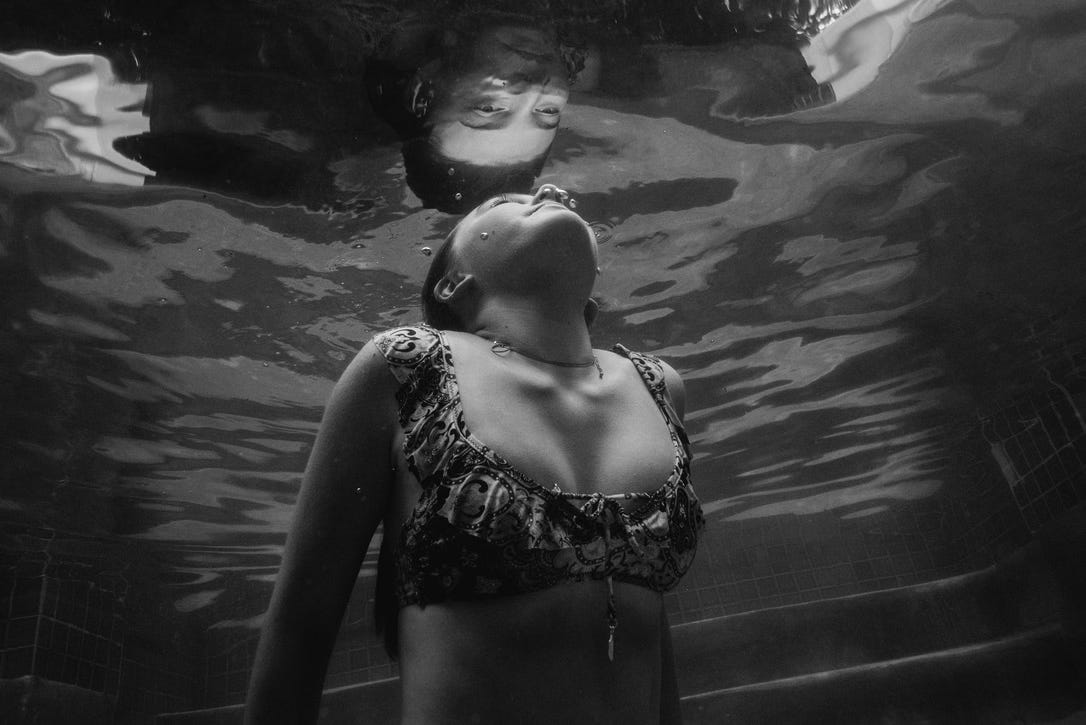
I think about this a lot as it affects the quality of the underwater images we take.
But it’s not just about water, but also about energy. About nervous system regulation. About why some days flow and other days fight.
The psychology of laminar flow is about understanding what conditions create smooth operation vs. what creates chaos.
We treat productivity like it’s a willpower problem. “I just need to focus harder. Push through. Be more disciplined.” But that’s like trying to force turbulent flow to smooth out through sheer determination. It doesn’t work that way.
Flow states, the ones where work feels effortless aren’t about trying harder. They’re about getting the conditions right.
In sessions, I watch families move between laminar and turbulent flow constantly.
A calm family enters the pool. Everyone is regulated. The children move smoothly through the water. Parents are present, responsive, attuned. The session flows. I can direct naturally. The images emerge without force.
A chaotic family enters the same pool. Everyone is dysregulated before they hit the water. The children are overstimulated or anxious. Parents are managing instead of experiencing. Nothing flows.
Same pool. Same water. Same photographer. Different nervous system states. Different flow conditions.
💭 WONDERING WHAT THIS LOOKS LIKE IN REAL LIFE?Every DIVE IN session is different, but the framework is the same: create conditions where surrender becomes possible. If you’re considering a session and want to understand what actually happens—from the moment you arrive to the moment you see your first image - download the preparation guide here.And here’s what I’ve learned: you can’t create laminar flow for someone who’s in a turbulent state. You can only reduce the variables that are creating turbulence and wait for their system to settle.
This is true in business too.
I spent years trying to force smooth operations through turbulent conditions. Multiple cities, compressed timelines, constant travel, managing every detail myself, proving I could handle the pressure.
I was generating turbulence and wondering why nothing flowed.
Now I’m redesigning for laminar conditions. Charleston-only. Reduced session count. Collaborator handling the camera. Slower velocity, right-sized container, lower pressure, better viscosity.
Not because I couldn’t handle turbulence. Because laminar flow produces better outcomes with less energy expenditure.
Your turn: Are you in laminar flow or turbulent flow right now? What conditions are creating chaos in your work, your relationships, your creative practice? What would need to change, not in your effort level, but in your operating conditions, to create smooth movement instead of constant churn?
This is the question beneath the surface.
Next post : Thermoclines - Invisible Layers Resist Mixing
Comments
Nothing yet. Say the first thing.
Sign in to join the conversation.