
The Callaway–Good Good disaster is what happens when the attention economy discovers misogyny sells.
There is something deeply wrong with the fact that a room full of adults apparently looked at an advertisement in which a man charges at a woman, shoves her to the ground, stands over her and warns her not to touch his golf club—and decided: Yep. That’ll sell drivers.
That is essentially what happened with the new Good Good Golf and Callaway campaign.
In the 15-second ad, Good Good co-founder Garrett Clark sees fellow golfer Alexis Miestowski reaching for his Callaway driver. He rushes over, knocks her to the ground and looms over her while warning her not to touch it. The closing message: “You have been warned.”
This wasn’t some rogue TikTok accidentally uploaded by an intern. Callaway has acknowledged that it approved the advertisement before it went live. Both companies pulled it after the backlash and apologized.
And that distinction matters.
Because the defense here cannot simply be that nobody realized what the video looked like.
What it looked like was the joke.
The entire premise requires the audience to recognize a familiar image: an angry man physically intimidating a woman over something she has done that displeased him. Without that recognition, there is no punchline.
Except violence against women isn’t an edgy cultural reference.
Nearly one in three women worldwide will experience physical or sexual violence during her lifetime, most often at the hands of an intimate partner. WHO estimates that roughly 840 million women and girls have experienced partner or sexual violence.
Against that reality, watching a huge golf brand turn male violence into a cute way to communicate this club is so awesome you’ll attack a woman who touches it doesn’t feel like an isolated advertising mistake.
It feels like another mile marker.
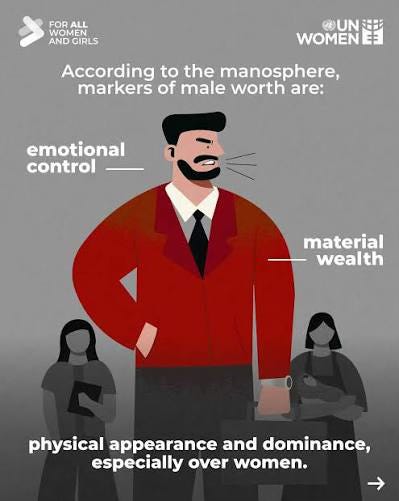
For years, misogyny online could be dismissed as something happening in dark corners of Reddit, incel forums or Andrew Tate videos.
It isn’t staying there.
The aesthetics and assumptions of the manosphere are increasingly bleeding into mainstream culture: women are annoying. Women are manipulative. Women are preventing men from succeeding. Feminism ruined everything. Masculinity means dominance. Relationships are a power struggle. Cruelty is funny as long as everyone agrees afterward that it was “just a joke.”
And increasingly, boys are encountering those ideas before they have even figured out what being a man means.
Research published in 2026 involving 601 American boys ages 13 to 17 found that following manosphere figures was associated with stronger beliefs that ideal masculinity requires dominance, toughness, emotional detachment and antifemininity.
Other research has demonstrated how recommendation systems can push young male users toward increasingly misogynistic content. The Institute for Strategic Dialogue found experimental YouTube accounts representing boys and young men were repeatedly recommended anti-feminist and manosphere material, with YouTube Shorts moving toward more extreme content particularly quickly.
So when a golf company trying to reach young men suddenly decides a little violence against a woman makes for provocative advertising, it isn’t occurring in a vacuum.
It is speaking a language the internet has spent years teaching young men.
Here is where we think we should be careful.
We don’t think there is evidence that a collection of tech billionaires sat around a conference table and decided, Let’s make men hate women.
The economic incentives can produce something frighteningly similar without a conspiracy.
Social platforms make money by holding attention. Anger holds attention extraordinarily well. Fear holds attention. Humiliation holds attention. Tribalism holds attention.
A 2025 study auditing Twitter’s engagement-based ranking found that it amplified more emotionally charged, partisan and out-group-hostile material than a chronological feed, including substantially more anger. Researchers specifically noted the tension between engagement-driven algorithms and the advertising businesses that benefit when people stay on platforms longer.
That creates an incredibly simple machine.
Tell a lonely or economically anxious young man:
Your life is difficult.
He listens.
Tell him housing is unaffordable, wages aren’t keeping up and adulthood feels impossible.
You’re still describing reality.
Then tell him:
And women did this to you.
Now you have a villain.
And villains are fantastic for engagement.
The manosphere takes legitimate male pain; loneliness, insecurity, dating frustration, economic instability, fear about the future and redirects it toward women.
Instead of asking why a 25-year-old can’t afford a home or obtain decent healthcare, he is encouraged to obsess over whether women have become too independent.
Instead of questioning concentrations of wealth and power, he can watch another four-hour podcast explaining that feminism is why he can’t get a girlfriend.
That is enormously useful to anyone benefiting from the status quo.
There is another piece of this culture that deserves scrutiny.
Parts of Silicon Valley have simultaneously developed an intense fascination with pronatalism—the belief that society desperately needs more babies—and with extending human life.
Elon Musk has become one of the loudest advocates for higher birth rates, but he is hardly alone. Across Silicon Valley, a growing pronatalist movement embraced by figures including Sam Altman, Peter Thiel and JD Vance, has centered on fears of population decline, fertility technology and, in some cases, embryo selection. At its most extreme, that worldview veers into explicitly eugenic territory: not just encouraging people to have more children, but debating which people should be reproducing.
At the same time, many of the same tech elites are pouring enormous sums into longevity research. Thiel, Altman and other billionaires have funded companies and scientific efforts focused on slowing aging, rejuvenating cells and dramatically extending human lifespan.
Those things do not prove some unified plot to turn men against women.
But the cultural contradiction is worth noticing.
The rest of us are being fed an internet increasingly built around isolation, resentment, competition and gender warfare while some of the richest people on Earth are preoccupied with optimizing reproduction, extending their own lives and building personal legacies that stretch generations into the future.
Maybe the connecting ideology isn’t hatred of women so much as hierarchy.
A worldview where everything can be ranked.
Men over women.
Winners over losers.
High-value people over low-value people.
The genetically desirable over everyone else.
The billionaire founder as visionary and the rest of humanity as users, consumers, workers and data points.
That worldview is practically tailor-made for the manosphere.
That is why we can’t look at the Good Good advertisement and dismiss it as one tasteless joke.
It is small, but revealing.
Maybe the most disturbing part isn’t that the ad existed.
It’s that somewhere along the way, this idea became normal enough to pitch.
We should be asking how that happened.
Because algorithms don’t merely show us culture anymore. They help manufacture it.
And after years of rewarding the loudest men telling boys that women are their enemies, perhaps we shouldn’t be shocked when that worldview eventually escapes the podcast studio and shows up somewhere as ordinary as an advertisement for a golf club.
What kind of society are we building when contempt for half the population has become a viable marketing strategy?
Like this kind of content? Follow us on Instagram, Facebook, Twitter and check out our Facebook group: Michiganders for Freedom, Not Fascism— we’d love to haveyou join in the conversation!

Click to download the Distill App in the App Store or Google Play. Let’s stay informed together.
Thanks for reading! This post is public so feel free to share it.
No posts
Comments
Nothing yet. Say the first thing.
Sign in to join the conversation.