
In America, it’s not uncommon to hear someone bragging about their sublime credit score. It’s often viewed as a sign of virtue; meant to signal to others that you are responsible, accountable, and trustworthy.
When you think of a credit score, what comes to mind? Lower interest rates on loans? Approval for a higher credit card limit?
Do you ever think about the fact that three major corporations collect, buy, and sell your personal data in ways that extend far beyond your debt and payment history?
What a significant percent of the US population doesn’t realize is that these companies are not just credit reporting agencies. They are private for-profit corporations raking in billions from selling your location data, your employment records, your advertisement data, your behavioral analytics, your email address, and much, much more.
These corporate giants sell this information to your employers, to landlords, to lenders, to the government, and to advertisers. Truthfully, they will sell this data to just about anyone with the right dollar amount.
In fact, I’d wager that they’re just as invasive as Palantir and Flock, and t he data they collect is used by organizations like the two, but they’re not the ones making the headlines.
The credit score system in itself is arguably a problem. Most Americans are one disability, one missed paycheck, or one emergency room visit away from a looping cycle of debt. And not only can a poor credit score prevent you from getting a loan, an additional line of credit, or a home, but it can even prevent you from getting a job. All that it takes is one employer putting negative information about you on the market.
The Equifax subsidiary “The Work Number” collects information about you—including your pay rates and employment history—from millions of companies and sells that information to other employers, lenders, people doing background checks, and even government agencies.
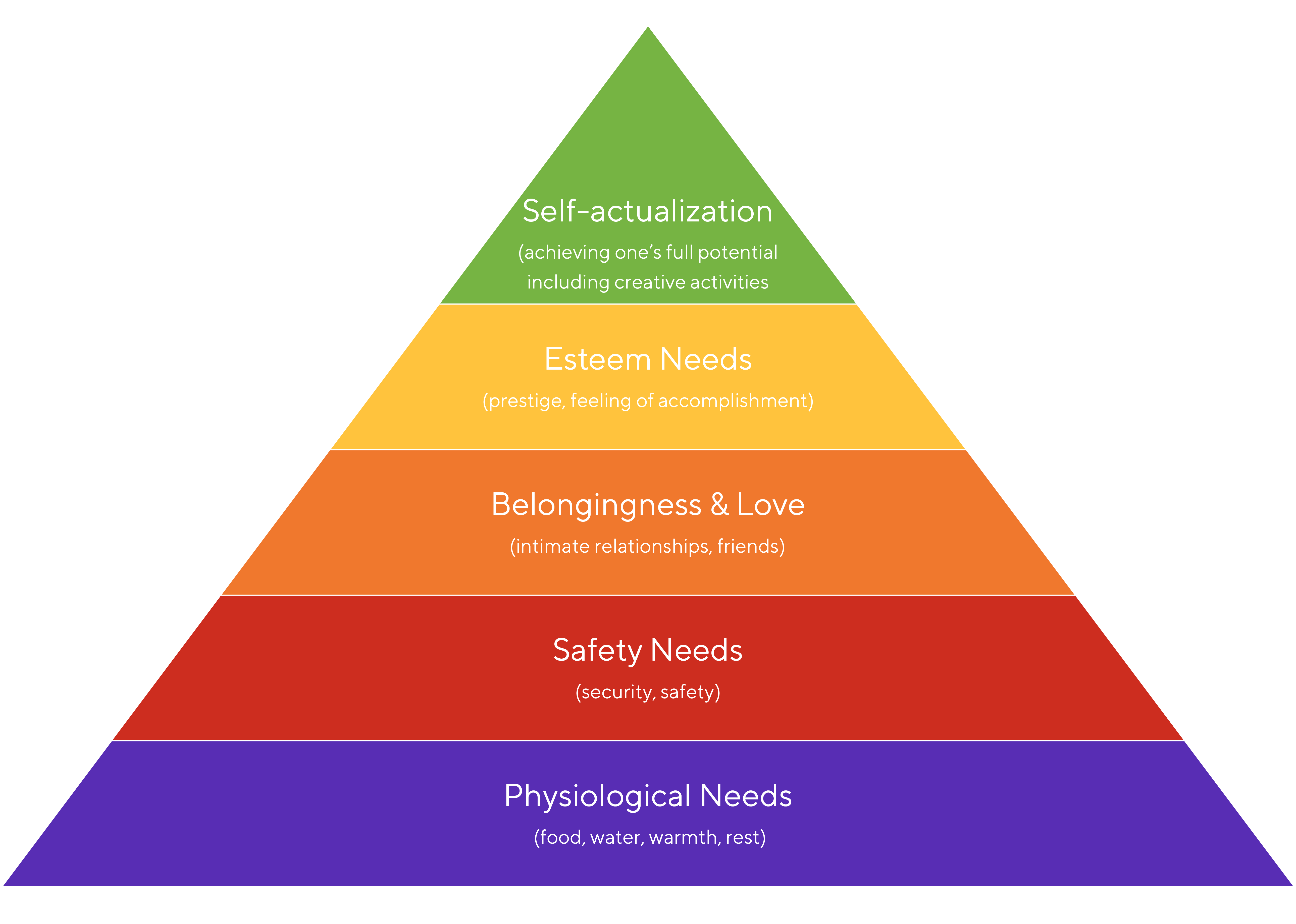
These companies are integrated into the very foundation of everything Americans need to survive, everything needed to meet the very basics of Maslow’s hierarchy of needs.
Food. Water. Warmth. Rest.
All things that are necessary for survival. One could even argue that if you’re not in good standing with these companies, then you cannot survive.
Most people have never actually chosen to use these companies, but you really can’t opt out—at least not in any meaningful way—because they are integrated into everything. These companies make their money from selling your personal data to lenders, landlords, insurers, and employers.
In most cases, if you’re unhappy with a company, you just stop using it. But with these three, you have no choice. They’re integrated. Yet, people seem more and more eager to give their personal information up if it means being viewed as upstanding in society.
All the data referenced here comes from the official annual reports and SEC data for Experian, Equifax, and TransUnion. The annual reports are written by the company, and they weren’t written for transparency or accountability. They were written to convince investors to hand over (more) money. Keep that in mind as you read.
Experian holds the role of a significant data broker. In their FY26, the company reported a revenue of an astronomical $8.445 billion dollars between their 213 subsidiaries. These companies span between the United States, Australia, England New Zealand, Monaco, and more.
In October 2017, Experian acquired Clarity Services, INC. This significantly expanded the amount of personal data companies were able to purchase on everyday people. It functions as a ‘micro credit score,’ providing them with smaller-scale information about things such as rent-to-own transactions, check cashing history, telecommunications, utility accounts, and information on auto loans.
And then in March 2019, Experian opted to give consumers the ability to feed them personal data directly with Experian Boost by offering to boost their Experian-only FICO scores if consumers linked personal bank accounts to prove they make recurring payments.
But it’s far beyond payment history.
While you would think that the companies that a credit bureau owns would report on things like loans, credit cards, and payment histories, they’re actually creating behavioral analysis of you to sell to marketing industries, health industries, and even ID verification platforms.
Using their subsidiary NeuroID, Experian states that they perform “behavior analytics” of consumers to provide companies with “end-to-end fraud protection.”
Using subsidiaries AtData and Xverify, Experian scans over 10 billion email addresses to track a person’s activity across websites and devices over time creating a profile of a person using their email address.
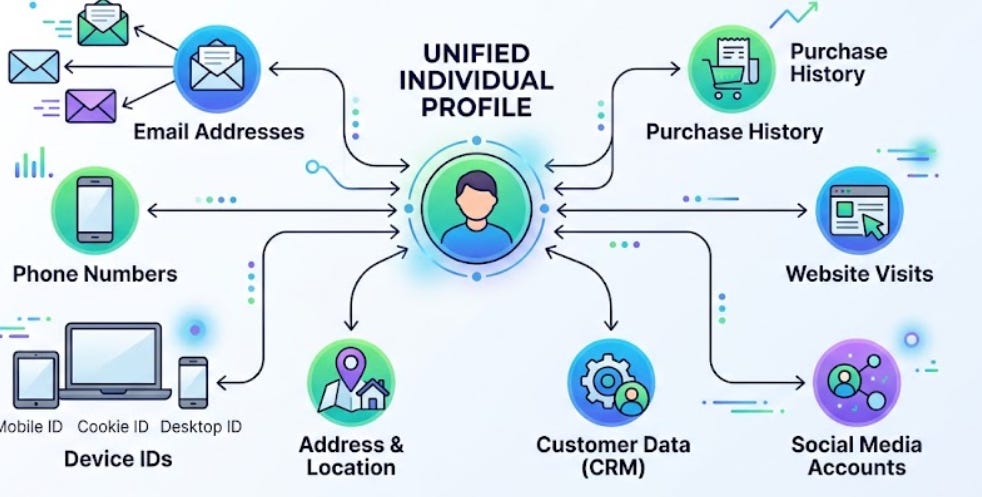
Tapad, another Experian subsidiary, builds "identity graphs" that link a single person or a household to multiple devices. A device fingerprint that catches a ‘fraudster’ is also a targeting identifier for advertisers.
PredictivePop INC, DBA as Audigent, is another subsidiary of Experian that sells personal data to advertisers so that they can create targeted, individualized content for brands and media agencies to place in front of people.
You can view the full, comprehensive list of Experian subsidies and corporate information compiled by Dissent in Bloom by clicking here.

The Equifax Annual Report and SEC report for FY25 show a revenue and subsidiary count that continues to grow. Their global reach expands from the United States to Germany to the UAE and even places like Argentina, Australia, and Ireland.
One subsidiary of Equifax, dubbed Appriss Insights, LLC, provides an individual’s “risk data.” They state their primary focus is, “retail loss prevention, risk intelligence, and healthcare data solutions.”
Their data encompasses information sourced through public records such as arrest records, bank liens, public credentialing databases, traffic tickets, and bankruptcy filings. From there, they look and see if you’ve ever had a civil judgment, substance use issues, your name on a restraining order, or any involvement with domestic violence.
This company is used by lenders, landlords, and employers too.
Appriss Insights (Equifax) offers pre-employment screenings and post-employment screenings, meaning they will provide ongoing monitoring of your records as requested by your employer.
I wouldn’t have journalistic integrity if I didn’t point out that this leaves victims of physical, psychological, and financial abuse at risk of being profiled and rejected for everything from loans to job opportunities because they are a “risk”.
These databases are created using AI data scrapers. They can’t understand context and nuance; they lack the ability to parse or divide information on victims or perpetrators in the clunky, mass-uploaded data sets.
Equifax has other companies that are just as invasive. TDX Group Unlimited is a company that sells a debt-collection software CyberFinancial to debt collectors and insolvency management services. This software includes information like a person’s “propensity to pay” score. This means the software looks at your current bank accounts, your credit limits, and your recent payments to calculate exactly how much available cash you likely have.
They do this by using credit reports and their program, The Work Number, which, as said above, is the massive database where Equifax tracks the real-time payroll data of millions of people.
If they see you pay off a car loan or if your credit limit increases, it tells them to pursue you even more aggressively because now you have the means to pay.
They also use skip tracing so that debt collectors can follow you no matter where you move, if you change your phone number, or if you ignore their calls. The software does this by using a feature named, “residency and trace.”
Because Equifax is constantly taking in your information from utility companies, cell phone providers, and landlords, the second that you open a new account or sign a lease, debt collectors can find you immediately.
No matter how much PR branding these corporations use, it’s important to see beyond that and recognize the massive pro-corporate behavior we see here.
You can view the full, comprehensive list of Equifax subsidies and corporate information by clicking here.
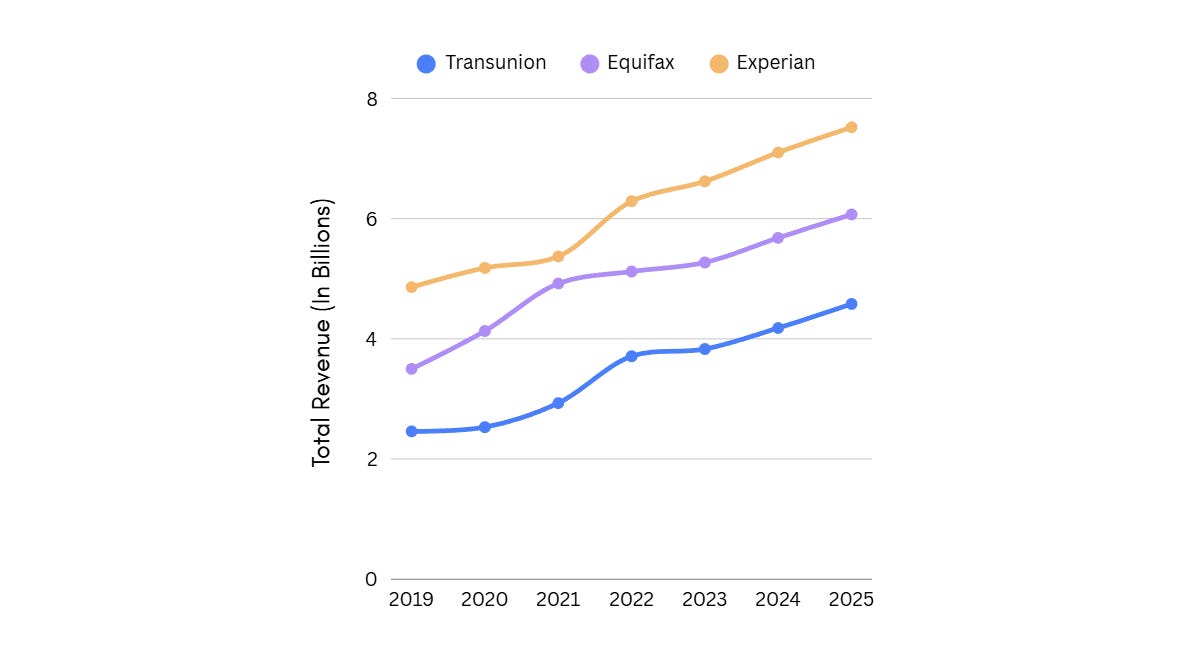
In their latest 2025 records, Transunion’s annual report and SEC filings show a 7% increase in revenue, equating to approximately $4.58 billion by the end of 2025. Just like their data-broker brothers, TransUnion is global, with companies located in South Africa, the United Kingdom, the U.S., Spain, the Philippines, and so on.
Perhaps the most concerning of the Transunion subsidiaries is Neustar, Inc. Neustar was purchased by Transunion in 2021 for $3.1 billion dollars.
Neustar is functionally another LexisNexis.
If you aren’t familiar with either,they exist to connect your digital footprint, such as your IP address and your identifying information, such as your email and phone number, to your real-world identity.
LexisNexis bought a company called ThreatMetrix to track the specific smartphones and laptops you use. TransUnion bought iovation (now rebranded as TruValidate) to do the same thing.
Ultimately, this means that anything you do across the internet on your device, using your cell phone number, name, email address, or anything that could be used as a tracking point, can be connected to you specifically. This is used for everything from government operations to advertising data.
They market it as fraud prevention and preventing risk. What something is marketed as vs. what it’s used for are very frequently different things. Functionally, these corporations act as invisible surveillance networks.
These are just two in an enormous ecosystem of data brokers, advertisement tech, and cybersecurity platforms all competing to build the biggest “identity graph” of a person.
You can view the full, comprehensive list of the “Big Three” subsidies, profit, and corporate information compiled by Dissent in Bloom by clicking here.
I preface this article by stating that I feel these companies are just as bad as Palantir and Flock. I’m not the only one that feels this way, which is why this interview happened between the CEO of Technology and Software Solutions at Experian, Alex Lintner, and The Verge magazine.
“First of all, we’re not Palantir, so we don’t do reputation scores.” — Alex Lintner, CEO of technology and software solutions at Experian.
What Alex doesn’t mention, however, is that three months before this interview, Experian was shut down in the Netherlands for doing just that.
In 2025, Experian was fined €2.7 million ($3.2 million USD) by the Dutch Data Protection Authority after the discovery of their illegal consumer credit assessment services in the Netherlands. Much like in America, Experian was purchasing private consumer data.
This data was used to create trustworthiness scores that were sold to corporations, leading to unexplained rental rejections, higher utility deposits, and even denied installment payment plans for Dutch residents, eventually triggering an investigation.
Experian officials ultimately decided not to appeal and told Dutch officials they would delete their entire database. That marked the end of Experian’s Netherlands operations.
This seems contrary to the fact that in their FY26 annual report Experian states that they help consumers, “save on car insurance, find the right credit card, lower bills and cancel subscriptions.”
Data brokers exist to purchase and sell your personal data. Their entire corporate foundation is based on the collection and selling of data. So, where do they get it from?
They may collect the public data for free, but private information gets bought, and somewhere in a terms of service you clicked through, you likely gave them permission.
Almost every application you download requires that you agree to their terms of service that dictate how users should use the app. This typically includes their privacy policy, which dictates how the app can use the users. More specifically their personal data.
A person may download a weather app, a flashlight, or a mobile game. These apps ask users for permission to access GPS data, contact lists, device ID, and usage habits.
Often, users will just hit accept because they want to get to the content or the application. And in doing so, they allow these innocuous-seeming apps to sell a continuous feed of an individual’s daily movements and activities to data brokers.
Pay attention to what an app is asking for access to.
The grocery giant Kroger operates a data analysis and monetization subsidiary called 84.51. 18.51 gets consumer data from store loyalty cards from Kroger and their various other brands. This data is then sold to data brokers. Kroger generates roughly $1 billion in annual revenue through its data monetization and retail media operations alone.
Hell, even your car was selling your data. General Motors (GM) collected and sold information on millions of customers’ driving habits through its “Smart Driver” OnStar program. Specifically, they sold this information to LexisNexis Risk Solutions and Verisk, who then sold it to auto insurance companies that used it to determine insurance rates based on the “risk score” assigned by their AI.
GM & OnStar accomplished this until early 2024 when it was shut down by the Federal Trade Commission because it wasn’t in the fine print so consumers argued they didn’t have informed consent.
You have probably heard of a FICO score. You have likely heard of the Fair Credit Reporting Act (FCRA). Not only that, but you’ve likely heard of the Consumer Finance Protection Bureau (CFPB). What countless people haven’t put together is the history that combines all three and that deeply involves Experian, Equifax, and TransUnion.
It also involves a dark, albeit fascinating history of keeping profiles on millions of Americans—a practice used by government officials to target “subversive” Americans during the Red Scare.
In fact, the FCRA was created so that private, investigative organizations—like Wackenhut, now known as GeoGroup—could not keep secret files on Americans without their knowledge or access to the information being collected about them.
Before the massive consolidation of personal data, credit scores used to exist on a city-by-city basis. This eventually grew to exist on a state-by-state basis, then a federal basis, and now a global basis.
Experian began as Credit Data Corporation (CDC). CDC was created in 1965 and was the first computerized credit bureau system to exist in California. The person behind it—Harry C. Jordan—was appointed to be an “expert advisor” on consumer privacy and credit automation to Ronald Reagan during his tenure as California governor.
CDC was ultimately sold to another corporation called TRW in 1968, and then in 1996 it was sold again to Bain Capital and Thomas H. Lee Partners.
In June 2023, Bain Capital was ranked the 13th largest private equity firm in the world on Private Equity International's PEI 300 list. They hold ownership in corporations from AMC Theaters to Dunkin’ Donuts to Hospital Corporation of America. Thomas H. Lee Partners is a smaller private equity firm holding ownership in corporations like The Nielsen Company, Warner Music Group, and Dunkin Brands. The two share a lot of corporate ownership.
Experian—the largest of the three—is traded on the London Stock Exchange. All three are structured the same way at the ownership level, they are public companies whose shares are held mostly by the same few corporations.
The difference is which country’s stock market and financial regulators they answer to, the UK’s for Experian and the US’s for Equifax and TransUnion. And in both places, they’re owned by the same people.
As of mid-2026:
Transunion: 15.3M shares, 7.90% stake, roughly $1.33B
Equifax: 6.1M shares, 5.00% stake, roughly $1.35B
Experian: 52.7M, 5.1% stake, roughly £1.43 billion, or approximately $1.78 billion USD
Transunion: 19.0M shares, 9.77% stake, roughly $1.65B value
Equifax: 15.2M shares, 12.44% stake, roughly $3.36B value
Experian: 45.6M shares, 5.1% stake, roughly £1.24 billion, or approximately $1.54 billion USD
Yes, your credit score was bought by private equity and sold to the highest bidder. Now Blackrock and Vanguard own your credit score, your 401K, and they’re selling your data, too.
Ultimately, whether you believe the PR or not, companies like this exist and sell data without real constraints or rules, and companies like Palantir, LexisNexis, and more eat it up.
During the Red Scare, private entities and government agents collected massive amounts of information on Americans. Now the corporations do it for them.
Experian makes the most money.
And it’s not just Experian, TransUnion, and Equifax, but companies like Axiom, Epsilon, and Corelogic. These are all massive private corporations raking in billions in revenue through data brokerage.
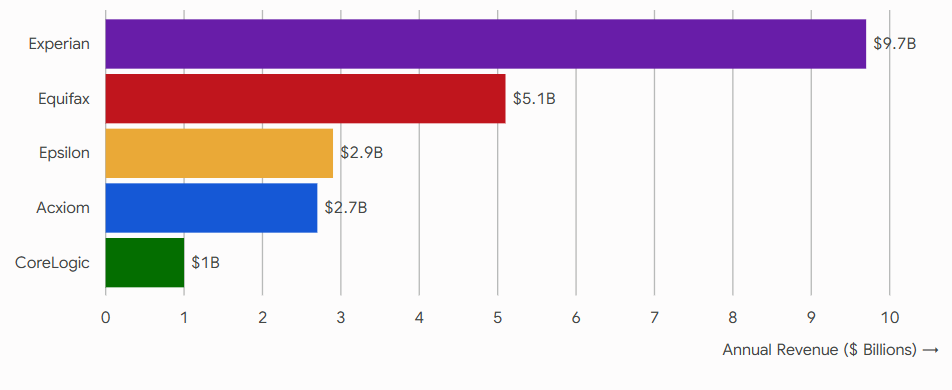
And nearly all of it is owned by the same group of billionaires that own your 401(k). They own the companies that track your every move, and they manage the money you need to survive when you get old. A tiny group of people owns absolutely everything—and they’re collecting your data right now.

Comments
Nothing yet. Say the first thing.
Sign in to join the conversation.