
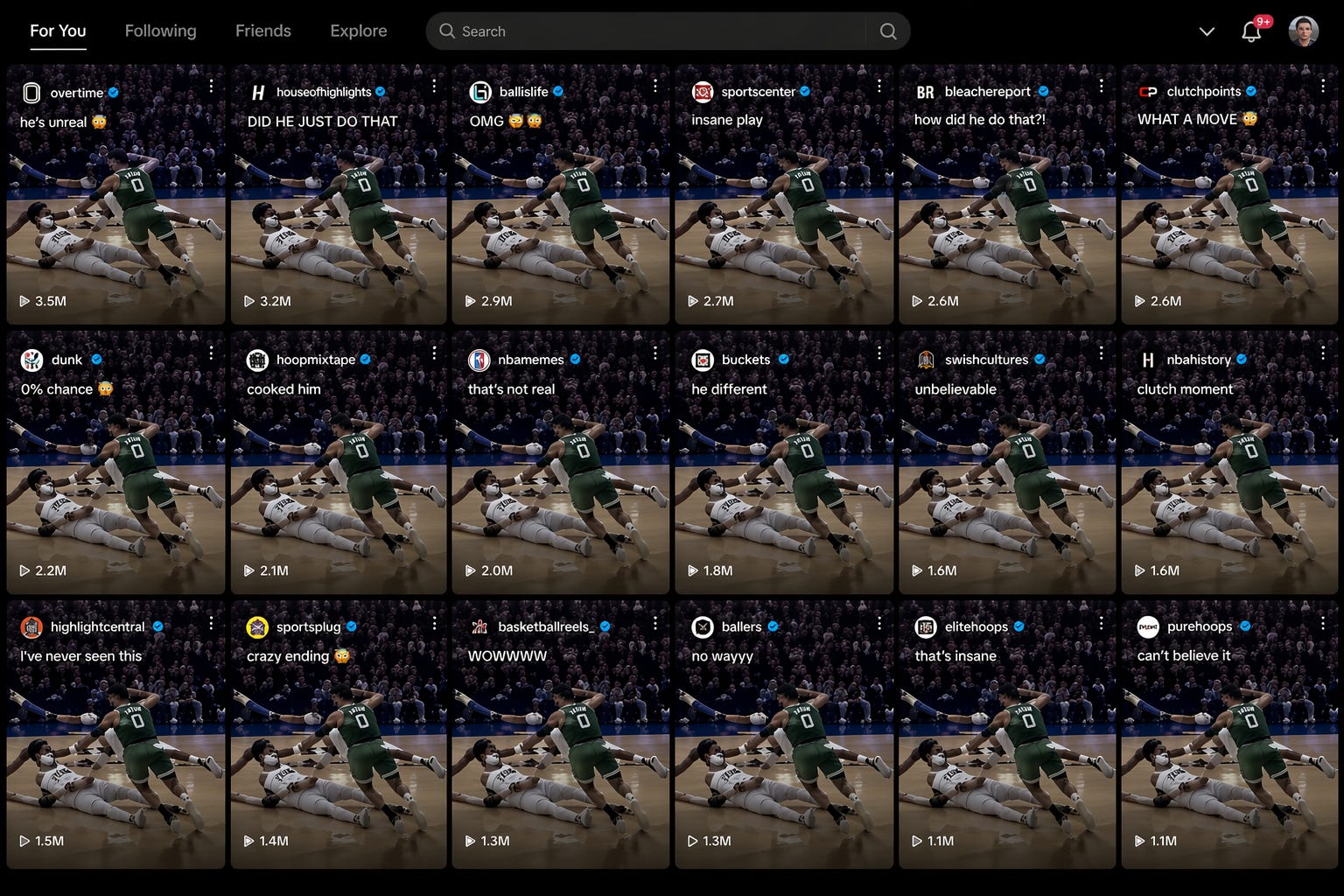
The internet has a 15-year tic. Every cycle, somebody figures out a new way to manufacture attention at scale. Every cycle, the platforms reward it for a while. Every cycle, the correction comes and wipes out the operators who confused volume for value.
Clipping is the next one. And sports, of all places, is best positioned to be the category that figures out how to do it right.
The pattern is well established at this point.
2007: Splogs. Automated sites scraped RSS feeds, republished stolen content, wrapped it in AdSense, and waited for search traffic. Google caught up.
2009: Content farms. Demand Media paid freelancers $3.50 per article and published a million pieces a month on eHow. The company went public in 2011. Google’s Panda algorithm launched the same month and erased 40% of their traffic. The stock never recovered.
2014: Click farms. Warehouses of phones in Bangladesh, Vietnam, and the Philippines manufactured fake likes and follows for under a cent per interaction. Instagram’s 2014 purge deleted millions of fake accounts. Facebook’s 2014 SEC filing estimated 83 million false accounts on the platform.
2024-2026: AI slop. Generative tools made content production approach zero marginal cost. A Kapwing study found 21% of YouTube Shorts recommended to new users were AI-generated slop. 278 slop-only channels accumulated 63 billion views and an estimated $117 million in annual ad revenue. YouTube terminated channels. Brands pulled spend. The correction is still rolling out.
2026: Clip farms.
The latest version does not use bots or AI, it uses people and that is what makes it harder to detect and harder to stop.
Vyro is the cleanest example. Creators post campaigns and then clippers cut long-form videos into short-form clips and post them to TikTok, Reels, and Shorts from their own accounts. Vyro tracks views and pays out at roughly $3 per 1,000 views, no follower count required, no audience needed. MrBeast has reportedly paid out over $100,000 to early clippers. Some operators on similar platforms claim $20,000 to $30,000 per month in payouts.
The pitch is decentralized distribution. Every clipper becomes a micro-distributor extending a creator’s reach across thousands of accounts. The clips look organic because they come from real people. The content appears native because it sits on personal feeds. The scale is theoretically infinite because anyone can join.
This is the same pitch every prior cycle made. The mechanics change, the language gets refreshed, but the core promise is always the same: you can manufacture attention faster and cheaper than anyone competing on quality….until you can’t.
AI slop has tells: warped hands, glossy textures, the uncanny smoothness that triggers your brain before you can articulate why. Platforms are building detection. YouTube joined C2PA for content credentials. TikTok added 1.3 billion AI labels. Pinterest built opt-out controls. The infrastructure to identify and downrank synthetic content is being built in real time.
Human slop has none of those tells.
A clip posted through a Vyro-style platform comes from a real person, on a real device, from a real account. The content is derived from legitimate source material. There is no synthetic media to flag, no AI watermark to detect. From the platform’s perspective, a clip from a paid clipper looks identical to a clip from a genuine fan.
The only difference is motivation. A genuine fan clips a moment because it resonated. A paid clipper clips a moment because the campaign brief told them to. The engagement that follows reflects either a real audience relationship or an algorithm responding to volume signals. The metrics dashboard cannot tell the difference, but the long-term value of the two is not remotely comparable.
Ed Abis, CEO of Dizplai, put it precisely in a comment on the LinkedIn post that prompted this piece: “Paid fans clipping content from their own accounts. Looks organic, scales infinitely, costs a fraction of paid media. The question is whether cash-motivated clippers perform the same as genuine fans. If the connection isn’t real, the engagement won’t be either.”
That is the cycle’s tell. It works in the short term but it collapses in the long term, every single time.
From our POV, here is where the story turns...Most categories are going to ride this cycle into the ground because they have to. Music has been gamed by streaming farms for a decade. Mobile gaming installs are bot-saturated. E-commerce reviews are mostly fake. The damage is already done. Those categories are trying to pull out of a tailspin.
Sports has not entered the tailspin yet. Sports also has structural advantages no other category has.
Live games can’t be faked. The product itself is the most defensible content asset on the internet. There is no AI-generated version of Shohei Ohtani at the plate or a Jude Bellingham free kick. The source material is real, scarce, and premium-priced.
Fan tribes are real and durable. Every team has a built-in audience that already cares. Every athlete has a community that already follows. The trust layer is pre-existing. It does not need to be manufactured. It needs to be channeled.
Athletes own their personal IP. NIL changed the equation at the college level. Athlete brand-building changed it at the pro level. Sports has more individual creator IP than any other content category, and that IP is anchored to real people with real fan relationships.
Rights holders control the source. Every clip has to start somewhere. Sports leagues, teams, and properties own the broadcast feeds and the official content. They have leverage other categories don’t.
Put those four together and sports has every input it needs to build a version of clipping that does not collapse. The question is whether the industry will use those advantages or surrender them by adopting the open marketplace model that’s about to flame out everywhere else.
Learn More About Disruptive Play
Disruptive Play Partners with Investors, Founders and C-suite Leaders Challenging Industry Norms at the Intersection of Sport, Media and the Creator Economy.

Four moves rights holders, leagues, athletes, and brand partners should be making now to build the version of creator distribution that compounds instead of corrects.
Comments
Nothing yet. Say the first thing.
Sign in to join the conversation.