
Women continue to do the majority of the housework in modern households even though most work in the labor market just like their male spouses. Kyle Hancock, Jeanne LaFortune, and Corrine Low show in their paper “Winning the Bread and Baking It Too” that this is even true in couples where the wife is the breadwinner (ie outearns her husband). So, men and women are not specializing within the household in housework and market work based on earnings. This is especially clear in the paper when they look at couples where the spouses are paid hourly (as opposed to salaried work) and the woman earns more per hour. The couple could jointly have more money if she spent more time doing market work and he spent more time doing household work. But still, the woman spends more time on housework than the man.
It is unclear how work from home might affect this dynamic. It will depend on who ends up working from home as well as their behavior while working from home. Thomas Lyttelton, Emma Zang and Kelly Musick found in time use data from before the pandemic that both men and women who were teleworking on the day they completed their American Time Use Survey time diary spent more time doing housework and childcare than those who were not teleworking. But women still did more than men. Particularly since women have a stronger preference for telework than men, the increase in telework could increase the inequality in housework.
We are still adjusting to the new norm of increased telework, but Andreas Kotsadam, Mette Løvgren, Nicolas Moreau, Elena Stancanelli, and Arthur Van Soest wanted to understand how these changes in workforce structure might translate into changes in expectations about household chores, while abstracting from the real-world choices about work from home. To do so, they provided survey respondents with a series of vignettes, or stories about a hypothetical couple: Rob and Petra. For some respondents Rob was the main character who was working from home and was asked to do more household chores, for others Petra was the main character.
For either character, respondents agreed that the partner who was working from home should do more household chores. But when Rob was the one working from home and was slacking off on the household chores, respondents thought he definitely needed to pull more weight, whereas they were more ambivalent about Petra (blue bars are more to the right than the pink bars in the graphs below). Given the historical inequality in household labor, Petra’s complaints about Rob slacking off may have been seen as more credible. Sure, maybe Petra could make more dinners when she is working from home, but maybe she’s already doing most of the cleaning and the laundry and the childcare. In that case, Rob should come home and put food on the table even if he is coming from the office.
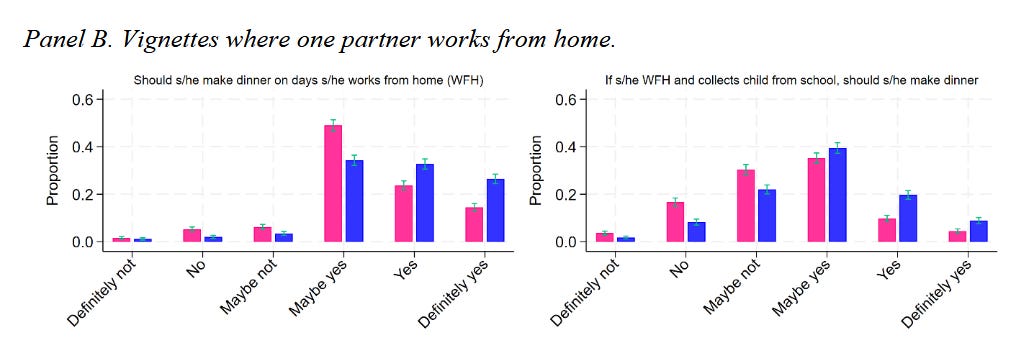
The fact that the survey respondents felt more strongly that Rob should contribute more when working from home is a sign of movement in gendered expectations of who does the chores, even if women are still spending more time on them than men. If a version of vignettes were run a decade or two ago, we may have instead seen an expectation that Petra was in charge of all of the household labor, even if she was also working. In that case Rob’s complaints about Petra slacking off on this household labor when working at home would have been seen as the more credible complaint.
So, the expectations are going in the right direction. It remains to be seen if the behavior will follow in kind as we adjust to this reorganized work environment.
No posts
Comments
Nothing yet. Say the first thing.
Sign in to join the conversation.