
Teams that bridge functions, disciplines, value chains, or sectors are diverse. Although in some quarters it may be a bad word, diversity brings benefits. A timely amplification of this idea arrived from my alma mater, UC Berkeley, in a note about a new book by Berkeley Law Professor David B. Oppenheimer, The Diversity Principle: The Story of a Transformative Idea. Here’s a short excerpt of the note (bold added by me):
Oppenheimer said, “The diversity principle holds that when you bring together people with different backgrounds and experiences, including people of different ages, of different religions, of different races and ethnicities and genders, when you include people with disabilities, when you include people who are perennially outsiders and make them all part of a group, they will be better problem-solvers.”
“In a classroom, they’ll generate more ideas. In a science lab, they will come up with more significant discoveries. In government, they will develop more original public policy initiatives. In a business, they’ll make more money.”
“And, Oppenheimer says, there’s extensive scientific research to prove the point. What remains to be seen is how much evidence will be needed to persuade a powerful corps of diversity opponents.”
How diversity benefits from facilitation
Oppenheimer’s right about getting better solutions. What this excerpt doesn’t capture is that although a bridging (e.g. “diverse”) team can be exciting and inspiring, at the start it can also be frustrating and take longer to get off the ground. People from different disciplines, for example, use the same words to mean different things. People from different cultures or different ages may hold assumptions they’re not even aware of.
Development of bridge teams and bridge projects often benefits from facilitation at strategic points to help uncover the assumptions, the languages, the expectations. And often you can’t just ask, “what are your assumptions?” or “what does your jargon mean?” You need to surface these indirectly.
Here are some other angles on diversity arising in my recent sessions.
Visual languages
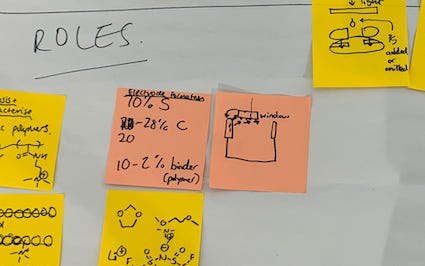
People have different ways of thinking and exploring ideas. I recently had a break-out group that spent more than half the session thinking primarily in chemical formulas and process diagrams on their sticky notes, instead of the words I’d requested. It was fun to see how energised they were by these visual ideas, but they sometimes got carried away by it. For example, what are their roles in the project?
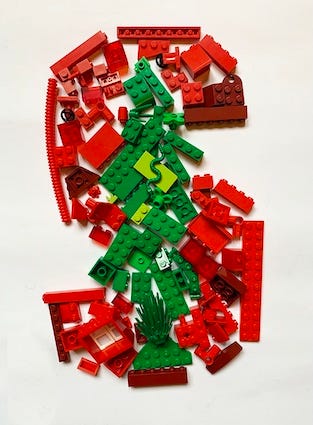
I’ve also had a number of people in Lego Serious Play sessions assemble the bricks without physically connecting them (more on Lego Serious Play). Some people like the freedom of movement when they’re explaining their ideas, or they like the looser associations. The image below is my construction (a Stanford University logo in keeping with the alumni theme), but it gives you a sense of this style.
Setting boundaries around a challenge
I’ve found over the years that people of different experience levels sometimes set different boundaries around a problem. More experience can mean more practical and less aspirational approaches, or a wider contextual approach instead of a narrower technical angle. More detailed knowledge can lead to more involved, even “rabbit hole” discussions—if not managed carefully. These patterns can help you plan ways of moving people toward, or away from, aspirational/practical discussions.
Aspirations
Diversity also emerges in what drives people. I ran a workshop on quantum strategy where some people were driven by theory (mathematical models, fundamental limits) and others by engineering (building quantum computers or sensors) and the groups prioritized different facilities and support.
Similar examples come from other functions: professional practitioners, researchers, regulators, or makers (like the quantum engineers). Diversity in a value chain ranges from front-line, customer-facing roles to executives.
What’s been your most surprising, humorous or rewarding experience getting a bridge team or bridge project off the ground?
No posts
Comments
Nothing yet. Say the first thing.
Sign in to join the conversation.