
Greetings from Jerusalem,
Today, we feature a long-form interview published yesterday (December 3, 2025) with two prominent Iranian researchers of China:
Esmaeil Bashari اسماعیل بشری, a senior IR scholar specializing in China and the Korean peninsula. Bashari previously worked as a researcher at the Center for Strategic Research (CSR مرکز تحقیقات استراتژیک), which is affiliated with the Expediency Discernment Council. Established in 1988 by Ayatollah Khomeini, the Council’s primary purpose is to resolve legislative conflicts and deadlocks between the Majlis (parliament) and the Guardian Council.
Hamed Vafaei حامد وفایی 好麦特, a Professor of Chinese Literature at the University of Tehran. He is also the Director of the Asia Research Center and the Iranian Director of the Confucius Institute at the university. Vafaei attended prestigious Tsinghua and Peking Universities, where he studied Chinese Language and Literature, and the University of Tehran.
The NPT is a hard red line: China’s support for Iran on the nuclear file is conditional on Tehran’s adherence to the Non-Proliferation Treaty (NPT). Vafaei warns that if Iran withdraws from the NPT, China will abandon Iran immediately, just as it voted against Tehran during the Ahmadinejad era.
Symbolism at Tiananmen parade: President Pezeshkian’s invitation to the Tiananmen military parade in September was a “green light,” a political act of reassurance after China’s lackluster support during the 12-Day War with Israel and the US. It was not a shopping spree for weapons.
Arms sales continue covertly: Iran never stopped buying weapons from China, though the details are classified. China won’t provide security guarantees or enter a conflict on behalf of Iran, but it will continue sales as long as they do not threaten China’s core interests.
China rejects the “Iran vs. Israel” binary: Beijing operates on the “unity of opposites,” maintaining simultaneous cooperation with conflicting parties (e.g., Iran/Saudi Arabia, Israel/Palestine, and Iran/Israel). China views itself as a pragmatic partner to all, refusing to pick a side in the Middle East conflict despite its military cooperation with Tehran.
China vs. Russia: Unlike Russia, which benefits from “controlled tension” in the Middle East to distract the West, China operates on a “Wealth Paradigm.” Beijing requires regional stability for energy security and trade; a stable Iran serves China, while a chaotic region serves Russia.
Iran’s “Look East” policy is reactive, not strategic. Vafaei argues Iran never developed a true long-term China policy; engagement with Beijing arises mostly as a response to Western pressure, not a planned national strategy.
Iran’s value depends entirely on how effectively Tehran defines and operationalizes its role. China will not ignore Iran’s geography, energy, or civilizational weight, but it will downgrade Iran’s importance - and even treat it as expendable - if Iran fails to present clear strategies, coherent diplomacy, or stable long-term frameworks
On this note, I recommend ChinaMed Project’s Theo Nencini and Veronica Turrini's excellent recap of Iranian experts’ debates on the future of the Iran-China relationship after the Twelve-Day War.
Machine translations from Persian were made using ChatGPT 5.1 and Gemini 3 Pro, then manually edited. Please reply to this email if you spot any major errors.
Thank you for reading,
Tuvia
The written interview was published in Shargh شرق, a prominent reformist daily newspaper, on December 3, 2025, and the full video interview was published on their YouTube page on the same day.
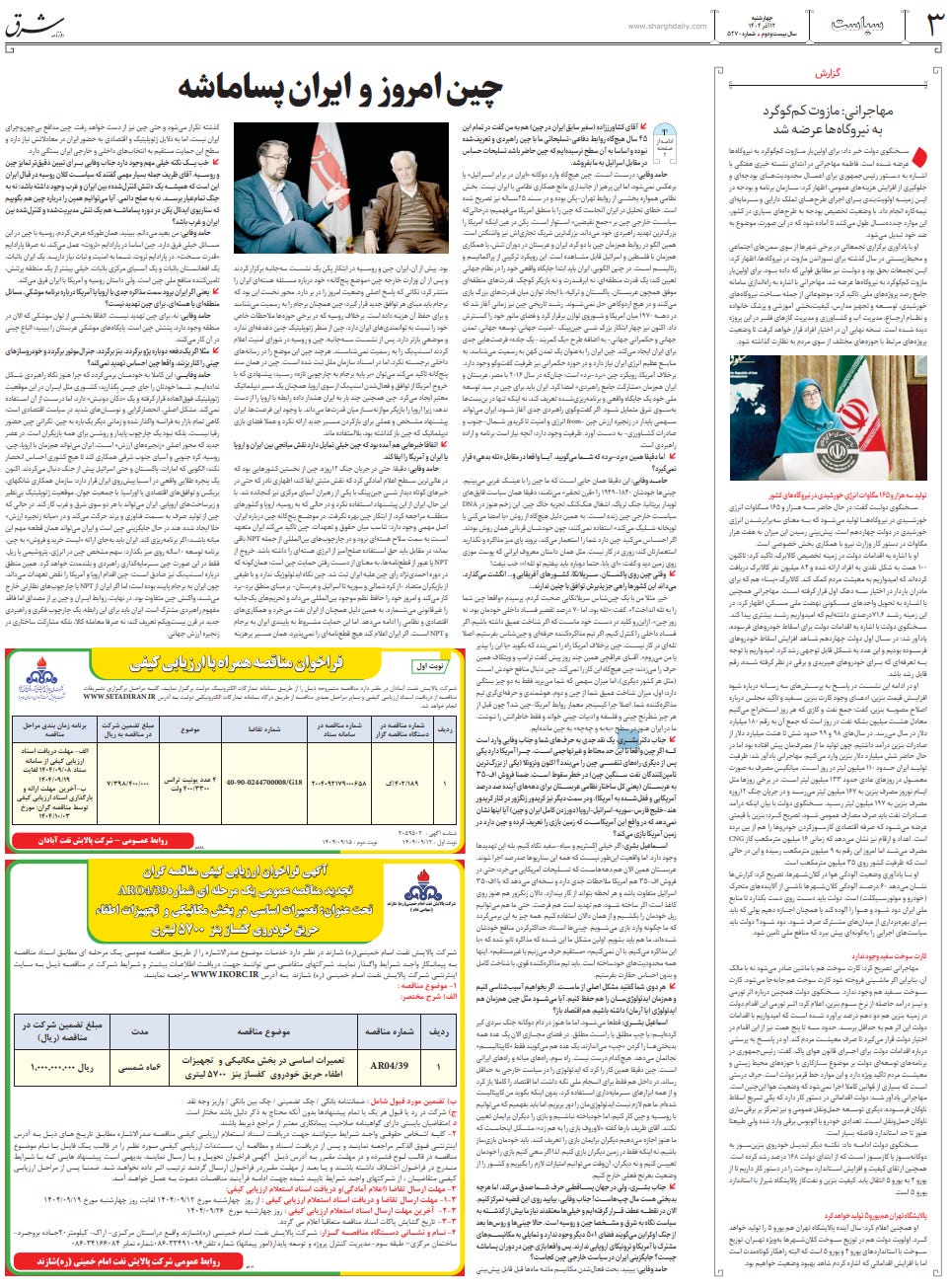
[The written interview opens with this quote:]
“In all these 45 years, our defense and arms relations with China have never been strategic or defined, and fundamentally, we have not reached the level where China is willing to sell us sensitive weaponry for use against Israel” - Mohammad Keshavarz-Zadeh, former Ambassador of Iran to China
Hamed Vafaei: That is correct. China never enters the binary of “Iran vs. Israel” or vice versa, but this avoidance of taking sides does not prevent military cooperation. The military sector has long been a key component of Tehran-Beijing relations and is explicitly mentioned in the 25-Year Agreement.
The analytical error in Iran is that we understand China through American logic, whereas China’s foreign policy is based on the ‘unity of opposites.’ While Beijing views the U.S. as its greatest strategic threat, Washington is also its largest trading partner. This same pattern is observable in China’s simultaneous relations with the two Koreas, Iran, and Saudi Arabia during times of tension, or simultaneous cooperation with Palestine and Israel. This approach is a combination of pragmatism and realism.
In such a model, Iran must first define its true position in the global system: a regional power, neither a superpower nor a minor player. Successful regional powers like Saudi Arabia, Pakistan, and Turkey play by balancing between great powers and do not limit themselves to any single camp. China’s own historical rise began when it established a balance between the U.S. and the Soviet Union in the 1970s, thereby expanding its maneuvering space.
Now, Xi Jinping’s four major initiatives for Global Security (GSI), Global Development (GDI), Global Civilization (GCI), and Global Governance (GGI), along with the Belt and Road Initiative (BRI), create serious opportunities for Iran. China recognizes Iran as an ancient civilization, needs Iran’s vast energy resources, and there is capacity for dialogue in the realm of governance.
Unlike the U.S., China’s approach is “win-win”; for instance, in 2016, it signed “Comprehensive Strategic Partnerships” with Egypt, Saudi Arabia, and Iran simultaneously. Iran must define a realistic and planned position for China within its national development basket, rather than leaning East only when it hits dead ends. If a serious strategic dialogue begins, Iran can secure a sustainable share in China’s value chain, from energy and security to the North-South Corridor and agricultural exports. The capacity exists; what is needed is a plan and strategic will.
Interviewer: But regarding this exact “win-win” you mention, does it not actually stand in contrast to the “Debt Trap”?
Hamed Vafaei: This is exactly where we are viewing China through Western glasses. The Chinese themselves call 1840–1949 the “Century of Humiliation”; it refers precisely to the policy of British gunboats, the Opium Wars, the occupation of Hong Kong, and the fragmentation of Chinese territory. This wound still lives in the DNA of China’s foreign policy. For this reason, they never force you into a “sign, or the artillery fires” situation, because they were victims of that very method themselves. If you feel China is colonizing you, go to the negotiating table and don’t let them colonize you; there is no force involved. It’s like the famous Iranian joke where a man saw a banana peel on the ground and said, “Oh no, I have to slip again!” Well, don’t slip!
Interviewer: When China puts its finger on Pakistan, Sri Lanka, African countries, etc., it knows these countries have no choice but to accept an agreement with China...
Hamed Vafaei: No. For example, I spoke with a Sri Lankan Sinologist and asked, “Did China really trap you?” He said, “It was a trap, but 70% of it was the fault of our own internal corruption, not Chinese force.” Therefore, the key is in our own hands. If we have deep knowledge, if we control internal corruption, and if we send a professional team of negotiators who know China, there is essentially no trap.
Unlike the U.S., China does not block the path, saying, “Accept this, or I leave.” [Foreign Minister] Mr. Abbas Araghchi said just a few days ago that Trump and Witkoff used to say that; China never does this. China seeks its own interests (like any other country), but the size of the share you get depends on only two things: first, the depth of your knowledge of China, and second, the intelligence and professionalism of your negotiating team. Why did Kissinger become the architect of U.S.-China relations? Because, first of all, he studied Chinese chess, philosophy, and literature; he didn’t just write his memoirs. In Iran, we are still stuck at the level of superficial praise for China.
Interviewer: Dr. Bashari, a serious critique applies to your remarks and those of Mr. Vafaei. If China is truly this cautious and non-aggressive, why is the U.S. cutting off China’s breathing paths one after another? Now Venezuela (one of China’s largest suppliers of heavy oil) is in danger of collapse. Furthermore, the sale of F-35s to Saudi Arabia (meaning Saudi Arabia’s entire military structure for the coming decades is 100% American and locked to the U.S.), and on the other side, the Zangezur Corridor, alongside the India-Gulf-Israel-Europe Corridor [IMEC] (completely bypassing Iran and China) - doesn’t this show that it is actually the U.S. defining the playing field and China is playing on American turf?
Esmail Bashari: If we look at it in a very extreme, black-and-white manner, yes, these threats exist. But the reality is not that all these scenarios will be implemented 100%. Saudi Arabia has been buying American weapons for decades already; even with the F-35 sale, the U.S. has serious reservations and provides a version different from Israel’s F-35, which it can disable at any moment. The Zangezur Corridor is still on paper; if built, it is both a threat and an opportunity. We can even lay our own rails and use that same corridor.
Everything comes back to how we enter the game. The Chinese have become masters of maximizing their own interests; we must do the same. Our first problem is that negotiation has become a taboo: “we negotiate with this one, not with that one,” “do we talk directly or indirectly?” These are all self-imposed limitations. We must send a strong negotiating team, with full knowledge and without a sense of inferiority.
Interviewer: Both of you said the main problem lies with us. If we want to diagnose the issue while maintaining our ideology, is it possible to be like China, having both an ideology (or ideal) and an open economy simultaneously?
Esmail Bashari: It is definitely possible, but we are still trapped in the binary trap of the Cold War: either absolute Left or absolute Right. In cyberspace right now, some blame all miseries on “Leftists,” while others say only “Capitalism” will save us. Neither is correct. The third way involves middle paths and Iranian paths.
This is exactly what China did: it minimized ideology in foreign policy, kept it internally only for national cohesion, but completely opened the economy and used all the tools of capitalism without saying, ‘I have become a capitalist.’ We don’t need to throw away our ideology, but we must understand that we can work with Russia and China without being self-deprecating and without letting others define the game for us. Mr. Zarif has said many times, “[Russian FM Sergey] Lavrov ruined the game”; the problem is that we still allow others to define the game for us. We must be game-makers ourselves, not just players on others’ fields. Therefore, if we try to determine the game ourselves rather than others, then we can extract the necessary concessions and pull the country out of the current complex situation.
Interviewer: Mr. Bashari, your point holds in a post-polar world, but [people think] whatever misery exists belongs to the Left! Mr. Vafaei, let’s focus on this issue. We are currently at a turning point, and many believe our need for a “Look to the East” policy- specifically China and Russia - is greater than before. Now, after the Ukraine war, the Chinese and Russians say the P5+1 atmosphere no longer exists, and they have no desire for joint mechanisms with the U.S. and the European Troika. So, what is China’s game in the post-Snapback [trigger mechanism] era?
Hamed Vafaei: Look, the discussion of activating the Snapback mechanism was predictable months ago. Before that, Iran, China, and Russia held a trilateral meeting under Beijing’s initiative, after which the Chinese Foreign Ministry published its “Five-Point Position” regarding the Iranian nuclear issue, points that contain the main answer to today’s situation.
The first pillar was that the JCPOA must be the basis for any new agreement; China still recognizes the JCPOA and has paid a cost to preserve it. Unlike Russia, which has its own specific reservations regarding Iran’s capabilities in certain areas, China does not have such concerns from a geopolitical perspective and holds a more open stance. After the trilateral meeting, China and Russia announced in the Security Council that they do not recognize the Snapback. Although China did not highlight this stance in its domestic media, it is recorded in UN documents.
In that same five-point document, China emphasizes that a “new framework can be reached based on the JCPOA,” a proposal that, even with the U.S. exit from the deal and the activation of Snapback by Europe, still created a valid diplomatic path. China has also warned Iran several times not to lose its relationship with Europe, because it views Europe as a balancing actor among powers. Despite these opportunities, Iran did not present a specific and practical proposal to open a new path, and practically, the diplomatic play space that China had left open remained unused.
Interviewer: Actually, there was news that China is very willing to play the role of mediator between Iran and Europe or Iran and the U.S.
Hamed Vafaei: Exactly. Even during the 12-day war, China was one of the first countries to announce readiness at the highest level to play a positive role; a rare statement that was even included in brief news reports of Xi Jinping’s meeting with a Central Asian leader. However, Iran did not use this offer, and while it turned to Russia, Europe, and regional countries, it did not utilize China’s initiative.
In China’s five-point stance on Iran, there is an important principle: the proportionality between rights and obligations. China emphasizes that Iran is obligated not to move toward nuclear weapons and to remain within international frameworks, including the NPT; in return, it must have the right to the peaceful use of nuclear energy. Exiting the NPT or violating resolutions means losing China’s support, just as China voted against Iran during the Ahmadinejad era.
China does not have an ideological view and works with a spectrum of opposing actors, from North Korea and Syria to Israel and Saudi Arabia, based on win-win logic. Today, it considers itself a guardian of the existing international order and considers unilateral sanctions illegal; for this reason, it continues to buy oil from Iran and continues economic and military cooperation. But this support is conditional on Iran’s adherence to the JCPOA and NPT. If Iran announces that it accepts no resolutions, the same costly path of the past will be repeated, and even China will be lost. China is not Iran’s unquestioning defender, but for geopolitical and economic reasons, it needs Iran’s presence in its equations, and the level of this support depends directly on Iran’s domestic and foreign choices.
Interviewer: Well, there is a very important point, Mr. Vafaei, to define the distinction between China and Russia more precisely. Mr. Zarif said a very important sentence: that Russia’s macro policy toward Iran is that there should always be a “controlled tension” between Iran and the West; neither reaching total war nor permanent peace. Can we say the same about China, that Beijing’s ideal scenario in the post-Snapback era is also a managed and controlled tension between Iran and the West?
Hamed Vafaei: I doubt it. Look, as I mentioned, Russia is very different from China on these issues. China fundamentally operates in the “Wealth Paradigm” [It refers to a geopolitical and strategic framework where a nation prioritizes economic prosperity, financial stability, and interdependence as its primary sources of power, security, and global influence], not merely the “Hard Power Paradigm.” In the wealth paradigm, you need security and stability. A stable Iran, a stable Afghanistan, and a stable Central Asia serve China’s national interests much more than a tension-filled region. But the story of Russia and the U.S. with Iran is different.
Interviewer: Meaning, if Iran moves toward serious negotiation with Europe or the U.S. regarding its missile program, regional issues, or nuclear issues, is that not a threat to China?
Hamed Vafaei: No, it is not a threat to China. In fact, part of the missile capability that currently exists in the region is backed by China. Look at Saudi Arabia’s missile bases; Chinese nationals are working there.
Interviewer: For example, if suddenly Peugeot returns, Benz returns, General Motors returns, and they push aside Chinese automakers, does China really not feel threatened?
Hamed Vafaei: This comes back entirely to us and why we haven’t yet formed a strategic view. Put yourself in China’s shoes; Iran has an extraordinarily valuable strategic location [lit. a “corner shop”دکان دونبش], but we don’t make good use of it [lit. “but we run it like a junk shop” بنجلفروشی]. The main problem is exclusivity and extreme fluctuations in economic policy; sometimes the entire market is handed to France, and other times suddenly to China. China’s worry is not the presence of competitors, but the lack of a stable and clear framework for all players.
In the new era, where the main axis is “value chains,” Iran can cooperate simultaneously with Europe, China, Russia, South Korea, and Southeast Asia, so that no country has a monopoly; this is a model that the UAE, Pakistan, and even Israel followed before the war.
Now, a real golden window in Asia is open before Iran in the form of the Shanghai Cooperation Organization (SCO), BRICS, and economic agreements with Eurasia. With a young population, a unique geopolitical location, and European-style infrastructure, Iran can work with both the East and the West. While China is moving from mere production toward technology and branding, creating a vacuum in the “middle of the value chain,” India is replacing China, and Iran can be that important piece in this middle - if it plans for it.
Instead of presenting a “buy and sell list” to China, Iran must put a 10-year development plan on the table: China’s specific share in energy, petrochemicals, or rail. Only in this case will China make strategic and long-term investments. The same logic applies to the Snapback: China views the European and American action as a violation of commitments because Iran has adhered to the JCPOA, but if Iran were to exit the NPT or monitoring frameworks, China’s reaction would be different. Ultimately, Iran-China relations are full of piecemeal projects پر از مصداق but lack a shared strategic concept. Iran must define a new intellectual and strategic framework for this relationship in the 21st century, not merely commodity trading, but structural participation in the global value chain.
[Context: The three islands of Abu Musa, Greater Tunb, and Lesser Tunb are strategically important islands located near the entrance of the Strait of Hormuz in the Persian Gulf. Iran currently administers all three, which have historical significance as part of Persian territory, but the United Arab Emirates (UAE) also claims them. In June 2024, during the China-Arab States Cooperation Forum (CASCF) in Beijing, a joint China-UAE statement called for bilateral negotiations to resolve the territorial dispute. After news outlets reported that China took the UAE’s position, Iran summoned China’s ambassador in Tehran in protest.]
This claim that “China has taken the UAE’s side on the three islands” is simply incorrect. You have to understand China’s relations with all Gulf states.
As for what Iran has done to establish its sovereignty over the three islands to Chinese audiences and policymakers - the answer is almost nothing.
China has never said the islands belong to the UAE. If it ever did, it would be unacceptable and would create major diplomatic conflict.
In meetings with the GCC states, China has only said that “the two sides should discuss the matter together.” That is the extent of China’s position.
Has Iran ever produced even a single Chinese-language dossier explaining why the islands belong to Iran?
Has Iran ever sat with the Chinese and said, “These are our legal and historical arguments”?
We have not. Not once.
Meanwhile, Saudi Arabia has produced extensive Chinese-language content, cultural programs, and heritage narratives targeting Chinese elites.
We cannot expect China to defend our position when we have never even presented it in their language or diplomatic frameworks.
“Right now, this is exactly our situation: we have become a bargaining chipکارتِ بازی. Both Russia and China really do try to trade us for their own advantage.
You yourself mentioned the issue of the three islands… Look, when the Chinese want to win over the Emiratis and secure projects there, for them the UAE is more important than Iran. For the Chinese, Saudi Arabia is more important than Iran, and so are many other countries.In a place like Djibouti on the Red Sea, China has a military base, which used to belong to France; the Americans are also there. China established a base there for influence in Africa. What I’m trying to say is that China’s view of Djibouti may actually be stronger than its view of Iran, because it can control a strategic passage there.
…We need to rethink our foreign policy. Because the way we have made it so complicated and contradictory has pushed us far away from the position we could have had in China’s strategic outlook.”
The military parade in Beijing was for the anniversary of China’s victory over Japan in World War II, a major symbolic event.
The usual guests are always there: Russia, Tajikistan, North Korea, and others.
The new development this year was the invitation extended to Iran.
Iran has no direct connection to that historical event, yet it was invited.
Given what happened during the 12-day war and the positions China took, China needed to send Iran a positive signal, a “green light.”
When you look at the strategic context, China seating President Pezeshkian prominently beside leaders of Russia, North Korea, Belarus, and others has a clear message.
In light of Iran’s expectations and the regional developments after the war, China judged that such symbolic reassurance was necessary.
Many people now say that Iran is moving toward China for weapons purchases.
However, the Chinese ambassador in Israel declared publicly that China does not sell weapons to either side of the Israel–Iran confrontation.
These matters are extremely sensitive. All countries keep their military relations secret, and Iran–China ties are no exception.
What we do know is this: Since the Iran–Iraq War - beginning in the mid-1980s -Iran has purchased Chinese weapons systems.
This predates today’s tensions and continues today. Iran buys from China just as it buys from others.
We have no precise numbers or public data; such figures are classified everywhere in the world.
Some have said China invited President Pezeshkian to the Tiananmen stands in order to sell weapons. That is incorrect.
If China wanted to sell weapons, it would simply send the catalogues. There was no need to seat him beside major world leaders during a symbolic parade.
The message was strategic, not commercial.
Historically, China supplied Iran with the “Silkworm” anti-ship missiles (کرم ابریشم) during the Iran–Iraq War, which significantly altered Iran’s capabilities.
Military sales have continued since then and will continue.
But China will not enter the Iran–Israel conflict on either side, because China does not involve itself militarily in conflicts that do not touch its core national security interests.
In China’s five-point position on the Iranian nuclear issue, there is a crucial principle: the balance between rights and obligations.
China states clearly that Iran has committed not to move toward nuclear weapons and to remain within international frameworks, including the NPT.
In exchange, Iran has the right to peaceful nuclear energy.
Some people in Iran said recently: “If necessary, Iran should leave the NPT.”
I said explicitly in official meetings: the moment Iran leaves the NPT, it will completely lose China’s support.
Do not forget: China’s red lines are firm.
During the Ahmadinejad period, when Iran crossed international red lines, China voted against Iran in both the UN Security Council and the IAEA Board of Governors.
Therefore, if Iran withdraws from the NPT or expels inspectors, China will no longer be able to work with Iran in international forums.
China is not an ideological actor; it is a global power with consistent rules. If Iran stays within those rules, it keeps China’s backing; if not, China will step away immediately.
Thanks for reading Discourse Power. If this free post was of any use to you, pay it forward by sharing it with others
Kiya Tabassian, an Iranian‑born musician and the artistic director of the ensemble Constantinople, hosting Senegalese kora player Ablaye Cissoko:
Tuvia Gering is an analyst at Planet Nine’s Digital Intelligence Team, a visiting fellow at the Israel-China Policy Center at the Institute for National Security Studies (INSS), and a nonresident fellow at the Atlantic Council’s Global China Hub. The views expressed in this article are solely those of the author and do not necessarily reflect the positions of the author’s affiliated organizations.
Comments
Nothing yet. Say the first thing.
Sign in to join the conversation.