
Greetings from Jerusalem,
As we prepare in Israel to light the first Hanukkah candle, news broke of a barbaric antisemitic terrorist attack on hundreds of Jews gathered at Sydney’s Bondi Beach to celebrate the Festival of Lights. As of this writing, at least eleven people have been murdered, including Chabad rabbi Eli Schlanger.
Some readers may regard my analysis of the global rise of antisemitism in the world’s second-largest country as a niche or purely academic subject. It is not. History shows that massacres of Jews are almost always preceded by prolonged campaigns of demonization and dehumanization.
I have been working slowly on an article analyzing a three-part series by the popular Chinese political commentator Ren Yi (Chairman Rabbit 兔主席), a Harvard Kennedy School alumnus and the grandson of reformer Ren Zhongyi. Ren gained millions of followers on Weibo and WeChat after covering the 2019-2020 Hong Kong protests, blending mainstream nationalist views with a polished and seemingly sophisticated analysis of international relations.
The series, published in three installments between November 21 and 28, argues that the Trump administration and the broader US elite are disproportionately and covertly run by networks of right-wing, pro-Israel Jews and “moneyed Jewish” donors.
Events ranging from 9/11 and the Iraq war to Iran policy, Gaza, and the Epstein case are presented by Ren as plausible evidence of a long-standing pattern of Jewish elites “pulling the strings” (操盘).
The essays explicitly claim that the American upper class is “controlled by Jews,” that Trump’s inner circle has been “fully infiltrated and compromised,” and that Trump himself is “an asset of both the Jews and Israel.”
Ren further argues that Jewish intellectuals have “always” directed major US wars and geopolitical decisions, including competition with China, framing Jews as opposing Chinese people and humanity as a whole. The series culminates in a detailed roster of “Trump’s Jews,” each graded by influence and “Jewishness” (犹太人指数).
The young pundit was once a research assistant to the late American scholar Ezra Vogel, one of the most revered historians of modern China. How would Ren rank him in terms of his “Jewishness”? How would he rank me?
Editors interested in publishing this analysis - please contact me.
May the memory of the victims in Australia be a blessing.
Tuvia
Iran and China talk partnership and alignment, but war, sanctions, and risk calculations are forcing both sides to confront the limits of their strategic trust.
by Tuvia Gering | December 14, 2025
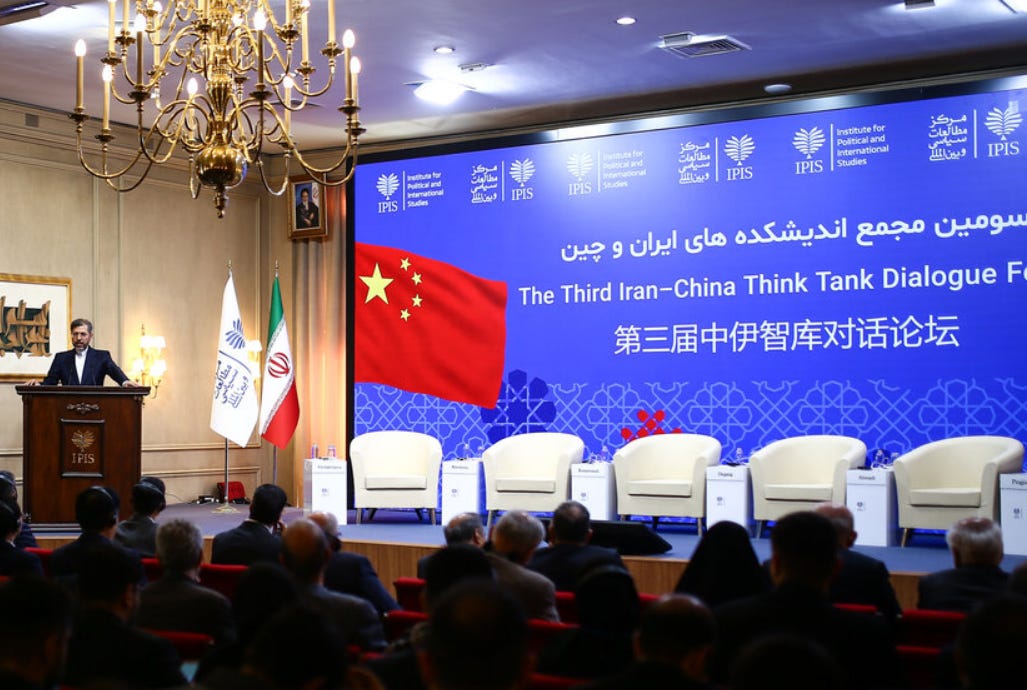
Iranian and Chinese scholars, diplomats, and policy advisers convened in Tehran this weekend for the “Third Iran-China Think Tank Dialogue Forum.” The event aimed to close what organizers described as a growing gap between elite decision-making and public perceptions in both countries, at a time when the relationship is facing new challenges from a bruising war, stifling sanctions, and region-wide realignment.
The two-day forum was held by Iran’s Institute for Political and International Studies (IPIS), which is affiliated with the Foreign Ministry. It brought together dozens of officials and researchers to mark the eve of the 55th anniversary of diplomatic relations between Tehran and Beijing.
In his opening remarks, Chinese Ambassador Cong Peiwu 丛培武 emphasized the strategic importance of the relationship at a time of rising global uncertainty. He called for maintaining the “correct orientation” of bilateral ties and strengthening mutual political trust. “In the current situation of the international system, where unilateralism is on the rise, the importance of China-Iran relations is more apparent than ever,” the ambassador said.
While the Chinese diplomat emphasized the relationship’s “strategic position” and the need to combat “unilateralism” - code for the US and its allies - the gathering was a painful reckoning for Tehran as it discovered the limits of Beijing’s support.
To counter the negative perceptions, IPIS President and Deputy Foreign Minister Saeed Khatibzadeh سعید خطیبزاده insisted that Iran-China relations are “based on choice, not compulsion,” and that the partnership is part of a shared effort by the two countries’ leaders to shape a more equitable international order.
According to Alireza Khoda-Gholipour علیرضا خداقلیپور, deputy director general of IPIS and head of its Asia Studies Department, the forum allowed Chinese and Iranian scholars to discuss political and security cooperation, trade and investment, culture and academia, emerging technologies, and new challenges, with the stated goal of developing practical proposals to strengthen bilateral ties.
However, Khoda-Gholipour added that it was also designed to “fill the cognitive gap between decision shapers, decision makers, and public opinion in the two countries.” This “gap” has widened significantly in recent months, as Iranian expectations were dashed by China’s hard-nosed, risk-averse approach.
The dialogue unfolded against the backdrop of the twelve-day war in June involving Israel, the US, and Iran. It also came more than two years after Iran-backed Hamas and the broader “axis of resistance” were sharply weakened across the region, following the fall of Assad, the collapse of Hezbollah, and the erosion of proxy forces in Yemen and Iraq.
The Israel-Iran war exposed the limits of Iran’s reliance on Russia and China, though all three continue to rely on one another for their larger anti-West strategy.
Iranian commentators who had seen China as a quasi-strategic partner were deeply disappointed when Beijing responded to the Israeli strikes with delayed, carefully worded statements and offered Tehran no obvious security assistance.
Yet the conflict also triggered self-criticism among Iranian China analysts who argue that Tehran overestimated its own importance, pursued an opportunistic and poorly institutionalized China policy, and mishandled economic opportunities. Experts argue that future relations in this post-snapback era will depend on Tehran developing a coherent, long-term strategy rather than waiting for Beijing’s rescue.
The economic dimension of the partnership remains equally fraught. While Iranian officials, including the Deputy Foreign Minister, highlighted opportunities in renewable energy and development corridors, Chinese experts offered a blunt assessment of why these projects often stall.
In an interview on Friday to Tehran Times, Fan Hongda, the director of the China-Middle East Center at Shaoxing University, acknowledged that US sanctions remain the “fundamental obstacle” to large-scale investment, but noted that Iranian domestic policies also play a role.
“Iran is currently not China’s main partner in West Asia [=the Middle East] in terms of both trade and investment,” Fan said, citing a difficult “environment” that dampens the enthusiasm of Chinese enterprises.
Despite the recent war, Fan dismissed the prospect of immediate defense collaboration. “Cooperation in security and defense depends on long-term strategic mutual trust, which China and Iran have not yet developed - sanctions are not the sole reason.”
Li Rui 李睿, a longtime correspondent in Iran for Chinese state-owned Phoenix TV who attended the forum, took a more direct approach to discussing the difficulties in the bilateral relationship.
In a video analysis she uploaded to social media, Li raised a question circulating quietly among Iranian observers: Why didn’t China’s top diplomat, Wang Yi, who is touring the region this week in the UAE, Saudi Arabia, and Jordan, stop in Tehran to attend an event hosted by Iran’s Foreign Ministry?
Since 2016, when President Xi Jinping visited Saudi Arabia, Egypt, and Iran and elevated relations with each to the level of a Comprehensive Strategic Partnership, Chinese diplomacy has sought to maintain a semblance of balance among relationships that are, in practice, deeply asymmetrical.
Her explanation for why Foreign Minister Wang skipped Iran is China’s growing focus on Gulf Cooperation Council countries, which present lower investment risk and offer a greater number of viable projects. Nevertheless, she emphasized that this did not amount to abandonment of Iran, pointing to China’s participation last week in a trilateral meeting with Saudi Arabia and Iran to advance the detente it brokered between the two opposing sides in 2023.
I would add that keeping this mid-level dialogue confined to the policymaking level and deliberately low-key is essential to addressing the forum’s two core questions, as Li put it: how to deepen Iran-China relations, and how China can assist Iran amid sanctions, war, and acute liquidity constraints.
China remains by far the largest destination for Iranian crude, with an estimated 90% of Iran’s oil exports ultimately sold to Chinese refineries. As Iran’s Islamic Revolutionary Guards Corps (IRGC) terrorists paradoxically took a leading role in Shanghai Cooperation Organization (SCO) largely symbolic counterterrorism drills in early December, PRC- and Hong Kong-based entities continued to channel illicit dual-use components critical to the IRGC’s UAV and ballistic missile programs, as well as those of Iran’s regional proxies.
Just as the Forum prepared to convene in Tehran, the Wall Street Journal reported that sometime last month, US special forces intercepted a vessel in the Indian Ocean en route from China to Iran. Upon boarding the ship, they seized and destroyed military-related dual-use components believed to be destined for Iran’s weapons programs.
Shanghai Institutes for International Studies (SIIS) scholar Jin Liangxiang 金良祥 told Phoenix’s Li Rui that across the region, from the Gulf to Iran, the unifying question is how to establish a new regional order.
Jin argued that while one model promoted by the US and Israel envisions a weakened Iran as the foundation of such an order, a new sustainable framework cannot be imposed militarily and must instead emerge through negotiations among key regional actors, including the Gulf states, Turkey, and Iran.
Notably, he said China is currently reassessing its Middle East posture ahead of the coming year, with the China-Arab States Cooperation Forum (CASCF) expected to convene a heads-of-state summit in Beijing for the second time, three years after President Xi led the forum in Riyadh in December 2022. That suggests Iran-China relations will need to be recalibrated accordingly.
Hamed Vafaei حامد وفایی 好麦特, Director of the Asia Research Center and head of the Confucius Institute at the University of Tehran, told Li in fluent Chinese that part of the friction stems from a reliance on “biased Western coverage” by Iranians trying to understand China.
Though it is worthwhile to revisit Vafaei’s lengthy interview earlier this month, where he provides more nuanced explanations, for the time being, focus on the Chinese correspondent, who suggested in her closing soliloquy that the “misunderstanding” goes deeper than media consumption patterns:
“Under the pressure of war and sanctions, Iran has an even greater need for stable external support, which is why you see Iran putting increasing emphasis on China. Road maps and project lists under the think tank dialogue framework are being discussed at an accelerated pace. Iran often describes the relationship as being in the “same trench” 同一战壕, opposing hegemony and unilateralism, but what China cares more about are controllable risks, calculable returns, and cooperation environments that can actually be implemented. The two sides are not speaking the same language, which is precisely why alignment through concrete projects is so necessary.
“In the past, every Iranian president came to office with a different policy orientation. For example, President Mahmoud Ahmadinejad was pro-China and pro-Russia, President Hassan Rouhani leaned toward the West, and after President Ebrahim Raisi took office, he once again emphasized ‘looking East.’ When President Masoud Pezeshkian’s government came to power and negotiations with the West proved hopeless, it naturally turned again toward China and Russia.
“This instability further highlights that Iran lacks a long-term strategic plan. I remember that when I attended the China-Iran think tank dialogue a few years ago, some Iranian officials criticized China for lacking long-term vision. They believed Iran was the only major energy power in the region capable of independently confronting the US and could serve as China’s energy guarantee: “Our two economies are complementary, and we both stand in the same trench against American hegemony.”
“Yet China’s most important relationships are with the US and the European Union. China does not want to be “anti-US,” but rather hopes to maintain a stable relationship with Washington. For Iran, meanwhile, the most important relationships are with the US and the Gulf Cooperation Council, not with China.
“…For many years, we have actully treated each other as instrumental partners 我们其实都把对方当作工具性伙伴. Only now, when we want to truly build trust, do we realize how much we need to make up for the lesson of mutual understanding.”
The Future of Tehran-Beijing Ties in the Snapback Era
·
December 4, 2025
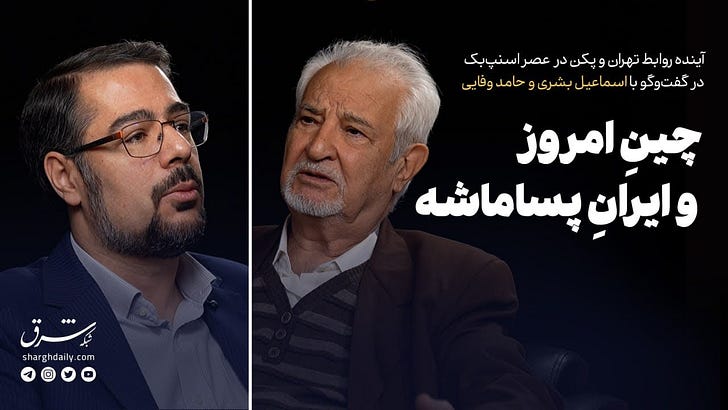
This edition of Discourse Power features a recent long-form interview with Esmaeil Bashari and Hamed Vafaei, two leading Iranian China specialists, who talk about the bilateral ties in the post-snapback era
Below is a Moroccan Jewish rendition of Maoz Tzur, a traditional liturgical poem sung during the eight nights of Hanukkah after lighting the menorah. The poem was written by a poet named Mordechai in the 13th century, during a period when Jewish communities in Europe were subjected to organized violence and expulsions under the Crusades. Its title means “Mighty Rock of My Salvation,” an epithet for God.
Tuvia Gering is an analyst at Planet Nine’s Digital Intelligence Team, a visiting fellow at the Israel-China Policy Center at the Institute for National Security Studies (INSS), and a nonresident fellow at the Atlantic Council’s Global China Hub. The views expressed in this article are solely those of the author and do not necessarily reflect the positions of the author’s affiliated organizations.
Thank you for reading Discourse Power. If you enjoyed this free post, spare a minute to share it with friends and colleagues
Comments
Nothing yet. Say the first thing.
Sign in to join the conversation.