
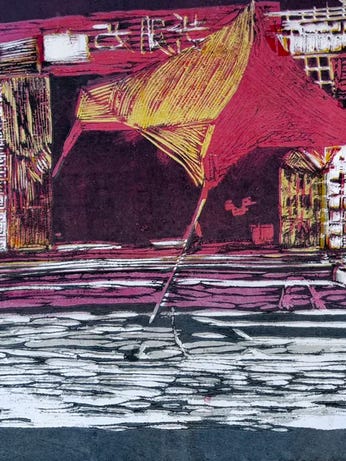
Leslie Rose, “Red and Yellow Tent” (Washington Printmakers Gallery)
FOOD MARKETS BECOME BOTH VAGUE AND VIVID in Leslie Rose’s prints, displayed as “Street Markets: Relief Prints and Reduction Screenprints.” Visitors to Washington Printmakers Gallery who move from left to right will ultimately encounter a few photos from which the local artist derived these pictures. While these are instructive, Rose is far from a photorealist. She partly abstracts the scenes she depicts, giving them a dream-like quality.
The markets glimpsed in these prints are in Asia or Latin America, although the only non-photographic hints of that are such titles as “Hong Kong Night Market.” Rose flattens the imagery and overlaps or intentionally misaligns the images to achieve a mysterious slipperiness. The visual drama is intensified by black areas, from which details emerge as if discerned by eyes that just adjusted to the darkness.
There’s not much bustle in the hushed scenarios, which include one in which a man has time to have a drink in his stall. The exception is “Street Scene,” a rare vertical composition whose subject matter is especially unclear. The upright elements in this brown-and-green picture could be either trees or buildings, portrayed with a jittery energy that recalls Futurism. It’s a sleepy night at the street market, yet this rendering is wide awake.
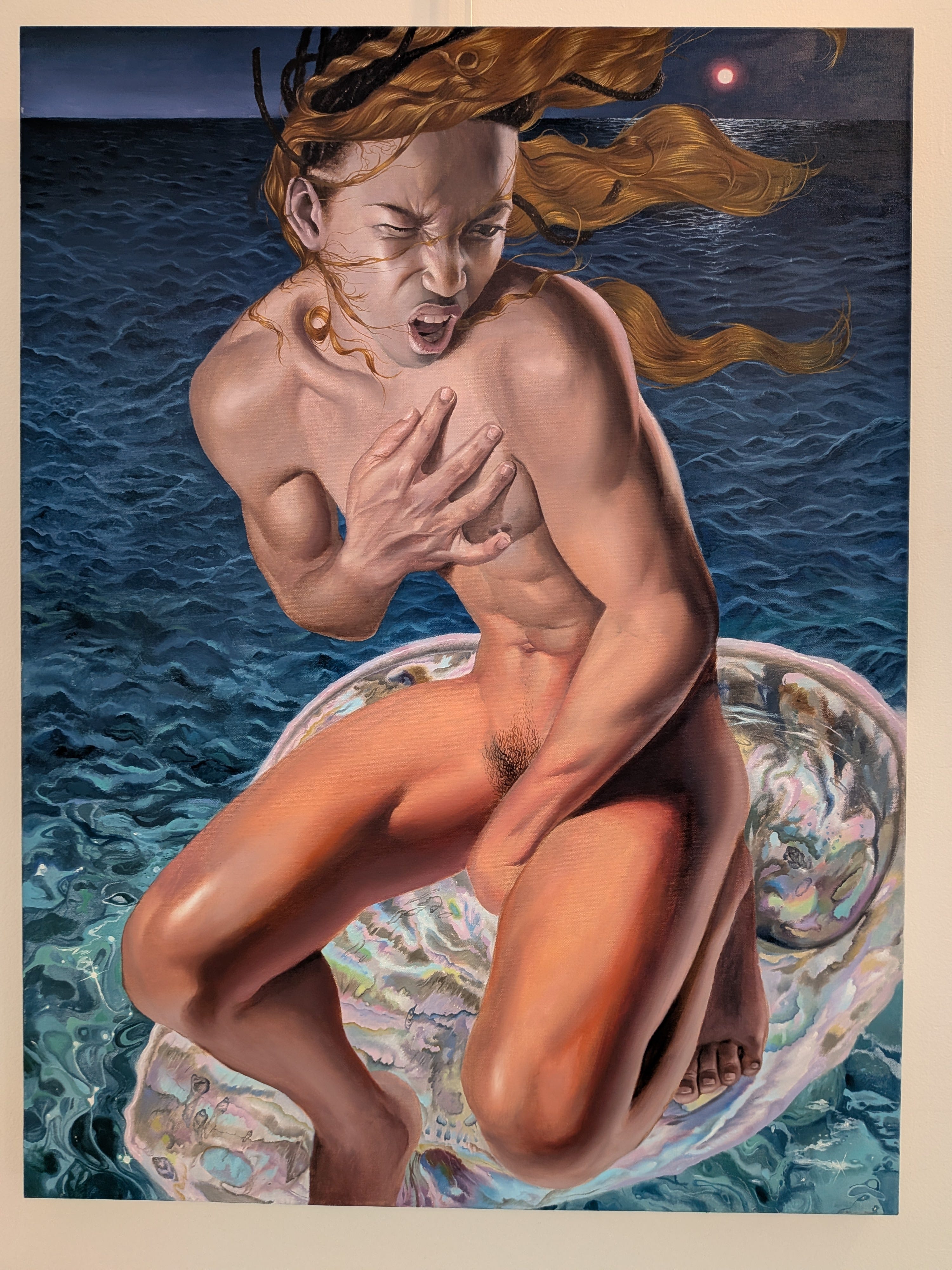
Kai Jones, “Blanched” (photo by Mark Jenkins)
THE WORK IN THIS YEAR’S “BETHESDA PAINTING AWARDS” is almost all representational, but that doesn’t mean it’s traditional. Among the eight winners of the 22nd annual regional competition, juried by Mira Hecht, Ernest Shaw, and Hilary Wilder, only one is fully an abstractionist. D.C.’s Thomas Bunnell makes colorfully patterned pictures that suggest cellular forms, capable of reproducing themselves endlessly. A different sort of patterning characterizes the semi-abstract work of Sally Bowring, a Richmond artist whose pictures feature color blocks and silhouetted shapes that resemble goblets and flasks.
Iconic and even mythic portraits of Black people are the speciality of Baltimore’s Monica Ikegwu (who took the top prize) and D.C.’s Kai Jones. Both artists are modernist realists, but Jones’s work refers more directly to Old Master painting. In his grandly emotional “Blanched,” a Black youth surfs on a large shell he might have borrowed from Botticelli’s Venus.
There’s a similar romanticism to the paintings of Baltimore’s Julia Gould, although the moments she portrays are contemporary and everyday. In one picture, a woman and two dogs commune in a forest bathed in eerie red light. (The image looks like a homage to the cover of Echo and the Bunnymen’s Crocodiles, although that’s probably inadvertent.) Richmond painter-collagist Minh Trang Hu?nh also depicts commonplace scenes, but with a turbulent past revealed by old photos and war images.
Two of the featured artists, both from Richmond, have been reviewed in DisCerning Eye recently. Elizabeth Coffey overlays text and lace over female faces to represent layers of identity. Jeffrey Deane Hall makes trompe l’oeil paintings of objects, mostly books, to suggest the limits of understanding. His wittiest picture here highlights the word “Zen” while obscuring the rest of the title: “and the Art of Motorcycle Maintenance.”
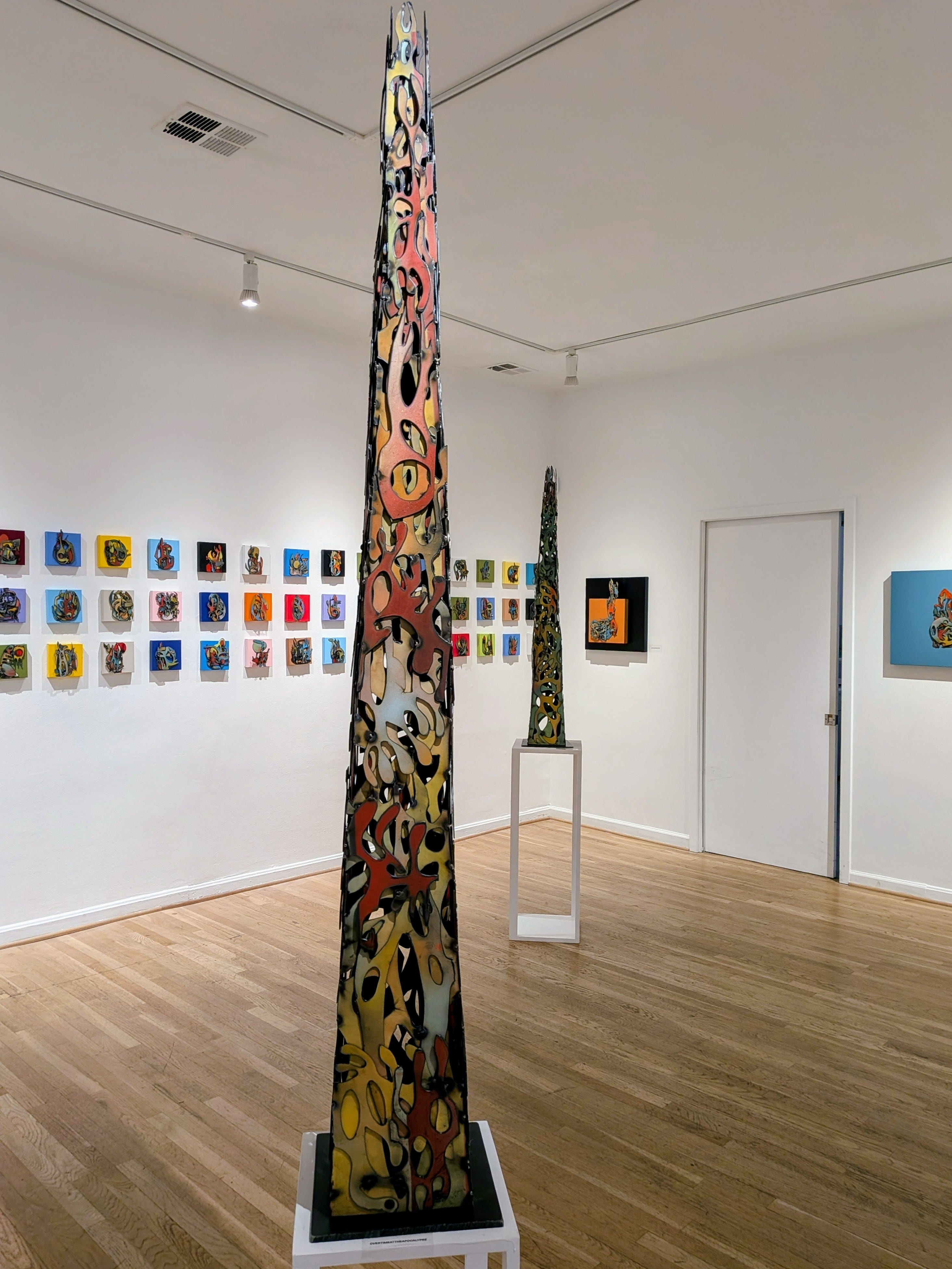
Rick Bach, “Cut” installation view (photo by Mark Jenkins)
THE NAME OF RICK BACH’S IA&A at Hillyer exhibition, “Cut,” describes only the first part of the D.C. artist’s process. As the son of the owner of a Pittsburgh auto-body shop, Bach was inspired to work with steel that’s plasma-cut and usually painted. He assembles the pieces of curve-edged metal into abstract assemblage-sculptures that retain an industrial feel even while the individual parts emulate natural forms.
Most of the pieces in this show are homages to -- or parodies of -- abstract paintings. Bach piles several levels of steel filigree atop canvas-like metal boxes that are usually painted a single color. There’s also a wall of nearly 100 “Seeds,” small versions of the larger works that take their power from regularity and repetition.
Although muscular and vividly hued, the painting-like wall sculptures aren’t as dynamic as Bach’s freestanding creations, most of them narrow and tapered pyramids. Fixed in place yet thrusting toward the ceiling, these towers have a sense of potential motion that honors their automotive origins.
Also at IA&A is “Abandonware [houses],” Tara Youngborg’s tribute, of sorts, to the New Castle and Frenchtown Railroad, a brief-lived 19th-century railway in Maryland and Delaware. The artist, who manages the Stamp Gallery at the University of Maryland, is not offering a literal history lesson. Her installation consists of a room-filling web of twisted cables; a diaphanous white box onto which images are projected; and an echoey, stuttery sound collage.
The piece’s title suggests parallels with obsolete computer software, which --like an abandoned right-of-way -- becomes unfunctional but doesn’t altogether disappear. While all human-forged networks decay, many leave ghostly traces.
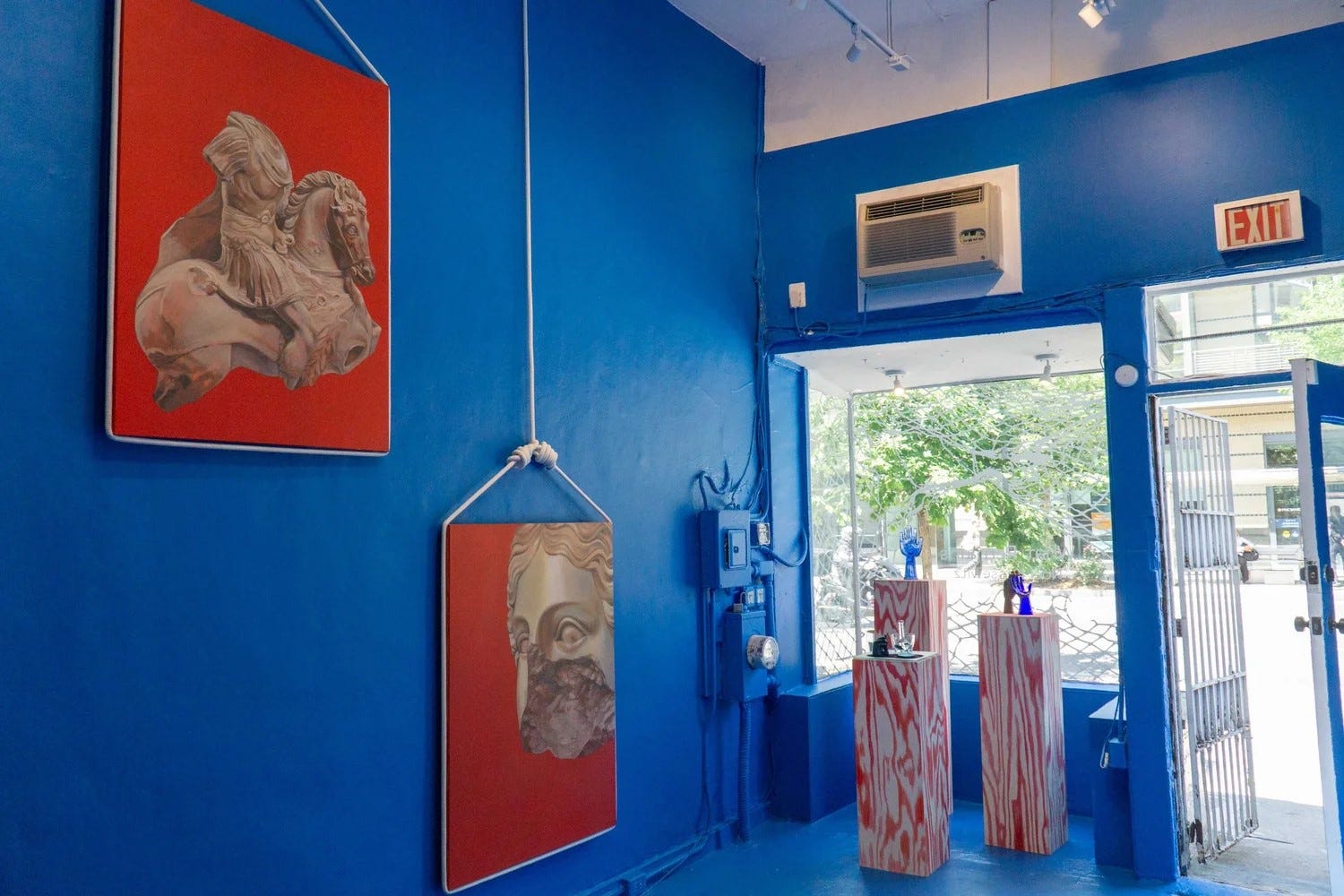
Noël Kassewitz, “What Remains” installation view (photo by Mei Matute)
TRANSFORMER HAS BEEN PAINTED A SUITABLE BLUE for “What Remains,” a show by ocean-focused D.C. artist Noël Kassewitz. It dovetails with one in April and May at Siren Arts, Transformer’s New Jersey affiliate. Many of the pieces are paintings, rendered in a realistic but streamlined style. Subjects range from damaged Roman sculptures -- Kassewitz is a sculpture conservator at the National Gallery of Art -- to fishing nets that float in water, here looking more like found patterns than maritime threats.
Kassewitz doesn’t just gaze at water. She engages with it in various ways, from performance pieces to salvaging manmade objects from the depths. A few such items have been placed into an assemblage that’s as tidy as the nearby paintings.
The show’s third element is a series of small sculptures, mostly made of glass and primarily depicting human hands. Two of the hands are in shades of translucent blue that complement the overall color scheme. These mirror a small painting of a pair of hands, submerged in water and seen through ripples. Water is all around, and also deep within.
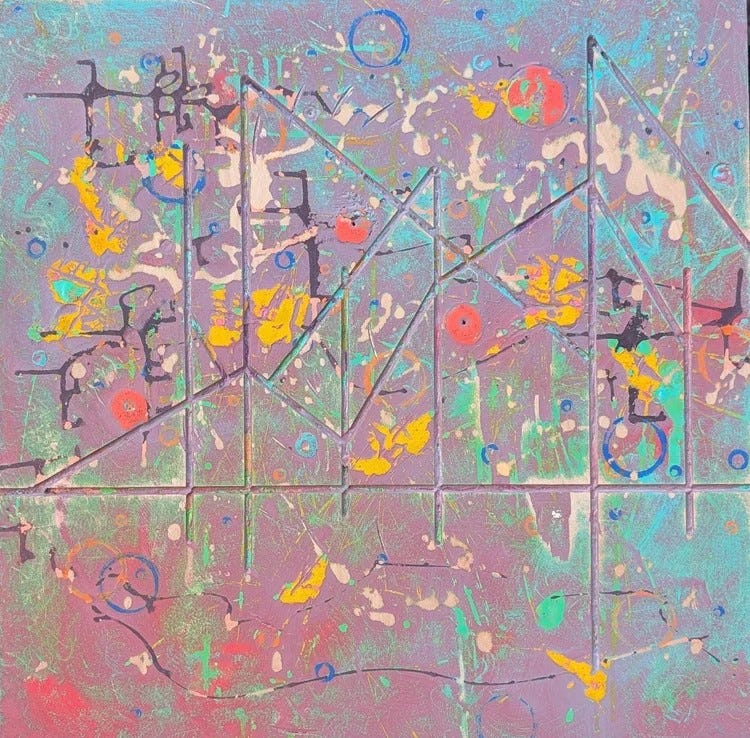
Bart Dluhy, “Take it from Here” (Foundry Gallery)
THE TEXTURES RANGE FROM SOFT PIGMENT TO HARD METAL at Foundry Gallery, whose “New Member Showcase” introduces four artists. The most gauzy imagery is by Luisa Zanforlin, whose paintings usually depict two people side by side, (One picture has three.) The haziness of the artist’s style suggests loss and longing, as do the poses of her subjects. They stare past or away from each other, and never return the viewer’s gaze. There’s something missing here, Zanforlin hints evocatively.
Deborah Maklowski’s relief-sculpture collages are inspired by landscape, but as conjured out of someone’s jewelry box. Black whorls cover Susanne Kamalieh’s mixed-media pictures, whose patterns are meant to represent skies. Through the air currents such unexpected things as a pair of human legs can occasionally be glimpsed.
The most intriguing work is by Bart Dluhy, whose all-over abstract paintings array rings, blotches, and mysterious glyphs on wooden panels. These planks are incised with lines and seemingly battered, so that the pictures resemble excavated artifacts. The artist’s compositions demonstrate a jazzy rhythm and a sophisticated color sense, with flashes of vivid hues on subdued grounds. Dluhy calls attention to the surface while alluding to unseen depths.
Leslie Rose: Street Markets: Relief Prints and Reduction Screenprints
Through June 28 at Washington Printmakers Gallery, 1675 Wisconsin Ave NW. washingtonprintmakers.com. 202-669-1497.
Bethesda Painting Awards
Through June 28 at Gallery B, 7700 Wisconsin Ave. #E, Bethesda. bethesda.org/bethesda/gallery-b-exhibitions. 301-215-7990.
Rick Bach: Cut
Tara Youngborg: Abandonware [houses]
Through June 28 at IA&A at Hillyer, 9 Hillyer Court NW. athillyer.org. 202-338-0680.
Noël Kassewitz: What Remains
Through July 4 at Transformer, 1404 P St. NW. transformerdc.org. 202-483-1102.
New Members Showcase
Through June 28 at Foundry Gallery, 2118 8th St. NW. foundrygallery.org. 202- 232-0203.
Comments
Nothing yet. Say the first thing.
Sign in to join the conversation.