
This newsletter is a compilation of recent disaster ~things~ that I think are cool, important, or otherwise of interest to people who are intrigued with disaster (broadly defined). There’s a little something for everyone!
Friends! I hope you are well!
I am skipping the usual Clown Car check-in this month to instead cover more substantive goings on. Two important bits of disaster news this month to start us off.
First, the mammoth housing bill has become law. This is of direct interest to emergency management because it changes to how HUD administers long-term recovery funding. There are many details to be worked out but you can read more from Grist and the “Place and Resilience” Substack.
Second, House democrats have released the findings of an investigative report: “Stretched Thin: The Erosion of FEMA’s Core Mission Under DHS” which outlines “how the department of homeland security diverted federal emergency management agency resources to support immigration enforcement and the consequences for America’s disaster readiness”. The investigation found DHS has negatively impacted FEMA’s ability to fulfill their mission by “systematically redirecting FEMA away from its statutory mission”. You can read more from the Washington Post.
I know some of you think I just sit around making memes and cyberbullying fascist state emergency management directors, but I do actually publish research too! My colleagues, Dr. Sarah Kirkpatrick and Dr. Amanda Savitt, and I recently had our article “Understanding the Federal Emergency Management Agency’s Challenges: Perspectives from Congressional Hearings” published by Risk, Hazards, & Crisis in Public Policy.
As you have probably noticed, everyone always has something to say about FEMA. Survivors, volunteers, researchers, journalists, local and state officials, FEMA staff, the President, and members of Congress from both parties have no problem complaining about the agency. I spend a lot of time sorting through those criticisms to figure out what the actual problems are and if FEMA is actually the responsible agency. In other words, FEMA often gets blamed for things outside the agency’s control. Sometimes this happens for political reasons but often it happens because of how confused everyone is about how the emergency management system is set up. This is an important issue because if we do not correctly identify the problems and why those problems exist, we cannot propose effective solutions. This, I think, is a source of our field’s long history of pursuing solutions that do not actually solve our problems.
This confusion about the emergency management system and FEMA’s position within it has always been a problem (I wrote a book to try and help clarify this) but in the current political climate, we are seeing the massive consequences of this confusion. We’ve got a lot of people out here running their mouths and making changes (or threatening to make changes) that will not actually address the problems FEMA has and, in fact, will likely make those problems worse.
Of the many people who influence FEMA’s work, Congress is among the most important. It is their responsibility to write the laws that dictate what FEMA can and cannot do. (Often when you’re mad at FEMA, you’re actually mad at Congress.) Yet, it often seems that those very same lawmakers have no clue what they have said FEMA can and cannot do. This leads to some very confusing congressional hearings that lead to a lot of grandstanding (which sometimes perhaps is the goal) and very little progress in making FEMA better.
It occurred to us that although this is a dynamic we see happen regularly, there is a stunning lack of empirical research on the relationship between FEMA and Congress. As a starting point, we figured it would be a good idea to systematically study congressional perspectives about FEMA. What do they actually think the problems are with FEMA? Once we establish that we can figure out if what Congress identifies as FEMA’s problems are even actually FEMA’s problems according to other stakeholder groups like local emergency managers and disaster survivors. And, if anyone is Congress is actually proposing solutions that would address those problems (I’m looking at you FEMA Act).
To begin to answer these questions we reviewed ten years of congressional hearings on FEMA. Yes, we read dozens and dozens of (often infuriating) congressional hearings so you do not have to. I wanted to fucking die. Say, “thank you”! (If you’ve wondered why I can quote years old congressional hearings off hand, this is why. A fun party trick?)
The first useful finding is that there has persistently been bipartisan praise of FEMA by Congress. This is meaningful given the current hostility towards FEMA from the Trump administration. The idea that FEMA should not exist is simply not aligned with how Congress publicly talks about the future of the agency.
The other useful finding is a synthesis of the problems members of Congress have persistently identified in hearings. This includes programmatic challenges, contracting problems, fiscal accountability and financial stewardship, capacity to fulfill agency responsibilities, and how FEMA fits into the larger federal system. If you work in emergency management, you’re probably nodding along.
The big take away is that these findings support what most of us have been saying for years: there is a widespread, bipartisan desire in Congress for federal emergency management reform. Now, what exactly that reform should look like is going to need some further investigation.
If you hit a paywall, you can request the full article here.
By the way, I got tenure! I then immediately left on an eight month sabbatical!
I will be using this time to work on some larger writing projects but will also be traveling full time (the dream!!). My travel destinations were not selected for disaster reasons but because disasters are ubiquitous, each place I go does have some disaster history that I simply have no choice but to learn about! I thought I could share some bits of this here.
The first leg of my sabbatical is Iceland. I was last here in 2019 and although I’m usually a one and done traveler, I have been dying to come back. I have spent most of my time here in the Westfjords writing away!
But, of course, my first stop was to see the lava fields and protective levees from the Sundhnukagigar volcanic eruptions outside Grindavik on the Reykjanes peninsula. You may remember the international coverage of the eruptions. The government built protective levees to help guide the lava away from the town of Grindavik, the Blue Lagoon, a power station and other important infrastructure. This was largely successful. I believe the lava only breached the levee once and they were able to cool it and repair the levee. I knew these barriers existed, but I did not comprehend the size. They are made of 2.5 million cubic meters of dirt and are 13.5 km long. (Some signage at one of the viewing points helpfully noted that “if the walls were open spaces, they could fit 33 million goats. That’s 16,000 times more goats than live in Iceland.”)
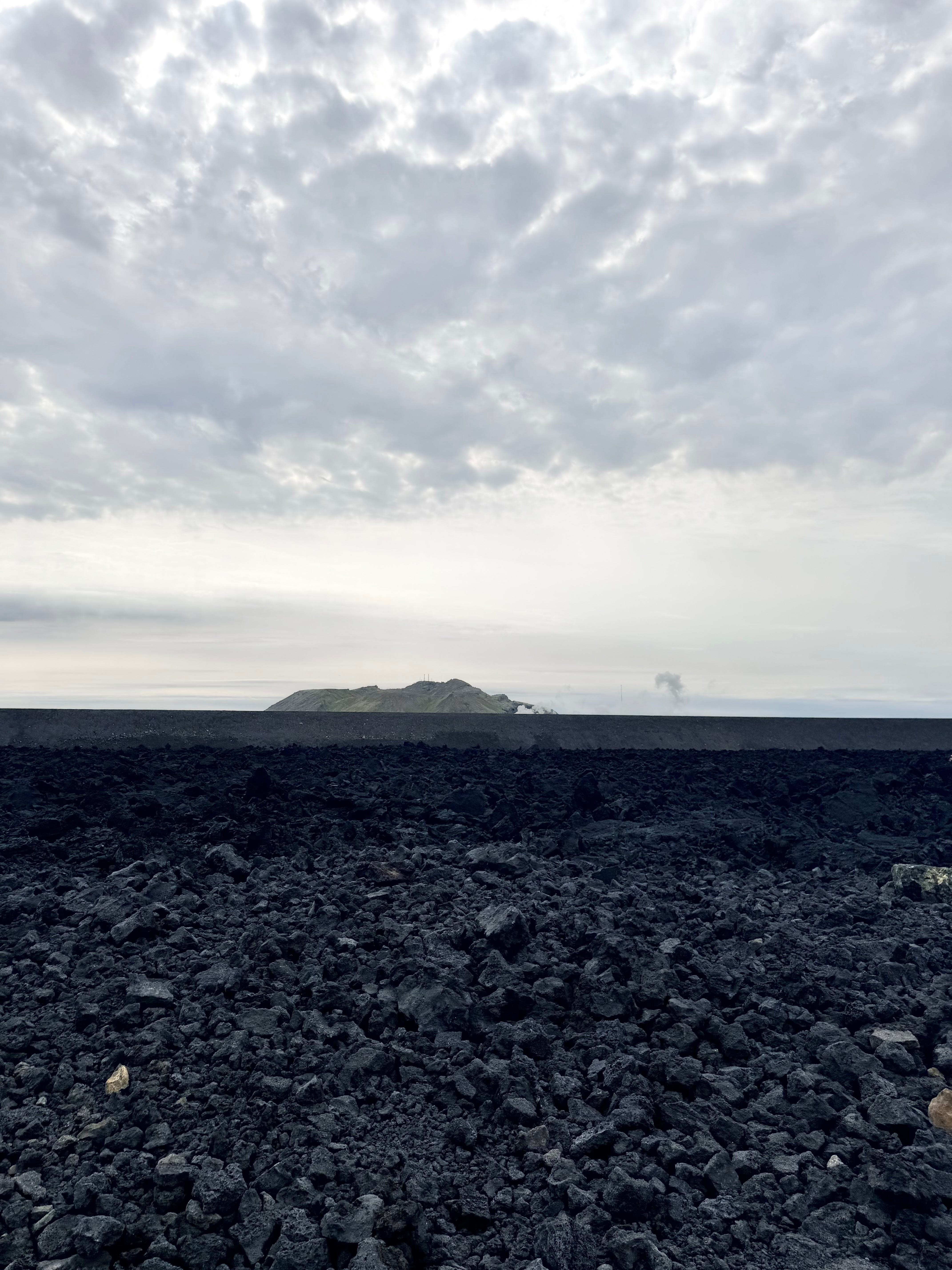
Although the protective levees were effective in directing and slowing the flow, as well as giving more time for evacuations, there was a significant amount of damage in town. Flowing lava destroyed three houses, with many more homes and buildings damaged by earthquakes. The town’s utilities and infrastructure were affected as well as local businesses that were shutdown during evacuations. Recovery efforts in Grindavik are still in progress. There is a great little café in town if you happen to pass through that you can stop at and in the center of town, they have a photo display up for visitors to learn more about the response. You can read more about the impacts and recovery here.
One thing I think Iceland does exceptionally well (even if it is controversial) is embrace hazard/disaster tourism. For better or worse, people are naturally drawn to disasters. They always have been and they always will be. For obvious reasons this can lead to frustration among survivors and authorities. These sightseers often get in the way. They can make the situation worse – bringing harm to themselves or others. There is an inclination in many places to try and prevent this sightseeing. We tend to do this in the United States. You block off roads, don’t let people into certain areas, etc. Sometimes this works. Other times, it just leads to sightseeing happening in ad-hoc and even more dangerous and offensive ways. The alternative is to embrace the natural impulse and try to channel it into something safe and productive.
Iceland has fully taken the “embrace it” approach. You cannot drive more than a few miles without running into some kind of volcano museum. They did this as well with Sundhnukagigar. As eruptions happened, instead of fighting the curiosity seekers, they directed them. As a result, they were able to keep the sightseers out of the way of the actual response efforts and keep people safe. In the aftermath, they have created hiking trails and specific viewing points for people to be able to see the lava field. Being proactive in directing the flow of tourists has again kept them out of the way and safe. I think that is a good thing that other communities should take note of for their next disaster.
(Sorry if I used any of these volcano terms incorrectly, they are not my usual hazard of focus!)
It’d be cool if you forwarded this newsletter to your friends, post it on social media, or undertake any other form of newsletter sharing you deem appropriate. I’ve heard some of you print out the memes to hang in your emergency management offices! Incredible.
In case you signed up for this newsletter without knowing who I am (a bold choice!), you can listen to this interview with me on Ologies. If you really want to dive in, you can read my book Disasterology: Dispatches From The Frontlines of The Climate Crisis to catch up (here’s a USA Today review). You can order it here and get it as an audiobook here.
Other places to find me: Blog. BlueSky. Instagram. TikTok.
This newsletter can be accessed for free, and I intend to keep it that way because eliminating barriers to disaster knowledge is important. However, there is a “paid subscriber” option for $5 a month, or whatever you’d like to give, if you’re interested in supporting this work.
No posts
Comments
Nothing yet. Say the first thing.
Sign in to join the conversation.