
This newsletter is a compilation of recent disaster ~things~ that I think are cool, important, or otherwise of interest to people who are intrigued with disaster (broadly defined). There’s a little something for everyone!
Greetings,
I come to you this month with a new dispatch from the frontlines of the climate crisis.
So, there I was three hours outside of Quito, Ecuador, minding my own business at a boutique hotel in the mountains. I am lounging by the pool; reading by day and writing by night. There are vibrant gardens, whimsical little birds, and a talented chef. There is peace and there is quiet. I have achieved what I wanted (dare I say needed) for my sabbatical – I am an off-duty disasterologist. Simply a regular tourist, or a traveler, if you prefer.
On my fourth night, I arrived for dinner. The waiter, a nice man who I had been exchanging pleasantries with for days in his broken English and my broken Spanish, said to me, “Hay un gran fuego en la montana”.
My Spanish is not great, but I immediately understood. I pulled out my phone. You aren’t just a tourist, though, are you?
--
My concern about the fire risk in Ecuador started within a few days of landing in Quito. The city sits nestled among mountains at 9350ft. The wildland urban interface encircles the city. Dense urban building abuts vegetation and forested mountains. It is very dry. El Niño is here. Then there is the wind. I tried to forget reading about bad fires in Quito a few years ago. I did the mental gymnastics to shut my “disaster vision” off as I looked out over the city. You need peace and quiet. You are just a tourist.
I went to Casa Museo Guayasamin and Capilla del Hombre – an art museum celebrating the work of Ecuador’s most famous artist– to be a tourist. There I looked out over the city and saw smoke coming up right where the edge of a neighborhood met the forested mountain (a volcano, actually). I faltered.
A bit of smoke is not itself a reason to worry. I remind myself there are all kinds of legitimate reasons someone may intentionally have started a fire. I looked around. It sure was dry and windy, though. But I am a tourist, so I continued my tour of the museum. Midway through I stumbled upon five firefighters in the woods. They had climbed up onto the roof of their fire truck. They were staring out at the smoke and pointing. One had a pair of binoculars. Probably not an intentional fire.
I am regularly accused of seeking out disasters. Not this time. I was at an art museum! I was minding my own business! I am seeking peace and quiet! I am a tourist! I returned to my tour.
By the time I left the fire was out and the firefighters were gone.
My travels continued. I left Quito and headed for quieter mountains. My next hotel had a fireplace in every room. Fires were stoked constantly to take the chill off. It was cozy. Outside my hotel I saw people burning yard debris and other things. Intentional fires. It is so dry and windy, I thought. Stop! You are a tourist. This is none of your business.
In a moment of weakness, I asked a tour guide if it was usually so dry. He shrugged. No, not usually this dry. None of the other tourists seemed concerned. After two weeks I became nose-blind to the burning smell and barely tensed every time I saw smoke. I was an unconcerned tourist.
The night I arrived at my final hotel, the one three hours outside of Quito, I posted a video on my Instagram of the big fire they had built on the patio. A gorgeous old fireplace was trying to contain the flames. But the fireplace was punctured from where it had rusted over time. Smoke and flames escaped through the holes. It was a roaring fire that spewed lit sticks out onto the ground. My disaster vision overcame my peace and quiet.
Over the video on Instagram I wrote, “I adore Ecuador but based on the two hotels I’ve stayed at they have an unbelievably laid back approach to fire making and it has me on fucking edge. It is windy and we are surrounded by dry mountains! (Don’t worry I’ll be sitting here until this goes out).”
That’s called foreshadowing, baby.
--
All pretenses of peace and quiet ended abruptly when the waiter told me about the fire on the mountain. I was not eating my dinner. He hovered, annoyed. I was locked in, Googling for information about a nearby wildfire. The luxury of Watch Duty has not made it to Ecuador. Luckily I know the disaster search techniques of yesteryear.
There they were, where they always are, the Twitter accounts and the Facebook Pages. I learned there were several fires burning across the country. I hadn’t realized.
On Google Maps I put in the town names listed in the news stories. They were all hours away except for one. That must be “un gran fuego en la montana”, I thought. It was over an hours’ drive away, but about 20km as the crow flies. A couple of mountains away. Was 20km close or far? I looked outside. The wind had stopped.
I pulled up Google Translate to ask the waiter some follow up questions. This is no time for high school Spanish. The waiter dodged my questions. Not a single straight answer. Shrugging. Weird to shrug about a wildfire, I thought.
Did the tech bros break Google Translate too, I wondered? I left to go find the front desk guy. He spoke more English.
What I wanted to know from the hotel staff, people who were from here, is if I was correctly understanding the location and severity of the fire. Assuming I was, would we be warned if the fire got closer to us? There was no cell service, just hotel WiFi. Does that matter? I paused in the middle of the walkway to Google if Ecuador had an emergency alert system.
I wanted to know if they thought 20km was close or far? Was there a plan if we needed to evacuate in the middle of the night? Living in New Orleans under the shadow of Katrina made me an evacuation girlie for life. I am happy to simply get out of the way. But Mr. Front Desk was nowhere to be found. I tried calling the hotel’s main number. No answer.
Did I mention that on this night, I was the only guest at the hotel? I had been excited about this all day. A private pool! A private chef! Now I was a one woman self-directed response team which I found to be decidedly less exciting.
A shrugging waiter, a missing front desk clerk, a disasterologist, and a wildfire that is either close or far away. I am in a Mike White disaster movie, I thought. And I am probably not one of the sympathetic characters.
I went back to my room. ICS for one, please! Logs, Ops, Planning? What have we got?
What I thought I knew: there was probably a fire, and it was probably about 20km away. The authorities knew about the fire because it had been written about in the local news. Ecuador has a relatively limited supply of firefighters and equipment and the fire of concern to me was in a remote area. It was dark outside. Other fires in the country were near bigger population centers and would probably be pulling most of the firefighting resources. It was dark. They probably weren’t going to do much to contain it until morning. The wind had stopped.
If everything I thought I knew was true and there wasn’t anything I did not know then I probably was not in imminent risk. The likelihood of there being something I didn’t know was quite high. I am not an expert in emergency management in Ecuador. I am not a fire science expert. I knew just enough to be dangerous. To me that meant one thing – GTFO.
Removing myself from this situation was both my instinct as a disasterologist and as a woman traveling alone. Rule number one of solo female travel is if you don’t feel safe for even a second you leave and you don’t feel bad about it. There might not have been imminent risk, but I didn’t feel safe. Between the hotel staff’s disappearing act, lack of credible and actionable information, and my own lack of knowledge, it was time to go.
But how? I had no transportation. I wasn’t even sure there was a single vehicle at the hotel. I hadn’t seen one. I considered the possibility of calling a cab. It was 10:00 pm and the closest (very small) town was 30 minutes away. Was there even a cab there? The closest city was an hour away. They had plenty of cabs, but it was dark. The road to my hotel was a single lane mostly dirt road through mountains where there was probably a wildfire and not a single guardrail. I would not put a cab driver, or myself, on that road. “The evacuation can kill you”, I kept thinking.
There wasn’t a safe way out in the middle of the night. I took the second best option: I booked a car for the morning. I would check out of the hotel early and go back to Quito. Safety in numbers, I thought.
I just had to get through the next twelve hours. Is twelve hours a little time or a long time, I wondered. I packed in case I needed to leave quickly and kept my sneakers next to my bed. I fully charged my phone and put my passport in my pocket.
I instituted a little routine. I woke up once an hour to check my phone for any news. There was none. I got up to look outside and check if there were flames, smoke, or wind. None of the above. I paid more attention to the burning smells. At some points throughout the night, the smell grew stronger. At 3:00am I woke up coughing. I thought it was psychosomatic.
By 4:00am sleeping became untenable. I looked through the Facebook and Twitter accounts I had found while I waited for the sun to come up. No updates. I considered that I had completely overreacted. How could I judge this situation off a few posts online? What did I know about wildfires in Ecuador?!
At 8:30 I went to breakfast. I laid eyes on the waiter, the first and last person I had seen during this entire ordeal. I will die before being a rude American. “Buenos Dias! Si, café por favor!” and then casually, “El Fuego??” The waiter shrugged. He asked how I slept. “Bueno!”, I, a total liar, responded. He clattered around. Not a care in the world. Fascinating.
Mr. Hotel Front Desk eventually shows up. “Well, well, well. Where the fuck have you been?”, I screamed in my head. “Buenos dias! Como estas?” Great, he replied! I broke the news I would be checking out in a few hours. He asked why. “WHY?!?!?!?!!” Instead, I casually asked about the “fire on the mountain”. “Oh, no problem!” Mr. Front Desk says with such conviction that I considered if I had fabricated the entire night.
I returned to my room. I am paranoid. I was catastrophizing. Not everything is a fucking disaster. Being a disasterologist has broken my brain. I was embarrassed.
Reality did not matter anymore. The trust was gone. It didn’t matter if I was safe, I didn’t feel safe. The peace and quiet was gone. I called my mom to tell her I was going to leave (some might say evacuate). There was no imminent threat, I assured her. If the fire was close by the people working here would have said something. They wouldn’t have shrugged. The whole thing just doesn’t feel right. Better to play it safe.
I sat outside in a rocking chair waiting for my driver. It was sunny with blue skies; there was a lingering burning stench. I sniffed my hair. Was it just me? Only the lightest of breezes. Mr. Front Desk waited nearby. I glanced at him hoping for a glimmer of recognition about what had transpired in the past 12 hours. He leaned back against a wall. Stoic. Fascinating.
The driver arrived. I held back an instinct to hug him. I jumped in the car. Let’s go! He sat in the driver’s seat casually setting up the GPS and reviewing our route. I brought you water. What kind of music do you want to listen to? I gritted my teeth. Thank you! This music is fine. I was embarrassed and annoyed and wanted to be anywhere but here.
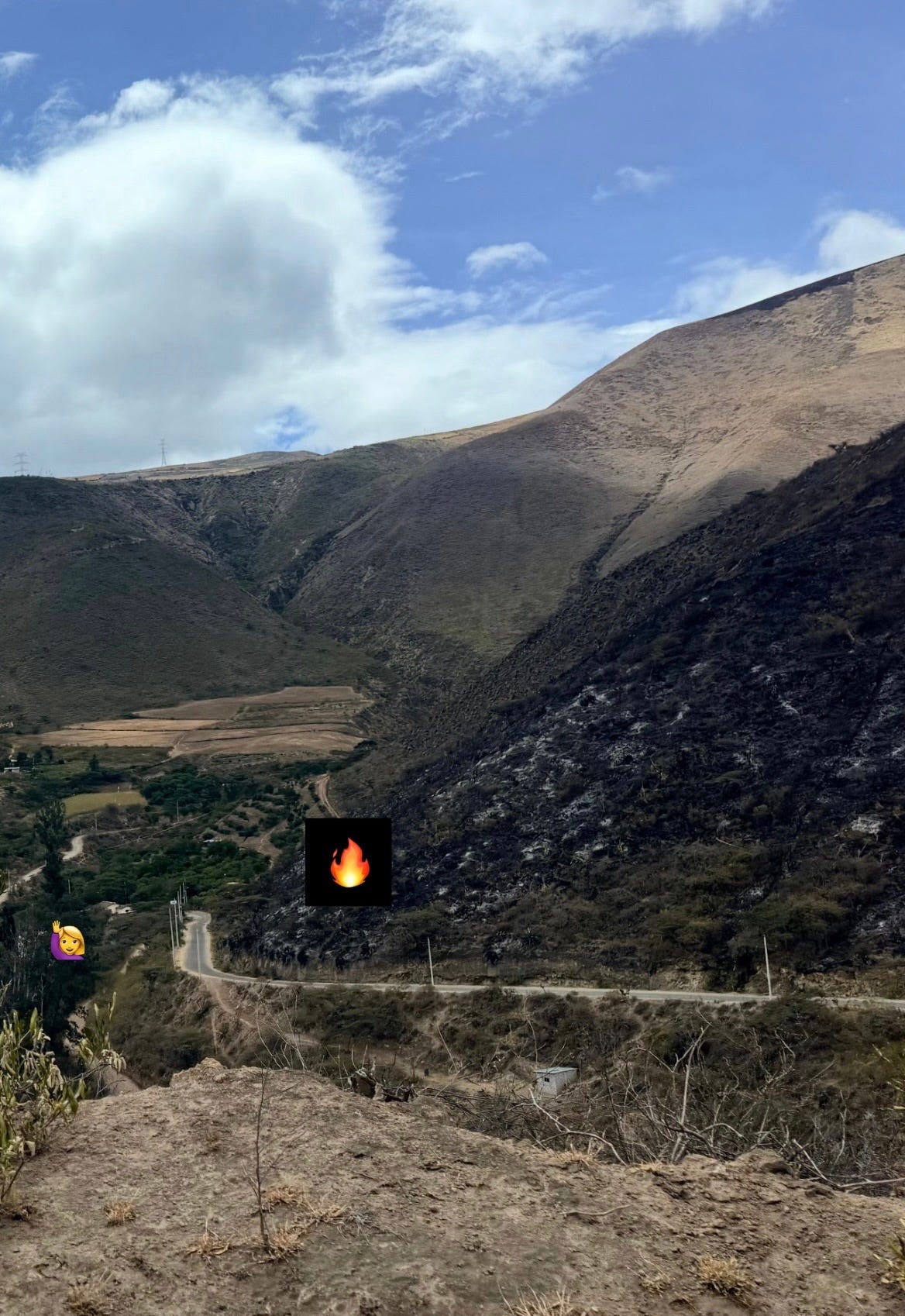
We pull out of the gates of the hotel, onto the little one lane, mostly dirt mountain road and holy shit.
--
There had been a fire 20km away. There had also been a fire a few feet away.
The mountain was smoldering. In a few places, gentle flames lashed out. Whisps of smoke, only noticeable against the burnt vegetation, danced skyward. We climbed higher up the mountain away from the fire, away from the hotel. I twisted around to look back from above and felt sick.
My driver asked me a series of questions I could not answer. When did this fire start? How did it start? Who put the fire out? Do they know it is still burning? Was everyone okay? Are you okay?
What I now knew: Somehow a fire had started. It climbed down the mountain to my hotel. It reached the one lane mostly dirt road which acted as a fire break. On the other side of the road, hidden within the foliage was my hotel room. The backside of my room faced the road. I could not see through the trees. It was dark. There were no windows on that side of my hotel room.
Throughout the night there had been a fire just a few feet away from me. How could I not have known? It was dark. The foliage was thick. There were no windows. But how could I not have known?
I thought of the shrugging waiter. Not a fire on a mountain, a fire on our mountain. This mountain.
I was not paranoid. I was not catastrophizing. I did not need to chill out.
My driver and I pointed out to each other more smoke among the mountains as we drove to the city. He mentioned Spain, replied with Spokane. He tells me it is extra dry and extra windy this year. El Nino and climate change are really affecting us. He glances at me in the rearview mirror. I nod. “That’s what they say.”
A while later he asks why I am in Ecuador. I tell him I was looking for some peace and quiet to write my next book. I brace for the next question. I could lie. I could say “the history of toothpicks”.
“What is your book about?”
I laughed.
It’d be cool if you forwarded this newsletter to your friends, post it on social media, or undertake any other form of newsletter sharing you deem appropriate. I’ve heard some of you print out the memes to hang in your emergency management offices! Incredible.
In case you signed up for this newsletter without knowing who I am (a bold choice!), you can listen to this interview with me on Ologies. If you really want to dive in, you can read my book Disasterology: Dispatches From The Frontlines of The Climate Crisis to catch up (here’s a USA Today review). You can order it here and get it as an audiobook here.
Other places to find me: Blog. BlueSky. Instagram. TikTok.
This newsletter can be accessed for free, and I intend to keep it that way because eliminating barriers to disaster knowledge is important. However, there is a “paid subscriber” option for $5 a month, or whatever you’d like to give, if you’re interested in supporting this work.
No posts
Comments
Nothing yet. Say the first thing.
Sign in to join the conversation.