
This newsletter is a compilation of recent disaster ~things~ that I think are cool, important, or otherwise of interest to people who are intrigued with disaster (broadly defined). There’s a little something for everyone!
Happy New Year My Little Fireworks,
You probably assumed we’d be reading about the FEMA Review Council Report in this month’s newsletter, but, as always, jokes on us!
Personally, I was THRILLED when the FEMA Review Council Meeting was cancelled. I am all in on delay tactics as emergency management’s best defense against the Trump Administration. Anything that slows down the dismantling of FEMA is good at this point. We are in our obstructionist era, if you will. Also, anytime Kristi Noem has a bad day, I have a good day.
To be honest, I am just deeply disinterested in the FEMA Council’s Report. First, as I have said from the beginning, this Council is illegitimate. Anything they produce should not be taken seriously. There is a single person on the Council who I think is qualified and is an appropriate person to be there (Bob Fenton). The other members are either ignorant of emergency management and/or morally bankrupt. Second, I don’t think anything in the report is going to be new, interesting, or good. Based on rumors and leaks, it really seems like it is largely a regurgitation of Project 2025. Okay, we get it, you want people to go broke and suffer. Finally, I remain skeptical that it will lead to actual changes. There is no legal obligation to implement the report’s findings, the surrounding politics are just too dicey, and all the people in this administration are unhinged.
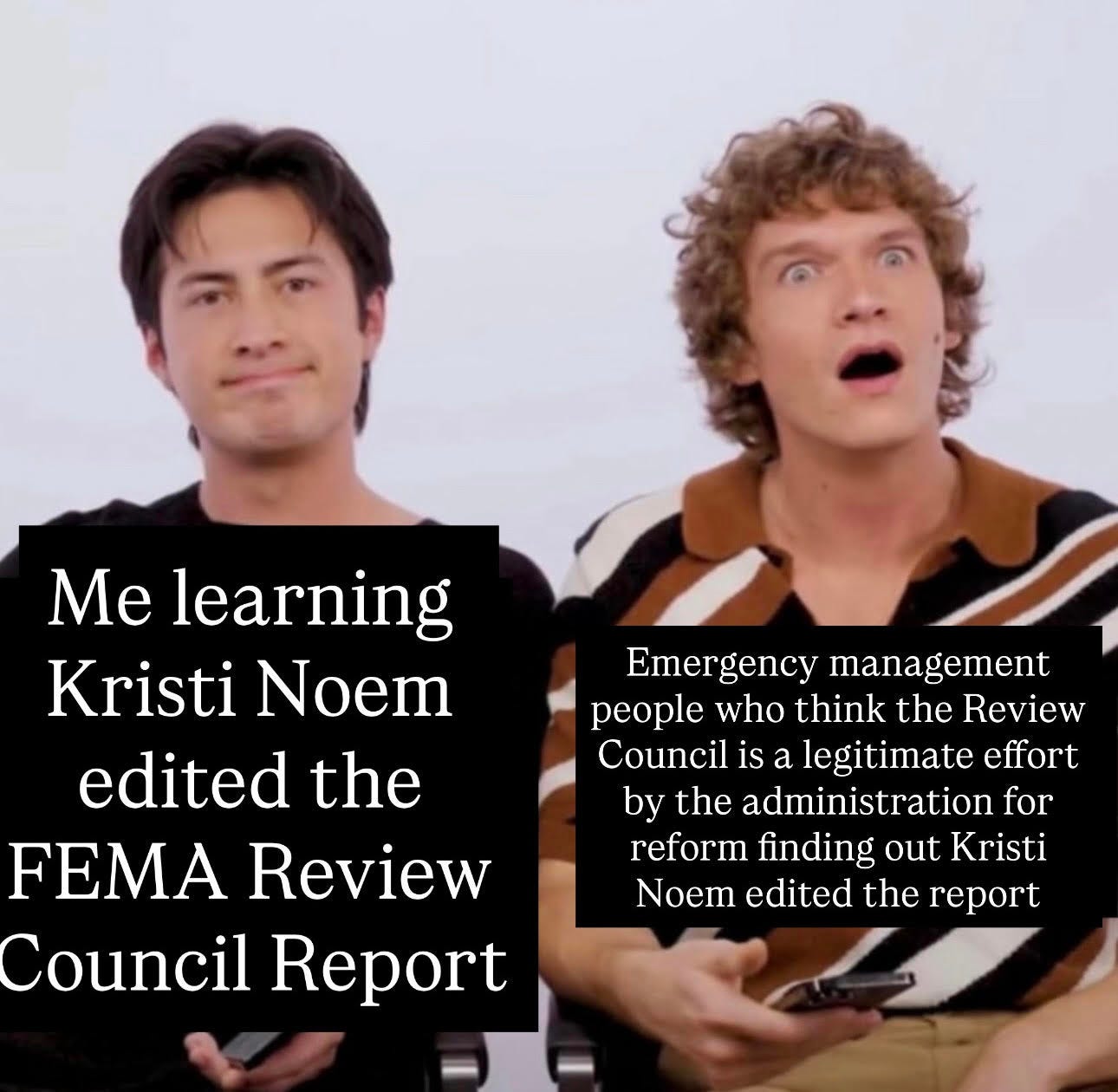
Then, of course, you have Kristi Noem just fully re-writing the report herself just days before it was meant to be released to the public. 10/10. No notes. Perfect plan.
MEME BREAK
Last December, I wrote an analysis of the FEMA part of the 900-page policy agenda called “Mandate for Leadership: The Conservative Promise” (shorthanded to Project 2025). No one else had done so at that point, and even now, I can count on one hand the number of people who have publicly engaged with the document. (Do you know that I regularly encounter seemingly serious people who work on emergency management policy who freely admit to me they have not read the FEMA section in Project 2025? Friends, it is less than two pages in length!)
A year later seems like an appropriate time to revisit the Project 2025 policy agenda and assess the extent to which it has been implemented. (The Project 2025 tracker, which monitors how much of their policy agenda has been implemented by the Trump Administration, is not fully and accurately tracking FEMA.)
[Note that when I mention the Review Council perspective below, I am largely basing it on this reporting from CNN. So, please read that part with many, many grains of salt.]
Project 2025 recommended moving FEMA out of DHS and into the Department of the Interior or the Department of Transportation. At the moment, FEMA is still being held captive by DHS. However, discussion about moving the agency has become mainstream. Although no one seems to be talking about Interior or DOT, Congress has mustered bipartisan support to remove FEMA from DHS. Their proposal is to restore FEMA as an independent cabinet-level agency – something emergency managers have wanted since it was demoted from such post-9/11. The Council has also considered where FEMA should be located. While some are clinging to the very stupid idea of putting FEMA within the National Security Council, it seems the conclusion reached mirrors Congress. Noem disagreed and, allegedly, in her version of the report, recommends that FEMA stay in DHS. In that way, the administration does not seem to intend to implement this recommendation. (In some ways, this recommendation is moot given Noem and Trump’s frequently mentioned idea to eliminate FEMA.)
(Here’s a long explanation and a short explanation of the Per Capita Indicator (PCI).)
In the spring, Hamilton circulated a memo that proposed quadrupling the PCI. This would mean the threshold would go from $1.89 to $7.56. First, LMAO. In Project 2025, they proposed raising the PCI but did not say by how much, leaving a vast range of possible implications.
To my knowledge, the PCI has not officially been changed. There have been instances where a declaration was denied despite the state reaching the current indicator (Washington State). However, other states have fallen below the proposed $7.56 threshold and received a declaration.
It is important to remember, though, that the PCI is not legally binding. The President has the sole authority to grant a declaration or not, regardless of the PCI.
I have not seen any discussion or moves by the Trump administration to implement a state deductible.
The current cost share for a declared disaster is 75% from the federal government and 25% from state/local governments. Notably, federal law requires the federal government to cover at least 75%. Previously, if a disaster was bad enough and the need great enough, the cost share could be raised so that the federal government would cover over 75% of costs. Project 2025 recommended reversing the cost share so that the federal government paid 25% to the state/locals 75%.
The same memo mentioned above recommended that the federal cost share should not exceed 75%. This would mean that state and locals would have had to come up with an additional 25% of COVID costs that were covered by FEMA – many billions of dollars. A huge impact.
Now, interestingly, despite their own memo, when the administration ended North Carolina’s 100% post-Helene cost share, they dropped it to 90% rather than 75%. To my knowledge, no disaster this year received more than a 75% cost share, but we got very lucky and did not have a disaster this year that was big enough to be given more than 75%. There’s a brief mention in the CNN reporting that suggests higher cost shares are included in the Council’s report, but there are no public details.
Interestingly, the only people who have not shared their unsolicited opinion of the National Flood Insurance Program with everyone this year is the Trump Administration. Project 2025 effectively calls for privatization. I am very tired. Maybe the administration realized what Congress is reminded of every few years: fucking with the NFIP causes big problems for insurance companies, the banking industry, and realtors. Good luck with that, though!
Project 2025 calls for the elimination of all preparedness grants. Some preparedness money is flowing, but it has been, and continues to be, a bumpy ride. At various points this year, the administration withheld various preparedness grants from states and localities. More recently, they have attempted to attach restrictions on critically important programs like EMPG. There remains immense confusion and uncertainty about what preparedness will be available, to whom, and for what.
Despite using the word “preparedness,” I had a sense when reading Project 2025 that they also meant mitigation grants and were just not using the correct terminology. I think I was probably right. Funding through the Hazard Mitigation Grant Program has not been approved, which is being felt by communities and disaster survivors across the country. This spring, the administration canceled the BRIC program, which provides billions of dollars in mitigation funding to communities all across the country. The move has been wrapped up all year in the courts. The good news is that just this month, a judge confirmed it was illegal for the administration to cancel the program. We’ll see what happens next.
Project 2025 recommended that only the FEMA administrator should require Senate confirmation. Currently, FEMA’s Deputy Administrator and Deputy Administrator for Resilience also require Senate confirmation. While this law has not changed, the Trump administration has found a way around it by simply not nominating anyone for these positions. Sigh.
Interestingly, the administration has gone a step further by also simply not nominating anyone to be FEMA administrator. You may have noticed that we have referred to Cameron Hamilton, David Richardson, and now Karen Evans as the “Senior Official Performing the Duties of the Administrator” rather than the FEMA Administrator. This is why. None of the three were confirmed by the Senate as required by law, so they are not technically the administrator. But aren’t they, though? (Incidentally, none of them were/are qualified to be FEMA administrator via the post-Katrina qualification changes.)
So, while the law has not been changed, the administration has found a way to effectively enact this recommendation and is filling FEMA with unqualified Trump loyalists and conspiracy theorists.
In the wake of Katrina, instead of correctly fixing the post-9/11 mistake of demoting FEMA, it was decided that the administrator could go directly to the President, effectively skipping over the Secretary of DHS in the midst of a response. PKEMRA establishes that the FEMA administrator is the principal advisor to the president on emergency management. The purpose here was to try to clarify the relationship between the FEMA administrator and the DHS Secretary. A band-aid, at best. Project 2025 recommended eliminating this capability.
Again, while this is not something that has legally been changed, it has effectively been changed in practice from what I can tell. It has been made quite clear that Secretary of DHS Kristi Noem is leading FEMA, including everything from micromanaging spending to personally being the one to go to major disasters. The Senior Official Performing the Duties of the Administrator Richardson was nowhere to be found during the Texas flooding, for example, but Noem was front and center for the photo-ops.
Now, I will add a bit of a caveat here. Given the particular people involved, I am not sure how much this matters operationally. I do not think Richardson, rather than Noem, being the one to update the President and lead the response would have changed anything in Texas. However, it is setting a precedent and lowering expectations in a deeply dangerous way. FEMA needs qualified leadership with freedom from DHS and access to the White House in order to be effective.
So, where does this leave us? Look, there’s plenty of uncertainty and things to be confused about here, but ultimately, 5 out of 8 Project 2025 recommendations have at least been discussed by the administration. I do not think that Project 2025 is an exact plan for the future of FEMA, but I think there is enough evidence at this point to unequivocally say that it is the guide.
I think there is a bit of good news here, though, too. While the administration is still doing a bunch of illegal stuff with FEMA, some of the lawsuits do appear to have been helpful in pushing back against this agenda. It also suggests that the political pushback and traditional non-starters do not look that different from those in previous administrations. The private pushback from Republican governors and public pushback from Democratic governors is written all over the lack of implementation of some of these recommendations. That’s good.
It’d be cool if you forwarded this newsletter to your friends, post it on social media, or undertake any other form of newsletter sharing you deem appropriate. I’ve heard some of you print out the memes to hang in your emergency management offices! Incredible.
In case you signed up for this newsletter without knowing who I am (a bold choice!), you can listen to this interview with me on Ologies. If you really want to dive in, you can read my book Disasterology: Dispatches From The Frontlines of The Climate Crisis to catch up (here’s a USA Today review). You can order it here and get it as an audiobook here.
Other places to find me: Blog. BlueSky. Instagram. TikTok.
This newsletter can be accessed for free, and I intend to keep it that way because eliminating barriers to disaster knowledge is important. However, there is a “paid subscriber” option for $5 a month, or whatever you’d like to give if you’re interested in supporting this work.
No posts
Comments
Nothing yet. Say the first thing.
Sign in to join the conversation.