
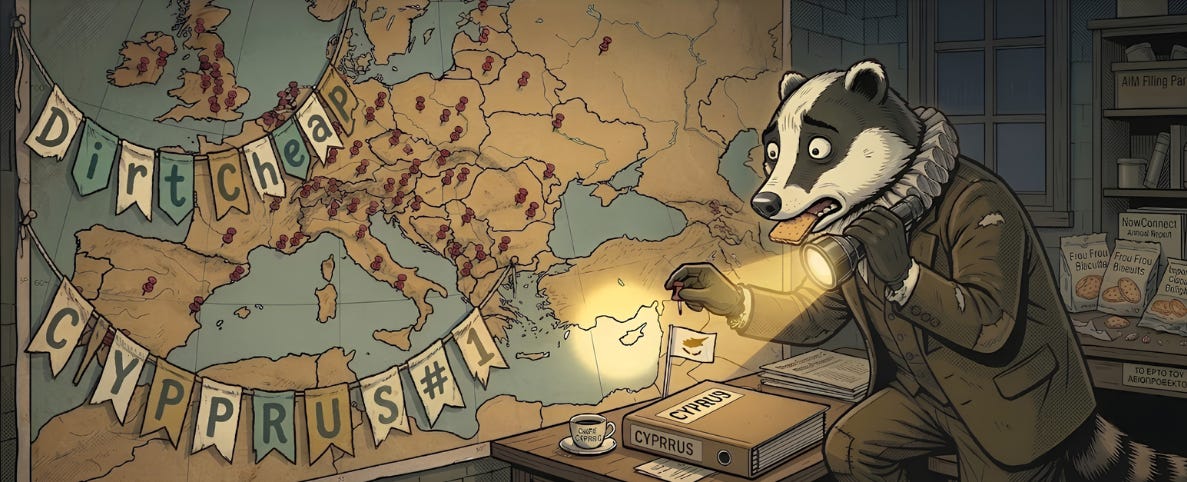
I keep a map on my office wall of every european stock exchange I have screened. it has pins in it. my wife thinks it looks like the wall of a detective in a television show, and she is not entirely wrong, except that the suspects are all cement companies and the victims are all minority shareholders. last month I noticed cyprus had no pin. this bothered me the way a gap in a bookshelf bothers a certain kind of person, not urgently, but persistently, and at four in the morning more than at four in the afternoon.
so I decided to open the exchange. I did not expect much. I knew cyprus had a small market, a couple of dozen names at most, and a reputation for the kind of illiquidity that makes you feel like you are negotiating a price at a village market rather than placing a trade. what I did not expect was to spend the next three weeks reading fifteen annual reports in greek, discovering that the orthodox church is arguably the best equity investor on the island, and learning to say “property revaluation” and “deferred tax liability” with complete fluency while remaining entirely unable to order a coffee. my greek is now fluent in balance sheets and mute in everything else. I can tell you the pension deficit of a cement company in limassol but I cannot ask for the bill. my wife says this explains more about me than I realise.
let me show you the island.
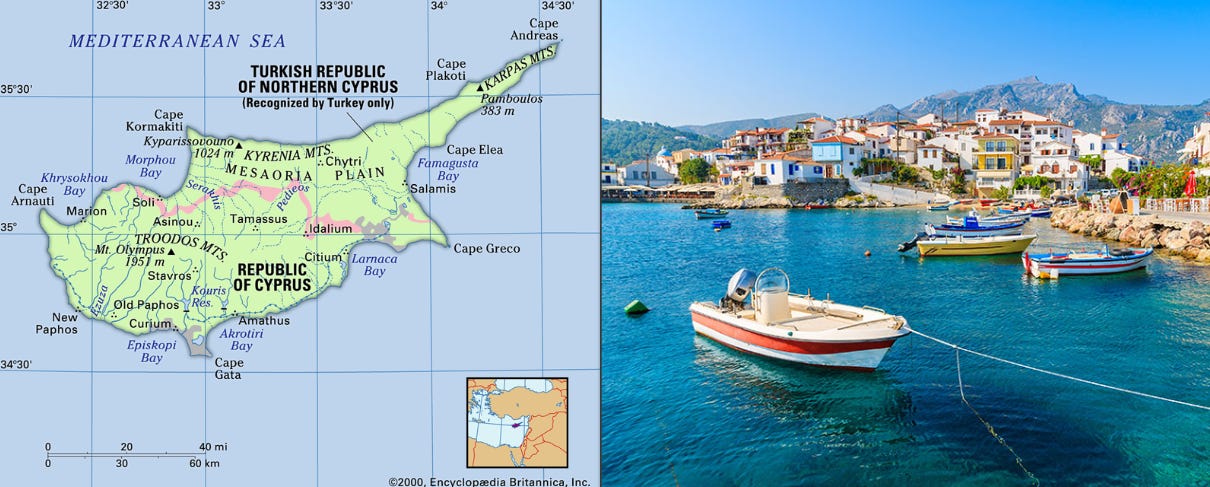
cyprus is a small island in the eastern mediterranean, closer to beirut than to athens. half of it has been occupied by turkey since 1974, which means the entire listed economy operates on one side of a line nobody pretends is moving. tourism is about 14% of the economy, which matters more than usual this year, and we will come back to it.
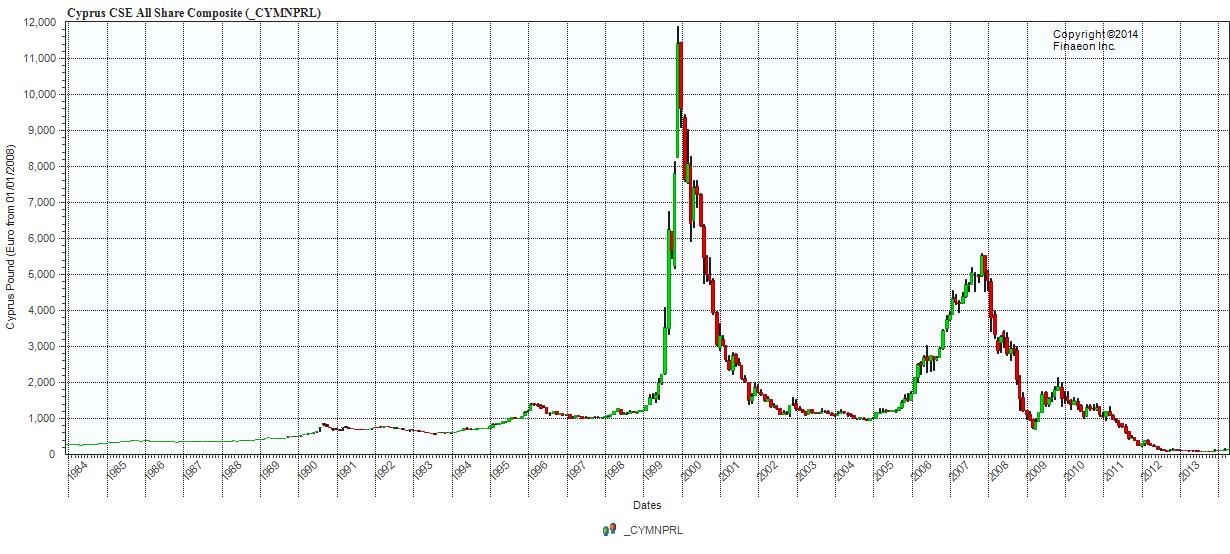
the stock exchange itself has only existed since 1996, younger than some of the companies listed on it. in thirty years it has managed two complete wipeouts: a speculative bubble in 1999 that mirrored the greek mania and crashed back to its starting point, and the bail-in of 2013, when the banking system collapsed so totally that ordinary depositors took a haircut to save it, people woke up with less money in the bank than they went to sleep with. pull up almost any chart on this exchange and the floor is right there, late 2013. everything since has been recovery, and most of these stocks have done five, ten, fourteen times off that bottom. the easy money was made by whoever was brave or insane enough to buy the island in the rubble. that trade is over. today the general index sits at around 305 against a base of 100, thirty years to triple, passing through two existential crises, which tells you most of the real money on this island was made by the families that own the companies, not by the people who traded them.
and here is the thing that almost nobody outside cyprus has noticed, because the 2013 headlines still hang over the country like a smell: the island underneath is quietly one of the better-performing economies in the eurozone. GDP has grown at 3 to 4 percent a year for the better part of a decade. unemployment is at a fifteen-year low of 4.6 percent. the government is running a budget surplus above 4 percent of GDP, one of the strongest fiscal positions in the EU. the debt ratio just fell below 60 percent for the first time since 2009. the banks slashed non-performing loans by more than 95 percent. the country repaid its IMF loan five years early. it regained investment grade in 2018. GDP per capita is above $45,000, which makes cypriots among the most prosperous people in the mediterranean. and the tech sector is growing so fast that cyprus was the fastest-growing startup ecosystem in the EU in 2025. the island most people still associate with a banking crisis is running budget surpluses and approaching full employment.
the macro is not the problem here. the corporate governance is. and that brings me to three facts that explain almost everything you are about to read.
first, the ownership. the listed market of cyprus is owned, to a first approximation, by the greek orthodox church and about a dozen families. not metaphorically. the church holds 69% of the national brewery and a quarter of the cement monopoly. the families, leptos, lordos, constantinou, galatariotis, mitsides, pyrishis, tyllis, and a few more, hold controlling blocks of nearly everything else, often the same surnames across companies that have nothing to do with each other. I am half convinced that if you trace enough share registers you arrive eventually at one dinner table. the free float on most of these is a rounding error. the corporate governance code is optional, and many have opted out in writing, for cost reasons. remember that phrase. it comes back at the end, and it is the whole story.

second, and this is new: the tax just flipped under everyone’s feet. until this year cyprus had a rule that pushed cash out the door, fail to pay out 70% of your profit and the taxman pretended you had and charged your shareholders anyway. from january 2026 it is gone. at the same time corporate tax went up to 15% and the tax on actual dividends was cut from 17% to 5%. which gives you the single most important sentence about this island in 2026: for a controlling family, hoarding cash is now free, and paying it out is now cheap. they can do whatever they want, at almost no cost. which one they choose is the entire game.
fifteen companies, five groups. I threw out the ones with no float and no pulse. thirteen survived. one is not even listed anymore, and it is the most important one in the piece, so it goes last.
I am going to do two things with every company.
first, I am going to read it like a buyer of the whole business, not a renter of the share price. that means three questions, every time: what do you hand over (the market cap, the price of the entire thing), what does it put in your pocket each year (the earnings and dividends that are actually yours as the owner), and what do you own underneath (the cash, land, or portfolio that is there whether the business thrives or not). buy the corner sweet shop and you would ask exactly this: the price, the annual take, and what the freehold’s worth if you shut it. a stock is no different; people just forget.
second, a star rating out of five and, for the two that earn it, a pick. the rating is not “how cheap”, half this island is cheap, it is “how good an actual investment,” which folds in the business, the price, the downside, and whether you, an outside shareholder, can ever touch the value. and the only return question that matters here, because the discount rarely closes: what do you earn if nothing reprices and the family never lets go?
one piece of weather first. the war in the region detonated cyprus’s tourism this spring, arrivals down almost 31% in march, almost 28% in april, the first four months down nearly 18% on an island where tourism is 14% of GDP. there are early signs of a thaw, but the summer that makes the year is happening under a cloud. that matters enormously for one basket and not at all for the others.
we start where the biscuit pointed.
Comments
Nothing yet. Say the first thing.
Sign in to join the conversation.