
The biography on Stan Peterec carries a title that feels like a punchline delivered with a broken nose: The 4th Toughest Man on Planet Earth. The name comes from a Black Belt magazine headline about the two-time world middleweight champion—Stan “The Steamer” Peterec, the humble warrior. The magazine had previously rated him the second toughest man alive, but fourth sounds grittier, dirtier, darker. It fits.
The documentary poster leans into that mythology: Peterec at 66, hood up, lit like a confession booth. His arms still look carved from Alberni Valley lumber, and the damage to his nose blooms beneath the shadows. For a while, pound for pound, he may have been the toughest man alive.
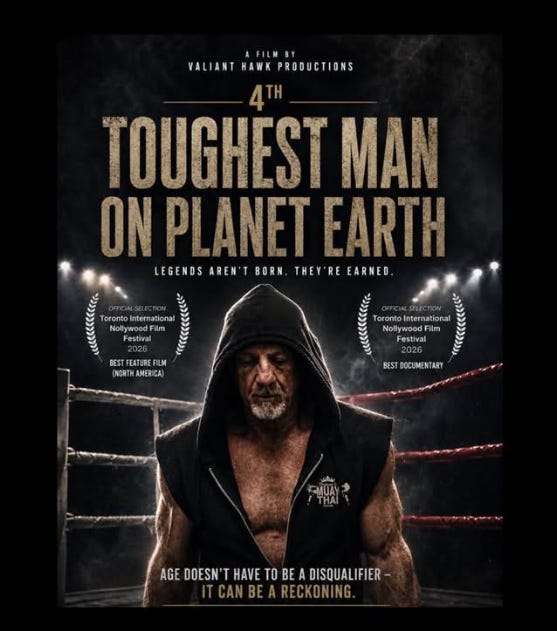
I was the kick judge—kick counter—for Peterec’s first professional world title fight. Before that, I watched him evolve from within the club from a Canadian titleholder staying sharp into a world-class fighter climbing toward his peak. I sparred with him occasionally—until he started getting intense as fight night approached. That’s when I quietly vacated the ring until his fight was over, at least while he was in it.
Watching Peterec fight was like watching Wayne Gretzky step onto the ice.
Something was going to happen.
When Peterec climbed between the ropes—after vomiting from nerves in the change room—he became dead calm. Hyped, sure, but calm in a way that made everyone else anticipatory. You could see it in how he moved, how he looked at his opponent.
Dead. Fucking. Calm.
He’d dump opponents onto their heads with a perfectly timed counter left or whip a kick into the jaw. Ringside doctors, judges, fans, media, vendors—we all waited for the knockout punch. Sometimes, instead, he’d fold someone into a lawn chair.
And I’d think: I was sparring with him two weeks ago. What exactly was I afraid of?
The answer was that he possessed extraordinary control. I would have been fine. But when that opening bell rang, whoever stood across from him was going to pay for it. They were going to eat a leather lunch.
I became so absorbed in the action that I dropped the kick cards in staccato bursts. Whether I dropped them correctly, I still couldn’t tell you.
I’d make a terrible judge.
“Judge Smith scores the fight 110–109. Judge Rankin scores it 109–110. Judge Kelsall scores it 1000–2.”
Well...
Stack this documentary against When We Were Kings or a polished Keith Richards biopic, and it won’t hold up technically. It wasn’t meant to.
Co-produced by Sean Vaillancourt of Valliant Films and Jeremy Hawks, the documentary was filmed largely with a single camera. Before the screening, Vaillancourt’s wife joked with the audience about the minimalist production. Archival footage supplies the fight scenes, while Peterec himself carries the story through interviews, along with former opponents, training partners, coaches and friends.
The result feels intimate rather than cinematic.
The viewer should ask why they’re in the theatre. To admire filmmaking, or to hear a compelling story?
This film chooses the latter.
I knew Peterec had struggled after his world-title years, but I didn’t know how deeply.
Outside the ring, he was down for the count.
Inside his own mind.
Where the demons live.
“Men never talked about these things,” Peterec told me recently at his downtown Victoria gym. “This isn’t just a long video of all my fights. It’s a story about struggle.”
“The sport often attracts people who don’t necessarily come from great situations.”
Peterec grew up bullied in the tough logging and fishing town of Port Alberni. Then a karate club opened.
Perfect timing.
He walked through the door and discovered he had a gift.
Kickboxers come from everywhere. Former boxers. Karate practitioners. Taekwondo stylists. Street fighters. Every style reveals itself eventually. One fighter looked like a boxer who had learned to kick. Another had beautiful taekwondo technique but no rhythm. Another relied almost entirely on chaos.
I loved figuring them out.
I was a mixture myself—a little boxing, a little karate, plenty of bad habits acquired elsewhere.
The film builds toward Peterec’s remarkable return to the ring at age 66 in 2025, making him the first professional fighter to compete across six decades—a Guinness World Record.
That achievement wasn’t straightforward.
The kickboxing commission did everything it could to prevent the bout from happening, throwing obstacle after obstacle in his path.
Metaphorically, Peterec knocked them out, too.
When the fight finally happened, he wasn’t moving like someone collecting senior discounts. He was throwing head kicks, combinations, slipping punches and moving with startling fluidity. His opponent—a respected karate sensei young enough to be his son—never looked outclassed because of effort. He looked outclassed because Peterec still possessed timing, composure and technique that age hadn’t managed to steal. During the fight, his smile suggested he could inflict collateral damage.
The documentary won’t be studied in film schools, and it won’t replace When We Were Kings on lists of the greatest sports documentaries ever made.
But it accomplishes something just as worthwhile.
It tells the truth.
The truth about a man who lived at the intersection of violence, discipline, control and depression. A man who dismantled opponents with frightening calm, then spent years trying to dismantle the parts of himself that fighting couldn’t fix.
The film received a standing ovation.
More accurately, Stan “The Steamer” Peterec did.
Maybe The 4th Toughest Man on Planet Earth was always the right title after all. Not because of where Black Belt magazine ranked him, but because the hardest fights of his life happened after the championships were over.
No posts
Comments
Nothing yet. Say the first thing.
Sign in to join the conversation.