
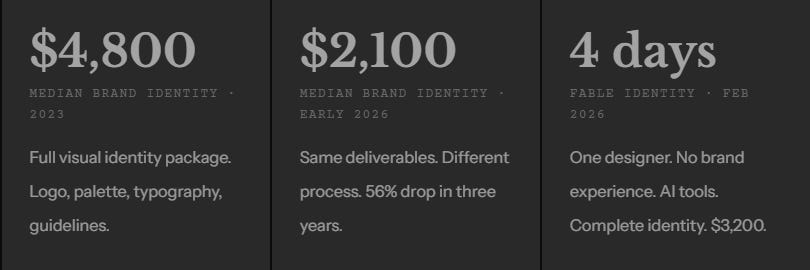
In February this year, a freelancer named Camille, who had spent her career resizing banners and updating product photos, built a complete brand identity in four days. Logo system, colour palette, typography hierarchy, packaging templates, social templates, a 12-page brand guide. She charged $3,200. The client was a DTC home-goods brand called Fable. She had never led a full brand identity project before.
The work looked professional. It looked considered. It looked like the output of a process.
The output existed. The thinking behind it didn’t.
There’s a number that should be unsettling to anyone working in brand design right now. In 2023, the median price for a complete visual identity package: logo, palette, typography, brand guide was around $4,800. By early 2026, it had dropped to $2,100. That’s a 56% compression in under three years. Not because the work got easier to think through. Because AI made it effortless to produce.
Production cost approaching zero changes the market in a specific way. When anyone can generate a logo that looks credible in 20 minutes, “competent” stops being a qualifier. It becomes the baseline. The floor. And the floor, right now, is very crowded.
Competitive audits still take time. Positioning still demands difficult conversations. Deciding what a brand refuses to become still requires patience and conviction. AI changed none of that. What changed was the willingness to do the work. Today, many brands and designers simply move forward without it.
In March 2026, a branding agency in Portland laid off two junior designers. The creative director was honest about it: the work hadn’t disappeared. It had changed shape. The part where a junior designer spends three days exploring typeface pairings, learning through repetition, building the kind of judgment that only comes from doing something badly and then doing it again- that’s 20 minutes of AI output now.
Some agencies are already redesigning the entry role. Not “junior designer” anymore. “AI editor.” Your job on day one is to critique what the model produced. You need taste before you’ve built it. You need to walk in with judgment that used to take three years of grunt work to develop.
Which raises a question nobody in the industry is answering cleanly: where does the next generation of senior designers come from, if the reps that built every senior designer working today no longer exist?
“You used to earn judgment through repetition. Now you’re expected to arrive with it. That gap is going to show up in the work before anyone admits it’s showing up in the industry.”
The World Economic Forum’s 2025 report ranked graphic design as the 11th fastest-declining job category over the next five years. Its previous report had described the field as moderately growing. The sharpest decline is happening in entry-level roles, which means the pipeline into the profession is narrowing much faster than many people realize.
The story told about Jaguar’s 2024 rebrand was polarization as strategy. The CEO said, “If we play by the same rules as everyone else, we’ll drown.” The agency, Accenture Song, built a campaign around “Delete Ordinary.” No cars in the ads. A new wordmark. A complete departure from the growler logo that had existed for decades.
What got less coverage was a leaked letter. Jaguar’s internal design team wrote to the chief creative officer, signed it, and sent it before the rebrand launched. They said the logo disconnected from the visual identity of the products. They felt the work had been outsourced over their objections to people who didn’t know the brand from the inside.
They were overruled. The people who overruled them had no accountability for what happened next.
What happened next
European sales dropped from 1,961 cars in April 2024 to 49 cars in April 2025. Not a dip. Not a rough quarter. 49 cars.
Jaguar fired Accenture Song. The internal team that signed the letter had been right. The executives who overruled them moved on. That is the part of this story that the design industry should be sitting with, and not whether the rebrand was bold enough, but who was accountable for the output when it failed.
The Jaguar rebrand exposed a problem that goes well beyond heritage or reinvention. Focusing the conversation there misses what actually happened.
The people with the deepest understanding of the brand had little influence over the decision. The people driving the decision were largely insulated from its consequences. That separation between expertise and accountability isn’t unique to Jaguar. It’s becoming a familiar pattern across brand work.
There is a distinct texture to AI-generated brand work in 2026. It’s difficult to define, but easy to recognize once you’ve seen enough of it.
The colour palette feels harmonious without revealing why those colours belong together. The logomark hints at meaning but never quite arrives there. The corner radius feels familiar. The sans-serif is clean, confident, and impossible to remember.
Merriam-Webster chose slop as its Word of the Year in late 2025, describing content that is polished yet strangely lifeless, produced by systems trained on the output of other systems. Brand design has drifted toward its own version of that aesthetic. Everyone in the review meeting senses it, even if nobody says it aloud. The designer notices it. The founder reviewing the deck notices it. The user notices it too, even if all they do is scroll past without remembering what they saw.
The visual language rarely changes. Categories fill with the same geometric sans-serifs, familiar earth tones or saturated primaries, and asymmetric grids that signal contemporary taste without expressing much conviction. As more teams rely on the same tools, the same models, and the same pool of outputs, brands begin to resemble one another.
Technical quality is no longer difficult to achieve. That means competence alone does very little to create distinction. In many categories today, a design can be flawlessly executed and still disappear into the background.
I keep watching this conversation get blamed on the tools. The tools are not the problem. The tools are fast, and they’re good at producing things that look like brand work. But a tool produces what you put into it, and what’s going into it right now is thin.
No real positioning. No clarity about what the brand refuses to become. No competitive audit that actually looked at the category. A brief that says “modern, trustworthy, approachable” and considers itself finished. That brief was producing average work from talented designers five years ago. It is producing invisible work from AI today. The output got worse. The brief was already the problem.
The question that cuts through it
Before the first visual gets made, who in the room is accountable if this brand is forgettable in six months? Not accountable for execution quality. Accountable for whether the output is strategically distinct from everything else in the category. If nobody owns that question, the answer is already written. You just won’t see it until the brand is already invisible.
The agencies doing the sharpest work right now aren’t the ones who refused AI. They’re the ones who kept the discovery process intact, the stakeholder interviews, the competitive audit, the positioning work, and used AI for production after the hard thinking was done. The strategic phases still take two weeks. The production phases went from eight weeks to two. That’s the right structure. Most brands skipped the two weeks and called it a process.
When production became effortless, and accountability left the room, the design didn’t get better or worse. It got weird. Technically fine. Somehow completely absent. And the brands wearing it are going to feel that absence before they understand what caused it.
That’s where we are.
Until next time
Stay curious. Stay intentional. Stay Groundbreaking.
— Dipaq
No posts
Comments
Nothing yet. Say the first thing.
Sign in to join the conversation.