
Somewhere along the way, the industry decided that becoming a Design Director and becoming a design leader were the same career trajectory. You earned the title, the title gave you authority, the authority made you a leader. That logic held for long enough that nobody questioned it.
But the gap between the two, between holding the Director title and actually leading design, is wider right now than it has ever been.
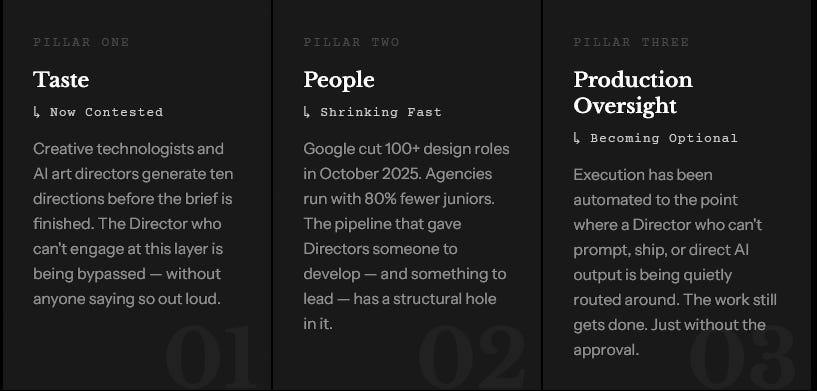
A Design Director is a job description. A design leader is someone the organization decides you are based on whether your judgment actually changes outcomes. These two things used to be correlated. The role came with enough structural weight, taste authority, team ownership, and production oversight that the title and the influence arrived together. Right now, all three of those pillars are being hollowed out simultaneously, and the title is arriving without the weight it used to carry.
None of this happened gradually. That’s the part worth talking about sitting. Gradual change gives you time to adjust your identity alongside the role. This happened all at once, and the industry is still pretending it’s the natural progression.
A new class of people has positioned itself between the Design Director and the output.
Creative technologists, generative design leads, Art directors, etc. They speak the language of the tools fluently. They move before the brief has been fully written.
A Director who can’t operate at this level rarely gets called out directly. There isn’t a difficult conversation or a performance review pointing to the gap. Instead, the flow of work begins to change. Decisions are taken in rooms where the Director is no longer present, not because anyone deliberately excluded them, but because the people in those rooms can keep the work moving while the Director struggles to keep pace.
“Nobody tells you you're being bypassed. You just notice fewer meetings on your calendar, more decisions being made before you're involved, and eventually hear about them in the debrief.”
More than 80% of designers now say AI skills will be essential to their future roles. What's more surprising is how many Design Directors read that stat and still mentally file it under "something to think about later."

The role of junior designers has changed in many organisations. Increasingly, they’re acting as AI editors, evaluating output, spotting what the model missed, and refining what it almost got right. Much of their time is spent curating rather than creating from scratch.
That’s a valuable skill, but it develops differently from the path that traditionally turned junior designers into mid-levels, seniors, and eventually directors.
Design expertise has always accumulated through repetition. Small mistakes sharpened judgment, repeated decisions built confidence, and years of hands-on work gradually formed a point of view. That apprenticeship model relied on thousands of iterations. As AI takes on more of the execution, many of those repetitions are simply no longer part of the learning process.
Which leaves the current generation of Design Directors with something they haven’t fully named yet: nobody to mentor the way they were mentored. The people coming up don’t need the same things. And the Directors who built their leadership identity around developing junior talent are finding that the job has shifted underneath them before they noticed.
The more difficult conversation remains largely absent.
What does this shift mean for the people who will lead design teams ten years from now? And if the foundations of design expertise are changing today, will the next generation of leaders have the experience and judgment the role has historically required?
The Design Directors still relevant today aren't necessarily the most technically fluent people in the room. They're the ones who recognize what’s changing and are ready to upskill themselves.
The difficult part is that their work is almost invisible.
Framing the right problem before the brief exists doesn’t show up on the portfolio.
Killing a bad idea in a strategy meeting rarely gets attributed to anyone.
The stakeholder alignment that saved a quarter disappears into the process.
So even Directors who see the shift often default to the work everyone can see: reviews, approvals, and late-night brainstorms.
Not because they don’t understand what’s changing. Because visible work gets measured and invisible work doesn’t. When your role is under pressure, it’s easy to optimize for the work you can point to.
McKinsey has found that the biggest obstacle to AI transformation isn’t adoption itself, but leadership’s ability to adapt the way organizations operate. Design Directors are experiencing that shift firsthand, often without a shared language for what the role is becoming.
Most companies are still evaluating Design Directors by the metrics that made sense when the role was about managing execution.
Number of reviews conducted. Team headcount. Delivery speed. Those metrics aren’t wrong exactly; they just describe a version of the job that has significantly less leverage than it used to.
The companies adapting most effectively are asking a different set of questions.
Can this person bring together business strategy, product vision, engineering constraints, and customer needs, then make sound decisions when those priorities conflict?
Can they create alignment where there isn’t an obvious answer?
Those responsibilities have little to do with team size, and they don’t show up in a sprint review.
I've been in enough conversations with Design Directors in the last eighteen months to notice a pattern.
The Question
Set aside the org chart, the review meetings, and the approvals for a moment.
What is the specific decision that consistently depends on your judgment?
What makes your perspective necessary, and why does the organization rely on you to make that decision well?
The Design Directors who can answer that question clearly and have shaped their work around it are the ones still gaining ground. The ones who can’t tend to be the ones who will be told, at some point in the next two years, that the role is “evolving.” Which is the word organizations use when they’ve already decided something but haven’t finished the paperwork.
I don’t think the Design Director role is going away. I think it’s being split into something more strategic on one end and something more technically hybrid on the other. The people who survive that split will be the ones who picked a side before they were forced to. Or found a way to hold both, which is the harder and rarer thing.
The ones who are still waiting for the role to stabilize on its own are going to be waiting for a while.
Until next time
Stay curious. Stay intentional. Stay Groundbreaking.
— Dipaq
No posts
Comments
Nothing yet. Say the first thing.
Sign in to join the conversation.