
Hey, it’s Marc.
I spent the past few days talking to founders, fund managers, and allocators who all said the same thing:
“The old game is over.”
Premiums evaporated. mNAVs broke. ETFs unlocked yield. Treasury companies suddenly look a lot more like levered, single-asset funds than growth stories. And the market is now repricing them in real time.
The past month was the first true stress test for the entire DAT ecosystem — and it exposed who’s running a strategy… and who’s just holding coins.
This newsletter breaks down the shift, what’s driving it, and why the next six months will separate winners from survivors.
“ETFs give you fixed exposure. But with a treasury company, you can grow the asset per share through yield, arbitrage, and M&A”
— Kyle Samani on why treasury companies can outperform ETFs
Treasury as levered single-asset funds: Over the past month, their mNAVs have dropped hard (<1), a warning not just to investors but to the companies themselves
With share premiums gone, the trade breaks: if the stock isn’t cheaper or better than the token, buyers skip the equity entirely.
Avoid exposures where the market cap ≈ treasury value.
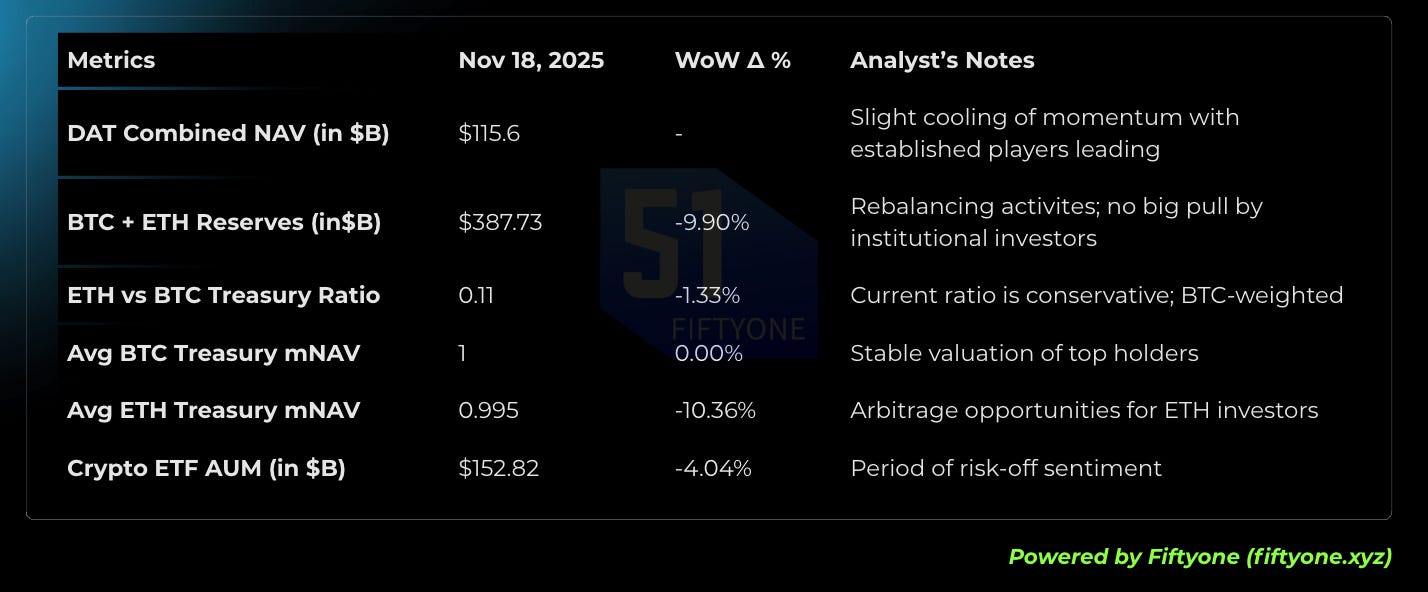
Volatility is a concern: The overall value of stacked digital asset treasuries ($123.18B) has decreased by a substantial -10%. The decline is primarily attributable to a fall in the underlying asset prices, not a strategic reduction in holdings by these companies.
Spot ETFs can now become a yield-bearing instrument: This will make ETFs a more attractive product for retail and institutional investors, competing with DATs, gaining exposure to ETH’s price appreciation and earning a passive return, all within a regulated and familiar ETF wrapper.
Crypto price correction: Bitcoin’s price fell to $83,000 and Ethereum saw a similar decrease to $2,700. A divergence has emerged between institutional investors (ETF holdings and public companies).
Thesis: A big shift is happening, and these companies need to rethink their approach now. As more firms adopt DATs, regulators are watching their finances much more closely, making it harder to use token holdings as an easy way to raise money.
🚨 We just opened new sponsorship slots for our newsletters & podcast. Want to reach 35k+ digital asset leaders? Contact us here.
Loading...
Let’s dig in.
👉 Subscribe to our digital asset newsletter & join 30k+ others
Down 13%, smarter than ever (Fiftyone)
Corporate presentation (Bitmine)
Inside BlackRock’s Crypto Strategy: Tokenisation, Stablecoins & The Next Trillion (Bankless)
Maja Vujinovic, FG Nexus | theCUBE + NYSE Wired (SiliconANGLE)
Europe’s €11 trillion stablecoin opportunity, with Sveinn Valfells (Fiftyone)
The cryptocurrency market saw a significant downturn, with its total capitalisation dropping by 7.23% to $3.19T. The sector was hit particularly hard, with its Total Value Locked (TVL) decreasing by 7.89% to $124.75B.
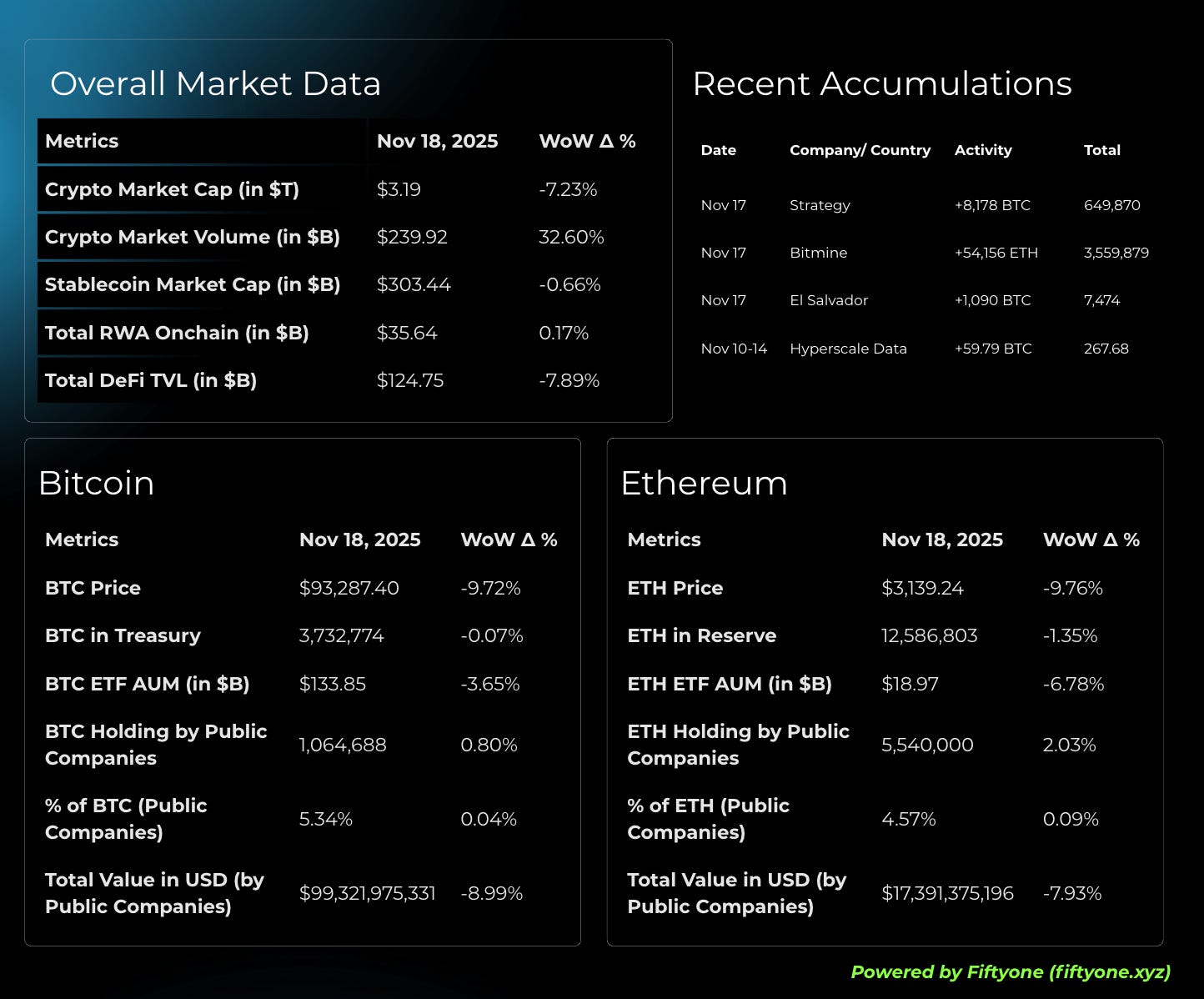
Takeaway: The past week witnessed a significant market correction driven by institutional selling. However, the trends of DATs buying and the stability of stablecoins and RWAs present a shift in crypto market dynamics.
Cango Inc. publishes a letter to shareholders. Link
Trump Media says Jack Smith secretly subpoenaed its bank records. Link
Upexi approves $50M share buyback. Link
Japan Exchange Group is considering steps to tighten oversight of DATs. Link
Solana Company plans to tokenise HSDT shares. Link
SharpLink released its Q3 2025 earnings and became the first digital asset treasury company with positive earnings. By not merely holding cryptocurrency but actively managing it for yield, SharpLink generated over $104M in net income, a stark reversal from a net loss the previous year. [RELEASE]
Comments
Nothing yet. Say the first thing.
Sign in to join the conversation.