
Hey, it’s Marc!
The corporate crypto treasury boom that fueled 2025 is finally cooling off. November posted just $1.32B in inflows, the weakest of the year. A structural shift is underway. The real question: who’s building an actual business, & who was just riding the wave?
“From 2023 to 2025, several major catalysts fuel the rise of DATCOs from an isolated phenomenon to a formal narrative — driving crypto from outsider to central part of treasury conversations.”
Modern finance needs modern financial instruments. Undoubtedly, digital asset treasury companies provide structural benefits to institutional investors against ETFs/ETPs. DATs sit inside familiar public‑equity or corporate structures, with an asset base while preserving on‑chain optionality.
👉 Subscribe to our digital asset newsletter & join 30k+ others
But these companies are undergoing a stress test, especially Strategy.
MSCI released a proposal to purge DATCOs from its global indexes
Over 15 bitcoin-focused DATs are trading below the net asset value of their tokens
Strategy (NASDAQ: MSTR 0.00%↑) plunged roughly 36% in November alone
and much more.
🚨 We just opened new sponsorship slots for our newsletters & podcast. Want to reach 35k+ digital asset leaders? Contact us here.
Let’s dig in.
The DAT Premium Is Gone (Fiftyone)
Strategy Took a Big Step Toward Solving Its Bitcoin-Preferred Problem (Barrons)
Digital asset treasury companies are running out of steam (Molly White)
MicroStrategy Is Oversold, but History Says That Matters (Sobhan Dorosti)
SPAC stocks are back (Bloomberg)
👉 Subscribe to our digital asset newsletter & join 30k+ others
Banks and TradFi are cautious. JPMorgan recently closed crypto company accounts for “compliance concerns” and issued a report warning that if MSCI removes crypto-heavy firms (“digital-asset treasuries”) from its indexes, MicroStrategy could see $2.8 B to $8.8 B in passive outflows.
Regulators are responding. On December 2, 2025, the Fed’s Vice Chair for Supervision testified that banks need clear rules for crypto, including stablecoin regulations under the GENIUS Act, so that banks can support “digital asset activities” safely. The OCC has already confirmed that banks can hold crypto on their balance sheet for operational uses (e.g. paying on-chain fees).
Market shift is happening. Many DATs are trading far below the asset value of their crypto. The key differentiator will be business models: efficiency (i.e. low-cost, yield-rich strategies) and compliance readiness. DATs generating actual revenue – via staking rewards, mining, or related services – are better positioned than those relying on endless capital raises. Example: SharpLink
“This isn’t a crypto winter; it’s a risk-off shakeout. After the October 10th outflows, government shutdown noise, and mixed Fed signals, investors are simply tired and taking chips off the table.”
— Maja Vujinovic, FG Nexus DA CEO
DATs market is crashing. The combined market cap has dropped from July’s $176B to $102B today. The reduction has already started with FG Nexus cutting 10,000 ETH to fund buybacks. This signals:
liquidity stress
capital-markets pressure
the end of the “never sell” narrative for ETH-heavy DATs
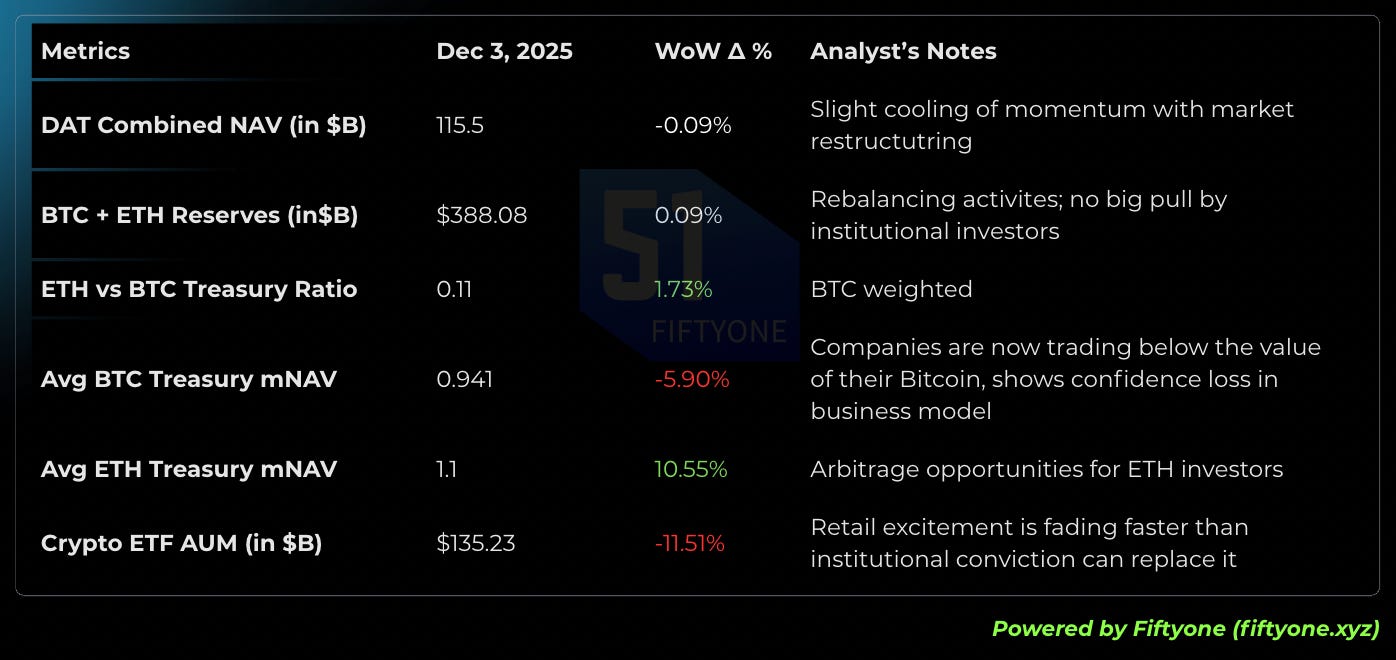
Takeaway: We’re transitioning to phase 2 of DAT where it’s no longer about the chasing the NAV but about building real businesses and generating outsized returns.
2026 will be a new phase for DATs, with new treasury frameworks, slowed issuance programs, potential downgrades and acquisitions and increased cost of capital. We will also see some regulation and compliance clarity in 2026.
Comments
Nothing yet. Say the first thing.
Sign in to join the conversation.