

Last Thursday was a double-header for me: I published a personal Substack on what C.S. Lewis might say about A.I. detection systems for A.I. writing, and my newest piece for MereOrthodoxy on my Q&A text line for my youth ministry was published as well. Both pieces were received well both online and in my church. As I realize more and more that writing is a key component of the ministry the Lord has called me to, it is genuinely encouraging when that writing is found beneficial in the lives of those I love.
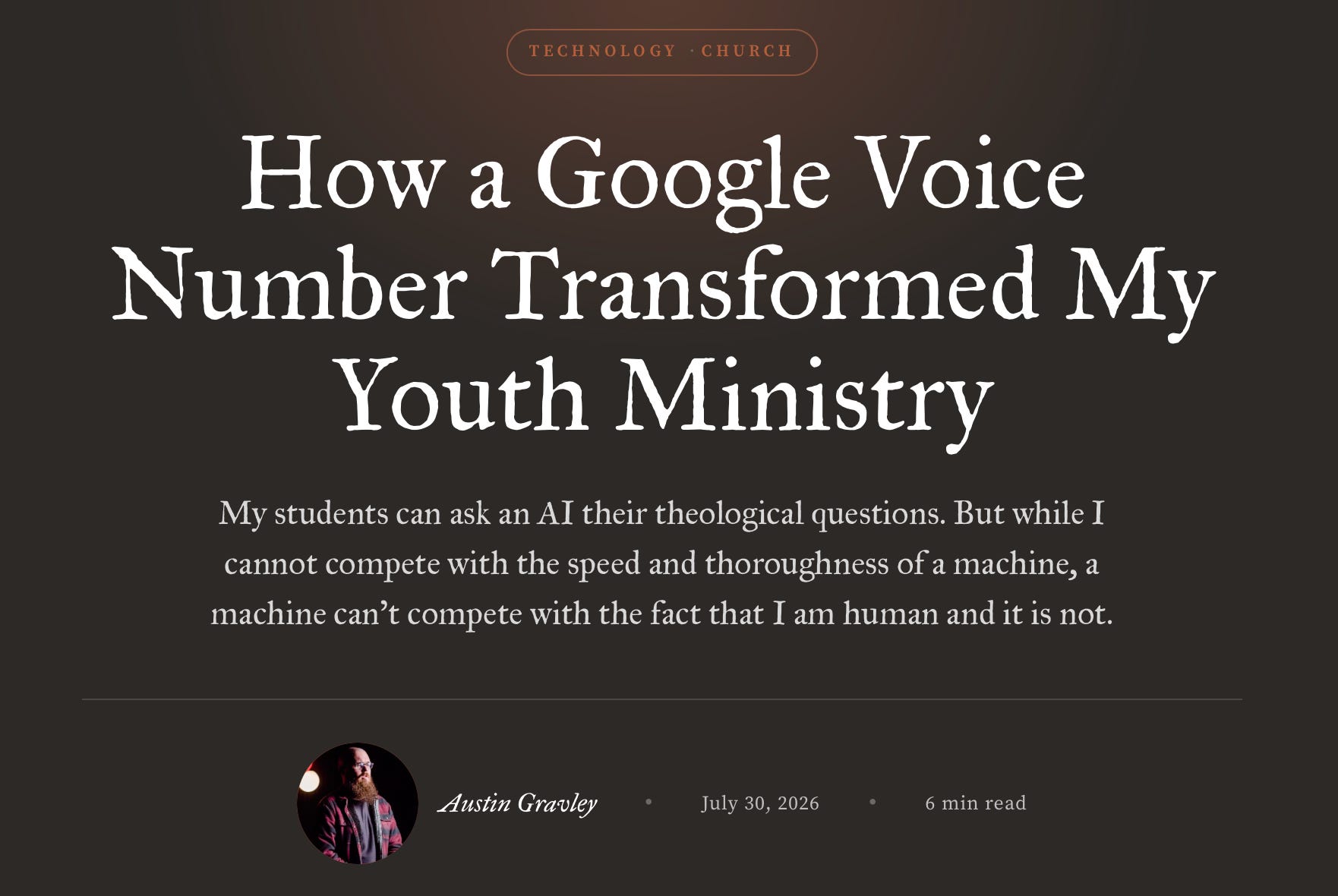
But what I want to do today is go behind the curtain some of “How a Google Voice Number Transformed My Youth Ministry”. I’ve mentioned in my past two newsletters that something serious is happening in my church. Originally, this piece was supposed to come out in mid-June, but the day after I approved final edits to the piece, my life changed forever. What I want to do today is connect a dot between my MereO piece to a positive thing happening in my church in response to the single worst crisis we could ever possibly face.
I’m not going to write too much about the event itself. I may do that a year later depending on where things are at by then. The short and simple version is this: on Saturday, June 13, the lead/planting pastor of my church–my pastor of nearly my entire adult life, my boss of nearly a decade, my colleague for another organization, my mentor, and my friend–was arrested for solicitation of a prostitute. The person I once was, the life I had, the 15 year old church that has been the center of gravity for my life for 14 years, and the stories I told about them all evaporated in a phone call at 9:02PM that night, and the Apocalypse–the “unveiling” of my world as it has truly existed–began.
It is continuing nearly two months later.
It will continue for a long time to come.
But that’s not what I am going to focus on here. Instead, I want to focus on the key theme of my MereOrthodoxy piece, which is one of the many good things the elders of my church have done in response to this crisis: they’ve given honest answers to honest questions to anyone who asks.
On Day One of the Apocalypse (we now refer to the events of that week according to the number of days since June 13, or Day Zero) all the elders stood in front of the church and gave a statement. They said explicitly that David–our pastor, my God it still doesn’t seem real even as I type this1– announcing that David had been arrested and was currently in jail for solicitation of a prostitute. There was no denial, no minimization, no coverup. The elders had immediately voted to remove him as an elder of the church, and he would be fired less than 48 hours later. Both votes were unanimous, including from some individuals who had been friends with David for decades.
The next Sunday, Day Seven of the Apocalypse, the elders gave another statement and announced that Andrew Merker–who gave the statement to the Roys Report–would be assuming leadership of the staff for the time being. Andrew and I have a long history together. In 2013, we began the youth ministry of our church with four students meeting in the living room of a family in our church, and navigated it together through growth, a pandemic, decline, and surprisingly more growth until circumstances called for him to step into the role of Executive Pastor and handed me the reigns of the youth ministry I helped him build.
The origins of the text-line ministry I write about come in 2022, when Andrew and I (along with a few others) needed to make some drastic changes to our youth ministry, and we agreed that we wanted a genuine back-and-forth between students and our leaders. For three years, Andrew and I both stood on stage each Wednesday night giving honest answers to the honest questions that students texted in to our Google Voice number. Many times we had genuine answers. Many times we had to honestly answer “I don’t know; let’s look into that together.” But every time we did it, we wanted to communicate a posture of courage and confidence to our students that Christianity can handle your hardest questions and Christians can be people who pursue truth even if they don’t always have the answers.
So it isn’t surprising to me that one of the first things Andrew implemented in response to this crisis was a weekly Q&A email about this situation, our church, and our future–and not just to students, but for the entire church.
I’m not going to share the full content of these Q&As. Those are in-house for my people. But, I will share you some of the questions that people have been asking and that Andrew and some of the other elders have answered at length in these emails:
What does leadership look like now?
Is Redeemer’s mission, vision, or theology changing?
Why were sermons and sermon notes removed from Redeemer's website?
Did the elders’ financial review find any evidence that church funds were improperly used?
Why are the elders bringing in an independent third-party review?
Did Redeemer hire a crisis management firm?
According to the Bible, does David's sin affect the baptisms, weddings, communion, or other ministry he participated in?
Have the elders begun the process of searching for a new Lead Pastor?
What does the timeline look like for the months ahead?
I don’t think its a coincidence that a man who spent a night each week giving honest answers to honest questions to teenagers about God, the Bible, the Gospel, creation, evolution, forgiveness, predestination and election, the end times, and numerous other topics reflexively adopted a posture of giving honest answers to honest questions about the crisis in our church. I don’t think it’s a coincidence that a man who pursued and modeled transparency in the small things is now pursuing and modeling transparency in the large things. I don’t think it’s a coincidence that what began in this youth ministry has now become a weekly part of the life of our church in the Apocalypse.
And for the love of all things good and holy, trust me when I say this: you do not want to wait until a crisis hits your church to be the kind of person who can do this.
The crisis of institutions in the West is both the result of immense external pressure without and failures of virtue within. I am a champion of institutions. Institutions are good, and churches are among the most vital of them. But when institutions adopt a posture of deflection, cover-up, and dismissal, it is rarely a new development to the situation. It almost always begins in the small, ordinary choices of the lives of the leaders of those institutions–and when crisis comes, the person you were before the crisis is the person you’ll be inside the crisis.
You cannot just snap your fingers and pronounce a culture that welcomes honest answers to honest questions. As I wrote in the MereO piece:
The harder challenge is creating a culture where people know they will get honest answers to their questions. It isn’t something you can just add atop your existing ministry philosophy and structures; it has to be made foundational to the core of what you do, and that time and emphasis has to be protected. If implemented haphazardly, it will come across as insincere and people will keep their questions to themselves. If implemented thoughtfully and intentionally, it will lead to discipleship opportunities that stage teaching and small groups can’t easily capture.
Before any kind of implementation like this can even happen, the people implementing it must be people who welcome honest answers to honest questions in their own lives. They must be people who welcome examination and scrutiny of their lives, beliefs, and practices. They must welcome those with hard and difficult questions with love, joy, and peace, not as threats to be managed. They must be people who pursue honesty and transparency not for gain or advantage, but out of a deeper conviction to keep their conscience clear when giving good answers for the reason for the hope in them (1 Pet 3:15-16). They must be able to truthfully say to people “Imitate me as I imitate Christ” and for those people to able to see a genuineness amid their imperfections and shortcomings.
You do not become a person like this overnight.
Only the Lord knows what comes next for my church. To say that we have a very long way to go is an understatement. But what gives me hope for our future is that we have been a church that has pursued honesty answers to honest questions, including the questions we never imagined we would have to ask. And the only reason we have been able to do this is because before the unimaginable occurred, the leaders of this church have been people who trained themselves in faithfulness to the small things. Now that the large things are here, they are able to give to others what they already had in themselves. They are reaping what they’ve quietly sown.
And it should go without saying: when you quietly sow lies, deception, manipulation, and deceit in the small things in times of peace, you will not automatically become a person of truth, transparency, compassion, and courage in times of war. You may think something like this will never happen to you. I once did. But it can. It will. And when it does: what kind of person do you want to be?
Become that person now.
This is a new recurring feature of Passing Through Digital Babylon, where I curate a weekly roundup of 3-4 articles covering the tech sector and Internet culture that I think are worth your time (and with some commentary on my own). I’ve wanted to do something like this for a while, and having spent nearly a year of bi-weekly radio appearances on Carmen LaBerge’s show, I’ve got the workflow to make this happen.
This week’s edition is going to be pretty Internet Culture-heavy. I am realizing that my work on Digital Babylon and my work on Internet Culture, while overlapping in many ways, are two giant areas of focus that I cannot always do equal justice to. As I explain at the end, we need a new generation of Christian writers who excel at writing about Internet culture, and while I am not that person, I hope to be a beacon to those who are capable of doing that work.
As an audiophile, I’ve always found ASMR (Autonomous Sensory Meridian Response) bizarre at best and sexually explicit at worse. Apparently, I’m not the only one. YouTube’s decision to ban a slate of ASMR creators on the grounds of violating YouTube’s policy on nudity and sexual content highlights many of the pitfalls of building a livelihood on Digital Babylon’s terms. These creators all maintain that this move is inconsistent and unjust, arguing that other ASMR accounts similar to theirs remain in good standing and that their content is not sexually explicit in the first place. It’s possible they’re right. But when you build your livelihood on rented land within an empire of Digital Babylon, and when that livelihood is based on creating content that is frequently associated with sensuality and sexuality (especially when many of its creators create erotic content on OnlyFans in addition to whatever they do on YouTube), you should always expect that this financial stability can be taken from you at any moment and that you’ll have no recourse in the process. Building a life on Digital Babylon’s shifty sands is always a risky bet.
Influencers are not going anywhere, but the people who play background accessories for their content are increasingly putting their foot down and saying “no”. Truthfully, I have mixed feelings about this. Being a professional influencer is not easy, and when done well, it can serve people in beneficial ways. Of course, those people are vastly outnumbered compared to the number of influencers who act as grifters peddling falsehood or cheap scams, but the misuse of a thing does not invalidate its good and proper use.
As I wrote several years ago, I believe the church should be training up influencer-evangelists, and believe that God has placed some people within Digital Babylon to do just that. To be clear: a lot of people pursue this line of work in the name of Christ who are truly just seeking their own glory. What is true of the Christian music industry is true of Christian influencers to an exponentially higher degree. And yet, I had the honor of working with several Christian influencers during my time at The Gospel Coalition who were boldly and courageously proclaiming Christ as they had been convicted and gifted to do so. Those people are few and far between, but they do exist, and ought to be regarded as exceptions to the norm.
Still, for any Christians who may be tasked with that work: understand that the tides are increasingly turning against you, and do not put all your eggs in the basket of making a name for yourself as an influencer. Proclaim Christ, and know that in an instant any attention or recognition you receive from doing so can disappear and never return. If the Lord grants this, well and good, and if not, do not pursue it to the neglect of the things he has called you to attend to.
I’m not exaggerating when I say that this is one of the best pieces on Internet Culture I’ve ever read. I tend to get pretty frustrated at writing about video games from people who tell on themselves, very quickly, that they have no idea what they are talking about and are writing from their anxieties about things that scare them because they don’t understand them. John Ehrett’s piece is not one of those. As he writes early in the piece:
Largely under the public radar, a curious shift has taken place: today, some of the most popular games on the market are the farthest thing from escapist. Rather, they are simulations of real-world blue-collar labor. Last year, PowerWash Simulator, the undisputed king of the genre, reached an astounding 17 million players. (Just to put that figure in perspective, that’s about three times as many as the latest blockbuster Assassin’s Creed release).
This is not an insight someone could have from the outside looking in. Ask any Gen Z student what kind of games they play and you’ll likely get answers like PowerWash Simulator or something akin to it. It’s hard to overstate how normal games like these are now, and if reading John’s piece fills you with a sense of confusion and shock, I need you to understand: you are the outlier here.
And yet, there were two things that weren’t included that I found puzzling (and shoutout to Society of St. Anne’s regular John Magnotti for noticing these as well):
These games are not just incredibly popular games to play; they’re also incredibly popular games to watch other people play. Mel and I both have watched more videos of our favorite YouTube creators playing PowerWash Simulator and other games in the genre than we can consciously recall. The top hit of an incognito YouTube search for “PowerWash Simulator” is Part 1 of Markiplier’s 11 part series of playing the game, a series which had a combined nearly 50 million views. This is just one YouTuber. Other YouTubers have done LetsPlay series with each video getting millions of views each. One thing non-gamers struggle to understand about modern gaming is how easy it is to live vicariously through someone else playing a game that you personally wouldn’t want to play and having a blast doing so. There is a communal aspect to it that is hard to describe. The more successful a game is, the even bigger its YouTube and Twitch viewership is.
The word “fun” doesn’t appear once in this essay. John cover a lot of legitimate ground about why these kind of games are appealing to millions of people, but he left off the most obvious one of them all: these games are fun to play. Clearly they’re fun to watch: Markiplier’s first video in his series is called “THE MOST SATISFYING GAME EVER MADE”. We can (and should) ask why millions of people are willing to play, and even millions more willing to watch, games about mundane blue collar jobs. But we cannot (and should not) ever move beyond the first and most important question of video games: is it fun?
Lastly, one generalized point that I hope to write more on soon: I get more than a little annoyed at the “death of culture” takes that percolate the Writer Class (of which I am an obligatory dues-paying member) not because they’re wrong, but because they’re incomplete. There was a cultural handoff that happened from Millennials and older to Gen Z and beyond, but because it wasn’t from one generation cleanly handing it off to another, the former generations interprets it as “the death of culture”. But another new culture has formed–they’re just not part of it. Participation in this culture takes place in untold hours of playing games, watching anime, and liking and subscribing to a generation of entertainers that regularly pull in more viewership than legacy media outlets. And while a lot of what exists in that culture is fundamentally incapable of surviving this generation and transmitting down to generations to come, there is a genuine amount of meaning-making that ought to be taken seriously and just isn’t.
The solution here is not for those of us on the outside-looking-in of Internet culture to throw ourselves into this ocean and learn how to swim in it. Rather, there is a vitally urgent need to identify, train, and promote a new generation of Christian culture writers who know both Internet Culture and the Christian faith and can write intelligently about them both. They do exist. I personally know several. But until there is a willingness to acknowledge Internet Culture as the dominant culture, those writers will never be able to fully contribute their gifts to the service of the church. I hope one day to give those creative men and women a voice and a place to use it.
Thanks for reading. I am going on vacation next week in preparation for the start of the school year, so no newsletter next week. But, when I get back, I will begin a new bi-weekly series building on my Digital Babylon framework through Scriptural exegesis and study. I am going to start with the place that Jonathan Haidt, Pope Leo, and countless others have started from–the Tower of Babel–to show that Babel is just the prologue to all the treasure Scripture has for us about living in this moment in history. We are leaving far too much on the table when we focus solely on Babel!
Reminder #1: I am looking for someone to design some assets for Passing Through Digital Babylon! Substackers, if you have someone you’d recommend to design a logo, wordmark, etc, please comment with a lead! If you’re a graphic designer, shoot me a DM with your rates. I want a human to design these and am willing to pay to do so.
Reminder #2: I will be at the THINQ Summit 2026 in Nashville on Oct 1-3 representing What Would Jesus Tech?. I’m excited to join Carmen LaBerge’s entourage and looking forward to good conversations with the others in her group. If you’re planning on being there, I would love to connect. Shoot me a DM and let me know.
Together, we are passing through Digital Babylon.
Austin
One of the hardest parts about living right now are the occasional pockets of sobriety from the disassociation and compartmentalization–where, in the quietness of my home, the car, the shower, the fullness of the horror of everything comes crashing down and I can only mutter “my God, this is real, isn’t it?”.
No posts
Comments
Nothing yet. Say the first thing.
Sign in to join the conversation.